 Add to Chrome
 Add to Firefox
 Add to Edge
TAP: A Token-Adaptive Predictor Framework for Training-Free Diffusion Acceleration
Mar 04, 2026
Diffusion models achieve strong generative performance but remain slow at inference due to the need for repeated full-model denoising passes. We present Token-Adaptive Predictor (TAP), a training-free, probe-driven framework that adaptively selects a predictor for each token at every sampling step. TAP uses a single full evaluation of the model's first layer as a low-cost probe to compute proxy losses for a compact family of candidate predictors (instantiated primarily with Taylor expansions of varying order and horizon), then assigns each token the predictor with the smallest proxy error. This per-token "probe-then-select" strategy exploits heterogeneous temporal dynamics, requires no additional training, and is compatible with various predictor designs. TAP incurs negligible overhead while enabling large speedups with little or no perceptual quality loss. Extensive experiments across multiple diffusion architectures and generation tasks show that TAP substantially improves the accuracy-efficiency frontier compared to fixed global predictors and caching-only baselines.

Train Short, Inference Long: Training-free Horizon Extension for Autoregressive Video Generation
Feb 17, 2026Autoregressive video diffusion models have emerged as a scalable paradigm for long video generation. However, they often suffer from severe extrapolation failure, where rapid error accumulation leads to significant temporal degradation when extending beyond training horizons. We identify that this failure primarily stems from the spectral bias of 3D positional embeddings and the lack of dynamic priors in noise sampling. To address these issues, we propose FLEX (Frequency-aware Length EXtension), a training-free inference-time framework that bridges the gap between short-term training and long-term inference. FLEX introduces Frequency-aware RoPE Modulation to adaptively interpolate under-trained low-frequency components while extrapolating high-frequency ones to preserve multi-scale temporal discriminability. This is integrated with Antiphase Noise Sampling (ANS) to inject high-frequency dynamic priors and Inference-only Attention Sink to anchor global structure. Extensive evaluations on VBench demonstrate that FLEX significantly outperforms state-of-the-art models at 6x extrapolation (30s duration) and matches the performance of long-video fine-tuned baselines at 12x scale (60s duration). As a plug-and-play augmentation, FLEX seamlessly integrates into existing inference pipelines for horizon extension. It effectively pushes the generation limits of models such as LongLive, supporting consistent and dynamic video synthesis at a 4-minute scale. Project page is available at https://ga-lee.github.io/FLEX_demo.
Hybrid SD: Edge-Cloud Collaborative Inference for Stable Diffusion Models
Aug 13, 2024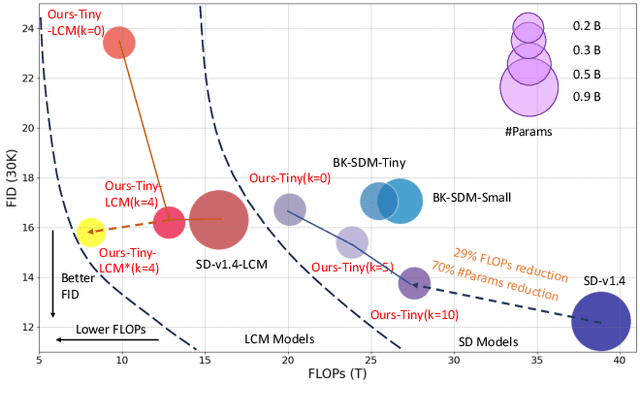

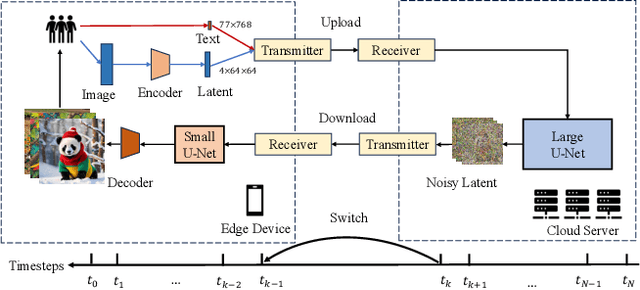

Stable Diffusion Models (SDMs) have shown remarkable proficiency in image synthesis. However, their broad application is impeded by their large model sizes and intensive computational requirements, which typically require expensive cloud servers for deployment. On the flip side, while there are many compact models tailored for edge devices that can reduce these demands, they often compromise on semantic integrity and visual quality when compared to full-sized SDMs. To bridge this gap, we introduce Hybrid SD, an innovative, training-free SDMs inference framework designed for edge-cloud collaborative inference. Hybrid SD distributes the early steps of the diffusion process to the large models deployed on cloud servers, enhancing semantic planning. Furthermore, small efficient models deployed on edge devices can be integrated for refining visual details in the later stages. Acknowledging the diversity of edge devices with differing computational and storage capacities, we employ structural pruning to the SDMs U-Net and train a lightweight VAE. Empirical evaluations demonstrate that our compressed models achieve state-of-the-art parameter efficiency (225.8M) on edge devices with competitive image quality. Additionally, Hybrid SD reduces the cloud cost by 66% with edge-cloud collaborative inference.