 Add to Chrome
 Add to Firefox
 Add to Edge
Degrees of Freedom and Beamforming for Large Intelligent Surfaces
Jun 18, 2026
Spatial degrees of freedom (DoF), sampling, and beamforming are fundamental to multi-user large intelligent surfaces (LISs), where electromagnetic fields must be shaped, resolved, and focused at multiple near-field locations. This work estimates the number of DoF using closed-form expressions derived from the mutual shadow area for representative LIS configurations. The resulting DoF predictions are validated through numerical singular-value spectra, whose spectral knee points closely match the theoretical estimates. For line-source configurations, an analytic sampling scheme is developed by partitioning the source or observation line into unit-DoF intervals, enabling the selection of spatial samples. Beamforming results using maximum-ratio transmission and zero-forcing demonstrate that approximately the number of DoF independent beams can be formed. Attempting to exceed this limit results in increased interference and degraded performance. For surface-based LIS configurations, sampling points are instead determined numerically using the discrete empirical interpolation method. The corresponding beamforming results further confirm that the target region can support approximately as many independent beams as predicted by the DoF analysis. Finally, a polarization-aware study reveals that the electric-field components contribute unequally to the DoF and that the total-field DoF is twice that of a single polarization component.

Vertical Sub-THz Channel Characterization: Sounder Implementation and Initial Measurements
Jun 13, 2026We present a measurement-based characterization of indoor vertical ceiling-to-ground sub-THz channels in the 136-144 GHz band, motivated by ceiling-mounted radio-unit deployments for future distributed indoor networks. The measurements are performed using a vector network analyzer (VNA)-based channel sounder with a mechanically scanned planar virtual antenna array (VAA) at the receiver, enabling single-input single-output (SISO), small-array single-input multiple-output (SIMO), and large-array SIMO measurements in three indoor environments: an office, a laboratory, and a ventilation room. The small-array and large-array SIMO measurements synthesize 2 X 2 cm and 30 X 1 cm uniform rectangular arrays (URAs), respectively. The results show that the vertical links are generally dominated by a strong Line-of-Sight (LOS) component close to the ceiling-to-ground direction, but with clear environmental differences. The office and laboratory exhibit relatively limited delay dispersion, whereas the ventilation room shows stronger delayed multipath due to its corrugated metallic ceiling and surrounding metallic structures. The measured root mean square (RMS) delay spreads are 0.55-1.74 ns for the small-array measurements and 0.44-2.57 ns for the large-array measurements, smaller than those reported in several horizontal indoor sub-THz measurement campaigns at similar frequencies. However, the channel is not purely free-space. Repeatable second-order reflections involving the receiver table, ceiling, transmitter structure, and ceiling-mounted objects are observed in all environments. The large-array measurements further reveal spatial non-stationarity along the 30 cm aperture, with several multipath components visible only over limited parts of the array. These results show that ceiling materials, obstructions, and aperture-dependent variations matter in vertical sub-THz channel modeling.
Properties of Near Field Focusing for Three-Dimensional Large Intelligent Surface
Feb 13, 2026This work investigates near-field focusing using a three-dimensional (3D) large intelligent surface (LIS) across frequencies and polarizations. Specifically, the LIS elements are distributed in 3D space within a long corridor, rather than being confined to a single planar aperture, and the focal point is located at a prescribed position in the radiating near field. By formulating optimization problems under both local and global power constraints, we obtain the corresponding optima. For continuous apertures, the optimal current magnitude distribution matches time-reversal (TR) solution under the global constraint and conjugate-phase (CP) solution when the local constraint dominates. When both constraints are active, the solution assigns larger excitation magnitudes to elements closer to the illumination field. This behavior remains invariant with respect to frequency and polarization for a fixed-size LIS. These findings are consistent to the more practical case of using discretized apertures in the form of Hertzian dipole arrays, studied using both analytical results and full-wave simulation. In addition, with the CP method, specific polarizations lead to identical transverse and longitudinal resolution, in contrast, under the TR method, these quantities can differ across polarizations.
Artificial intelligence enabled radio propagation for communications-Part II: Scenario identification and channel modeling
Nov 24, 2021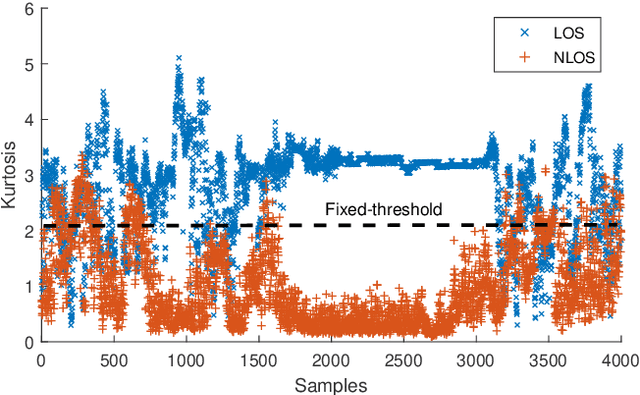
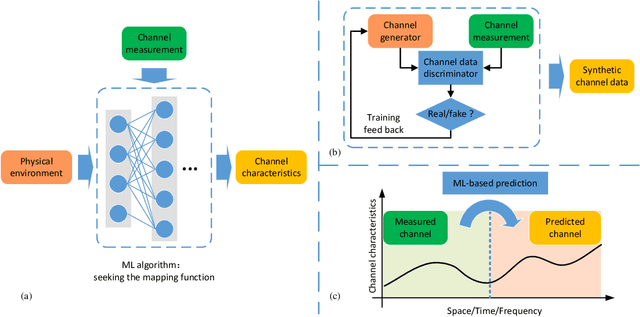
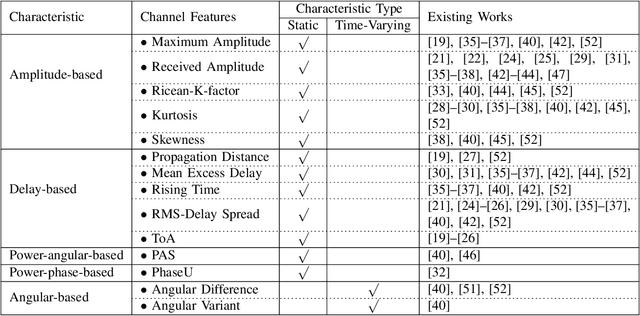
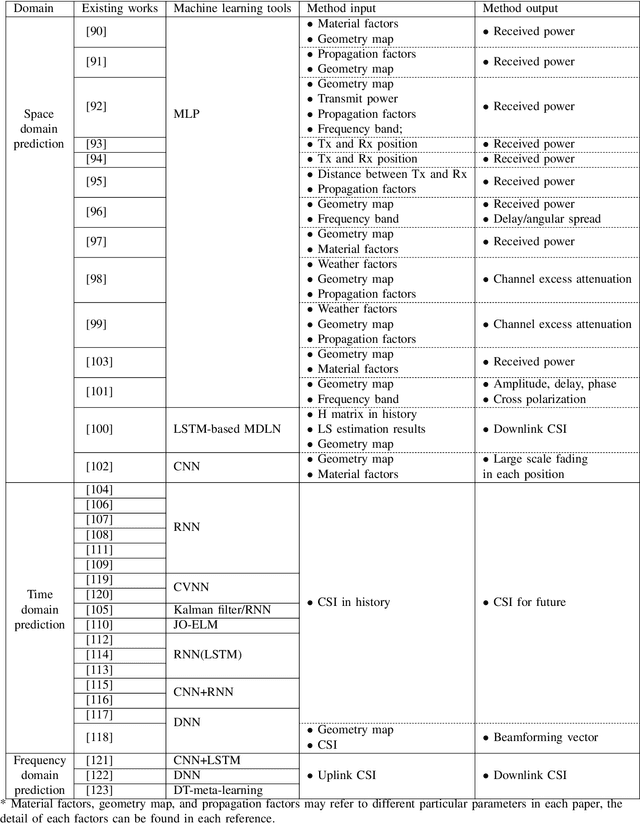
This two-part paper investigates the application of artificial intelligence (AI) and in particular machine learning (ML) to the study of wireless propagation channels. In Part I, we introduced AI and ML as well as provided a comprehensive survey on ML enabled channel characterization and antenna-channel optimization, and in this part (Part II) we review state-of-the-art literature on scenario identification and channel modeling here. In particular, the key ideas of ML for scenario identification and channel modeling/prediction are presented, and the widely used ML methods for propagation scenario identification and channel modeling and prediction are analyzed and compared. Based on the state-of-art, the future challenges of AI/ML-based channel data processing techniques are given as well.
Artificial intelligence enabled radio propagation for communications-Part I: Channel characterization and antenna-channel optimization
Nov 24, 2021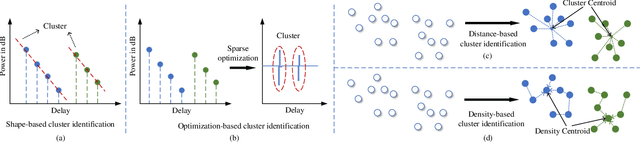
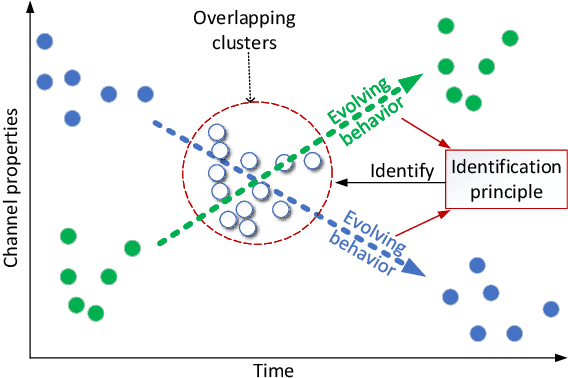
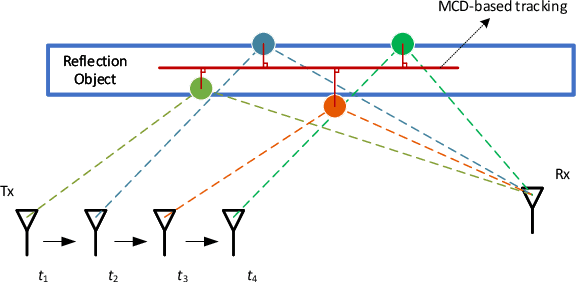
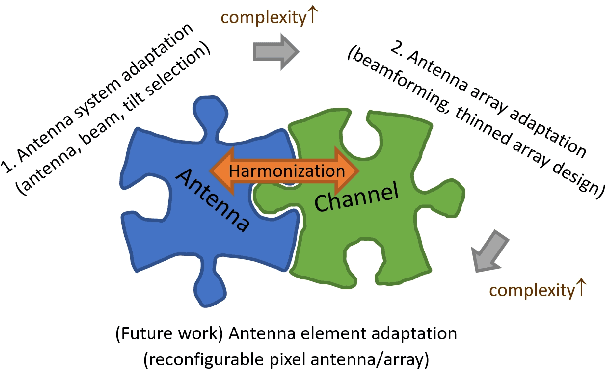
To provide higher data rates, as well as better coverage, cost efficiency, security, adaptability, and scalability, the 5G and beyond 5G networks are developed with various artificial intelligence techniques. In this two-part paper, we investigate the application of artificial intelligence (AI) and in particular machine learning (ML) to the study of wireless propagation channels. It firstly provides a comprehensive overview of ML for channel characterization and ML-based antenna-channel optimization in this first part, and then it gives a state-of-the-art literature review of channel scenario identification and channel modeling in Part II. Fundamental results and key concepts of ML for communication networks are presented, and widely used ML methods for channel data processing, propagation channel estimation, and characterization are analyzed and compared. A discussion of challenges and future research directions for ML-enabled next generation networks of the topics covered in this part rounds off the paper.