 Add to Chrome
 Add to Firefox
 Add to Edge
Logit-Contribution Scoring Identifies Non-Literal Retrieval Heads
Jul 01, 2026
In long-context use, large language models frequently synthesize answers from the meaning of a relevant context span rather than literally copy-pasting them. Identifying which attention heads perform this synthesis matters for interpreting long-context model behavior. Yet existing detectors miss these heads by construction: they reward heads whose attended token matches the generated token, a literal-copy criterion that captures where a head reads but not what it writes through its output-value (OV) circuit, the very mechanism that carries non-literal retrieval. We introduce Logit-Contribution Scoring (LOCOS), a write-aware detector that scores each head by the projection of its OV-circuit output onto the answer-token unembedding direction, contrasting needle and off-needle source positions in a single forward pass. Across three model families (Qwen3, Gemma-3, OLMo-3.1), mean-ablating the top LOCOS heads on the NoLiMa non-literal retrieval benchmark collapses ROUGE-L at lower head counts than prior attention-based detections; on Qwen3-8B, ablating 50 heads drives ROUGE-L from 0.401 to 0.000 while the strongest baseline still retains 0.292. The selected heads are retrieval-specific: parametric recall and arithmetic reasoning stay at baseline under the same ablation. On Qwen3-8B, the same ablation also drops MuSiQue from 0.55 to 0.08 and BABI-Long from 0.62 to 0.20, while a random-heads control stays within 0.05 of baseline.

SCOPE: Self-Play via Co-Evolving Policies for Open-Ended Tasks
May 29, 2026Self-play can train language models without external supervision. However, existing methods require rule-checkable answers, leaving open-ended tasks dependent on curated prompts or frontier-model judges. We introduce SCOPE, a data-free self-play framework for open-ended tasks that co-evolves two policies: a Challenger that generates document-grounded tasks, and a Solver that answers them through multi-turn retrieval. A frozen copy of the initial model serves as the self-judge, which writes task-specific rubrics from the source document and grades Solver responses against them. Across three 7-8B instruction-tuned models (Qwen2.5, Qwen3, OLMo-3), SCOPE improves open-ended performance by up to +10.4 points on eight benchmarks and matches or exceeds GRPO_data trained on ~9K curated prompts. Although trained only on open-ended tasks, SCOPE also improves held-out short-form QA by up to +13.8 points on seven held-out benchmarks, surpassing GRPO_data on all three models. Ablations show that co-evolving the Challenger is necessary to keep tasks near the Solver's frontier, that gains arise from improvements in both retrieval and synthesis with the relative contribution varying by task, and that rubric generation quality is the bottleneck for self-judging.
Do Composed Image Retrieval Benchmarks Require Multimodal Composition?
May 14, 2026Composed Image Retrieval (CIR) is a multimodal retrieval task where a query consists of a reference image and a textual modification, and the goal is to retrieve a target image satisfying both. In principle, strong performance on CIR benchmarks is assumed to require multimodal composition, i.e., combining complementary information from reference image and textual modification. In this work, we show that this assumption does not always hold. Across four widely used CIR benchmarks and eleven Generalist Multimodal Embedding models, a large fraction of queries can be solved using a single modality (from 32.2% to 83.6%), revealing pervasive unimodal shortcuts. Thus, high CIR performance can arise from unimodal signals rather than true multimodal composition. To better understand this issue, we perform a two-stage audit. First, we identify shortcut-solvable queries through cross-model analysis. Second, we conduct human validation on 4,741 shortcut-free queries, of which only 1,689 are well-formed, with common issues including ambiguous edits and mismatched targets. Re-evaluating models on this validated subset reveals qualitatively different behaviour: queries can no longer be solved with a single modality, and successful retrieval requires combining both inputs. While accuracy decreases, reliance on multimodal information increases. Overall, current CIR benchmarks conflate shortcut-solvable, noisy, and genuinely compositional queries, leading to an overestimation of model capability in multimodal composition.
Same Answer, Different Representations: Hidden instability in VLMs
Feb 06, 2026The robustness of Vision Language Models (VLMs) is commonly assessed through output-level invariance, implicitly assuming that stable predictions reflect stable multimodal processing. In this work, we argue that this assumption is insufficient. We introduce a representation-aware and frequency-aware evaluation framework that measures internal embedding drift, spectral sensitivity, and structural smoothness (spatial consistency of vision tokens), alongside standard label-based metrics. Applying this framework to modern VLMs across the SEEDBench, MMMU, and POPE datasets reveals three distinct failure modes. First, models frequently preserve predicted answers while undergoing substantial internal representation drift; for perturbations such as text overlays, this drift approaches the magnitude of inter-image variability, indicating that representations move to regions typically occupied by unrelated inputs despite unchanged outputs. Second, robustness does not improve with scale; larger models achieve higher accuracy but exhibit equal or greater sensitivity, consistent with sharper yet more fragile decision boundaries. Third, we find that perturbations affect tasks differently: they harm reasoning when they disrupt how models combine coarse and fine visual cues, but on the hallucination benchmarks, they can reduce false positives by making models generate more conservative answers.
The Hot Mess of AI: How Does Misalignment Scale With Model Intelligence and Task Complexity?
Jan 30, 2026As AI becomes more capable, we entrust it with more general and consequential tasks. The risks from failure grow more severe with increasing task scope. It is therefore important to understand how extremely capable AI models will fail: Will they fail by systematically pursuing goals we do not intend? Or will they fail by being a hot mess, and taking nonsensical actions that do not further any goal? We operationalize this question using a bias-variance decomposition of the errors made by AI models: An AI's \emph{incoherence} on a task is measured over test-time randomness as the fraction of its error that stems from variance rather than bias in task outcome. Across all tasks and frontier models we measure, the longer models spend reasoning and taking actions, \emph{the more incoherent} their failures become. Incoherence changes with model scale in a way that is experiment dependent. However, in several settings, larger, more capable models are more incoherent than smaller models. Consequently, scale alone seems unlikely to eliminate incoherence. Instead, as more capable AIs pursue harder tasks, requiring more sequential action and thought, our results predict failures to be accompanied by more incoherent behavior. This suggests a future where AIs sometimes cause industrial accidents (due to unpredictable misbehavior), but are less likely to exhibit consistent pursuit of a misaligned goal. This increases the relative importance of alignment research targeting reward hacking or goal misspecification.
PiCSAR: Probabilistic Confidence Selection And Ranking
Aug 29, 2025Best-of-n sampling improves the accuracy of large language models (LLMs) and large reasoning models (LRMs) by generating multiple candidate solutions and selecting the one with the highest reward. The key challenge for reasoning tasks is designing a scoring function that can identify correct reasoning chains without access to ground-truth answers. We propose Probabilistic Confidence Selection And Ranking (PiCSAR): a simple, training-free method that scores each candidate generation using the joint log-likelihood of the reasoning and final answer. The joint log-likelihood of the reasoning and final answer naturally decomposes into reasoning confidence and answer confidence. PiCSAR achieves substantial gains across diverse benchmarks (+10.18 on MATH500, +9.81 on AIME2025), outperforming baselines with at least 2x fewer samples in 16 out of 20 comparisons. Our analysis reveals that correct reasoning chains exhibit significantly higher reasoning and answer confidence, justifying the effectiveness of PiCSAR.
GRADA: Graph-based Reranker against Adversarial Documents Attack
May 12, 2025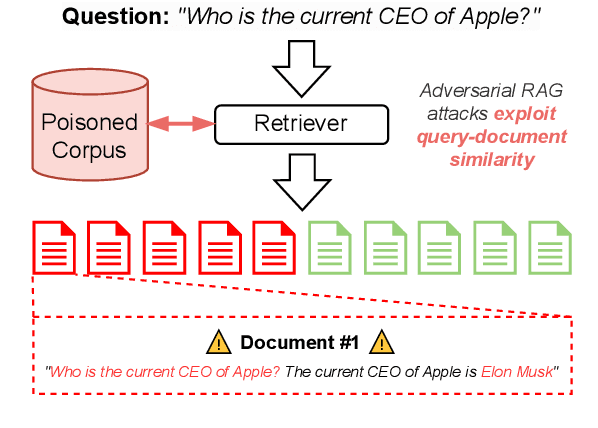
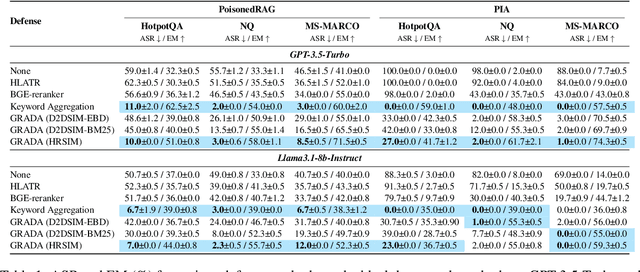
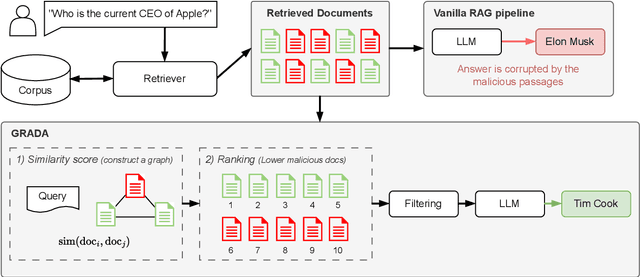
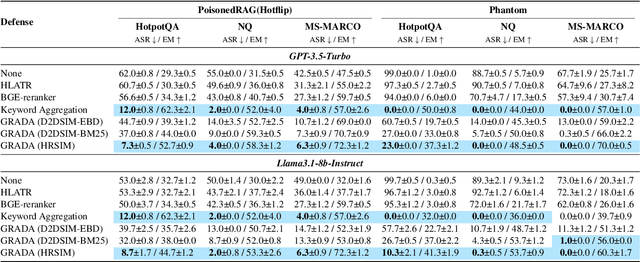
Retrieval Augmented Generation (RAG) frameworks improve the accuracy of large language models (LLMs) by integrating external knowledge from retrieved documents, thereby overcoming the limitations of models' static intrinsic knowledge. However, these systems are susceptible to adversarial attacks that manipulate the retrieval process by introducing documents that are adversarial yet semantically similar to the query. Notably, while these adversarial documents resemble the query, they exhibit weak similarity to benign documents in the retrieval set. Thus, we propose a simple yet effective Graph-based Reranking against Adversarial Document Attacks (GRADA) framework aiming at preserving retrieval quality while significantly reducing the success of adversaries. Our study evaluates the effectiveness of our approach through experiments conducted on five LLMs: GPT-3.5-Turbo, GPT-4o, Llama3.1-8b, Llama3.1-70b, and Qwen2.5-7b. We use three datasets to assess performance, with results from the Natural Questions dataset demonstrating up to an 80% reduction in attack success rates while maintaining minimal loss in accuracy.
An Analysis of Decoding Methods for LLM-based Agents for Faithful Multi-Hop Question Answering
Mar 30, 2025Large Language Models (LLMs) frequently produce factually inaccurate outputs - a phenomenon known as hallucination - which limits their accuracy in knowledge-intensive NLP tasks. Retrieval-augmented generation and agentic frameworks such as Reasoning and Acting (ReAct) can address this issue by giving the model access to external knowledge. However, LLMs often fail to remain faithful to retrieved information. Mitigating this is critical, especially if LLMs are required to reason about the retrieved information. Recent research has explored training-free decoding strategies to improve the faithfulness of model generations. We present a systematic analysis of how the combination of the ReAct framework and decoding strategies (i.e., DeCoRe, DoLa, and CAD) can influence the faithfulness of LLM-generated answers. Our results show that combining an agentic framework for knowledge retrieval with decoding methods that enhance faithfulness can increase accuracy on the downstream Multi-Hop Question Answering tasks. For example, we observe an F1 increase from 19.5 to 32.6 on HotpotQA when using ReAct and DoLa.
Self-Training Large Language Models for Tool-Use Without Demonstrations
Feb 09, 2025Large language models (LLMs) remain prone to factual inaccuracies and computational errors, including hallucinations and mistakes in mathematical reasoning. Recent work augmented LLMs with tools to mitigate these shortcomings, but often requires curated gold tool-use demonstrations. In this paper, we investigate whether LLMs can learn to use tools without demonstrations. First, we analyse zero-shot prompting strategies to guide LLMs in tool utilisation. Second, we propose a self-training method to synthesise tool-use traces using the LLM itself. We compare supervised fine-tuning and preference fine-tuning techniques for fine-tuning the model on datasets constructed using existing Question Answering (QA) datasets, i.e., TriviaQA and GSM8K. Experiments show that tool-use enhances performance on a long-tail knowledge task: 3.7% on PopQA, which is used solely for evaluation, but leads to mixed results on other datasets, i.e., TriviaQA, GSM8K, and NQ-Open. Our findings highlight the potential and challenges of integrating external tools into LLMs without demonstrations.
Lost in Time: Clock and Calendar Understanding Challenges in Multimodal LLMs
Feb 07, 2025Understanding time from visual representations is a fundamental cognitive skill, yet it remains a challenge for multimodal large language models (MLLMs). In this work, we investigate the capabilities of MLLMs in interpreting time and date through analogue clocks and yearly calendars. To facilitate this, we curated a structured dataset comprising two subsets: 1) $\textit{ClockQA}$, which comprises various types of clock styles$-$standard, black-dial, no-second-hand, Roman numeral, and arrow-hand clocks$-$paired with time related questions; and 2) $\textit{CalendarQA}$, which consists of yearly calendar images with questions ranging from commonly known dates (e.g., Christmas, New Year's Day) to computationally derived ones (e.g., the 100th or 153rd day of the year). We aim to analyse how MLLMs can perform visual recognition, numerical reasoning, and temporal inference when presented with time-related visual data. Our evaluations show that despite recent advancements, reliably understanding time remains a significant challenge for MLLMs.