 Add to Chrome
 Add to Firefox
 Add to Edge
LEGS: Laplacian-Enhanced Gaussian Splatting with a Nonlinear Weighted Loss
Jun 06, 2026
3D Gaussian Splatting (3DGS) has become an efficient explicit representation for radiance field reconstruction and real-time novel view synthesis. However, its standard photometric loss treats flat and structure-rich regions similarly, which may limit the recovery of sharp contours and fine details. Edge-Guided Gaussian Splatting (EGGS) improves structure awareness through edge-guided weighting, but mainly relies on first-order gradient responses and linear weighting. In this paper, we propose LEGS, a Laplacian-Enhanced Gaussian Splatting method with a nonlinearly weighted loss. LEGS replaces first-order gradient guidance with second-order Laplacian structural guidance and maps the normalized Laplacian response into pixel-wise weights through nonlinear response-to-weight functions. The proposed loss improves structure-aware Gaussian optimization while keeping the original 3DGS rendering pipeline unchanged. Experiments on the full Tanks\&Temples and Mip-NeRF360 datasets show that LEGS improves peak signal-to-noise ratio (PSNR) by up to 1.68 dB over 3DGS and up to 0.52 dB over EGGS. Incorporating the proposed second-order nonlinear weighting strategy into FastGS and FasterGS further improves PSNR by up to 1.69 dB, demonstrating its effectiveness as a general loss-level extension for Gaussian Splatting pipelines with potential applications in AR/VR, immersive visualization, and real-time 3D content generation.

Shared-kernel Wavelet Neural Networks for Poisson Image Reconstruction
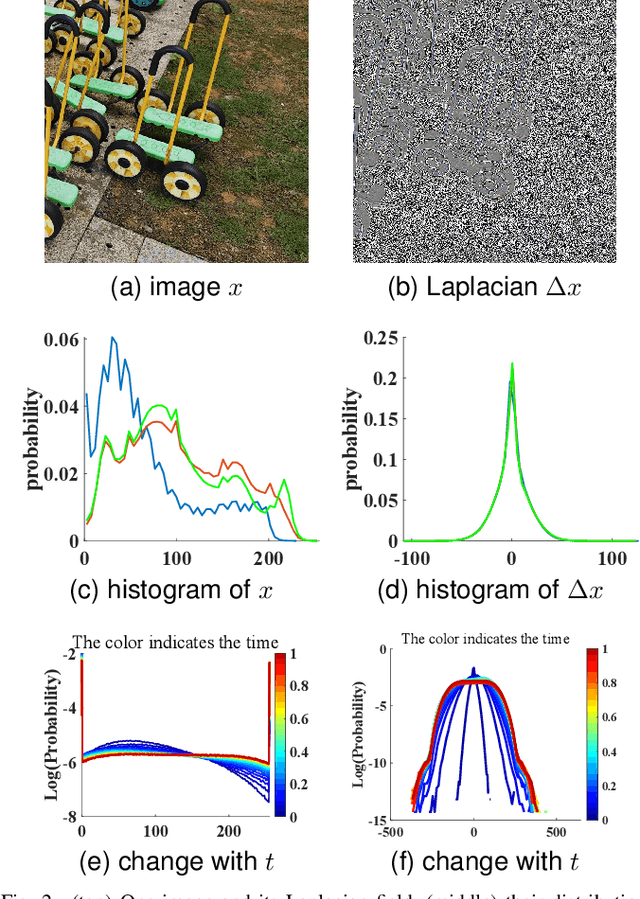
Apr 27, 2026The Laplacian operator transforms the image into its Laplacian field, which usually is sparse and satisfies a stable distribution. On the other hand, an image can be uniquely reconstructed from its Laplacian field via solving a Poisson equation with a proper boundary condition. Such uniqueness is mathematically guaranteed. Thanks to these properties, we propose to use the sparse Laplacian field to present the image. We first show that the Laplacian field is sparse and satisfies a stable distribution on hundreds images. Then, we show that the image can be accurately reconstruct from its Laplacian field. For the reconstruction task, we propose a shared-kernel wavelet neural network, which solves the Poisson equation and has three advantages. First, it has less than {\bf 0.0002M} parameters, which is compact enough for most of devices. Second, it has linear computation complexity, leading to a real-time reconstruction. Third, it achieves higher accuracy than previous methods. Several numerical experiments are conducted to show the effectiveness and efficiency of the sparse Laplacian field and the proposed Poisson solver. The proposed method can be applied in a large range of applications such as image compression, low light enhancement, object tracking, etc.
GDGS: Gradient Domain Gaussian Splatting for Sparse Representation of Radiance Fields
May 08, 2024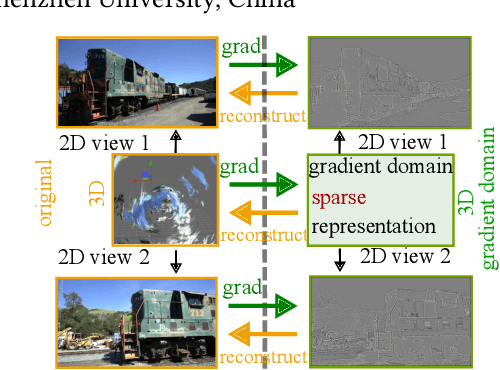
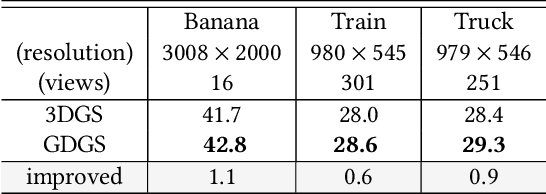
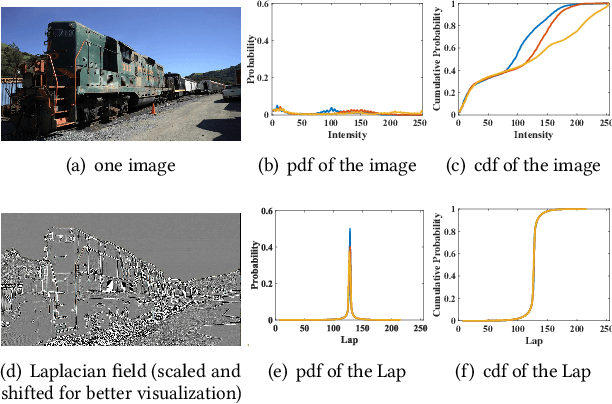
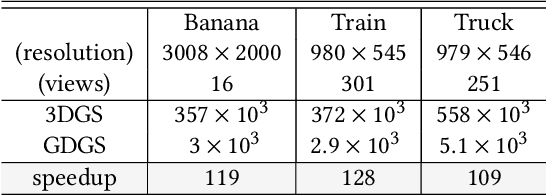
The 3D Gaussian splatting methods are getting popular. However, they work directly on the signal, leading to a dense representation of the signal. Even with some techniques such as pruning or distillation, the results are still dense. In this paper, we propose to model the gradient of the original signal. The gradients are much sparser than the original signal. Therefore, the gradients use much less Gaussian splats, leading to the more efficient storage and thus higher computational performance during both training and rendering. Thanks to the sparsity, during the view synthesis, only a small mount of pixels are needed, leading to much higher computational performance ($100\sim 1000\times$ faster). And the 2D image can be recovered from the gradients via solving a Poisson equation with linear computation complexity. Several experiments are performed to confirm the sparseness of the gradients and the computation performance of the proposed method. The method can be applied various applications, such as human body modeling and indoor environment modeling.
EGGS: Edge Guided Gaussian Splatting for Radiance Fields
Apr 14, 2024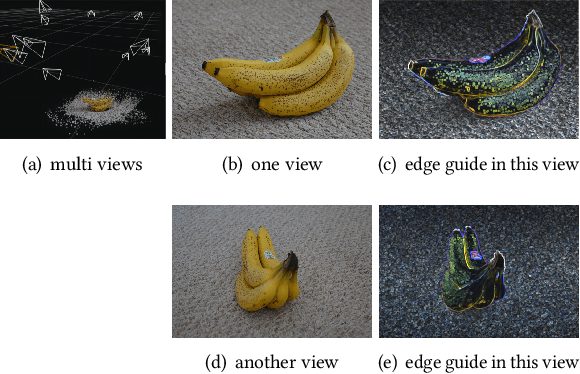
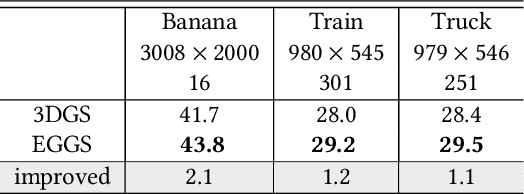
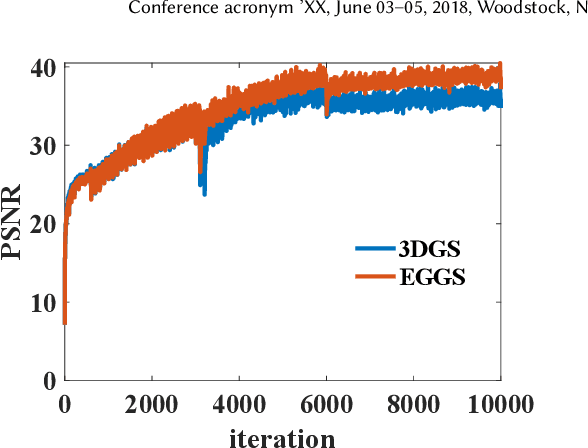
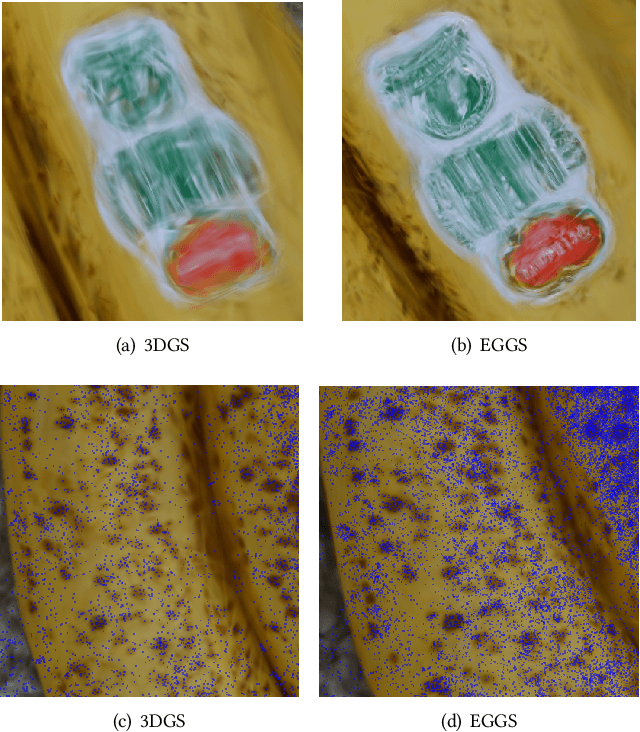
The Gaussian splatting methods are getting popular. However, their loss function only contains the $\ell_1$ norm and the structural similarity between the rendered and input images, without considering the edges in these images. It is well-known that the edges in an image provide important information. Therefore, in this paper, we propose an Edge Guided Gaussian Splatting (EGGS) method that leverages the edges in the input images. More specifically, we give the edge region a higher weight than the flat region. With such edge guidance, the resulting Gaussian particles focus more on the edges instead of the flat regions. Moreover, such edge guidance does not crease the computation cost during the training and rendering stage. The experiments confirm that such simple edge-weighted loss function indeed improves about $1\sim2$ dB on several difference data sets. With simply plugging in the edge guidance, the proposed method can improve all Gaussian splatting methods in different scenarios, such as human head modeling, building 3D reconstruction, etc.
Isotropic Gaussian Splatting for Real-Time Radiance Field Rendering
Mar 21, 2024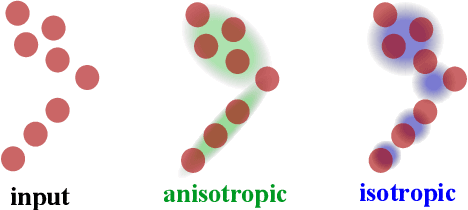
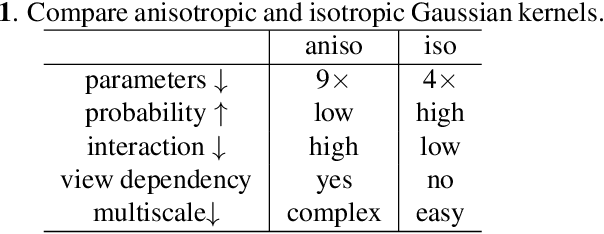
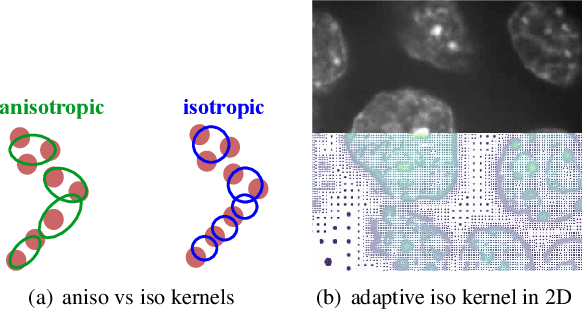
The 3D Gaussian splatting method has drawn a lot of attention, thanks to its high performance in training and high quality of the rendered image. However, it uses anisotropic Gaussian kernels to represent the scene. Although such anisotropic kernels have advantages in representing the geometry, they lead to difficulties in terms of computation, such as splitting or merging two kernels. In this paper, we propose to use isotropic Gaussian kernels to avoid such difficulties in the computation, leading to a higher performance method. The experiments confirm that the proposed method is about {\bf 100X} faster without losing the geometry representation accuracy. The proposed method can be applied in a large range applications where the radiance field is needed, such as 3D reconstruction, view synthesis, and dynamic object modeling.
P2I-NET: Mapping Camera Pose to Image via Adversarial Learning for New View Synthesis in Real Indoor Environments
Sep 27, 2023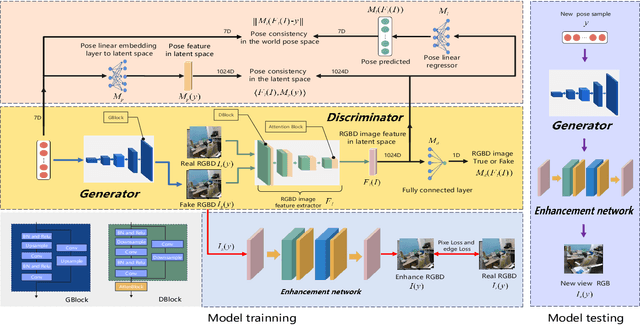
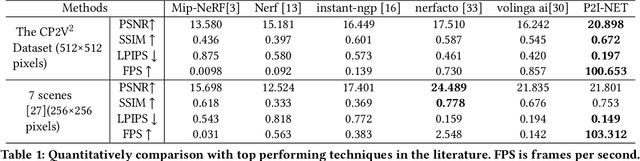
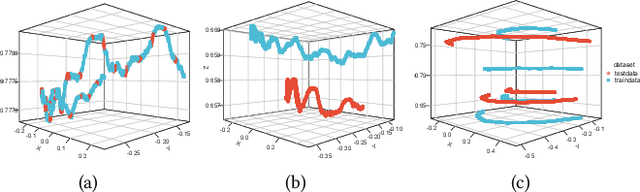
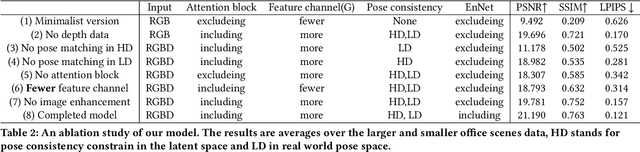
Given a new $6DoF$ camera pose in an indoor environment, we study the challenging problem of predicting the view from that pose based on a set of reference RGBD views. Existing explicit or implicit 3D geometry construction methods are computationally expensive while those based on learning have predominantly focused on isolated views of object categories with regular geometric structure. Differing from the traditional \textit{render-inpaint} approach to new view synthesis in the real indoor environment, we propose a conditional generative adversarial neural network (P2I-NET) to directly predict the new view from the given pose. P2I-NET learns the conditional distribution of the images of the environment for establishing the correspondence between the camera pose and its view of the environment, and achieves this through a number of innovative designs in its architecture and training lost function. Two auxiliary discriminator constraints are introduced for enforcing the consistency between the pose of the generated image and that of the corresponding real world image in both the latent feature space and the real world pose space. Additionally a deep convolutional neural network (CNN) is introduced to further reinforce this consistency in the pixel space. We have performed extensive new view synthesis experiments on real indoor datasets. Results show that P2I-NET has superior performance against a number of NeRF based strong baseline models. In particular, we show that P2I-NET is 40 to 100 times faster than these competitor techniques while synthesising similar quality images. Furthermore, we contribute a new publicly available indoor environment dataset containing 22 high resolution RGBD videos where each frame also has accurate camera pose parameters.
PLMM: Personal Large Models on Mobile Devices
Sep 26, 2023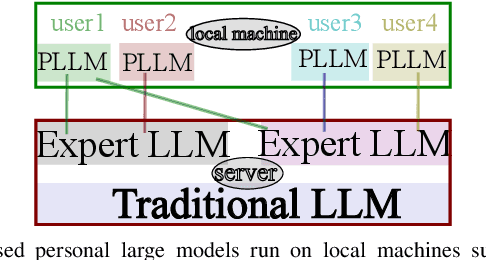
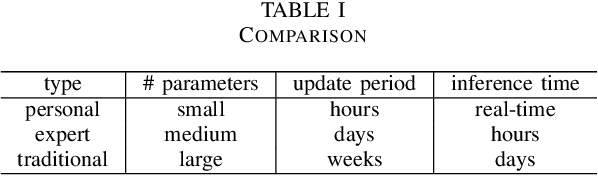
Inspired by Federated Learning, in this paper, we propose personal large models that are distilled from traditional large language models but more adaptive to local users' personal information such as education background and hobbies. We classify the large language models into three levels: the personal level, expert level and traditional level. The personal level models are adaptive to users' personal information. They encrypt the users' input and protect their privacy. The expert level models focus on merging specific knowledge such as finance, IT and art. The traditional models focus on the universal knowledge discovery and upgrading the expert models. In such classifications, the personal models directly interact with the user. For the whole system, the personal models have users' (encrypted) personal information. Moreover, such models must be small enough to be performed on personal computers or mobile devices. Finally, they also have to response in real-time for better user experience and produce high quality results. The proposed personal large models can be applied in a wide range of applications such as language and vision tasks.
Gradient Domain Diffusion Models for Image Synthesis
Sep 05, 2023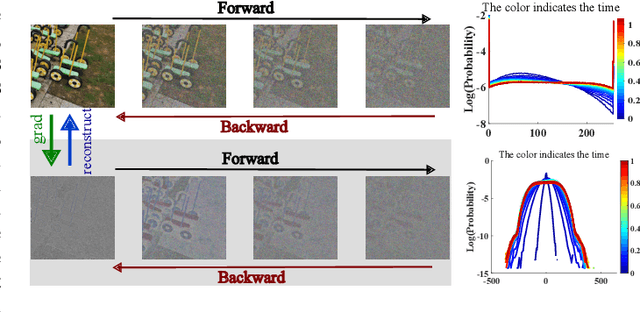
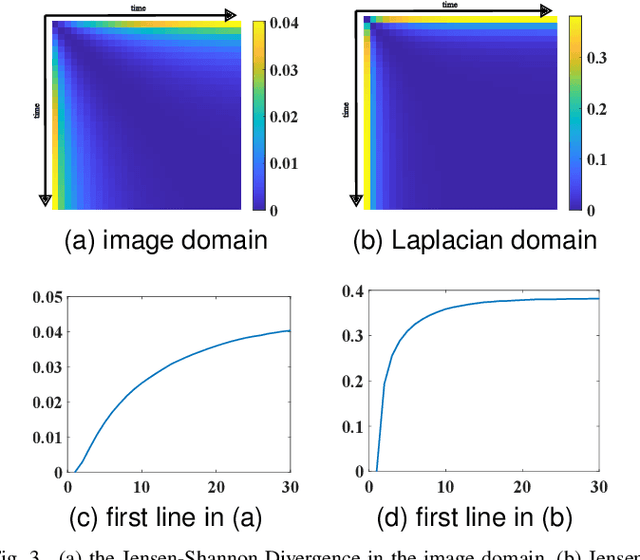
Diffusion models are getting popular in generative image and video synthesis. However, due to the diffusion process, they require a large number of steps to converge. To tackle this issue, in this paper, we propose to perform the diffusion process in the gradient domain, where the convergence becomes faster. There are two reasons. First, thanks to the Poisson equation, the gradient domain is mathematically equivalent to the original image domain. Therefore, each diffusion step in the image domain has a unique corresponding gradient domain representation. Second, the gradient domain is much sparser than the image domain. As a result, gradient domain diffusion models converge faster. Several numerical experiments confirm that the gradient domain diffusion models are more efficient than the original diffusion models. The proposed method can be applied in a wide range of applications such as image processing, computer vision and machine learning tasks.
TSSR: A Truncated and Signed Square Root Activation Function for Neural Networks
Aug 09, 2023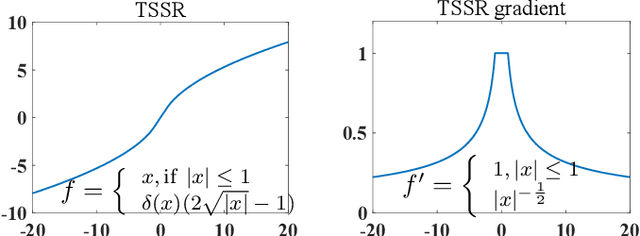
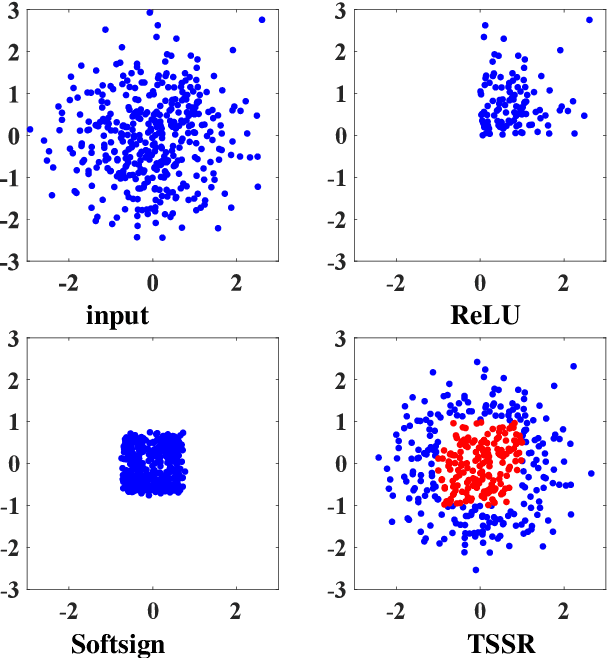
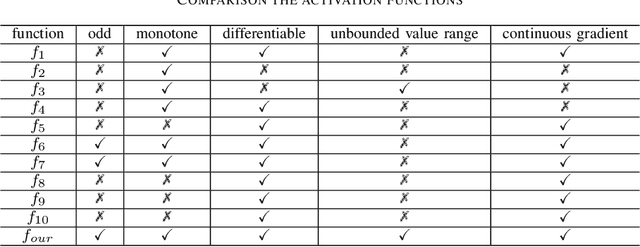
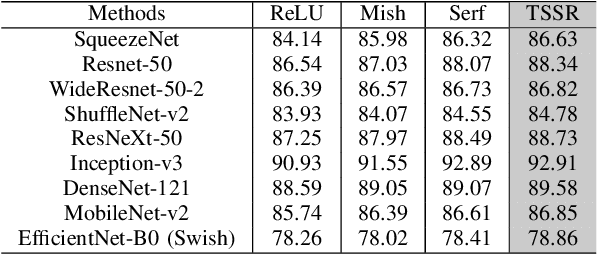
Activation functions are essential components of neural networks. In this paper, we introduce a new activation function called the Truncated and Signed Square Root (TSSR) function. This function is distinctive because it is odd, nonlinear, monotone and differentiable. Its gradient is continuous and always positive. Thanks to these properties, it has the potential to improve the numerical stability of neural networks. Several experiments confirm that the proposed TSSR has better performance than other stat-of-the-art activation functions. The proposed function has significant implications for the development of neural network models and can be applied to a wide range of applications in fields such as computer vision, natural language processing, and speech recognition.
STL: A Signed and Truncated Logarithm Activation Function for Neural Networks
Jul 31, 2023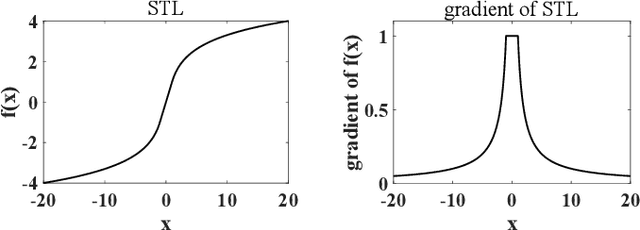
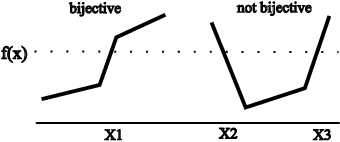
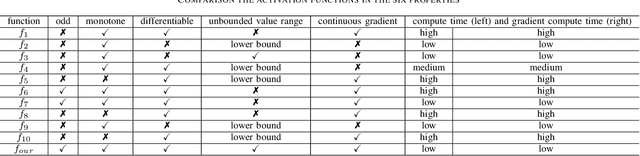
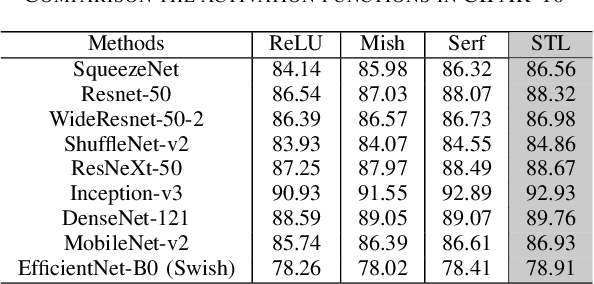
Activation functions play an essential role in neural networks. They provide the non-linearity for the networks. Therefore, their properties are important for neural networks' accuracy and running performance. In this paper, we present a novel signed and truncated logarithm function as activation function. The proposed activation function has significantly better mathematical properties, such as being odd function, monotone, differentiable, having unbounded value range, and a continuous nonzero gradient. These properties make it an excellent choice as an activation function. We compare it with other well-known activation functions in several well-known neural networks. The results confirm that it is the state-of-the-art. The suggested activation function can be applied in a large range of neural networks where activation functions are necessary.