 Add to Chrome
 Add to Firefox
 Add to Edge
OmniTraffic: A Controllable Generation Pipeline and Benchmark for Spatio-Temporal Traffic Reasoning
Jun 14, 2026
Traffic scene understanding requires models to reason beyond object recognition, including lane topology, multi-view geometry, temporal evolution, and signal-phase semantics. However, existing traffic-oriented multimodal benchmarks largely emphasize passive visual recognition or isolated video understanding, offering limited support for evaluating structure-aware traffic reasoning under controlled conditions. We introduce OmniTraffic, a controllable generation pipeline and benchmark for spatio-temporal traffic reasoning. Built around 12 real-world intersections reconstructed into editable 3D traffic environments and complemented by surveillance footage from two countries, OmniTraffic supports both controlled and natural-condition evaluation. It defines a three-level task hierarchy spanning scene perception, multi-view and temporal reasoning, and decision support. Using structured traffic metadata, OmniTraffic generates synchronized multi-view VQA samples covering vehicle states, lane functions, view--BEV correspondence, temporal dynamics, and signal-phase analysis, resulting in 8M VQA samples and a 3K human-verified test set. Evaluation of eleven frontier MLLMs reveals a large human--model gap, with the most pronounced failures in topology-grounded and spatio-temporal reasoning tasks. Fine-tuning a lightweight MLLM on simulated OmniTraffic data further improves performance on real-world traffic scenes, demonstrating the value of simulation-generated supervision for traffic-specific multimodal reasoning. Beyond a fixed dataset, OmniTraffic provides an extensible pipeline with configurable intersections, camera views, traffic demands, signal phases, visual conditions, and rare events.

KoMA: Knowledge-driven Multi-agent Framework for Autonomous Driving with Large Language Models
Jul 19, 2024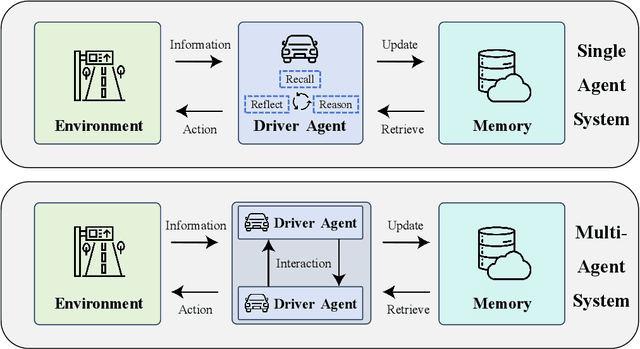


Large language models (LLMs) as autonomous agents offer a novel avenue for tackling real-world challenges through a knowledge-driven manner. These LLM-enhanced methodologies excel in generalization and interpretability. However, the complexity of driving tasks often necessitates the collaboration of multiple, heterogeneous agents, underscoring the need for such LLM-driven agents to engage in cooperative knowledge sharing and cognitive synergy. Despite the promise of LLMs, current applications predominantly center around single agent scenarios. To broaden the horizons of knowledge-driven strategies and bolster the generalization capabilities of autonomous agents, we propose the KoMA framework consisting of multi-agent interaction, multi-step planning, shared-memory, and ranking-based reflection modules to enhance multi-agents' decision-making in complex driving scenarios. Based on the framework's generated text descriptions of driving scenarios, the multi-agent interaction module enables LLM agents to analyze and infer the intentions of surrounding vehicles, akin to human cognition. The multi-step planning module enables LLM agents to analyze and obtain final action decisions layer by layer to ensure consistent goals for short-term action decisions. The shared memory module can accumulate collective experience to make superior decisions, and the ranking-based reflection module can evaluate and improve agent behavior with the aim of enhancing driving safety and efficiency. The KoMA framework not only enhances the robustness and adaptability of autonomous driving agents but also significantly elevates their generalization capabilities across diverse scenarios. Empirical results demonstrate the superiority of our approach over traditional methods, particularly in its ability to handle complex, unpredictable driving environments without extensive retraining.