 Add to Chrome
 Add to Firefox
 Add to Edge
BrainPilot: Automating Brain Discovery with Agentic Research
Jul 16, 2026
Understanding the brain increasingly depends on integrating evidence across scales, modalities, and disciplines. Addressing a single research question therefore requires a coordinated sequence of operations, from surveying prior work to executing analyses and interpreting results in light of domain knowledge. AI agents promise to accelerate this process, but current agents lack domain expertise in brain science, may fabricate claims, drift during multi-step reasoning, and offer few defined points for expert intervention. These failures are especially costly in brain science, where conclusions feed into downstream scientific claims and depend on laboratory-specific expertise and careful human judgment. We present \textbf{BrainPilot} a \textbf{fully open-source} multi-agent system that accelerates brain science research with traceable logs and agent-verified results. A principal investigator (PI) agent coordinates specialist agents grounded in curated domain knowledge: a unified brain science knowledge base containing 7{,}233 indexed items and a skill library of 72 reusable methodology units across seven research domains. Every major step is recorded in the Graph of Trace, an auditable record that links subgoals, tool use, evidence, and claims and allows researchers to follow and inspect the workflow. An Auditor agent further integrates fabrication checking into the workflow. For evaluation, we run three brain science tasks from Agents' Last Exam, introduce our own benchmark, \textbf{BrainPilotBench-v0}, and present additional end-to-end case studies. Across these evaluations, BrainPilot with an open-source backbone model attains performance comparable to state-of-the-art agent framework with less costs.

Continual Visual and Verbal Learning Through a Child's Egocentric Input
Jun 03, 2026Children learn the meanings of words from a continuous, temporally structured stream of egocentric experience. Recent work shows that neural networks can also learn word-referent mappings from a child's egocentric video recordings, but they cycle through the shuffled data for hundreds of epochs, contrasting with how children actually encounter their environment. We introduce BabyCL, a continual multimodal learning framework that processes the SAYCam dataset in a single chronological pass, combining streaming visual representation learning with an image-text contrastive objective. BabyCL combines a multi-stage temporal segmentation of the stream with a dual replay buffer that independently manages visual and multimodal histories, and it is jointly trained with three contrastive losses on a shared backbone. Under a matched optimization budget, BabyCL outperforms streaming learning baselines on the SAYCam Labeled-S 4AFC benchmark, substantially narrowing the gap to an upper bound of offline training. Ablations show that the gains are robust to the length of the online temporal segmentation window and the eviction rule of the replay buffer. Together, these results show that meaningful word-referent mappings can emerge under training conditions much closer to a child's actual experience.
Fully Spiking Neural Network for Legged Robots
Oct 08, 2023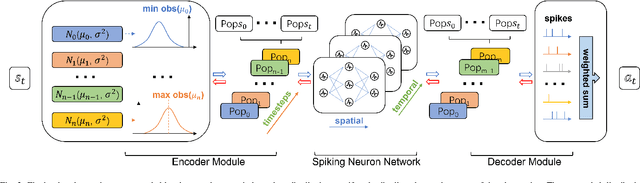
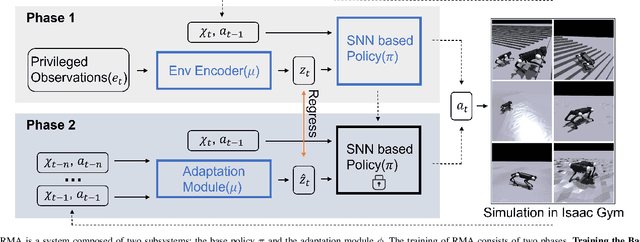
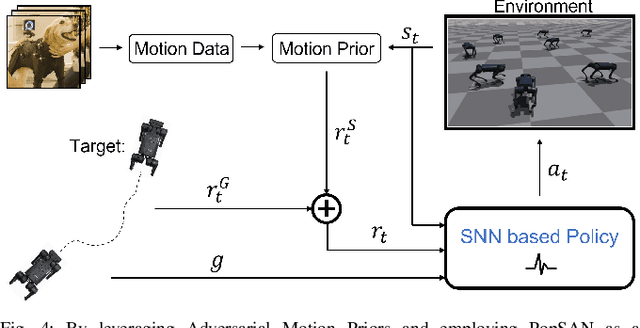
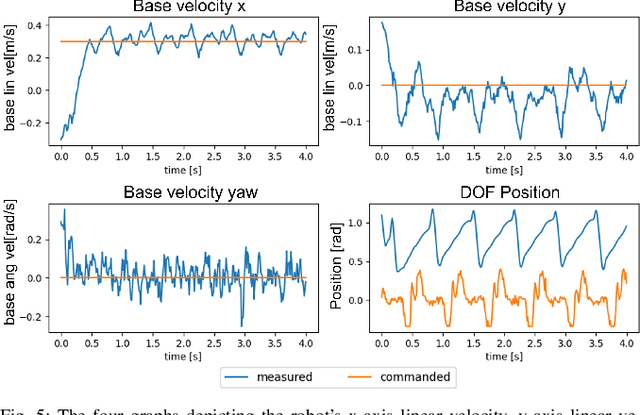
In recent years, legged robots based on deep reinforcement learning have made remarkable progress. Quadruped robots have demonstrated the ability to complete challenging tasks in complex environments and have been deployed in real-world scenarios to assist humans. Simultaneously, bipedal and humanoid robots have achieved breakthroughs in various demanding tasks. Current reinforcement learning methods can utilize diverse robot bodies and historical information to perform actions. However, prior research has not emphasized the speed and energy consumption of network inference, as well as the biological significance of the neural networks themselves. Most of the networks employed are traditional artificial neural networks that utilize multilayer perceptrons (MLP). In this paper, we successfully apply a novel Spiking Neural Network (SNN) to process legged robots, achieving outstanding results across a range of simulated terrains. SNN holds a natural advantage over traditional neural networks in terms of inference speed and energy consumption, and their pulse-form processing of body perception signals offers improved biological interpretability. To the best of our knowledge, this is the first work to implement SNN in legged robots.
Saliency-Guided Hidden Associative Replay for Continual Learning
Oct 06, 2023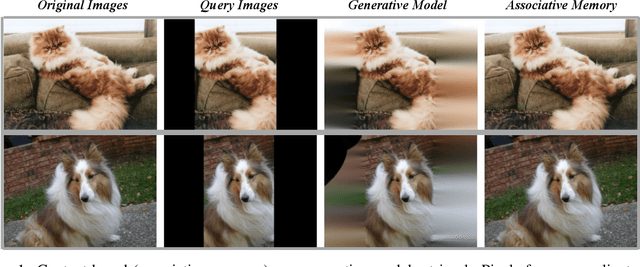
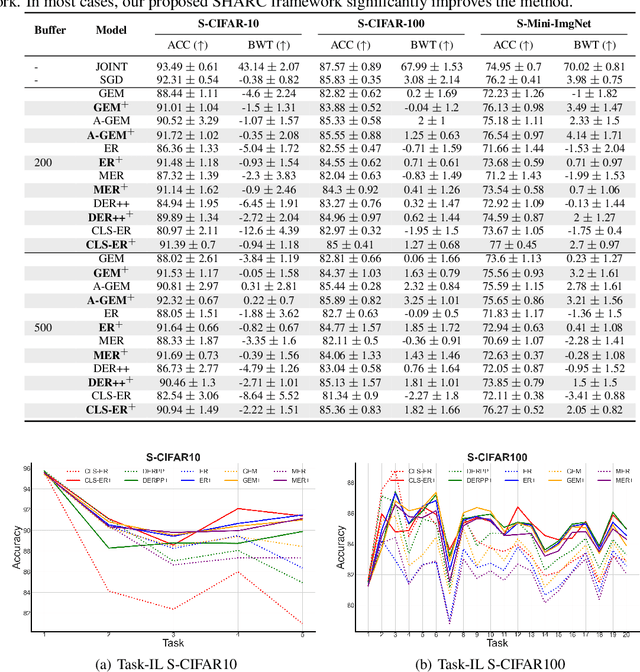
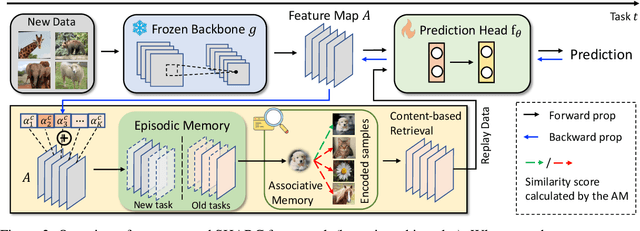
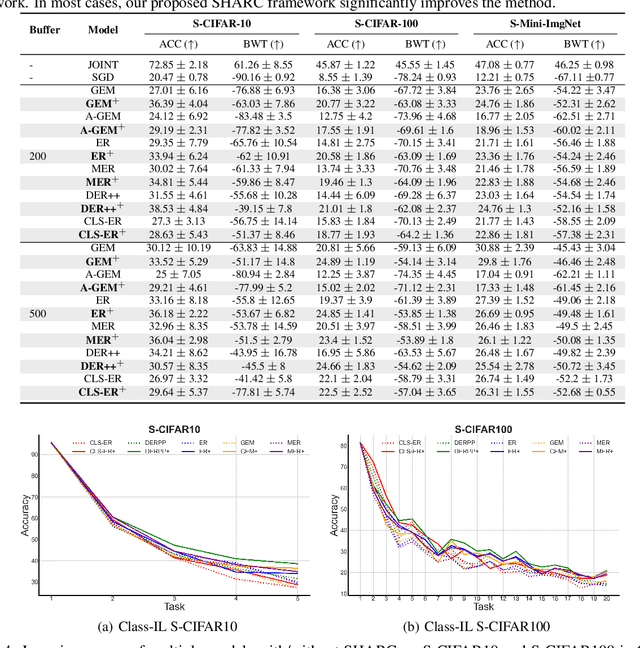
Continual Learning is a burgeoning domain in next-generation AI, focusing on training neural networks over a sequence of tasks akin to human learning. While CL provides an edge over traditional supervised learning, its central challenge remains to counteract catastrophic forgetting and ensure the retention of prior tasks during subsequent learning. Amongst various strategies to tackle this, replay based methods have emerged as preeminent, echoing biological memory mechanisms. However, these methods are memory intensive, often preserving entire data samples, an approach inconsistent with humans selective memory retention of salient experiences. While some recent works have explored the storage of only significant portions of data in episodic memory, the inherent nature of partial data necessitates innovative retrieval mechanisms. Current solutions, like inpainting, approximate full data reconstruction from partial cues, a method that diverges from genuine human memory processes. Addressing these nuances, this paper presents the Saliency Guided Hidden Associative Replay for Continual Learning. This novel framework synergizes associative memory with replay-based strategies. SHARC primarily archives salient data segments via sparse memory encoding. Importantly, by harnessing associative memory paradigms, it introduces a content focused memory retrieval mechanism, promising swift and near-perfect recall, bringing CL a step closer to authentic human memory processes. Extensive experimental results demonstrate the effectiveness of our proposed method for various continual learning tasks.
Prompt, Plan, Perform: LLM-based Humanoid Control via Quantized Imitation Learning
Sep 20, 2023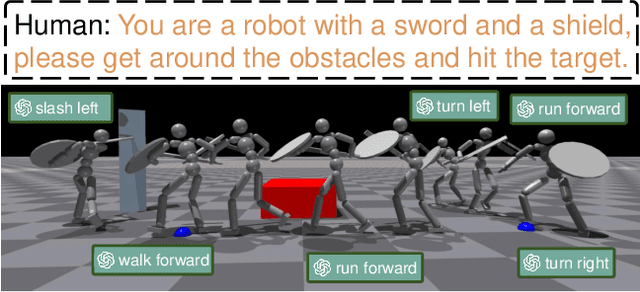
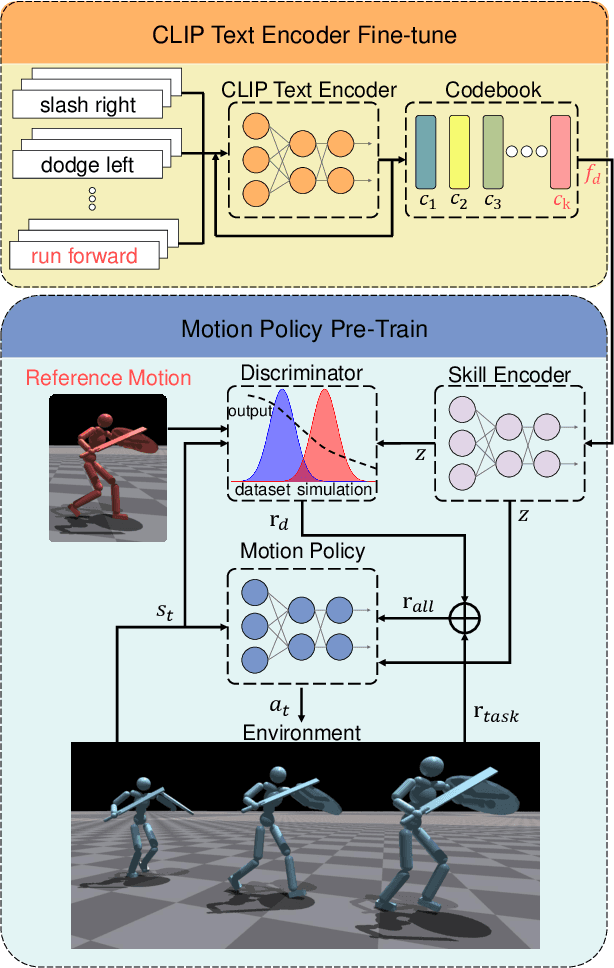
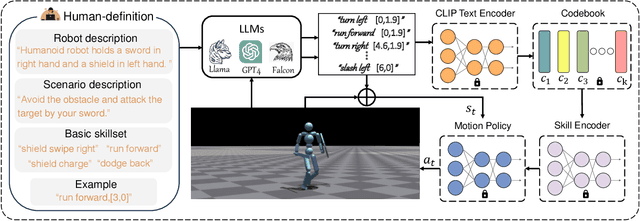
In recent years, reinforcement learning and imitation learning have shown great potential for controlling humanoid robots' motion. However, these methods typically create simulation environments and rewards for specific tasks, resulting in the requirements of multiple policies and limited capabilities for tackling complex and unknown tasks. To overcome these issues, we present a novel approach that combines adversarial imitation learning with large language models (LLMs). This innovative method enables the agent to learn reusable skills with a single policy and solve zero-shot tasks under the guidance of LLMs. In particular, we utilize the LLM as a strategic planner for applying previously learned skills to novel tasks through the comprehension of task-specific prompts. This empowers the robot to perform the specified actions in a sequence. To improve our model, we incorporate codebook-based vector quantization, allowing the agent to generate suitable actions in response to unseen textual commands from LLMs. Furthermore, we design general reward functions that consider the distinct motion features of humanoid robots, ensuring the agent imitates the motion data while maintaining goal orientation without additional guiding direction approaches or policies. To the best of our knowledge, this is the first framework that controls humanoid robots using a single learning policy network and LLM as a planner. Extensive experiments demonstrate that our method exhibits efficient and adaptive ability in complicated motion tasks.