 Add to Chrome
 Add to Firefox
 Add to Edge
BrainPilot: Automating Brain Discovery with Agentic Research
Jul 16, 2026
Understanding the brain increasingly depends on integrating evidence across scales, modalities, and disciplines. Addressing a single research question therefore requires a coordinated sequence of operations, from surveying prior work to executing analyses and interpreting results in light of domain knowledge. AI agents promise to accelerate this process, but current agents lack domain expertise in brain science, may fabricate claims, drift during multi-step reasoning, and offer few defined points for expert intervention. These failures are especially costly in brain science, where conclusions feed into downstream scientific claims and depend on laboratory-specific expertise and careful human judgment. We present \textbf{BrainPilot} a \textbf{fully open-source} multi-agent system that accelerates brain science research with traceable logs and agent-verified results. A principal investigator (PI) agent coordinates specialist agents grounded in curated domain knowledge: a unified brain science knowledge base containing 7{,}233 indexed items and a skill library of 72 reusable methodology units across seven research domains. Every major step is recorded in the Graph of Trace, an auditable record that links subgoals, tool use, evidence, and claims and allows researchers to follow and inspect the workflow. An Auditor agent further integrates fabrication checking into the workflow. For evaluation, we run three brain science tasks from Agents' Last Exam, introduce our own benchmark, \textbf{BrainPilotBench-v0}, and present additional end-to-end case studies. Across these evaluations, BrainPilot with an open-source backbone model attains performance comparable to state-of-the-art agent framework with less costs.

Remember and Recall: Associative-Memory-based Trajectory Prediction
Oct 03, 2024
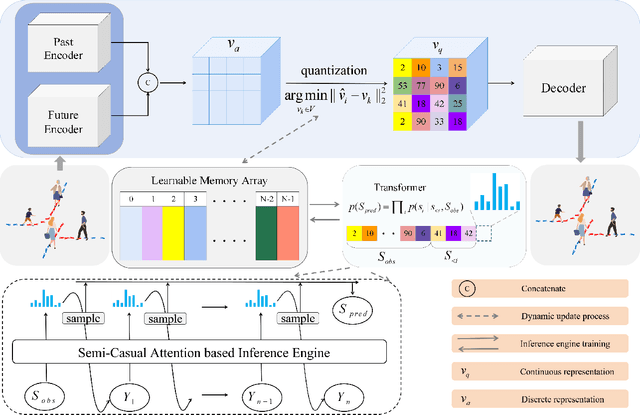
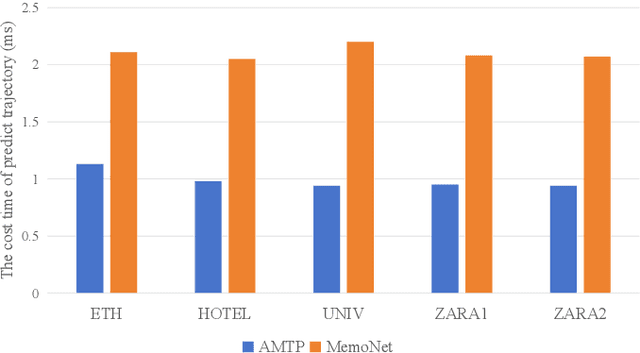

Trajectory prediction is a pivotal component of autonomous driving systems, enabling the application of accumulated movement experience to current scenarios. Although most existing methods concentrate on learning continuous representations to gain valuable experience, they often suffer from computational inefficiencies and struggle with unfamiliar situations. To address this issue, we propose the Fragmented-Memory-based Trajectory Prediction (FMTP) model, inspired by the remarkable learning capabilities of humans, particularly their ability to leverage accumulated experience and recall relevant memories in unfamiliar situations. The FMTP model employs discrete representations to enhance computational efficiency by reducing information redundancy while maintaining the flexibility to utilize past experiences. Specifically, we design a learnable memory array by consolidating continuous trajectory representations from the training set using defined quantization operations during the training phase. This approach further eliminates redundant information while preserving essential features in discrete form. Additionally, we develop an advanced reasoning engine based on language models to deeply learn the associative rules among these discrete representations. Our method has been evaluated on various public datasets, including ETH-UCY, inD, SDD, nuScenes, Waymo, and VTL-TP. The extensive experimental results demonstrate that our approach achieves significant performance and extracts more valuable experience from past trajectories to inform the current state.
Enhancing Robotic Adaptability: Integrating Unsupervised Trajectory Segmentation and Conditional ProMPs for Dynamic Learning Environments
Apr 30, 2024We propose a novel framework for enhancing robotic adaptability and learning efficiency, which integrates unsupervised trajectory segmentation with adaptive probabilistic movement primitives (ProMPs). By employing a cutting-edge deep learning architecture that combines autoencoders and Recurrent Neural Networks (RNNs), our approach autonomously pinpoints critical transitional points in continuous, unlabeled motion data, thus significantly reducing dependence on extensively labeled datasets. This innovative method dynamically adjusts motion trajectories using conditional variables, significantly enhancing the flexibility and accuracy of robotic actions under dynamic conditions while also reducing the computational overhead associated with traditional robotic programming methods. Our experimental validation demonstrates superior learning efficiency and adaptability compared to existing techniques, paving the way for advanced applications in industrial and service robotics.