 Add to Chrome
 Add to Firefox
 Add to Edge
Anchor3R: Streaming 3D Reconstruction with Transient Anchors for Long-Horizon Visual Mapping
Jun 03, 2026
Long-horizon online visual mapping is a core capability for robot perception, requiring continuous camera-motion and scene-geometry estimation from visual streams under bounded memory and computation. Recent feed-forward 3D reconstruction models provide strong geometric priors, but their streaming variants often predict poses in a fixed coordinate system tied to the first frame or a persistent scene memory. This fixed-gauge design leads to train--test mismatch, attention bias toward early anchors, and accumulated drift on sequences much longer than those seen during training. We propose \emph{Anchor3R}, a streaming 3D reconstruction framework that treats feed-forward reconstruction as current-centric local measurement prediction rather than persistent global-gauge regression. At each time step, Anchor3R predicts window-relative poses and a local pointmap in the current-frame coordinate system, turning streaming reconstruction into relative-pose measurement generation. These measurements support online pose updates, while loop-closure reinsertion and motion averaging align the trajectory and transform local pointmaps into a coherent global reconstruction. Experiments on indoor, outdoor, driving, and RGB-D benchmarks show that Anchor3R improves long-horizon pose accuracy and dense reconstruction quality over existing streaming baselines, while supporting bounded-memory online inference.

HorizonStream: Long-Horizon Attention for Streaming 3D Reconstruction
May 22, 2026Online 3D reconstruction requires estimating camera pose and scene geometry under strict causal and bounded-memory constraints. Existing methods often suffer from drift, jitter, or collapse on long sequences. We trace these failures to a fundamental mismatch. Streaming geometry is inherently temporally heterogeneous, with evidence ranging from short-lived correspondences to persistent global scale. However, current architectures impose uniform and pathological influence patterns. For example, sliding windows enforce hard cutoffs, while ungated recurrence and causal attention cause cache saturation and spike-like attention sinks. To resolve this, we formalize geometric propagation as an \emph{evidence influence kernel} and propose HorizonStream, a long-horizon Transformer that explicitly factorizes this kernel. For the long-range temporal factor, Geometric Linear Attention learns channel-wise decay rates to enable bounded, multi-timescale propagation of geometric evidence. For the short-range spatial factor, Geometric Local Attention with Spatiotemporal RoPE performs reliable 3D matching while suppressing attention sinks. Finally, Metric Readout Tokens recover stable scale and rigid pose directly from the persistent geometric state. Extensive experiments show that HorizonStream, trained on only 48-frame clips, generalizes stably to sequences exceeding 10,000\ frames with constant memory and linear time, achieving state-of-the-art streaming 3D reconstruction performance. Project Page: https://3dagentworld.github.io/horizonstream/
PGC: Peak-Guided Calibration for Generalizable AI-Generated Image Detection
May 20, 2026The rapid evolution of generative AI, from GANs to modern diffusion models, has resulted in increasingly subtle discriminative clues. These fine-grained signals are often overshadowed by dominant, high-fidelity image content (e.g., the main subject), limiting the reliability of existing detectors that predominantly rely on global representations. To address this challenge, we propose the Peak-Guided Calibration (PGC) framework. PGC introduces a novel strategy that aggregates salient features via a peak-focusing mechanism. Specifically, by employing a peak-sensitive aggregation that accentuates the most discriminative local clues, PGC leverages these critical signals to calibrate the global decision. This approach recovers subtle patterns that would otherwise be submerged in the global context. Furthermore, to better simulate real-world threats, we introduce the CommGen15 dataset, a challenging benchmark comprising samples from 15 commercial models. Extensive experiments demonstrate that PGC achieves state-of-the-art performance. Specifically, it improves mean accuracy by +12.3% on our CommGen15 dataset, and sets new records on standard benchmarks, including GenImage (+2.1%), AIGI (+3.5%), and UniversalFakeDetect (+1.7%). Code is available at https://github.com/xiaoyu6868/PGC.
LongStream: Long-Sequence Streaming Autoregressive Visual Geometry
Feb 13, 2026Long-sequence streaming 3D reconstruction remains a significant open challenge. Existing autoregressive models often fail when processing long sequences. They typically anchor poses to the first frame, which leads to attention decay, scale drift, and extrapolation errors. We introduce LongStream, a novel gauge-decoupled streaming visual geometry model for metric-scale scene reconstruction across thousands of frames. Our approach is threefold. First, we discard the first-frame anchor and predict keyframe-relative poses. This reformulates long-range extrapolation into a constant-difficulty local task. Second, we introduce orthogonal scale learning. This method fully disentangles geometry from scale estimation to suppress drift. Finally, we solve Transformer cache issues such as attention-sink reliance and long-term KV-cache contamination. We propose cache-consistent training combined with periodic cache refresh. This approach suppresses attention degradation over ultra-long sequences and reduces the gap between training and inference. Experiments show LongStream achieves state-of-the-art performance. It delivers stable, metric-scale reconstruction over kilometer-scale sequences at 18 FPS. Project Page: https://3dagentworld.github.io/longstream/
Graph-Guided Scene Reconstruction from Images with 3D Gaussian Splatting
Feb 24, 2025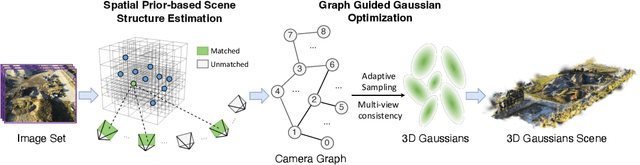
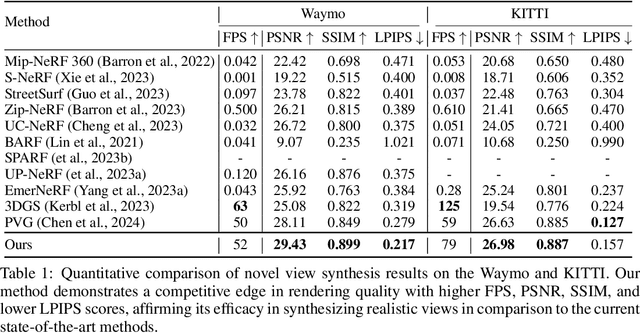
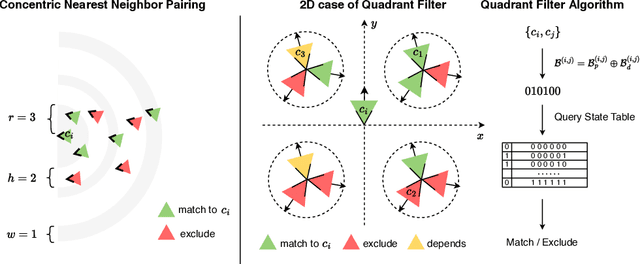

This paper investigates an open research challenge of reconstructing high-quality, large 3D open scenes from images. It is observed existing methods have various limitations, such as requiring precise camera poses for input and dense viewpoints for supervision. To perform effective and efficient 3D scene reconstruction, we propose a novel graph-guided 3D scene reconstruction framework, GraphGS. Specifically, given a set of images captured by RGB cameras on a scene, we first design a spatial prior-based scene structure estimation method. This is then used to create a camera graph that includes information about the camera topology. Further, we propose to apply the graph-guided multi-view consistency constraint and adaptive sampling strategy to the 3D Gaussian Splatting optimization process. This greatly alleviates the issue of Gaussian points overfitting to specific sparse viewpoints and expedites the 3D reconstruction process. We demonstrate GraphGS achieves high-fidelity 3D reconstruction from images, which presents state-of-the-art performance through quantitative and qualitative evaluation across multiple datasets. Project Page: https://3dagentworld.github.io/graphgs.
RGB-Only Gaussian Splatting SLAM for Unbounded Outdoor Scenes
Feb 21, 2025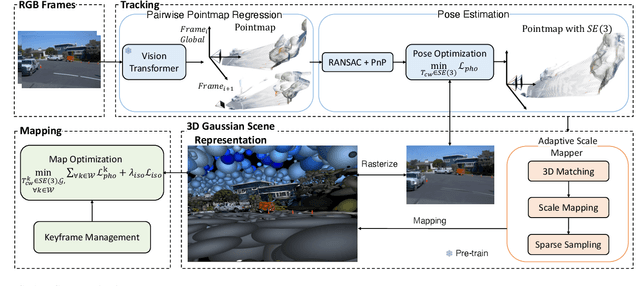
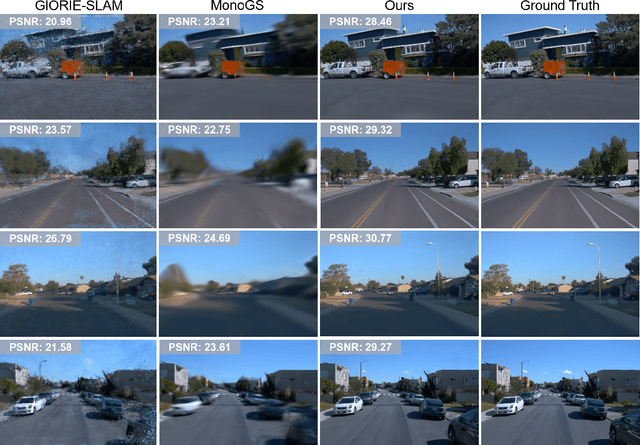
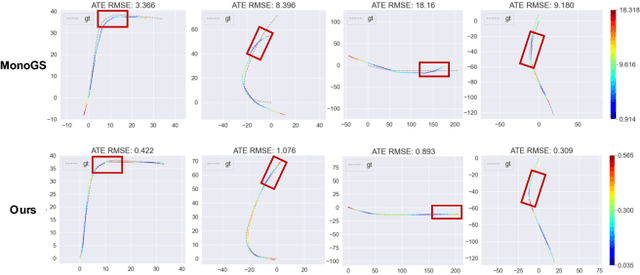
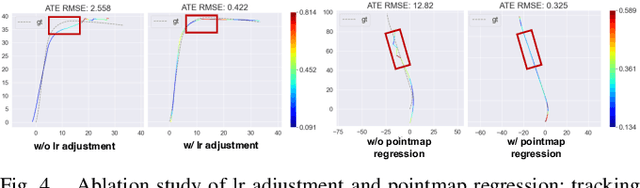
3D Gaussian Splatting (3DGS) has become a popular solution in SLAM, as it can produce high-fidelity novel views. However, previous GS-based methods primarily target indoor scenes and rely on RGB-D sensors or pre-trained depth estimation models, hence underperforming in outdoor scenarios. To address this issue, we propose a RGB-only gaussian splatting SLAM method for unbounded outdoor scenes--OpenGS-SLAM. Technically, we first employ a pointmap regression network to generate consistent pointmaps between frames for pose estimation. Compared to commonly used depth maps, pointmaps include spatial relationships and scene geometry across multiple views, enabling robust camera pose estimation. Then, we propose integrating the estimated camera poses with 3DGS rendering as an end-to-end differentiable pipeline. Our method achieves simultaneous optimization of camera poses and 3DGS scene parameters, significantly enhancing system tracking accuracy. Specifically, we also design an adaptive scale mapper for the pointmap regression network, which provides more accurate pointmap mapping to the 3DGS map representation. Our experiments on the Waymo dataset demonstrate that OpenGS-SLAM reduces tracking error to 9.8\% of previous 3DGS methods, and achieves state-of-the-art results in novel view synthesis. Project Page: https://3dagentworld.github.io/opengs-slam/
GVKF: Gaussian Voxel Kernel Functions for Highly Efficient Surface Reconstruction in Open Scenes
Nov 04, 2024

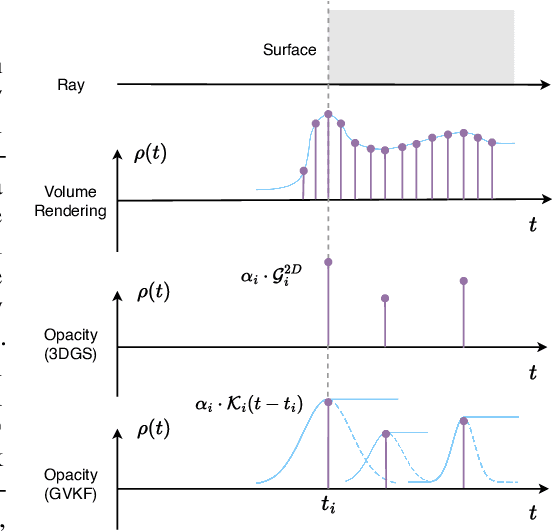
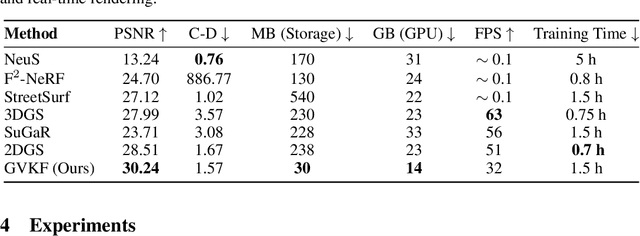
In this paper we present a novel method for efficient and effective 3D surface reconstruction in open scenes. Existing Neural Radiance Fields (NeRF) based works typically require extensive training and rendering time due to the adopted implicit representations. In contrast, 3D Gaussian splatting (3DGS) uses an explicit and discrete representation, hence the reconstructed surface is built by the huge number of Gaussian primitives, which leads to excessive memory consumption and rough surface details in sparse Gaussian areas. To address these issues, we propose Gaussian Voxel Kernel Functions (GVKF), which establish a continuous scene representation based on discrete 3DGS through kernel regression. The GVKF integrates fast 3DGS rasterization and highly effective scene implicit representations, achieving high-fidelity open scene surface reconstruction. Experiments on challenging scene datasets demonstrate the efficiency and effectiveness of our proposed GVKF, featuring with high reconstruction quality, real-time rendering speed, significant savings in storage and training memory consumption.
Prompt, Plan, Perform: LLM-based Humanoid Control via Quantized Imitation Learning
Sep 20, 2023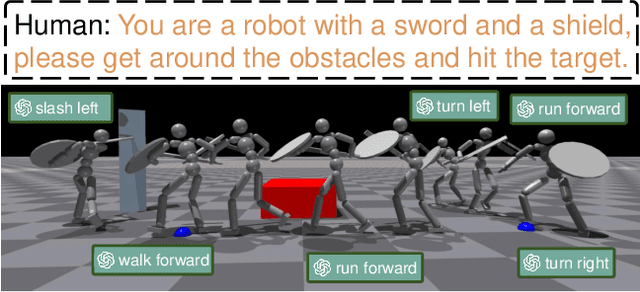
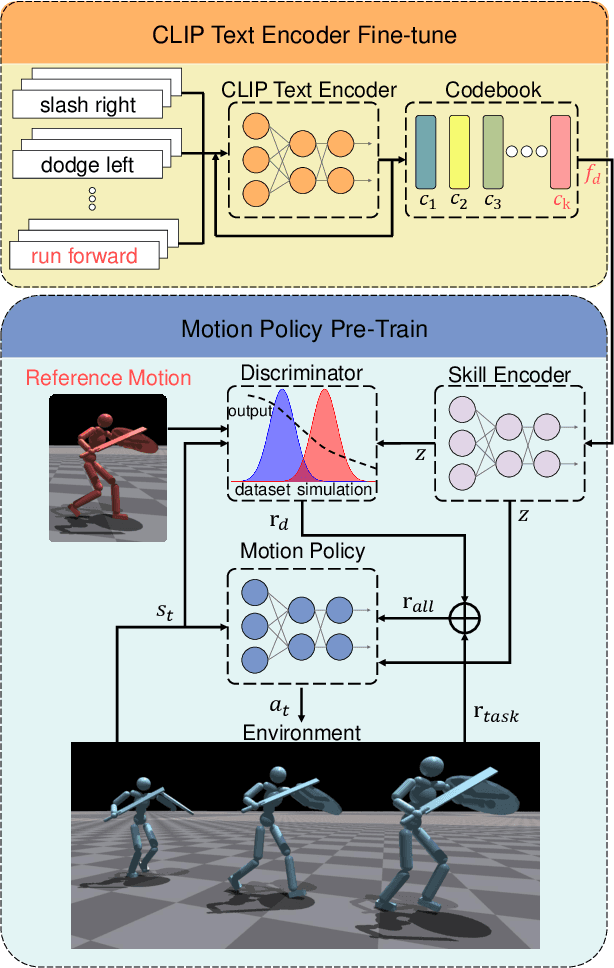
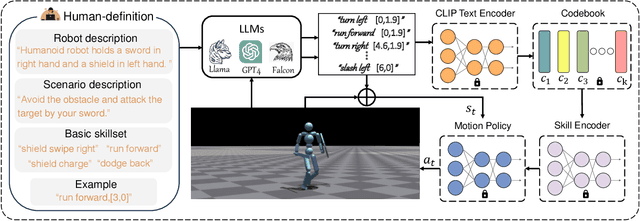
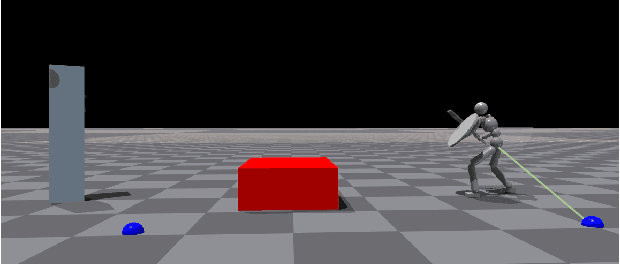
In recent years, reinforcement learning and imitation learning have shown great potential for controlling humanoid robots' motion. However, these methods typically create simulation environments and rewards for specific tasks, resulting in the requirements of multiple policies and limited capabilities for tackling complex and unknown tasks. To overcome these issues, we present a novel approach that combines adversarial imitation learning with large language models (LLMs). This innovative method enables the agent to learn reusable skills with a single policy and solve zero-shot tasks under the guidance of LLMs. In particular, we utilize the LLM as a strategic planner for applying previously learned skills to novel tasks through the comprehension of task-specific prompts. This empowers the robot to perform the specified actions in a sequence. To improve our model, we incorporate codebook-based vector quantization, allowing the agent to generate suitable actions in response to unseen textual commands from LLMs. Furthermore, we design general reward functions that consider the distinct motion features of humanoid robots, ensuring the agent imitates the motion data while maintaining goal orientation without additional guiding direction approaches or policies. To the best of our knowledge, this is the first framework that controls humanoid robots using a single learning policy network and LLM as a planner. Extensive experiments demonstrate that our method exhibits efficient and adaptive ability in complicated motion tasks.