 Add to Chrome
 Add to Firefox
 Add to Edge
BulkPR-Bench: Benchmarking Queue-Level Governance of Interacting Pull Requests
Aug 03, 2026
Coding-agent benchmarks increasingly cover long-horizon, end-to-end, and interactive development, but typically retain one requested outcome or a fixed change sequence. Sequential policies can process a pull-request (PR) queue one candidate at a time, but when queued PRs interact, maximizing safe delivery can require jointly deciding which changes to merge and in what order. We introduce BulkPR-Bench, an executable benchmark in which an agent must recover consequential PR relations and return a large safe subset in executable order under a rolling-release protocol. The suite contains 581 newly authored candidate PRs on frozen snapshots of 18 real repositories. Registered state-by-state repository execution, including hidden safety checks, validates the gold relation graph; an exact oracle then computes the largest safe subset. Our primary metric, Relational Delivery Score (RDS), scores safe delivery and correct rejection over relation groups from the realized merge trace; Global Safety-Gated Yield (Global-SGY) separately measures strict delivery of the realized whole-queue plan. Under the buffered primary protocol with batch size $K=32$, the three highest RDS estimates among the six models are 66.6%, 62.0%, and 57.9%, compared with 53.1% for the strongest sequential baseline. Only 8 of 324 model runs complete a queue exactly. Critical-relation recall ranges from 35.2% to 57.7%, and diagnostic runs supplied with the gold relations show substantial remaining headroom. Gains on relation groups therefore do not yet translate into dependable whole-queue governance.

ERNIE-Image Technical Report
May 25, 2026We introduce ERNIE-Image, an open-source text-to-image generation model built upon an 8B single-stream DiT architecture. ERNIE-Image aims to bridge the gap between current open-source models and leading closed-source systems through more effective mining of large-scale pre-training data and improved supervision quality throughout training. During pre-training, we adopt a bottom-up data construction pipeline that combines fine-grained image categorization, rich caption annotation, aesthetic assessment, and hierarchical sampling. This strategy reduces data noise while preserving long-tail concepts and detailed real-world knowledge, providing a stronger foundation for complex generation tasks. In the post-training stage, we use a top-down data construction pipeline for high-demand scenarios, diversify prompt annotations to better match real user inputs, and apply a stabilized DPO strategy to align the model with human aesthetic preferences. We further train ERNIE-Image-Turbo for efficient 8-NFE generation and propose MT-DMD to mitigate capability drift during distillation. To make the model easier to use in practical scenarios, we equip it with a lightweight Prompt Enhancer that expands concise user intents into structured visual descriptions. In addition, we develop ERNIE-Image-Aes, an industrial-grade aesthetic model, together with ERNIE-Image-Aes-1K, a human-annotated benchmark for realistic aesthetic evaluation. Extensive qualitative and quantitative experiments show that ERNIE-Image achieves leading performance among open-source models and approaches top-tier commercial models in instruction following, text rendering, and aesthetic quality. We release the trained models and aesthetic resources to facilitate further academic research and technical progress in the AIGC community.
Hierarchical-Task-Aware Multi-modal Mixture of Incremental LoRA Experts for Embodied Continual Learning
Jun 05, 2025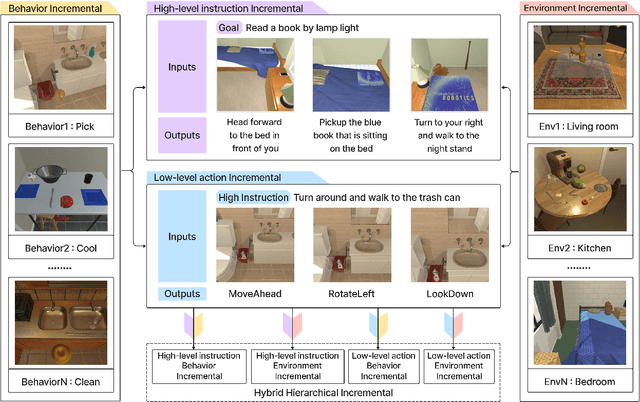
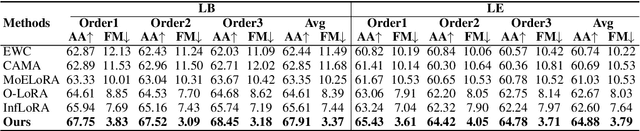
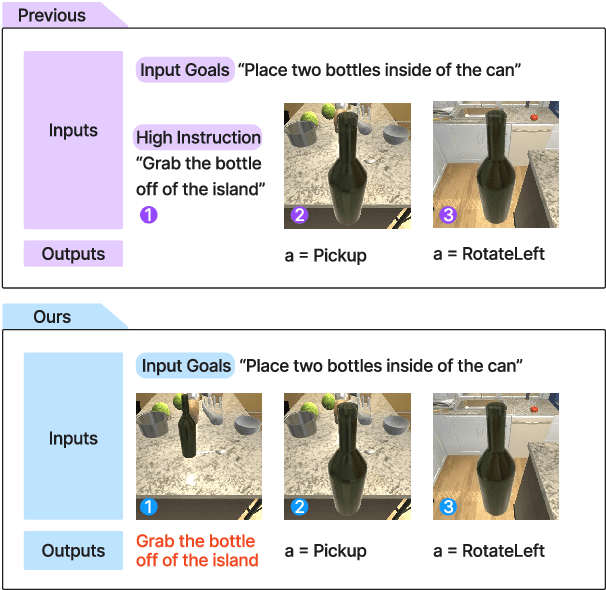
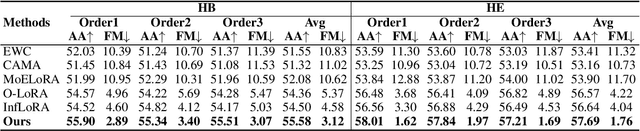
Previous continual learning setups for embodied intelligence focused on executing low-level actions based on human commands, neglecting the ability to learn high-level planning and multi-level knowledge. To address these issues, we propose the Hierarchical Embodied Continual Learning Setups (HEC) that divide the agent's continual learning process into two layers: high-level instructions and low-level actions, and define five embodied continual learning sub-setups. Building on these setups, we introduce the Task-aware Mixture of Incremental LoRA Experts (Task-aware MoILE) method. This approach achieves task recognition by clustering visual-text embeddings and uses both a task-level router and a token-level router to select the appropriate LoRA experts. To effectively address the issue of catastrophic forgetting, we apply Singular Value Decomposition (SVD) to the LoRA parameters obtained from prior tasks, preserving key components while orthogonally training the remaining parts. The experimental results show that our method stands out in reducing the forgetting of old tasks compared to other methods, effectively supporting agents in retaining prior knowledge while continuously learning new tasks.