 Add to Chrome
 Add to Firefox
 Add to Edge
BulkPR-Bench: Benchmarking Queue-Level Governance of Interacting Pull Requests
Aug 03, 2026
Coding-agent benchmarks increasingly cover long-horizon, end-to-end, and interactive development, but typically retain one requested outcome or a fixed change sequence. Sequential policies can process a pull-request (PR) queue one candidate at a time, but when queued PRs interact, maximizing safe delivery can require jointly deciding which changes to merge and in what order. We introduce BulkPR-Bench, an executable benchmark in which an agent must recover consequential PR relations and return a large safe subset in executable order under a rolling-release protocol. The suite contains 581 newly authored candidate PRs on frozen snapshots of 18 real repositories. Registered state-by-state repository execution, including hidden safety checks, validates the gold relation graph; an exact oracle then computes the largest safe subset. Our primary metric, Relational Delivery Score (RDS), scores safe delivery and correct rejection over relation groups from the realized merge trace; Global Safety-Gated Yield (Global-SGY) separately measures strict delivery of the realized whole-queue plan. Under the buffered primary protocol with batch size $K=32$, the three highest RDS estimates among the six models are 66.6%, 62.0%, and 57.9%, compared with 53.1% for the strongest sequential baseline. Only 8 of 324 model runs complete a queue exactly. Critical-relation recall ranges from 35.2% to 57.7%, and diagnostic runs supplied with the gold relations show substantial remaining headroom. Gains on relation groups therefore do not yet translate into dependable whole-queue governance.

ADRNet: A Generalized Collaborative Filtering Framework Combining Clinical and Non-Clinical Data for Adverse Drug Reaction Prediction
Aug 03, 2023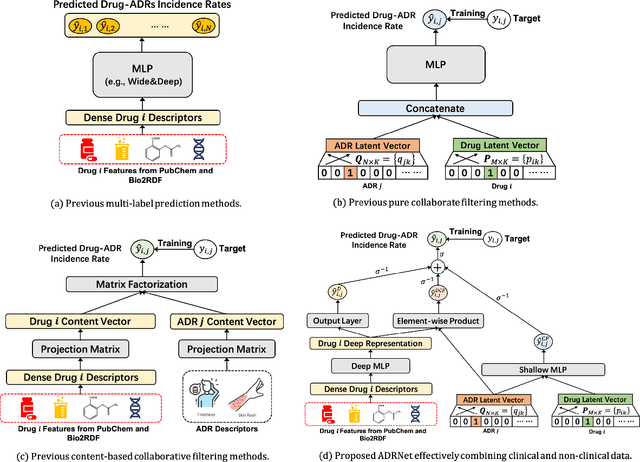
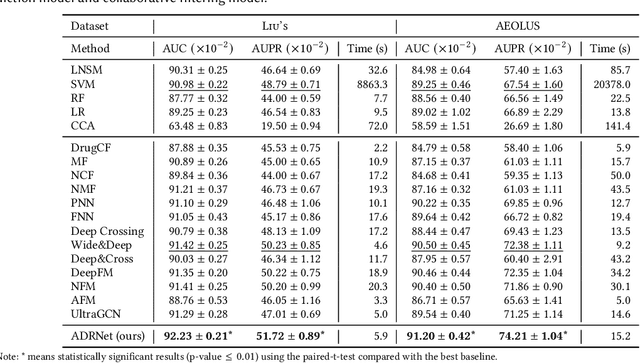
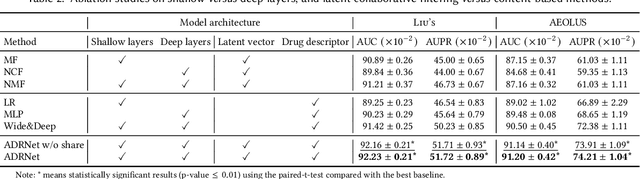

Adverse drug reaction (ADR) prediction plays a crucial role in both health care and drug discovery for reducing patient mortality and enhancing drug safety. Recently, many studies have been devoted to effectively predict the drug-ADRs incidence rates. However, these methods either did not effectively utilize non-clinical data, i.e., physical, chemical, and biological information about the drug, or did little to establish a link between content-based and pure collaborative filtering during the training phase. In this paper, we first formulate the prediction of multi-label ADRs as a drug-ADR collaborative filtering problem, and to the best of our knowledge, this is the first work to provide extensive benchmark results of previous collaborative filtering methods on two large publicly available clinical datasets. Then, by exploiting the easy accessible drug characteristics from non-clinical data, we propose ADRNet, a generalized collaborative filtering framework combining clinical and non-clinical data for drug-ADR prediction. Specifically, ADRNet has a shallow collaborative filtering module and a deep drug representation module, which can exploit the high-dimensional drug descriptors to further guide the learning of low-dimensional ADR latent embeddings, which incorporates both the benefits of collaborative filtering and representation learning. Extensive experiments are conducted on two publicly available real-world drug-ADR clinical datasets and two non-clinical datasets to demonstrate the accuracy and efficiency of the proposed ADRNet. The code is available at https://github.com/haoxuanli-pku/ADRnet.