 Add to Chrome
 Add to Firefox
 Add to Edge
Triage: Hierarchical Visual Budgeting for Efficient Video Reasoning in Vision-Language Models
Jan 30, 2026
Vision-Language Models (VLMs) face significant computational challenges in video processing due to massive data redundancy, which creates prohibitively long token sequences. To address this, we introduce Triage, a training-free, plug-and-play framework that reframes video reasoning as a resource allocation problem via hierarchical visual budgeting. Its first stage, Frame-Level Budgeting, identifies keyframes by evaluating their visual dynamics and relevance, generating a strategic prior based on their importance scores. Guided by this prior, the second stage, Token-Level Budgeting, allocates tokens in two phases: it first secures high-relevance Core Tokens, followed by diverse Context Tokens selected with an efficient batched Maximal Marginal Relevance (MMR) algorithm. Extensive experiments demonstrate that Triage improves inference speed and reduces memory footprint, while maintaining or surpassing the performance of baselines and other methods on various video reasoning benchmarks.

Hierarchical-Task-Aware Multi-modal Mixture of Incremental LoRA Experts for Embodied Continual Learning
Jun 05, 2025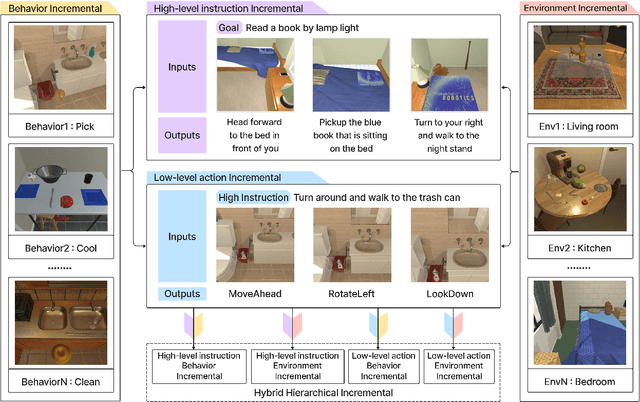
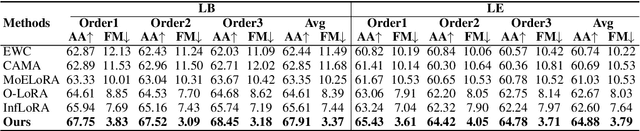
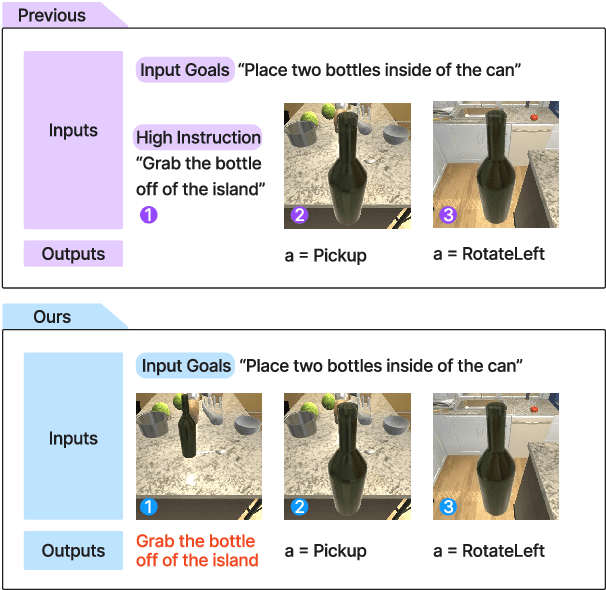
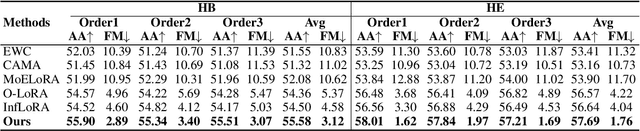
Previous continual learning setups for embodied intelligence focused on executing low-level actions based on human commands, neglecting the ability to learn high-level planning and multi-level knowledge. To address these issues, we propose the Hierarchical Embodied Continual Learning Setups (HEC) that divide the agent's continual learning process into two layers: high-level instructions and low-level actions, and define five embodied continual learning sub-setups. Building on these setups, we introduce the Task-aware Mixture of Incremental LoRA Experts (Task-aware MoILE) method. This approach achieves task recognition by clustering visual-text embeddings and uses both a task-level router and a token-level router to select the appropriate LoRA experts. To effectively address the issue of catastrophic forgetting, we apply Singular Value Decomposition (SVD) to the LoRA parameters obtained from prior tasks, preserving key components while orthogonally training the remaining parts. The experimental results show that our method stands out in reducing the forgetting of old tasks compared to other methods, effectively supporting agents in retaining prior knowledge while continuously learning new tasks.