 Add to Chrome
 Add to Firefox
 Add to Edge
Alleviating Distortion in Image Generation via Multi-Resolution Diffusion Models
Jun 13, 2024
This paper presents innovative enhancements to diffusion models by integrating a novel multi-resolution network and time-dependent layer normalization. Diffusion models have gained prominence for their effectiveness in high-fidelity image generation. While conventional approaches rely on convolutional U-Net architectures, recent Transformer-based designs have demonstrated superior performance and scalability. However, Transformer architectures, which tokenize input data (via "patchification"), face a trade-off between visual fidelity and computational complexity due to the quadratic nature of self-attention operations concerning token length. While larger patch sizes enable attention computation efficiency, they struggle to capture fine-grained visual details, leading to image distortions. To address this challenge, we propose augmenting the Diffusion model with the Multi-Resolution network (DiMR), a framework that refines features across multiple resolutions, progressively enhancing detail from low to high resolution. Additionally, we introduce Time-Dependent Layer Normalization (TD-LN), a parameter-efficient approach that incorporates time-dependent parameters into layer normalization to inject time information and achieve superior performance. Our method's efficacy is demonstrated on the class-conditional ImageNet generation benchmark, where DiMR-XL variants outperform prior diffusion models, setting new state-of-the-art FID scores of 1.70 on ImageNet 256 x 256 and 2.89 on ImageNet 512 x 512. Project page: https://qihao067.github.io/projects/DiMR

An Image is Worth 32 Tokens for Reconstruction and Generation
Jun 11, 2024


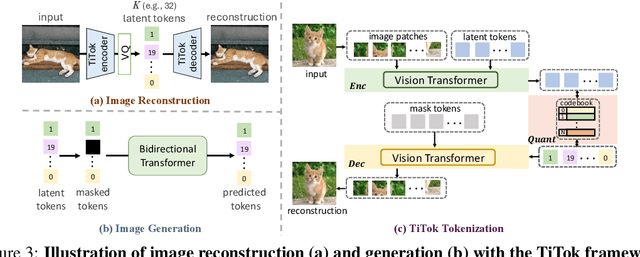
Recent advancements in generative models have highlighted the crucial role of image tokenization in the efficient synthesis of high-resolution images. Tokenization, which transforms images into latent representations, reduces computational demands compared to directly processing pixels and enhances the effectiveness and efficiency of the generation process. Prior methods, such as VQGAN, typically utilize 2D latent grids with fixed downsampling factors. However, these 2D tokenizations face challenges in managing the inherent redundancies present in images, where adjacent regions frequently display similarities. To overcome this issue, we introduce Transformer-based 1-Dimensional Tokenizer (TiTok), an innovative approach that tokenizes images into 1D latent sequences. TiTok provides a more compact latent representation, yielding substantially more efficient and effective representations than conventional techniques. For example, a 256 x 256 x 3 image can be reduced to just 32 discrete tokens, a significant reduction from the 256 or 1024 tokens obtained by prior methods. Despite its compact nature, TiTok achieves competitive performance to state-of-the-art approaches. Specifically, using the same generator framework, TiTok attains 1.97 gFID, outperforming MaskGIT baseline significantly by 4.21 at ImageNet 256 x 256 benchmark. The advantages of TiTok become even more significant when it comes to higher resolution. At ImageNet 512 x 512 benchmark, TiTok not only outperforms state-of-the-art diffusion model DiT-XL/2 (gFID 2.74 vs. 3.04), but also reduces the image tokens by 64x, leading to 410x faster generation process. Our best-performing variant can significantly surpasses DiT-XL/2 (gFID 2.13 vs. 3.04) while still generating high-quality samples 74x faster.
Enhancing Temporal Consistency in Video Editing by Reconstructing Videos with 3D Gaussian Splatting
Jun 04, 2024


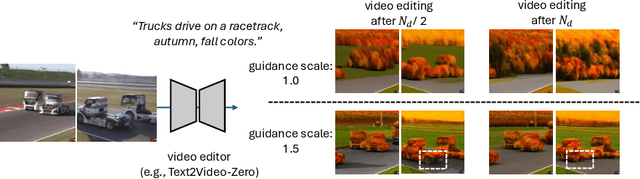
Recent advancements in zero-shot video diffusion models have shown promise for text-driven video editing, but challenges remain in achieving high temporal consistency. To address this, we introduce Video-3DGS, a 3D Gaussian Splatting (3DGS)-based video refiner designed to enhance temporal consistency in zero-shot video editors. Our approach utilizes a two-stage 3D Gaussian optimizing process tailored for editing dynamic monocular videos. In the first stage, Video-3DGS employs an improved version of COLMAP, referred to as MC-COLMAP, which processes original videos using a Masked and Clipped approach. For each video clip, MC-COLMAP generates the point clouds for dynamic foreground objects and complex backgrounds. These point clouds are utilized to initialize two sets of 3D Gaussians (Frg-3DGS and Bkg-3DGS) aiming to represent foreground and background views. Both foreground and background views are then merged with a 2D learnable parameter map to reconstruct full views. In the second stage, we leverage the reconstruction ability developed in the first stage to impose the temporal constraints on the video diffusion model. To demonstrate the efficacy of Video-3DGS on both stages, we conduct extensive experiments across two related tasks: Video Reconstruction and Video Editing. Video-3DGS trained with 3k iterations significantly improves video reconstruction quality (+3 PSNR, +7 PSNR increase) and training efficiency (x1.9, x4.5 times faster) over NeRF-based and 3DGS-based state-of-art methods on DAVIS dataset, respectively. Moreover, it enhances video editing by ensuring temporal consistency across 58 dynamic monocular videos.
COCONut: Modernizing COCO Segmentation
Apr 12, 2024
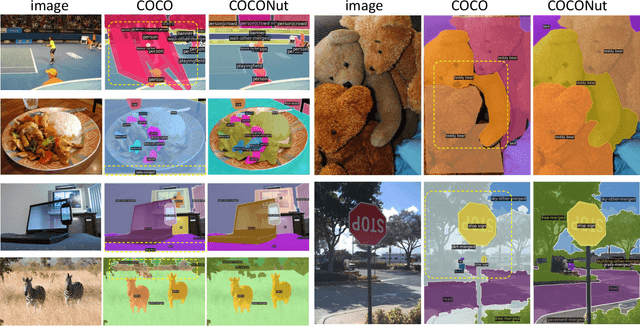
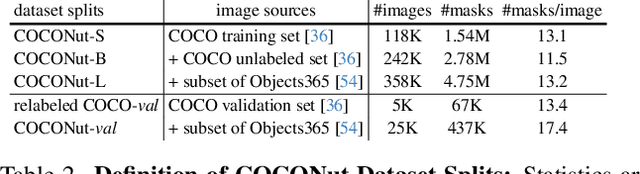
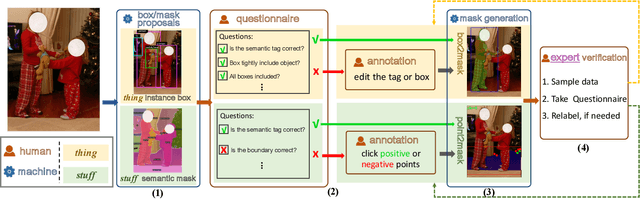
In recent decades, the vision community has witnessed remarkable progress in visual recognition, partially owing to advancements in dataset benchmarks. Notably, the established COCO benchmark has propelled the development of modern detection and segmentation systems. However, the COCO segmentation benchmark has seen comparatively slow improvement over the last decade. Originally equipped with coarse polygon annotations for thing instances, it gradually incorporated coarse superpixel annotations for stuff regions, which were subsequently heuristically amalgamated to yield panoptic segmentation annotations. These annotations, executed by different groups of raters, have resulted not only in coarse segmentation masks but also in inconsistencies between segmentation types. In this study, we undertake a comprehensive reevaluation of the COCO segmentation annotations. By enhancing the annotation quality and expanding the dataset to encompass 383K images with more than 5.18M panoptic masks, we introduce COCONut, the COCO Next Universal segmenTation dataset. COCONut harmonizes segmentation annotations across semantic, instance, and panoptic segmentation with meticulously crafted high-quality masks, and establishes a robust benchmark for all segmentation tasks. To our knowledge, COCONut stands as the inaugural large-scale universal segmentation dataset, verified by human raters. We anticipate that the release of COCONut will significantly contribute to the community's ability to assess the progress of novel neural networks.
ViTamin: Designing Scalable Vision Models in the Vision-Language Era
Apr 03, 2024


Recent breakthroughs in vision-language models (VLMs) start a new page in the vision community. The VLMs provide stronger and more generalizable feature embeddings compared to those from ImageNet-pretrained models, thanks to the training on the large-scale Internet image-text pairs. However, despite the amazing achievement from the VLMs, vanilla Vision Transformers (ViTs) remain the default choice for the image encoder. Although pure transformer proves its effectiveness in the text encoding area, it remains questionable whether it is also the case for image encoding, especially considering that various types of networks are proposed on the ImageNet benchmark, which, unfortunately, are rarely studied in VLMs. Due to small data/model scale, the original conclusions of model design on ImageNet can be limited and biased. In this paper, we aim at building an evaluation protocol of vision models in the vision-language era under the contrastive language-image pretraining (CLIP) framework. We provide a comprehensive way to benchmark different vision models, covering their zero-shot performance and scalability in both model and training data sizes. To this end, we introduce ViTamin, a new vision models tailored for VLMs. ViTamin-L significantly outperforms ViT-L by 2.0% ImageNet zero-shot accuracy, when using the same publicly available DataComp-1B dataset and the same OpenCLIP training scheme. ViTamin-L presents promising results on 60 diverse benchmarks, including classification, retrieval, open-vocabulary detection and segmentation, and large multi-modal models. When further scaling up the model size, our ViTamin-XL with only 436M parameters attains 82.9% ImageNet zero-shot accuracy, surpassing 82.0% achieved by EVA-E that has ten times more parameters (4.4B).
MaXTron: Mask Transformer with Trajectory Attention for Video Panoptic Segmentation
Nov 30, 2023Video panoptic segmentation requires consistently segmenting (for both `thing' and `stuff' classes) and tracking objects in a video over time. In this work, we present MaXTron, a general framework that exploits Mask XFormer with Trajectory Attention to tackle the task. MaXTron enriches an off-the-shelf mask transformer by leveraging trajectory attention. The deployed mask transformer takes as input a short clip consisting of only a few frames and predicts the clip-level segmentation. To enhance the temporal consistency, MaXTron employs within-clip and cross-clip tracking modules, efficiently utilizing trajectory attention. Originally designed for video classification, trajectory attention learns to model the temporal correspondences between neighboring frames and aggregates information along the estimated motion paths. However, it is nontrivial to directly extend trajectory attention to the per-pixel dense prediction tasks due to its quadratic dependency on input size. To alleviate the issue, we propose to adapt the trajectory attention for both the dense pixel features and object queries, aiming to improve the short-term and long-term tracking results, respectively. Particularly, in our within-clip tracking module, we propose axial-trajectory attention that effectively computes the trajectory attention for tracking dense pixels sequentially along the height- and width-axes. The axial decomposition significantly reduces the computational complexity for dense pixel features. In our cross-clip tracking module, since the object queries in mask transformer are learned to encode the object information, we are able to capture the long-term temporal connections by applying trajectory attention to object queries, which learns to track each object across different clips. Without bells and whistles, MaXTron demonstrates state-of-the-art performances on video segmentation benchmarks.
Towards Open-Ended Visual Recognition with Large Language Model
Nov 14, 2023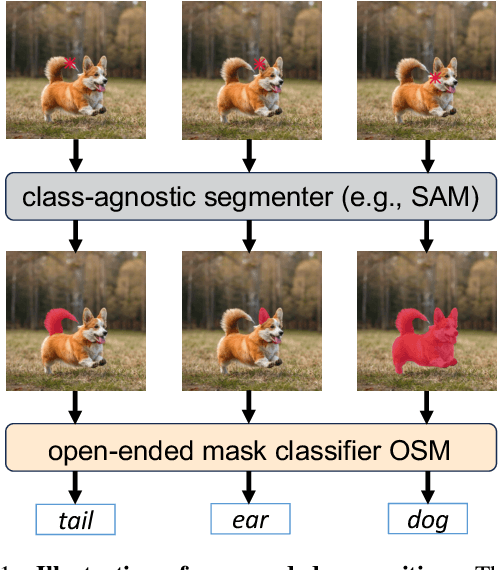
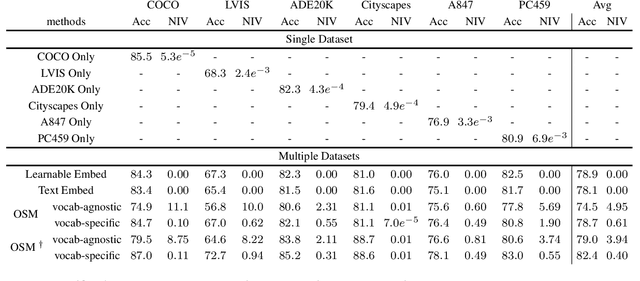
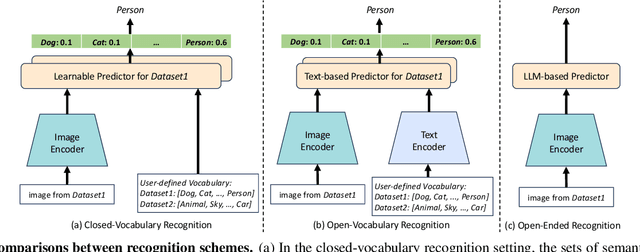

Localizing and recognizing objects in the open-ended physical world poses a long-standing challenge within the domain of machine perception. Recent methods have endeavored to address the issue by employing a class-agnostic mask (or box) proposal model, complemented by an open-vocabulary classifier (e.g., CLIP) using pre-extracted text embeddings. However, it is worth noting that these open-vocabulary recognition models still exhibit limitations in practical applications. On one hand, they rely on the provision of class names during testing, where the recognition performance heavily depends on this predefined set of semantic classes by users. On the other hand, when training with multiple datasets, human intervention is required to alleviate the label definition conflict between them. In this paper, we introduce the OmniScient Model (OSM), a novel Large Language Model (LLM) based mask classifier, as a straightforward and effective solution to the aforementioned challenges. Specifically, OSM predicts class labels in a generative manner, thus removing the supply of class names during both training and testing. It also enables cross-dataset training without any human interference, exhibiting robust generalization capabilities due to the world knowledge acquired from the LLM. By combining OSM with an off-the-shelf mask proposal model, we present promising results on various benchmarks, and demonstrate its effectiveness in handling novel concepts. Code/model are available at https://github.com/bytedance/OmniScient-Model.
Convolutions Die Hard: Open-Vocabulary Segmentation with Single Frozen Convolutional CLIP
Aug 04, 2023Open-vocabulary segmentation is a challenging task requiring segmenting and recognizing objects from an open set of categories. One way to address this challenge is to leverage multi-modal models, such as CLIP, to provide image and text features in a shared embedding space, which bridges the gap between closed-vocabulary and open-vocabulary recognition. Hence, existing methods often adopt a two-stage framework to tackle the problem, where the inputs first go through a mask generator and then through the CLIP model along with the predicted masks. This process involves extracting features from images multiple times, which can be ineffective and inefficient. By contrast, we propose to build everything into a single-stage framework using a shared Frozen Convolutional CLIP backbone, which not only significantly simplifies the current two-stage pipeline, but also remarkably yields a better accuracy-cost trade-off. The proposed FC-CLIP, benefits from the following observations: the frozen CLIP backbone maintains the ability of open-vocabulary classification and can also serve as a strong mask generator, and the convolutional CLIP generalizes well to a larger input resolution than the one used during contrastive image-text pretraining. When training on COCO panoptic data only and testing in a zero-shot manner, FC-CLIP achieve 26.8 PQ, 16.8 AP, and 34.1 mIoU on ADE20K, 18.2 PQ, 27.9 mIoU on Mapillary Vistas, 44.0 PQ, 26.8 AP, 56.2 mIoU on Cityscapes, outperforming the prior art by +4.2 PQ, +2.4 AP, +4.2 mIoU on ADE20K, +4.0 PQ on Mapillary Vistas and +20.1 PQ on Cityscapes, respectively. Additionally, the training and testing time of FC-CLIP is 7.5x and 6.6x significantly faster than the same prior art, while using 5.9x fewer parameters. FC-CLIP also sets a new state-of-the-art performance across various open-vocabulary semantic segmentation datasets. Code at https://github.com/bytedance/fc-clip
$R^{2}$Former: Unified $R$etrieval and $R$eranking Transformer for Place Recognition
Apr 06, 2023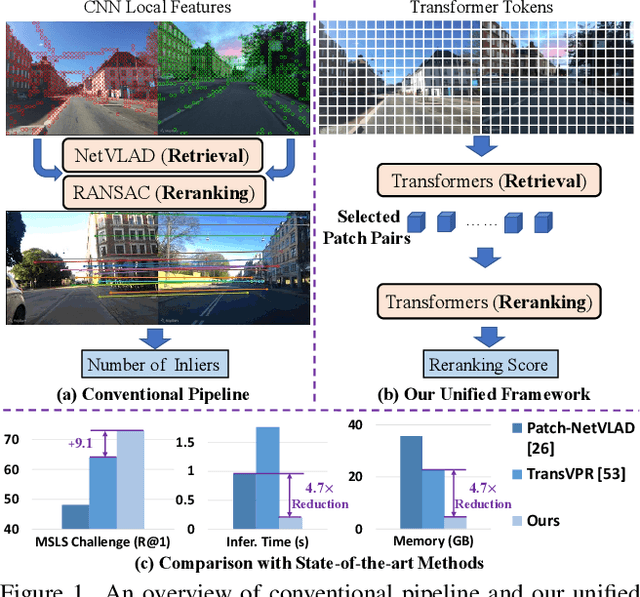
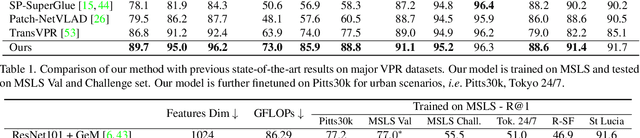
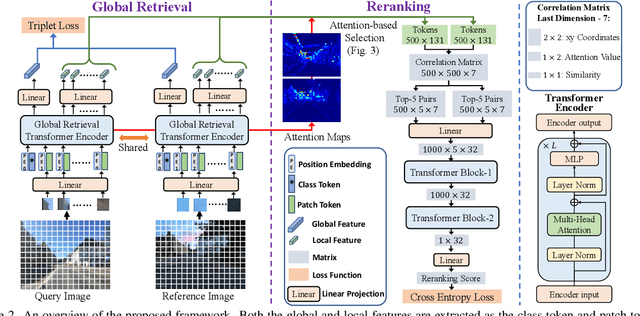

Visual Place Recognition (VPR) estimates the location of query images by matching them with images in a reference database. Conventional methods generally adopt aggregated CNN features for global retrieval and RANSAC-based geometric verification for reranking. However, RANSAC only employs geometric information but ignores other possible information that could be useful for reranking, e.g. local feature correlations, and attention values. In this paper, we propose a unified place recognition framework that handles both retrieval and reranking with a novel transformer model, named $R^{2}$Former. The proposed reranking module takes feature correlation, attention value, and xy coordinates into account, and learns to determine whether the image pair is from the same location. The whole pipeline is end-to-end trainable and the reranking module alone can also be adopted on other CNN or transformer backbones as a generic component. Remarkably, $R^{2}$Former significantly outperforms state-of-the-art methods on major VPR datasets with much less inference time and memory consumption. It also achieves the state-of-the-art on the hold-out MSLS challenge set and could serve as a simple yet strong solution for real-world large-scale applications. Experiments also show vision transformer tokens are comparable and sometimes better than CNN local features on local matching. The code is released at https://github.com/Jeff-Zilence/R2Former.
Multimodal Video Adapter for Parameter Efficient Video Text Retrieval
Jan 19, 2023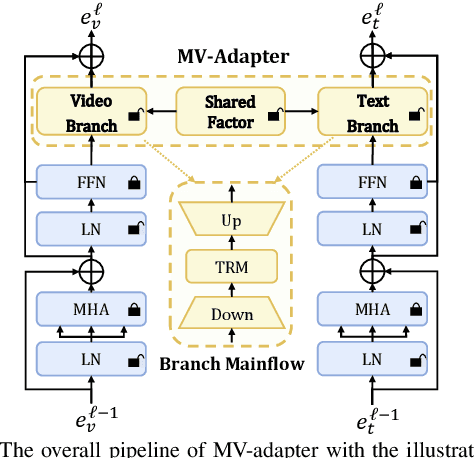

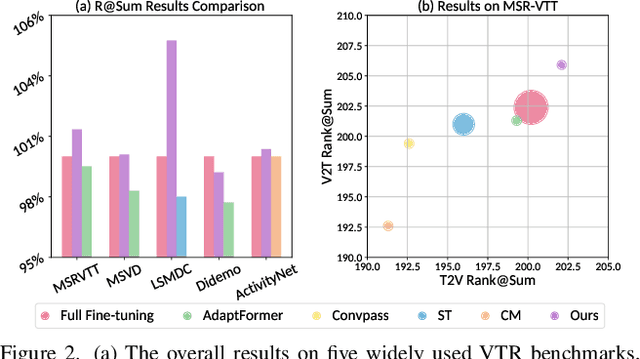
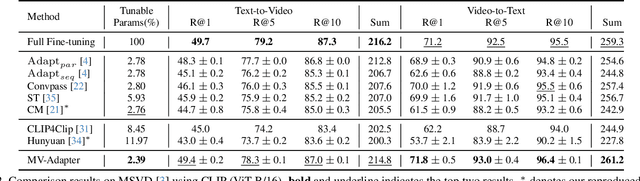
State-of-the-art video-text retrieval (VTR) methods usually fully fine-tune the pre-trained model (e.g. CLIP) on specific datasets, which may suffer from substantial storage costs in practical applications since a separate model per task needs to be stored. To overcome this issue, we present the premier work on performing parameter-efficient VTR from the pre-trained model, i.e., only a small number of parameters are tunable while freezing the backbone. Towards this goal, we propose a new method dubbed Multimodal Video Adapter (MV-Adapter) for efficiently transferring the knowledge in the pre-trained CLIP from image-text to video-text. Specifically, MV-Adapter adopts bottleneck structures in both video and text branches and introduces two novel components. The first is a Temporal Adaptation Module employed in the video branch to inject global and local temporal contexts. We also learn weights calibrations to adapt to the dynamic variations across frames. The second is a Cross-Modal Interaction Module that generates weights for video/text branches through a shared parameter space, for better aligning between modalities. Thanks to above innovations, MV-Adapter can achieve on-par or better performance than standard fine-tuning with negligible parameters overhead. Notably, on five widely used VTR benchmarks (MSR-VTT, MSVD, LSMDC, DiDemo, and ActivityNet), MV-Adapter consistently outperforms various competing methods in V2T/T2V tasks with large margins. Codes will be released.