 Add to Chrome
 Add to Firefox
 Add to Edge
UniVR: Thinking in Visual Space for Unified Visual Reasoning
Jul 14, 2026
Learning broad world knowledge directly from raw visual data is a fundamental capability of intelligence. We introduce UniVR, the first investigation into simultaneously learning complex reasoning, fine-grained physical dynamics, and long-term planning from pure visual demonstrations. At its core, UniVR features VR-GRPO, a reinforcement learning paradigm with complementary global and step-level rewards. This approach enforces logical coherence and physical consistency throughout the reasoning process without requiring task-specific heuristics or image-text pairs. To train and evaluate UniVR, we construct VR-X, a large-scale benchmark curated from 16 diverse sources spanning long-horizon manipulation, spatial puzzles, and physical reasoning. It is the first comprehensive suite to assess these heterogeneous capabilities under a purely visual protocol. Remarkably, UniVR achieves up to a 25% improvement on VR-X, and its superior visual reasoning also boosts performance on various multimodal understanding benchmarks. These findings underscore the vast potential of reasoning within visual spaces, with all code, data, and models are open-sourced for further research.

From Materials Database to Materials Bank: Assetizing Data for AI Driven Materials Innovation
Jun 30, 2026Driven by high-throughput experimentation, computational modeling, and artificial intelligence (AI), materials data has expanded at an unprecedented rate. Conventional materials databases function only as passive repositories, archiving raw experimental records indiscriminately including both successful and failed data, without systematic value filtering or asset management. This creates a critical gap between massive data accumulation and actionable innovation, hindering the identification of high-potential materials and industrial translation. To address this bottleneck, we propose an industrialization-oriented Materials Bank, a dedicated valuefiltering and assetization layer that operates beyond traditional databases. It does not merely curate high-quality data but systematically elevates qualified candidates into standardized, upgradable materials assets via a multi-dimensional BankCard framework covering scientific validity, synthesis feasibility, application readiness, and industrial value. By unifying databases, AI models, automated experimentation, and multi-criteria assessment into a cohesive closed-loop ecosystem, the Materials Bank establishes a clear trajectory from data to knowledge, candidate, asset, and product. It serves not as an enhanced database or screening tool, but as a decision infrastructure bridging academic discovery and industrial demand, offering a scalable paradigm to accelerate AI-driven materials innovation and deliver tangible real-world impact.
Empowering Polymeric Materials Discovery by Artificial Intelligence
Jun 18, 2026Polymeric materials underpin modern technologies spanning energy storage, microelectronics, healthcare and sustainable manufacturing. Yet their rational design remains exceptionally challenging because material performance emerges from complex interactions among molecular composition, chain architecture, processing history and hierarchical structural evolution across multiple length and time scales. Consequently, polymer research has long relied on labor-intensive experimentation and fragmented modeling approaches, limiting both mechanistic understanding and innovation efficiency. Recent advances in data infrastructure, machine learning, large artificial intelligence (AI) models and laboratory automation are beginning to reshape this landscape. Rather than functioning as isolated tools, polymer databases, predictive models, AI agents and automated laboratories are increasingly converging into interconnected discovery ecosystems. As a result, the central challenge is shifting from improving predictive accuracy alone to enabling reliable decision-making, adaptive learning and seamless integration across computation, experimentation and scientific reasoning. We argue that polymer science is entering an era of autonomous discovery, in which data, simulation, reasoning and experimentation operate within self-improving feedback loops that continuously generate hypotheses, design materials, execute experiments and refine predictive models. By unifying molecular design, process optimization, experimental validation and industrial translation, such autonomous ecosystems establish a more predictive, reproducible and scalable paradigm for polymer innovation, fundamentally transforming how polymer research is conducted.
VCoME: Verbal Video Composition with Multimodal Editing Effects
Jul 05, 2024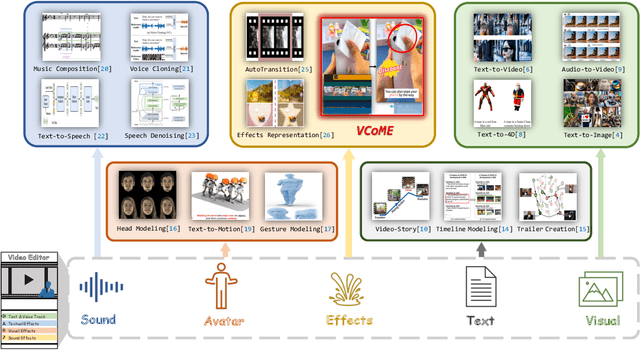
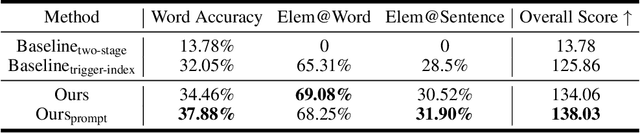
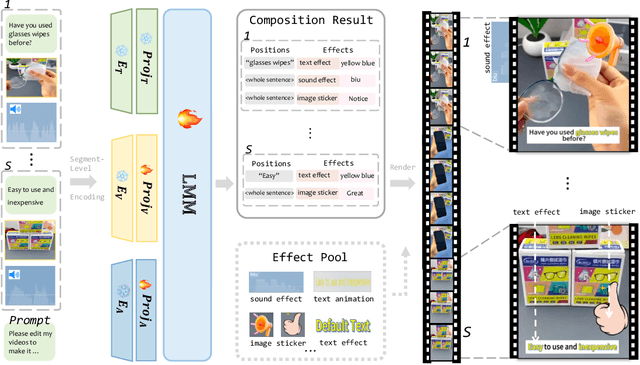
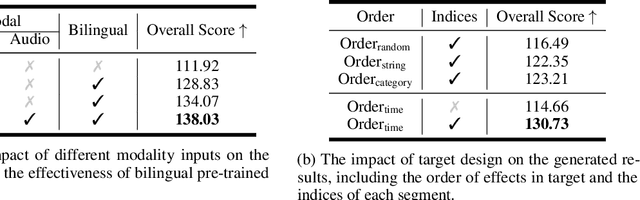
Verbal videos, featuring voice-overs or text overlays, provide valuable content but present significant challenges in composition, especially when incorporating editing effects to enhance clarity and visual appeal. In this paper, we introduce the novel task of verbal video composition with editing effects. This task aims to generate coherent and visually appealing verbal videos by integrating multimodal editing effects across textual, visual, and audio categories. To achieve this, we curate a large-scale dataset of video effects compositions from publicly available sources. We then formulate this task as a generative problem, involving the identification of appropriate positions in the verbal content and the recommendation of editing effects for these positions. To address this task, we propose VCoME, a general framework that employs a large multimodal model to generate editing effects for video composition. Specifically, VCoME takes in the multimodal video context and autoregressively outputs where to apply effects within the verbal content and which effects are most appropriate for each position. VCoME also supports prompt-based control of composition density and style, providing substantial flexibility for diverse applications. Through extensive quantitative and qualitative evaluations, we clearly demonstrate the effectiveness of VCoME. A comprehensive user study shows that our method produces videos of professional quality while being 85$\times$ more efficient than professional editors.
Relative coordinates are crucial for Ulam's "trick to the train of thought"
Mar 15, 2023Spatial signal processing algorithms often use pre-given coordinate systems to label pixel positions. These processing algorithms are thus burdened by an external reference grid, making the acquisition of relative, intrinsic features difficult. This is in contrast to animal vision and cognition: animals recognize features without an external coordinate system. We show that a coordinate system-independent algorithm for visual signal processing is not only important for animal vision, but also fundamental for concept formation. In this paper we start with a visual object deformation transfer experiment. We then formulate an algorithm that achieves deformation-invariance with relative coordinates. The paper concludes with implications for general concept formation.
Multimodal Video Adapter for Parameter Efficient Video Text Retrieval
Jan 19, 2023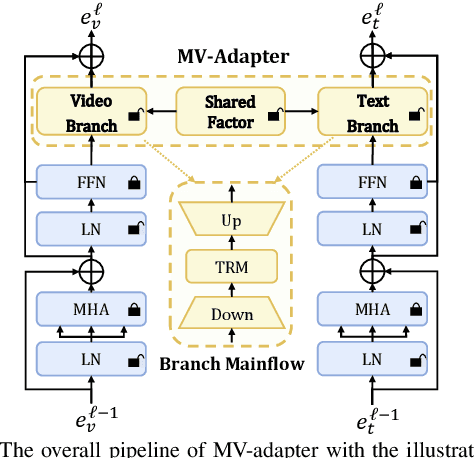

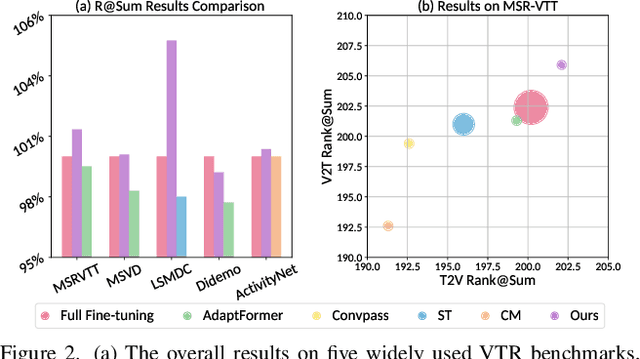
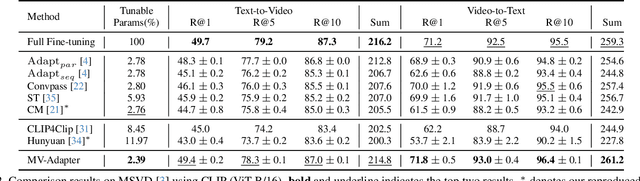
State-of-the-art video-text retrieval (VTR) methods usually fully fine-tune the pre-trained model (e.g. CLIP) on specific datasets, which may suffer from substantial storage costs in practical applications since a separate model per task needs to be stored. To overcome this issue, we present the premier work on performing parameter-efficient VTR from the pre-trained model, i.e., only a small number of parameters are tunable while freezing the backbone. Towards this goal, we propose a new method dubbed Multimodal Video Adapter (MV-Adapter) for efficiently transferring the knowledge in the pre-trained CLIP from image-text to video-text. Specifically, MV-Adapter adopts bottleneck structures in both video and text branches and introduces two novel components. The first is a Temporal Adaptation Module employed in the video branch to inject global and local temporal contexts. We also learn weights calibrations to adapt to the dynamic variations across frames. The second is a Cross-Modal Interaction Module that generates weights for video/text branches through a shared parameter space, for better aligning between modalities. Thanks to above innovations, MV-Adapter can achieve on-par or better performance than standard fine-tuning with negligible parameters overhead. Notably, on five widely used VTR benchmarks (MSR-VTT, MSVD, LSMDC, DiDemo, and ActivityNet), MV-Adapter consistently outperforms various competing methods in V2T/T2V tasks with large margins. Codes will be released.