 Add to Chrome
 Add to Firefox
 Add to Edge
Beyond Teacher Likelihood: Group-Calibrated On-Policy Distillation for Long-Context Reasoning
Aug 19, 2026
On-policy distillation (OPD) trains a student on its own responses using dense token-level guidance from a stronger teacher. In long-context tasks, however, token-level teacher support can favor locally plausible responses that omit evidence distributed across the input or violate global task constraints. Task-specific verifiers, in contrast, evaluate task completion at the response level and may return graded rewards that reflect partial success. We diagnose this mismatch on fixed responses from two representative long-context evidence-aggregation tasks. Across longer input ranges, trajectory-level OPD scores become progressively less aligned with verifier rewards, indicating teacher-verifier disagreement. Motivated by this observation, we introduce Group-Calibrated On-Policy Distillation (GC-OPD). GC-OPD separately normalizes verifier rewards and trajectory-level OPD scores within each rollout group and uses their difference as a signed teacher-verifier disagreement residual. Relative-advantage-based credit assignment (RACA) distributes this trajectory-level residual across tokens according to their relative OPD advantages while preserving the original OPD signal. Across five long-context benchmarks, post-training with GC-OPD raises the five-benchmark averages of the official Qwen3-4B and Qwen3-8B checkpoints from 29.08 to 40.47 and from 35.12 to 44.65, respectively. Vanilla OPD reaches 39.31 and 43.56 under the same setup. Controlled ablations show that the signed residual is more effective than either an additional OPD-derived term or direct group-normalized verifier reward addition, while RACA further improves over uniform token allocation. Together, these results demonstrate that group-relative residual calibration can incorporate verifier outcomes without discarding dense token-level guidance. Code is available at https://github.com/SolereZhang/GC-OPD.

The changing rule of human bone density with aging based on a novel definition and mensuration of bone density with computed tomography
Aug 05, 2023
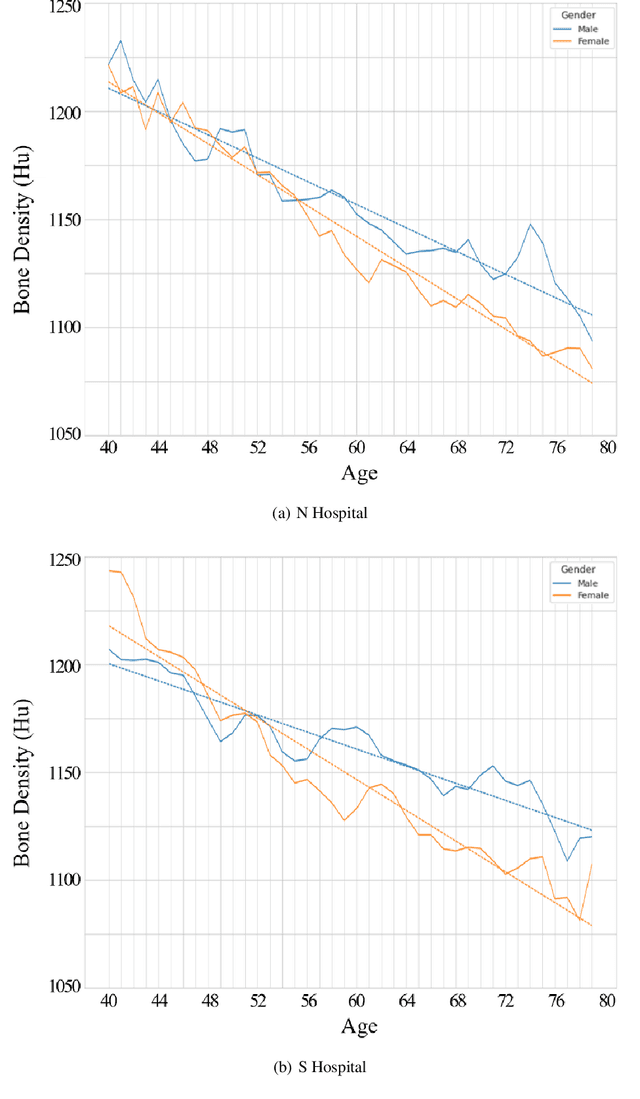

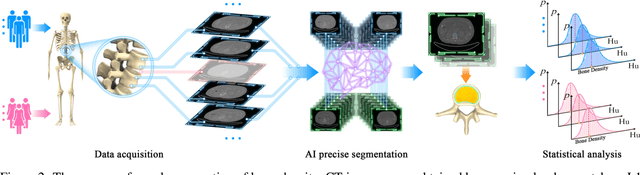
Osteoporosis and fragility fractures have emerged as major public health concerns in an aging population. However, measuring age-related changes in bone density using dual-energy X-ray absorptiometry has limited personalized risk assessment due to susceptibility to interference from various factors. In this study, we propose an innovative statistical model of bone pixel distribution in fine-segmented computed tomography (CT) images, along with a novel approach to measuring bone density based on CT values of bone pixels. Our findings indicate that bone density exhibits a linear decline with age during adulthood between the ages of 39 and 80, with the rate of decline being approximately 1.6 times faster in women than in men. This contradicts the widely accepted notion that bone density starts declining in women at menopause and in men at around 50 years of age. The linearity of age-related changes provides further insights into the dynamics of the aging human body. Consequently, our findings suggest that the definition of osteoporosis by the World Health Organization should be revised to the standard deviation of age-based bone density. Furthermore, these results open up new avenues for research in bone health care and clinical investigation of osteoporosis.