 Add to Chrome
 Add to Firefox
 Add to Edge
Route Sparse Autoencoder to Interpret Large Language Models
Mar 11, 2025
Mechanistic interpretability of large language models (LLMs) aims to uncover the internal processes of information propagation and reasoning. Sparse autoencoders (SAEs) have demonstrated promise in this domain by extracting interpretable and monosemantic features. However, prior works primarily focus on feature extraction from a single layer, failing to effectively capture activations that span multiple layers. In this paper, we introduce Route Sparse Autoencoder (RouteSAE), a new framework that integrates a routing mechanism with a shared SAE to efficiently extract features from multiple layers. It dynamically assigns weights to activations from different layers, incurring minimal parameter overhead while achieving high interpretability and flexibility for targeted feature manipulation. We evaluate RouteSAE through extensive experiments on Llama-3.2-1B-Instruct. Specifically, under the same sparsity constraint of 64, RouteSAE extracts 22.5% more features than baseline SAEs while achieving a 22.3% higher interpretability score. These results underscore the potential of RouteSAE as a scalable and effective method for LLM interpretability, with applications in feature discovery and model intervention. Our codes are available at https://github.com/swei2001/RouteSAEs.

ACE: Concept Editing in Diffusion Models without Performance Degradation
Mar 11, 2025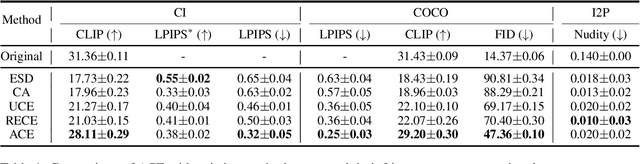
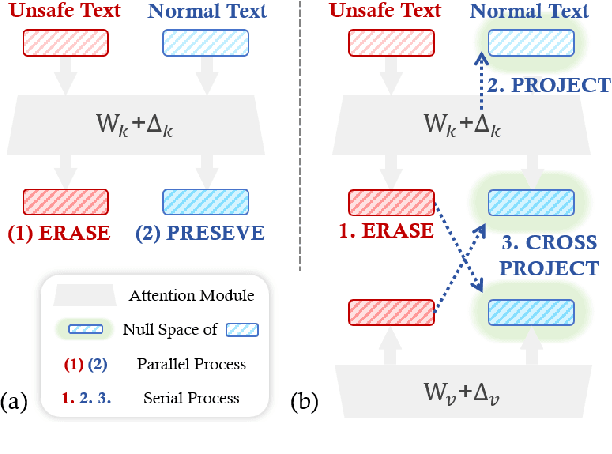
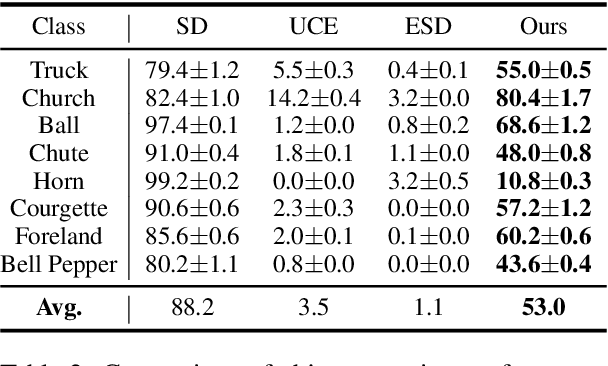
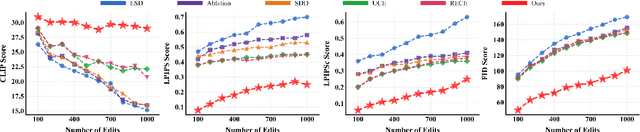
Diffusion-based text-to-image models have demonstrated remarkable capabilities in generating realistic images, but they raise societal and ethical concerns, such as the creation of unsafe content. While concept editing is proposed to address these issues, they often struggle to balance the removal of unsafe concept with maintaining the model's general genera-tive capabilities. In this work, we propose ACE, a new editing method that enhances concept editing in diffusion models. ACE introduces a novel cross null-space projection approach to precisely erase unsafe concept while maintaining the model's ability to generate high-quality, semantically consistent images. Extensive experiments demonstrate that ACE significantly outperforms the advancing baselines,improving semantic consistency by 24.56% and image generation quality by 34.82% on average with only 1% of the time cost. These results highlight the practical utility of concept editing by mitigating its potential risks, paving the way for broader applications in the field. Code is avaliable at https://github.com/littlelittlenine/ACE-zero.git
RePO: ReLU-based Preference Optimization
Mar 10, 2025Aligning large language models (LLMs) with human preferences is critical for real-world deployment, yet existing methods like RLHF face computational and stability challenges. While DPO establishes an offline paradigm with single hyperparameter $\beta$, subsequent methods like SimPO reintroduce complexity through dual parameters ($\beta$, $\gamma$). We propose {ReLU-based Preference Optimization (RePO)}, a streamlined algorithm that eliminates $\beta$ via two advances: (1) retaining SimPO's reference-free margins but removing $\beta$ through gradient analysis, and (2) adopting a ReLU-based max-margin loss that naturally filters trivial pairs. Theoretically, RePO is characterized as SimPO's limiting case ($\beta \to \infty$), where the logistic weighting collapses to binary thresholding, forming a convex envelope of the 0-1 loss. Empirical results on AlpacaEval 2 and Arena-Hard show that RePO outperforms DPO and SimPO across multiple base models, requiring only one hyperparameter to tune.
DreamRelation: Relation-Centric Video Customization
Mar 10, 2025Relational video customization refers to the creation of personalized videos that depict user-specified relations between two subjects, a crucial task for comprehending real-world visual content. While existing methods can personalize subject appearances and motions, they still struggle with complex relational video customization, where precise relational modeling and high generalization across subject categories are essential. The primary challenge arises from the intricate spatial arrangements, layout variations, and nuanced temporal dynamics inherent in relations; consequently, current models tend to overemphasize irrelevant visual details rather than capturing meaningful interactions. To address these challenges, we propose DreamRelation, a novel approach that personalizes relations through a small set of exemplar videos, leveraging two key components: Relational Decoupling Learning and Relational Dynamics Enhancement. First, in Relational Decoupling Learning, we disentangle relations from subject appearances using relation LoRA triplet and hybrid mask training strategy, ensuring better generalization across diverse relationships. Furthermore, we determine the optimal design of relation LoRA triplet by analyzing the distinct roles of the query, key, and value features within MM-DiT's attention mechanism, making DreamRelation the first relational video generation framework with explainable components. Second, in Relational Dynamics Enhancement, we introduce space-time relational contrastive loss, which prioritizes relational dynamics while minimizing the reliance on detailed subject appearances. Extensive experiments demonstrate that DreamRelation outperforms state-of-the-art methods in relational video customization. Code and models will be made publicly available.
START: Self-taught Reasoner with Tools
Mar 07, 2025Large reasoning models (LRMs) like OpenAI-o1 and DeepSeek-R1 have demonstrated remarkable capabilities in complex reasoning tasks through the utilization of long Chain-of-thought (CoT). However, these models often suffer from hallucinations and inefficiencies due to their reliance solely on internal reasoning processes. In this paper, we introduce START (Self-Taught Reasoner with Tools), a novel tool-integrated long CoT reasoning LLM that significantly enhances reasoning capabilities by leveraging external tools. Through code execution, START is capable of performing complex computations, self-checking, exploring diverse methods, and self-debugging, thereby addressing the limitations of LRMs. The core innovation of START lies in its self-learning framework, which comprises two key techniques: 1) Hint-infer: We demonstrate that inserting artificially designed hints (e.g., ``Wait, maybe using Python here is a good idea.'') during the inference process of a LRM effectively stimulates its ability to utilize external tools without the need for any demonstration data. Hint-infer can also serve as a simple and effective sequential test-time scaling method; 2) Hint Rejection Sampling Fine-Tuning (Hint-RFT): Hint-RFT combines Hint-infer and RFT by scoring, filtering, and modifying the reasoning trajectories with tool invocation generated by a LRM via Hint-infer, followed by fine-tuning the LRM. Through this framework, we have fine-tuned the QwQ-32B model to achieve START. On PhD-level science QA (GPQA), competition-level math benchmarks (AMC23, AIME24, AIME25), and the competition-level code benchmark (LiveCodeBench), START achieves accuracy rates of 63.6%, 95.0%, 66.7%, 47.1%, and 47.3%, respectively. It significantly outperforms the base QwQ-32B and achieves performance comparable to the state-of-the-art open-weight model R1-Distill-Qwen-32B and the proprietary model o1-Preview.
NExT-Mol: 3D Diffusion Meets 1D Language Modeling for 3D Molecule Generation
Feb 18, 20253D molecule generation is crucial for drug discovery and material design. While prior efforts focus on 3D diffusion models for their benefits in modeling continuous 3D conformers, they overlook the advantages of 1D SELFIES-based Language Models (LMs), which can generate 100% valid molecules and leverage the billion-scale 1D molecule datasets. To combine these advantages for 3D molecule generation, we propose a foundation model -- NExT-Mol: 3D Diffusion Meets 1D Language Modeling for 3D Molecule Generation. NExT-Mol uses an extensively pretrained molecule LM for 1D molecule generation, and subsequently predicts the generated molecule's 3D conformers with a 3D diffusion model. We enhance NExT-Mol's performance by scaling up the LM's model size, refining the diffusion neural architecture, and applying 1D to 3D transfer learning. Notably, our 1D molecule LM significantly outperforms baselines in distributional similarity while ensuring validity, and our 3D diffusion model achieves leading performances in conformer prediction. Given these improvements in 1D and 3D modeling, NExT-Mol achieves a 26% relative improvement in 3D FCD for de novo 3D generation on GEOM-DRUGS, and a 13% average relative gain for conditional 3D generation on QM9-2014. Our codes and pretrained checkpoints are available at https://github.com/acharkq/NExT-Mol.
Reinforced Lifelong Editing for Language Models
Feb 09, 2025Large language models (LLMs) acquire information from pre-training corpora, but their stored knowledge can become inaccurate or outdated over time. Model editing addresses this challenge by modifying model parameters without retraining, and prevalent approaches leverage hypernetworks to generate these parameter updates. However, they face significant challenges in lifelong editing due to their incompatibility with LLM parameters that dynamically change during the editing process. To address this, we observed that hypernetwork-based lifelong editing aligns with reinforcement learning modeling and proposed RLEdit, an RL-based editing method. By treating editing losses as rewards and optimizing hypernetwork parameters at the full knowledge sequence level, we enable it to precisely capture LLM changes and generate appropriate parameter updates. Our extensive empirical evaluation across several LLMs demonstrates that RLEdit outperforms existing methods in lifelong editing with superior effectiveness and efficiency, achieving a 59.24% improvement while requiring only 2.11% of the time compared to most approaches. Our code is available at: https://github.com/zhrli324/RLEdit.
AnyEdit: Edit Any Knowledge Encoded in Language Models
Feb 08, 2025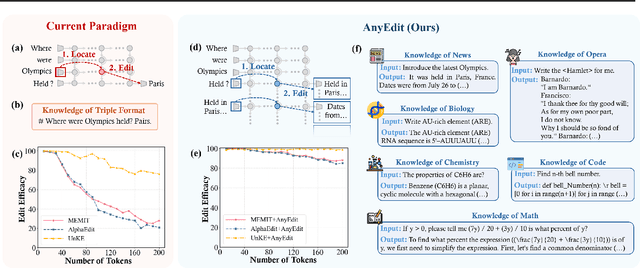

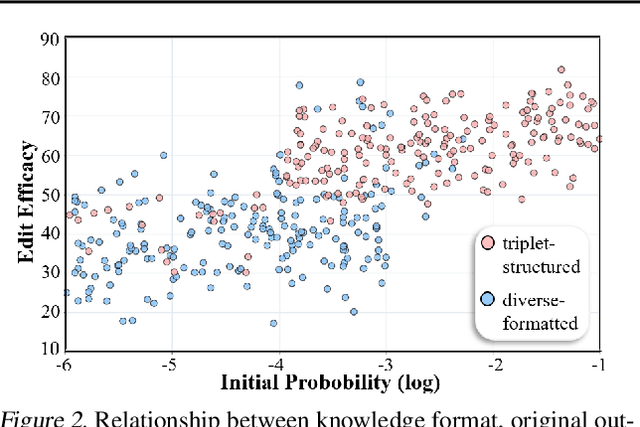

Large language models (LLMs) often produce incorrect or outdated information, necessitating efficient and precise knowledge updates. Current model editing methods, however, struggle with long-form knowledge in diverse formats, such as poetry, code snippets, and mathematical derivations. These limitations arise from their reliance on editing a single token's hidden state, a limitation we term "efficacy barrier". To solve this, we propose AnyEdit, a new autoregressive editing paradigm. It decomposes long-form knowledge into sequential chunks and iteratively edits the key token in each chunk, ensuring consistent and accurate outputs. Theoretically, we ground AnyEdit in the Chain Rule of Mutual Information, showing its ability to update any knowledge within LLMs. Empirically, it outperforms strong baselines by 21.5% on benchmarks including UnKEBench, AKEW, and our new EditEverything dataset for long-form diverse-formatted knowledge. Additionally, AnyEdit serves as a plug-and-play framework, enabling current editing methods to update knowledge with arbitrary length and format, significantly advancing the scope and practicality of LLM knowledge editing.
Multi-agent Architecture Search via Agentic Supernet
Feb 06, 2025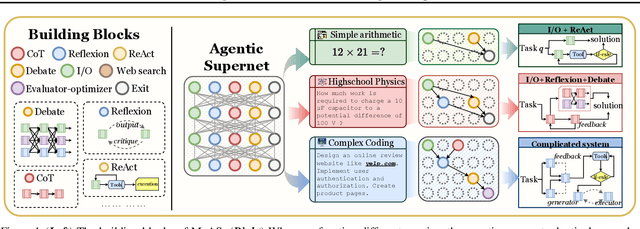
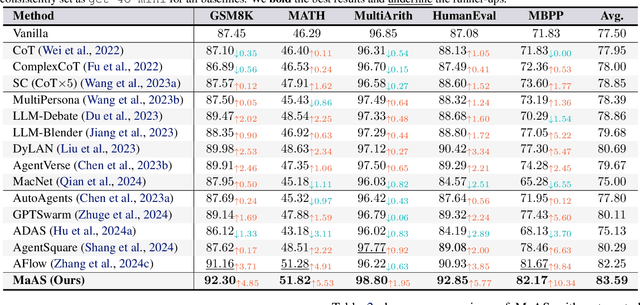
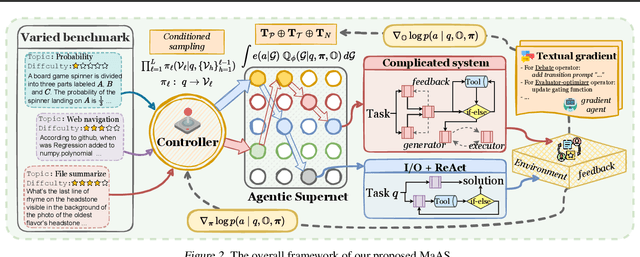
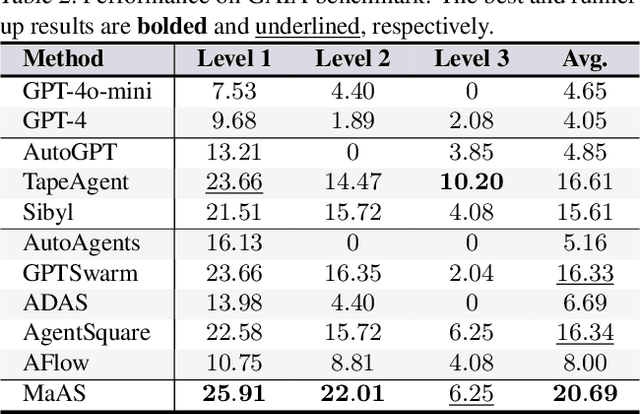
Large Language Model (LLM)-empowered multi-agent systems extend the cognitive boundaries of individual agents through disciplined collaboration and interaction, while constructing these systems often requires labor-intensive manual designs. Despite the availability of methods to automate the design of agentic workflows, they typically seek to identify a static, complex, one-size-fits-all system, which, however, fails to dynamically allocate inference resources based on the difficulty and domain of each query. To address this challenge, we shift away from the pursuit of a monolithic agentic system, instead optimizing the \textbf{agentic supernet}, a probabilistic and continuous distribution of agentic architectures. We introduce MaAS, an automated framework that samples query-dependent agentic systems from the supernet, delivering high-quality solutions and tailored resource allocation (\textit{e.g.}, LLM calls, tool calls, token cost). Comprehensive evaluation across six benchmarks demonstrates that MaAS \textbf{(I)} requires only $6\sim45\%$ of the inference costs of existing handcrafted or automated multi-agent systems, \textbf{(II)} surpasses them by $0.54\%\sim11.82\%$, and \textbf{(III)} enjoys superior cross-dataset and cross-LLM-backbone transferability.
DAMO: Data- and Model-aware Alignment of Multi-modal LLMs
Feb 04, 2025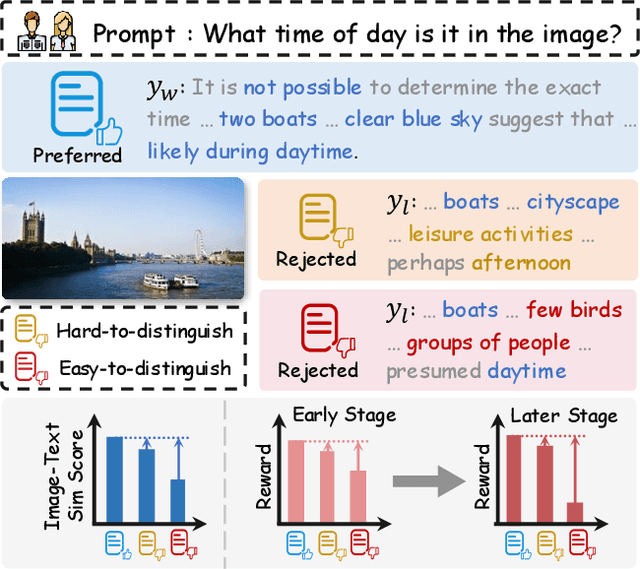
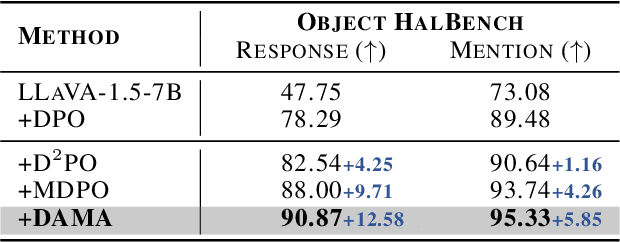

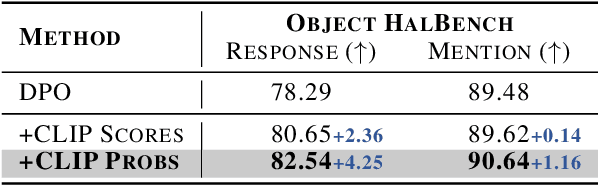
Direct Preference Optimization (DPO) has shown effectiveness in aligning multi-modal large language models (MLLM) with human preferences. However, existing methods exhibit an imbalanced responsiveness to the data of varying hardness, tending to overfit on the easy-to-distinguish data while underfitting on the hard-to-distinguish data. In this paper, we propose Data- and Model-aware DPO (DAMO) to dynamically adjust the optimization process from two key aspects: (1) a data-aware strategy that incorporates data hardness, and (2) a model-aware strategy that integrates real-time model responses. By combining the two strategies, DAMO enables the model to effectively adapt to data with varying levels of hardness. Extensive experiments on five benchmarks demonstrate that DAMO not only significantly enhances the trustworthiness, but also improves the effectiveness over general tasks. For instance, on the Object HalBench, our DAMO-7B reduces response-level and mentioned-level hallucination by 90.0% and 95.3%, respectively, surpassing the performance of GPT-4V.