 Add to Chrome
 Add to Firefox
 Add to Edge
Referring Expression Comprehension Using Language Adaptive Inference
Jun 06, 2023
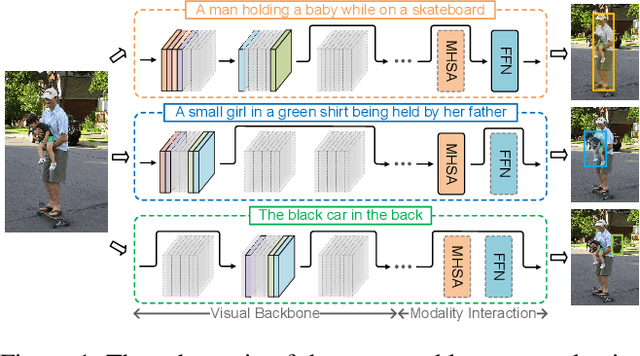
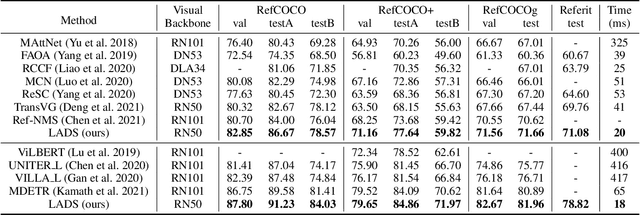
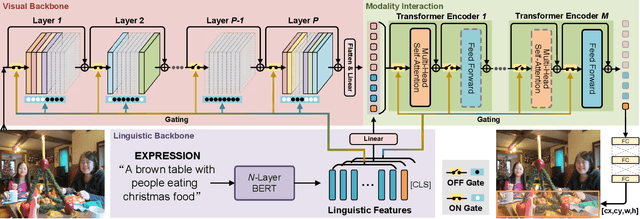
Different from universal object detection, referring expression comprehension (REC) aims to locate specific objects referred to by natural language expressions. The expression provides high-level concepts of relevant visual and contextual patterns, which vary significantly with different expressions and account for only a few of those encoded in the REC model. This leads us to a question: do we really need the entire network with a fixed structure for various referring expressions? Ideally, given an expression, only expression-relevant components of the REC model are required. These components should be small in number as each expression only contains very few visual and contextual clues. This paper explores the adaptation between expressions and REC models for dynamic inference. Concretely, we propose a neat yet efficient framework named Language Adaptive Dynamic Subnets (LADS), which can extract language-adaptive subnets from the REC model conditioned on the referring expressions. By using the compact subnet, the inference can be more economical and efficient. Extensive experiments on RefCOCO, RefCOCO+, RefCOCOg, and Referit show that the proposed method achieves faster inference speed and higher accuracy against state-of-the-art approaches.

Language Adaptive Weight Generation for Multi-task Visual Grounding
Jun 06, 2023


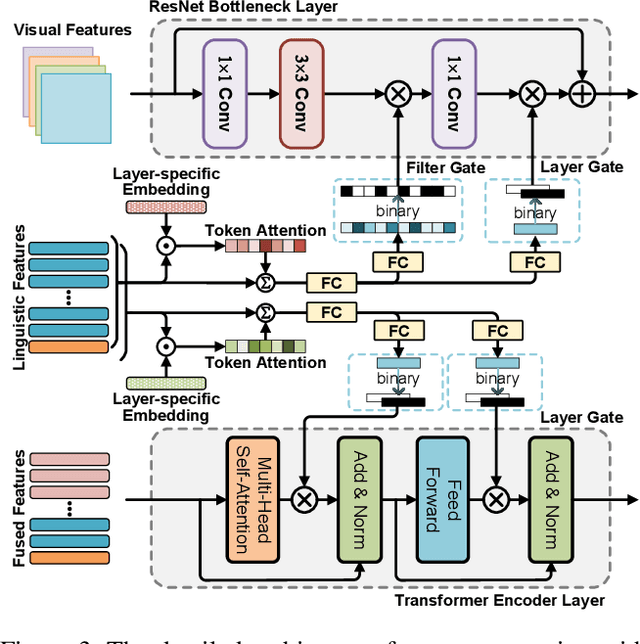
Although the impressive performance in visual grounding, the prevailing approaches usually exploit the visual backbone in a passive way, i.e., the visual backbone extracts features with fixed weights without expression-related hints. The passive perception may lead to mismatches (e.g., redundant and missing), limiting further performance improvement. Ideally, the visual backbone should actively extract visual features since the expressions already provide the blueprint of desired visual features. The active perception can take expressions as priors to extract relevant visual features, which can effectively alleviate the mismatches. Inspired by this, we propose an active perception Visual Grounding framework based on Language Adaptive Weights, called VG-LAW. The visual backbone serves as an expression-specific feature extractor through dynamic weights generated for various expressions. Benefiting from the specific and relevant visual features extracted from the language-aware visual backbone, VG-LAW does not require additional modules for cross-modal interaction. Along with a neat multi-task head, VG-LAW can be competent in referring expression comprehension and segmentation jointly. Extensive experiments on four representative datasets, i.e., RefCOCO, RefCOCO+, RefCOCOg, and ReferItGame, validate the effectiveness of the proposed framework and demonstrate state-of-the-art performance.
MetaGait: Learning to Learn an Omni Sample Adaptive Representation for Gait Recognition
Jun 06, 2023Gait recognition, which aims at identifying individuals by their walking patterns, has recently drawn increasing research attention. However, gait recognition still suffers from the conflicts between the limited binary visual clues of the silhouette and numerous covariates with diverse scales, which brings challenges to the model's adaptiveness. In this paper, we address this conflict by developing a novel MetaGait that learns to learn an omni sample adaptive representation. Towards this goal, MetaGait injects meta-knowledge, which could guide the model to perceive sample-specific properties, into the calibration network of the attention mechanism to improve the adaptiveness from the omni-scale, omni-dimension, and omni-process perspectives. Specifically, we leverage the meta-knowledge across the entire process, where Meta Triple Attention and Meta Temporal Pooling are presented respectively to adaptively capture omni-scale dependency from spatial/channel/temporal dimensions simultaneously and to adaptively aggregate temporal information through integrating the merits of three complementary temporal aggregation methods. Extensive experiments demonstrate the state-of-the-art performance of the proposed MetaGait. On CASIA-B, we achieve rank-1 accuracy of 98.7%, 96.0%, and 89.3% under three conditions, respectively. On OU-MVLP, we achieve rank-1 accuracy of 92.4%.
GaitGCI: Generative Counterfactual Intervention for Gait Recognition
Jun 06, 2023
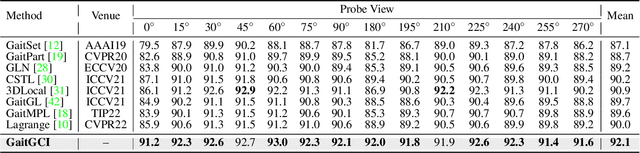


Gait is one of the most promising biometrics that aims to identify pedestrians from their walking patterns. However, prevailing methods are susceptible to confounders, resulting in the networks hardly focusing on the regions that reflect effective walking patterns. To address this fundamental problem in gait recognition, we propose a Generative Counterfactual Intervention framework, dubbed GaitGCI, consisting of Counterfactual Intervention Learning (CIL) and Diversity-Constrained Dynamic Convolution (DCDC). CIL eliminates the impacts of confounders by maximizing the likelihood difference between factual/counterfactual attention while DCDC adaptively generates sample-wise factual/counterfactual attention to efficiently perceive the sample-wise properties. With matrix decomposition and diversity constraint, DCDC guarantees the model to be efficient and effective. Extensive experiments indicate that proposed GaitGCI: 1) could effectively focus on the discriminative and interpretable regions that reflect gait pattern; 2) is model-agnostic and could be plugged into existing models to improve performance with nearly no extra cost; 3) efficiently achieves state-of-the-art performance on arbitrary scenarios (in-the-lab and in-the-wild).
DenseDINO: Boosting Dense Self-Supervised Learning with Token-Based Point-Level Consistency
Jun 06, 2023


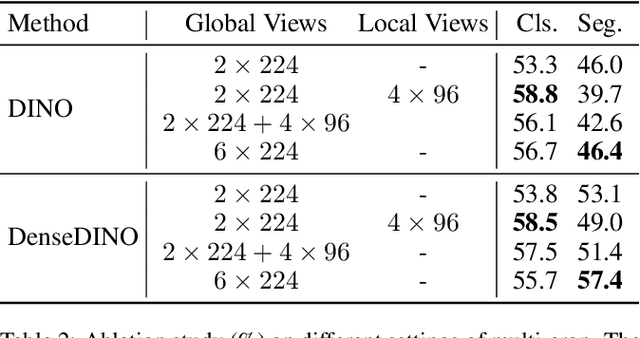
In this paper, we propose a simple yet effective transformer framework for self-supervised learning called DenseDINO to learn dense visual representations. To exploit the spatial information that the dense prediction tasks require but neglected by the existing self-supervised transformers, we introduce point-level supervision across views in a novel token-based way. Specifically, DenseDINO introduces some extra input tokens called reference tokens to match the point-level features with the position prior. With the reference token, the model could maintain spatial consistency and deal with multi-object complex scene images, thus generalizing better on dense prediction tasks. Compared with the vanilla DINO, our approach obtains competitive performance when evaluated on classification in ImageNet and achieves a large margin (+7.2% mIoU) improvement in semantic segmentation on PascalVOC under the linear probing protocol for segmentation.
SGAT4PASS: Spherical Geometry-Aware Transformer for PAnoramic Semantic Segmentation
Jun 06, 2023As an important and challenging problem in computer vision, PAnoramic Semantic Segmentation (PASS) gives complete scene perception based on an ultra-wide angle of view. Usually, prevalent PASS methods with 2D panoramic image input focus on solving image distortions but lack consideration of the 3D properties of original $360^{\circ}$ data. Therefore, their performance will drop a lot when inputting panoramic images with the 3D disturbance. To be more robust to 3D disturbance, we propose our Spherical Geometry-Aware Transformer for PAnoramic Semantic Segmentation (SGAT4PASS), considering 3D spherical geometry knowledge. Specifically, a spherical geometry-aware framework is proposed for PASS. It includes three modules, i.e., spherical geometry-aware image projection, spherical deformable patch embedding, and a panorama-aware loss, which takes input images with 3D disturbance into account, adds a spherical geometry-aware constraint on the existing deformable patch embedding, and indicates the pixel density of original $360^{\circ}$ data, respectively. Experimental results on Stanford2D3D Panoramic datasets show that SGAT4PASS significantly improves performance and robustness, with approximately a 2% increase in mIoU, and when small 3D disturbances occur in the data, the stability of our performance is improved by an order of magnitude. Our code and supplementary material are available at https://github.com/TencentARC/SGAT4PASS.
GaitMPL: Gait Recognition with Memory-Augmented Progressive Learning
Jun 06, 2023Gait recognition aims at identifying the pedestrians at a long distance by their biometric gait patterns. It is inherently challenging due to the various covariates and the properties of silhouettes (textureless and colorless), which result in two kinds of pair-wise hard samples: the same pedestrian could have distinct silhouettes (intra-class diversity) and different pedestrians could have similar silhouettes (inter-class similarity). In this work, we propose to solve the hard sample issue with a Memory-augmented Progressive Learning network (GaitMPL), including Dynamic Reweighting Progressive Learning module (DRPL) and Global Structure-Aligned Memory bank (GSAM). Specifically, DRPL reduces the learning difficulty of hard samples by easy-to-hard progressive learning. GSAM further augments DRPL with a structure-aligned memory mechanism, which maintains and models the feature distribution of each ID. Experiments on two commonly used datasets, CASIA-B and OU-MVLP, demonstrate the effectiveness of GaitMPL. On CASIA-B, we achieve the state-of-the-art performance, i.e., 88.0% on the most challenging condition (Clothing) and 93.3% on the average condition, which outperforms the other methods by at least 3.8% and 1.4%, respectively.
A Deep RL Approach on Task Placement and Scaling of Edge Resources for Cellular Vehicle-to-Network Service Provisioning
May 16, 2023Cellular-Vehicle-to-Everything (C-V2X) is currently at the forefront of the digital transformation of our society. By enabling vehicles to communicate with each other and with the traffic environment using cellular networks, we redefine transportation, improving road safety and transportation services, increasing efficiency of traffic flows, and reducing environmental impact. This paper proposes a decentralized approach for provisioning Cellular Vehicular-to-Network (C-V2N) services, addressing the coupled problems of service task placement and scaling of edge resources. We formalize the joint problem and prove its complexity. We propose an approach to tackle it, linking the two problems, employing decentralized decision-making using (i) a greedy approach for task placement and (ii) a Deep Deterministic Policy Gradient (DDPG) based approach for scaling. We benchmark the performance of our approach, focusing on the scaling agent, against several State-of-the-Art (SoA) scaling approaches via simulations using a real C-V2N traffic data set. The results show that DDPG-based solutions outperform SoA solutions, keeping the latency experienced by the C-V2N service below the target delay while optimizing the use of computing resources. By conducting a complexity analysis, we prove that DDPG-based solutions achieve runtimes in the range of sub-milliseconds, meeting the strict latency requirements of C-V2N services.
FusionBooster: A Unified Image Fusion Boosting Paradigm
May 10, 2023


Numerous ideas have emerged for designing fusion rules in the image fusion field. Essentially, all the existing formulations try to manage the diverse levels of information communicated by the source images to achieve the best fusion result. We argue that there is a scope for improving the performance of existing methods further with the help of FusionBooster, a fusion guidance method proposed in this paper. Our booster is based on the divide and conquer strategy controlled by an information probe. The booster is composed of three building blocks: the probe units, the booster layer, and the assembling module. Given the embedding produced by a backbone method, the probe units assess the source images and divide them according to their information content. This is instrumental in identifying missing information, as a step to its recovery. The recovery of the degraded components along with the fusion guidance are embedded in the booster layer. Lastly, the assembling module is responsible for piecing these advanced components together to deliver the output. We use concise reconstruction loss functions and lightweight models to formulate the network, with marginal computational increase. The experimental results obtained in various fusion tasks, as well as downstream detection tasks, consistently demonstrate that the proposed FusionBooster significantly improves the performance. Our codes will be publicly available on the project homepage.
LayoutDiffusion: Controllable Diffusion Model for Layout-to-image Generation
Mar 30, 2023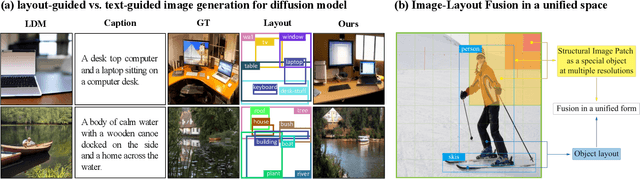
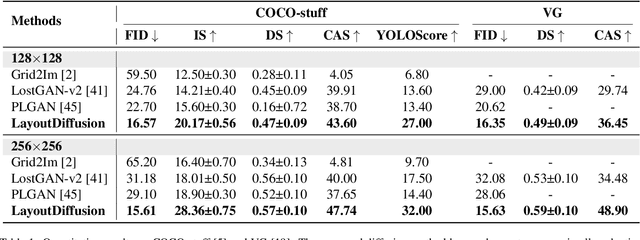
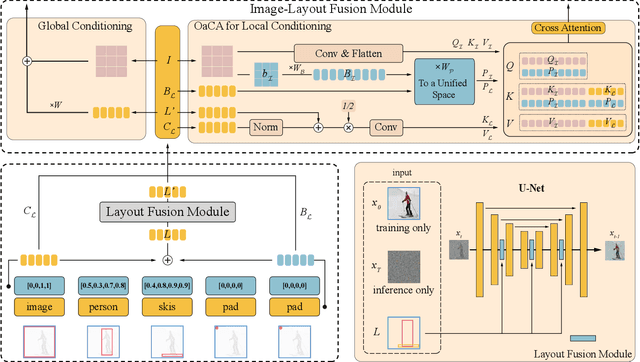

Recently, diffusion models have achieved great success in image synthesis. However, when it comes to the layout-to-image generation where an image often has a complex scene of multiple objects, how to make strong control over both the global layout map and each detailed object remains a challenging task. In this paper, we propose a diffusion model named LayoutDiffusion that can obtain higher generation quality and greater controllability than the previous works. To overcome the difficult multimodal fusion of image and layout, we propose to construct a structural image patch with region information and transform the patched image into a special layout to fuse with the normal layout in a unified form. Moreover, Layout Fusion Module (LFM) and Object-aware Cross Attention (OaCA) are proposed to model the relationship among multiple objects and designed to be object-aware and position-sensitive, allowing for precisely controlling the spatial related information. Extensive experiments show that our LayoutDiffusion outperforms the previous SOTA methods on FID, CAS by relatively 46.35%, 26.70% on COCO-stuff and 44.29%, 41.82% on VG. Code is available at https://github.com/ZGCTroy/LayoutDiffusion.