 Add to Chrome
 Add to Firefox
 Add to Edge
When Does Multi-Agent RL Improve LLM Workflows? Workflow, Scale, and Policy-Sharing Tradeoffs
May 22, 2026
Multi-agent LLM workflows route inference through specialized roles to lift end-task accuracy, but jointly training those roles with reinforcement learning is unstable in ways that are poorly understood. We study when end-to-end RL training of multi-agent LLM workflows improves over their base models, comparing Shared-Policy training, where all roles update one policy, with Isolated-Policy training, where each role has its own parameters. Our experimental matrix spans Eval-Opt, Voting, and Orch-Workers workflows, math and code tasks, and three model scales (0.6B, 1.7B, 4B). We find that multi-agent RL usually improves over base models, but gains depend jointly on workflow, task, and scale, not on policy sharing alone. Isolated-Policy tends to reach higher peak accuracy yet more often falls off a terminal accuracy cliff, while Shared-Policy training does not eliminate failure; it redistributes failure into qualitatively different patterns. We then explain the strongest of these patterns through role-level gradient dynamics induced by workflow topology and policy routing: under Isolated-Policy, parallel same-role agents on shared prompts amplify per-role gradients and drive terminal degradation in Voting and Orch-Workers workflows; under Shared-Policy, asymmetric per-step gradient mass causes the shared policy to be captured by the dominant role, producing different failure signatures by task and workflow. Together, the empirical map and its underlying mechanisms show that policy sharing routes training pressure through different channels rather than offering uniform stability, making it a design choice with workflow- and task-conditional tradeoffs.

AMARIS: A Memory-Augmented Rubric Improvement System for Rubric-Based Reinforcement Learning
May 18, 2026Rubric-based reward shaping is an effective method for fine-tuning LLMs via RL, where structured rubrics decompose standard outcome rewards into multiple dimensions to provide richer reward signals. Recent works make the rubrics adaptive based on local signals such as the rollouts from the current step or pairwise comparisons. However, these methods discard the diagnostics produced during evaluation after immediate use and prevent the long-term accumulation and strategic reuse of evaluation knowledge. This forces the system to re-derive evaluation principles from scratch, limits its ability to detect recurring suboptimal behaviors, and forfeits the curriculum-like progression that a persistent training history would naturally support. To address these limitations, we introduce AMARIS, which grounds rubric modifications in long-term training history. At each training step, AMARIS analyzes individual rollouts, aggregates findings into step-level summaries, retrieves relevant historical context from a persistent evaluation memory through both static (recent steps) and dynamic (semantically matched) retrieval, and updates rubrics based on these accumulated analyses. This procedure runs asynchronously alongside the normal RL loop with minimal overhead. Experiments across both closed and open-ended domains show that AMARIS consistently outperforms the baselines. Ablation studies show that static and dynamic memory retrieval contributes to the performance gain and their combination provides the strongest results with moderate retrieval budgets sufficient to provide most of the gain, and that the entire pipeline adds only ~5\% time overhead through asynchronous execution. These results show that persistent evaluation memory can transform rubric-based reward shaping from a stateless, per-step heuristic into an evidence-driven loop for RL training.
HiPRAG: Hierarchical Process Rewards for Efficient Agentic Retrieval Augmented Generation
Oct 09, 2025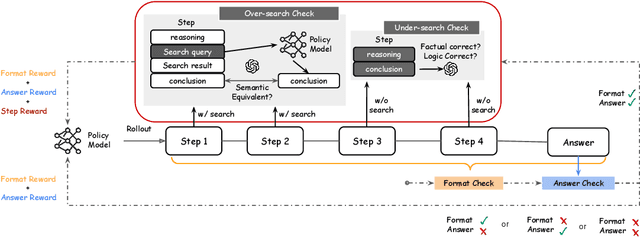
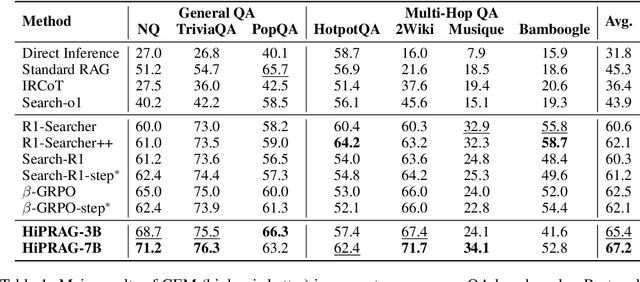
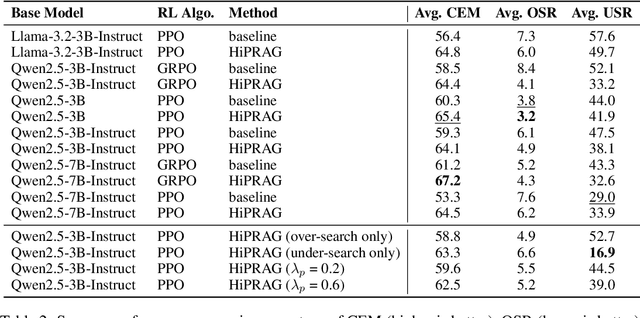
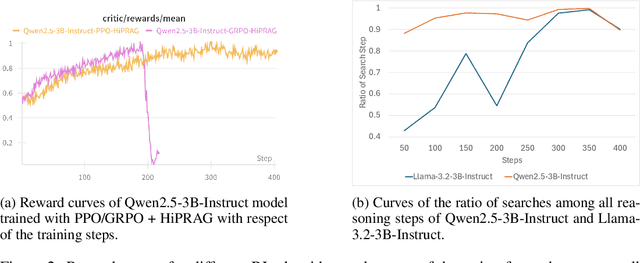
Agentic RAG is a powerful technique for incorporating external information that LLMs lack, enabling better problem solving and question answering. However, suboptimal search behaviors exist widely, such as over-search (retrieving information already known) and under-search (failing to search when necessary), which leads to unnecessary overhead and unreliable outputs. Current training methods, which typically rely on outcome-based rewards in a RL framework, lack the fine-grained control needed to address these inefficiencies. To overcome this, we introduce Hierarchical Process Rewards for Efficient agentic RAG (HiPRAG), a training methodology that incorporates a fine-grained, knowledge-grounded process reward into the RL training. Our approach evaluates the necessity of each search decision on-the-fly by decomposing the agent's reasoning trajectory into discrete, parsable steps. We then apply a hierarchical reward function that provides an additional bonus based on the proportion of optimal search and non-search steps, on top of commonly used outcome and format rewards. Experiments on the Qwen2.5 and Llama-3.2 models across seven diverse QA benchmarks show that our method achieves average accuracies of 65.4% (3B) and 67.2% (7B). This is accomplished while improving search efficiency, reducing the over-search rate to just 2.3% and concurrently lowering the under-search rate. These results demonstrate the efficacy of optimizing the reasoning process itself, not just the final outcome. Further experiments and analysis demonstrate that HiPRAG shows good generalizability across a wide range of RL algorithms, model families, sizes, and types. This work demonstrates the importance and potential of fine-grained control through RL, for improving the efficiency and optimality of reasoning for search agents.
EPO: Entropy-regularized Policy Optimization for LLM Agents Reinforcement Learning
Sep 26, 2025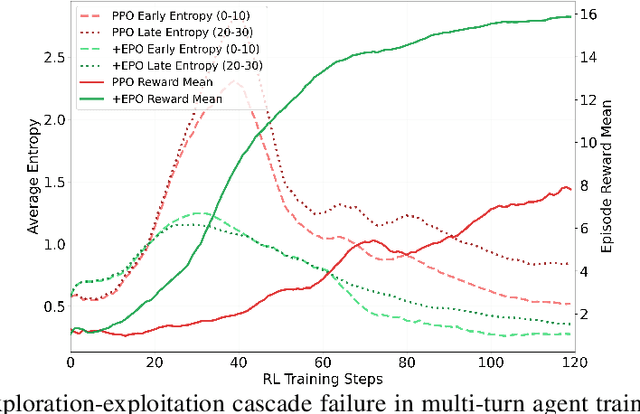
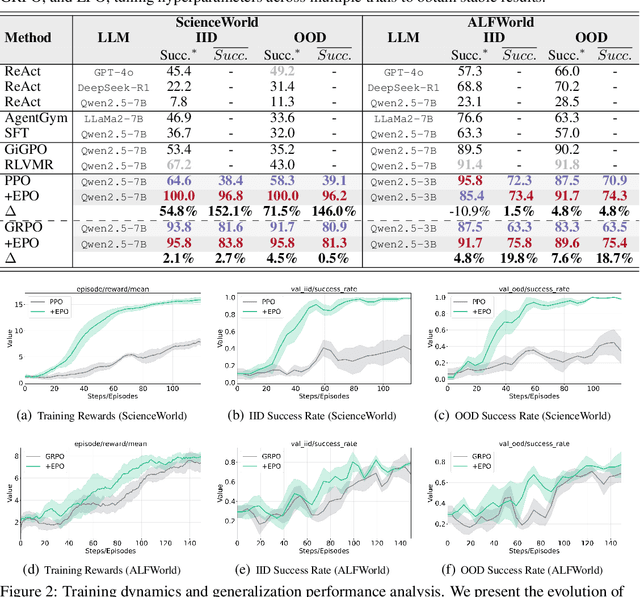
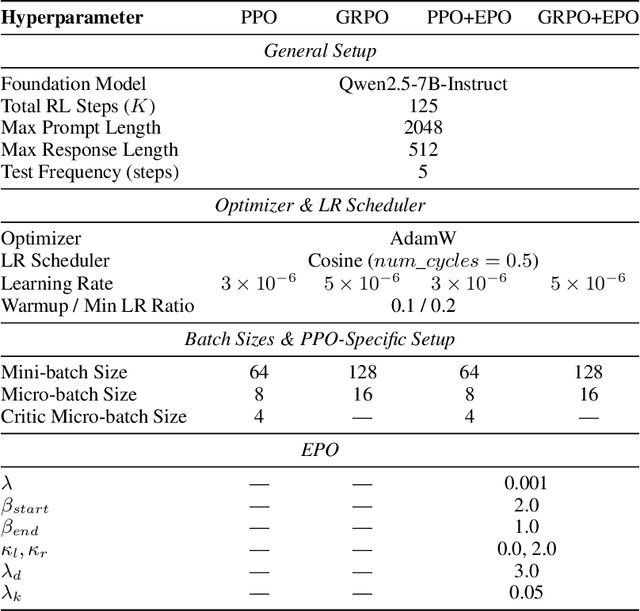
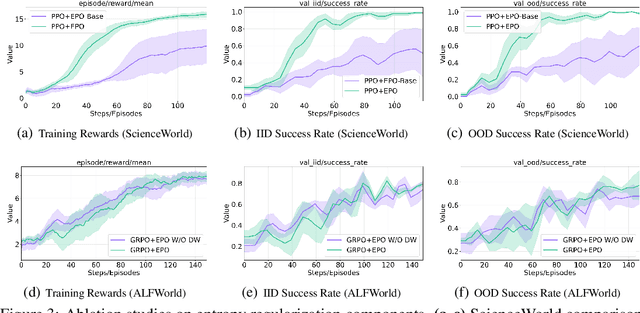
Training LLM agents in multi-turn environments with sparse rewards, where completing a single task requires 30+ turns of interaction within an episode, presents a fundamental challenge for reinforcement learning. We identify a critical failure mode unique to this setting: the exploration-exploitation cascade failure. This cascade begins with early-stage policy premature convergence, where sparse feedback causes agents to commit to flawed, low-entropy strategies. Subsequently, agents enter late-stage policy collapse, where conventional entropy regularization becomes counterproductive, promoting chaotic exploration that destabilizes training. We propose Entropy-regularized Policy Optimization (EPO), a general framework that breaks this failure cycle through three synergistic mechanisms: (1) adopting entropy regularization in multi-turn settings to enhance exploration, (2) an entropy smoothing regularizer that bounds policy entropy within historical averages to prevent abrupt fluctuations, and (3) adaptive phase-based weighting that balances exploration and exploitation across training. Our analysis justifies that EPO guarantees monotonically decreasing entropy variance while maintaining convergence. EPO achieves up to 152% performance improvement on ScienceWorld and up to 19.8% on ALFWorld. Our work demonstrates that multi-turn sparse-reward settings require fundamentally different entropy control than traditional RL, with broad implications for LLM agent training.
Give Me FP32 or Give Me Death? Challenges and Solutions for Reproducible Reasoning
Jun 11, 2025Large Language Models (LLMs) are now integral across various domains and have demonstrated impressive performance. Progress, however, rests on the premise that benchmark scores are both accurate and reproducible. We demonstrate that the reproducibility of LLM performance is fragile: changing system configuration such as evaluation batch size, GPU count, and GPU version can introduce significant difference in the generated responses. This issue is especially pronounced in reasoning models, where minor rounding differences in early tokens can cascade into divergent chains of thought, ultimately affecting accuracy. For instance, under bfloat16 precision with greedy decoding, a reasoning model like DeepSeek-R1-Distill-Qwen-7B can exhibit up to 9% variation in accuracy and 9,000 tokens difference in response length due to differences in GPU count, type, and evaluation batch size. We trace the root cause of this variability to the non-associative nature of floating-point arithmetic under limited numerical precision. This work presents the first systematic investigation into how numerical precision affects reproducibility in LLM inference. Through carefully controlled experiments across various hardware, software, and precision settings, we quantify when and how model outputs diverge. Our analysis reveals that floating-point precision -- while critical for reproducibility -- is often neglected in evaluation practices. Inspired by this, we develop a lightweight inference pipeline, dubbed LayerCast, that stores weights in 16-bit precision but performs all computations in FP32, balancing memory efficiency with numerical stability. Code is available at https://github.com/nanomaoli/llm_reproducibility.
DUMP: Automated Distribution-Level Curriculum Learning for RL-based LLM Post-training
Apr 13, 2025Recent advances in reinforcement learning (RL)-based post-training have led to notable improvements in large language models (LLMs), particularly in enhancing their reasoning capabilities to handle complex tasks. However, most existing methods treat the training data as a unified whole, overlooking the fact that modern LLM training often involves a mixture of data from diverse distributions-varying in both source and difficulty. This heterogeneity introduces a key challenge: how to adaptively schedule training across distributions to optimize learning efficiency. In this paper, we present a principled curriculum learning framework grounded in the notion of distribution-level learnability. Our core insight is that the magnitude of policy advantages reflects how much a model can still benefit from further training on a given distribution. Based on this, we propose a distribution-level curriculum learning framework for RL-based LLM post-training, which leverages the Upper Confidence Bound (UCB) principle to dynamically adjust sampling probabilities for different distrubutions. This approach prioritizes distributions with either high average advantage (exploitation) or low sample count (exploration), yielding an adaptive and theoretically grounded training schedule. We instantiate our curriculum learning framework with GRPO as the underlying RL algorithm and demonstrate its effectiveness on logic reasoning datasets with multiple difficulties and sources. Our experiments show that our framework significantly improves convergence speed and final performance, highlighting the value of distribution-aware curriculum strategies in LLM post-training. Code: https://github.com/ZhentingWang/DUMP.
Efficient Self-Improvement in Multimodal Large Language Models: A Model-Level Judge-Free Approach
Nov 26, 2024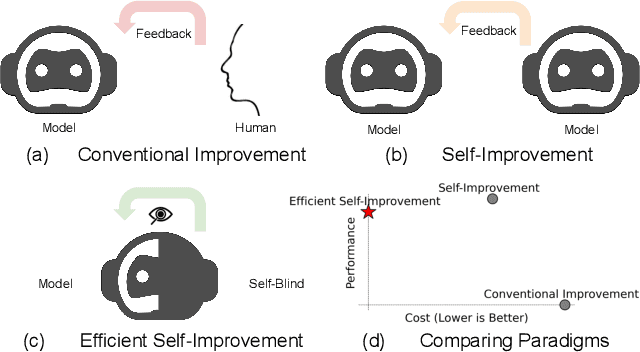
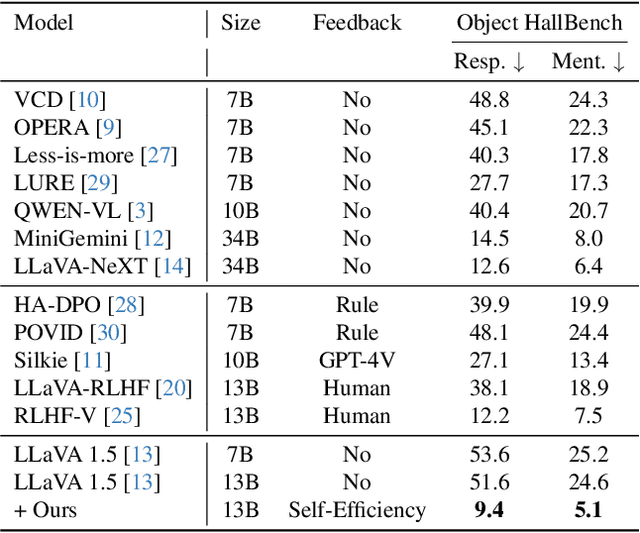

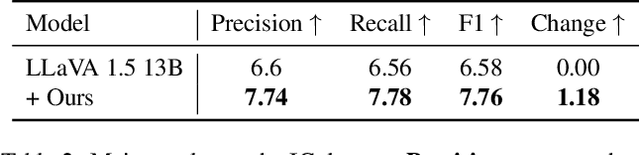
Self-improvement in multimodal large language models (MLLMs) is crucial for enhancing their reliability and robustness. However, current methods often rely heavily on MLLMs themselves as judges, leading to high computational costs and potential pitfalls like reward hacking and model collapse. This paper introduces a novel, model-level judge-free self-improvement framework. Our approach employs a controlled feedback mechanism while eliminating the need for MLLMs in the verification loop. We generate preference learning pairs using a controllable hallucination mechanism and optimize data quality by leveraging lightweight, contrastive language-image encoders to evaluate and reverse pairs when necessary. Evaluations across public benchmarks and our newly introduced IC dataset designed to challenge hallucination control demonstrate that our model outperforms conventional techniques. We achieve superior precision and recall with significantly lower computational demands. This method offers an efficient pathway to scalable self-improvement in MLLMs, balancing performance gains with reduced resource requirements.
Quadratic Is Not What You Need For Multimodal Large Language Models
Oct 08, 2024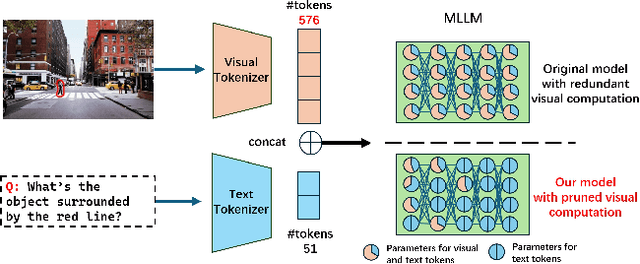
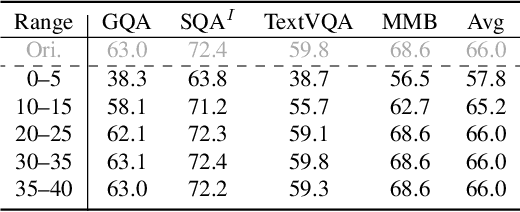
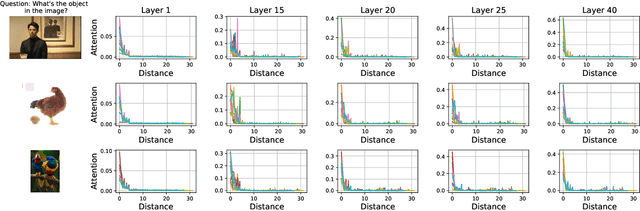
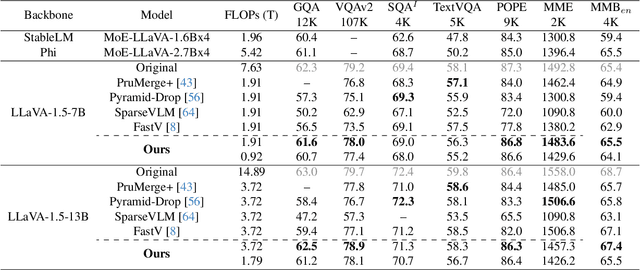
In the past year, the capabilities of Multimodal Large Language Models (MLLMs) have significantly improved across various aspects. However, constrained by the quadratic growth of computation in LLMs as the number of tokens increases, efficiency has become a bottleneck for further scaling MLLMs. Although recent efforts have been made to prune visual tokens or use more lightweight LLMs to reduce computation, the problem of quadratic growth in computation with the increase of visual tokens still persists. To address this, we propose a novel approach: instead of reducing the input visual tokens for LLMs, we focus on pruning vision-related computations within the LLMs. After pruning, the computation growth in the LLM is no longer quadratic with the increase of visual tokens, but linear. Surprisingly, we found that after applying such extensive pruning, the capabilities of MLLMs are comparable with the original one and even superior on some benchmarks with only 25% of the computation. This finding opens up the possibility for MLLMs to incorporate much denser visual tokens. Additionally, based on this finding, we further analyzed some architectural design deficiencies in existing MLLMs and proposed promising improvements. To the best of our knowledge, this is the first study to investigate the computational redundancy in the LLM's vision component of MLLMs. Code and checkpoints will be released soon.
DL3DV-10K: A Large-Scale Scene Dataset for Deep Learning-based 3D Vision
Dec 29, 2023

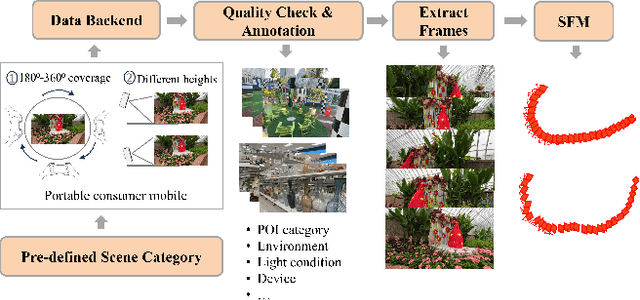
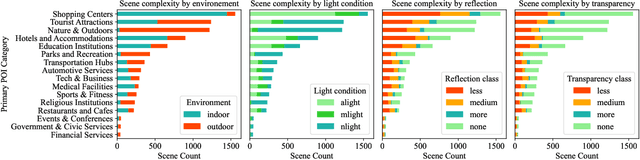
We have witnessed significant progress in deep learning-based 3D vision, ranging from neural radiance field (NeRF) based 3D representation learning to applications in novel view synthesis (NVS). However, existing scene-level datasets for deep learning-based 3D vision, limited to either synthetic environments or a narrow selection of real-world scenes, are quite insufficient. This insufficiency not only hinders a comprehensive benchmark of existing methods but also caps what could be explored in deep learning-based 3D analysis. To address this critical gap, we present DL3DV-10K, a large-scale scene dataset, featuring 51.2 million frames from 10,510 videos captured from 65 types of point-of-interest (POI) locations, covering both bounded and unbounded scenes, with different levels of reflection, transparency, and lighting. We conducted a comprehensive benchmark of recent NVS methods on DL3DV-10K, which revealed valuable insights for future research in NVS. In addition, we have obtained encouraging results in a pilot study to learn generalizable NeRF from DL3DV-10K, which manifests the necessity of a large-scale scene-level dataset to forge a path toward a foundation model for learning 3D representation. Our DL3DV-10K dataset, benchmark results, and models will be publicly accessible at https://dl3dv-10k.github.io/DL3DV-10K/.
Text2Layer: Layered Image Generation using Latent Diffusion Model
Jul 19, 2023Layer compositing is one of the most popular image editing workflows among both amateurs and professionals. Motivated by the success of diffusion models, we explore layer compositing from a layered image generation perspective. Instead of generating an image, we propose to generate background, foreground, layer mask, and the composed image simultaneously. To achieve layered image generation, we train an autoencoder that is able to reconstruct layered images and train diffusion models on the latent representation. One benefit of the proposed problem is to enable better compositing workflows in addition to the high-quality image output. Another benefit is producing higher-quality layer masks compared to masks produced by a separate step of image segmentation. Experimental results show that the proposed method is able to generate high-quality layered images and initiates a benchmark for future work.