 Add to Chrome
 Add to Firefox
 Add to Edge
VoxStruct3D: Structure-Leading Flow Matching for Voxel-Space 3D MRI Synthesis
Aug 05, 2026
High-fidelity 3D MRI synthesis requires both globally coherent anatomy and fine-grained voxel-level detail. Although latent diffusion makes volumetric generation tractable, its image autoencoder introduces a reconstruction bottleneck that can limit the fine detail recoverable in the final volume. We present VoxStruct3D, a voxel-space flow-matching framework that directly models full-resolution MRI volumes using a clean-data prediction objective. Its Volumetric Voxel Generator (VVG) combines factorized 3D patch embedding with overlapping upsampling, time-modulated residual refinement, and skip fusion, enabling neighboring tokens to jointly reconstruct shared voxel regions and suppress patch-boundary artifacts. To complement direct voxel-space modeling with an explicit anatomical prior, we further introduce a Structure-First, Image-Follows (SFIF) strategy. A frozen pretrained 3D medical encoder and a StructVAE extract compact structure tokens that preserve dominant anatomy, while a structure-leading schedule keeps their trajectory ahead of the image trajectory. Patch-Aligned RoPE spatially aligns the unequal token grids, and asymmetric attention enforces one-way guidance from structure to image. Experiments on pathological and healthy T1-weighted brain MRI datasets show that VoxStruct3D achieves the strongest overall performance across feature-distribution alignment, sample diversity, and perceptual quality, producing anatomically coherent and visually realistic volumes.

TRCoRSurg: Temporal-Relational Co-Reasoning for Surgical Video Triplet Recognition
Aug 05, 2026Understanding complex surgical scenes requires recognizing multiple interdependent entities, such as instruments, actions, and targets, while maintaining their relational consistency across time. Existing surgical triplet recognition methods struggle to jointly model intra-frame label dependencies and inter-frame temporal semantics in a unified manner. To address these limitations, we propose a unified framework that integrates spatial, relational, and temporal cues for robust surgical triplet recognition. Specifically, class-specific spatial priors are first extracted through a multi-scale encoder. These priors are then refined by a Label Correlation Modeling module with multi-scale class activation map-guided relational extraction (MS-CAMRE), enabling the model to capture both static co-occurrence patterns and dynamic contextual dependencies among triplet components. Furthermore, a Bidirectional Temporal-Relational Fusion Attention (BTRFA) module harmonizes temporal and relational representations to achieve coherent temporal reasoning. We also introduce a new evaluation metric, the Triplet Consistency Error Rate (TCER), which quantitatively measures the model's ability to preserve causal and semantic consistency across triplets. Extensive experiments on the CholecT45 and ProstaTD datasets show that our method achieves state-of-the-art performance, improving AP_IVT by 5.1 percent and 7.8 percent, respectively. Moreover, according to TCER, our approach achieves relative reductions of more than 36 percent and 25 percent on the two datasets, respectively, demonstrating the effectiveness of our framework in temporal-relational co-reasoning.
Towards Unified Surgical Scene Understanding:Bridging Reasoning and Grounding via MLLMs
May 13, 2026Surgical scene understanding is a cornerstone of computer-assisted intervention. While recent advances, particularly in surgical image segmentation, have driven progress, real-world clinical applications require a more holistic understanding that jointly captures procedural context, semantic reasoning, and precise visual grounding. However, existing approaches typically address these components in isolation, leading to fragmented representations and limited semantic consistency. To address this limitation, we propose SurgMLLM, a unified surgical scene understanding framework that bridges high-level reasoning and low-level visual grounding within a single model. Given surgical videos, SurgMLLM fine-tunes a multimodal large language model (MLLM) to support structured interpretability reasoning, which is used to jointly model phases, instrument-verb-target (IVT) triplets, and triplet-entity segmentation tokens. These tokens are then temporally aggregated and serve as prompts for a segmentation network, enabling accurate pixel-wise grounding of triplet instruments and targets. The entire framework is trained end-to-end with a unified objective that couples language-based reasoning supervision with visual grounding losses, promoting coherent cross-task learning and clinically consistent scene representations. To facilitate unified evaluation, we introduce CholecT45-Scene, extending CholecT45 dataset with 64,299 frames of pixel-level mask annotations for instruments and targets, aligned with existing triplet labels. Extensive experiments show that SurgMLLM significantly advances surgical scene understanding, improving the primary triplet recognition metric AP_IVT from 40.7% to 46.0% and consistently outperforming prior methods in phase recognition and segmentation. These results highlight the effectiveness of unified reasoning-and-grounding for reliable, context-aware surgical assistance.
TempDiffReg: Temporal Diffusion Model for Non-Rigid 2D-3D Vascular Registration
Jan 26, 2026Transarterial chemoembolization (TACE) is a preferred treatment option for hepatocellular carcinoma and other liver malignancies, yet it remains a highly challenging procedure due to complex intra-operative vascular navigation and anatomical variability. Accurate and robust 2D-3D vessel registration is essential to guide microcatheter and instruments during TACE, enabling precise localization of vascular structures and optimal therapeutic targeting. To tackle this issue, we develop a coarse-to-fine registration strategy. First, we introduce a global alignment module, structure-aware perspective n-point (SA-PnP), to establish correspondence between 2D and 3D vessel structures. Second, we propose TempDiffReg, a temporal diffusion model that performs vessel deformation iteratively by leveraging temporal context to capture complex anatomical variations and local structural changes. We collected data from 23 patients and constructed 626 paired multi-frame samples for comprehensive evaluation. Experimental results demonstrate that the proposed method consistently outperforms state-of-the-art (SOTA) methods in both accuracy and anatomical plausibility. Specifically, our method achieves a mean squared error (MSE) of 0.63 mm and a mean absolute error (MAE) of 0.51 mm in registration accuracy, representing 66.7\% lower MSE and 17.7\% lower MAE compared to the most competitive existing approaches. It has the potential to assist less-experienced clinicians in safely and efficiently performing complex TACE procedures, ultimately enhancing both surgical outcomes and patient care. Code and data are available at: \textcolor{blue}{https://github.com/LZH970328/TempDiffReg.git}
PAS-Mamba: Phase-Amplitude-Spatial State Space Model for MRI Reconstruction
Jan 20, 2026Joint feature modeling in both the spatial and frequency domains has become a mainstream approach in MRI reconstruction. However, existing methods generally treat the frequency domain as a whole, neglecting the differences in the information carried by its internal components. According to Fourier transform theory, phase and amplitude represent different types of information in the image. Our spectrum swapping experiments show that magnitude mainly reflects pixel-level intensity, while phase predominantly governs image structure. To prevent interference between phase and magnitude feature learning caused by unified frequency-domain modeling, we propose the Phase-Amplitude-Spatial State Space Model (PAS-Mamba) for MRI Reconstruction, a framework that decouples phase and magnitude modeling in the frequency domain and combines it with image-domain features for better reconstruction. In the image domain, LocalMamba preserves spatial locality to sharpen fine anatomical details. In frequency domain, we disentangle amplitude and phase into two specialized branches to avoid representational coupling. To respect the concentric geometry of frequency information, we propose Circular Frequency Domain Scanning (CFDS) to serialize features from low to high frequencies. Finally, a Dual-Domain Complementary Fusion Module (DDCFM) adaptively fuses amplitude phase representations and enables bidirectional exchange between frequency and image domains, delivering superior reconstruction. Extensive experiments on the IXI and fastMRI knee datasets show that PAS-Mamba consistently outperforms state of the art reconstruction methods.
Surgical Scene Segmentation using a Spike-Driven Video Transformer with Real-Time Potential
Dec 24, 2025Modern surgical systems increasingly rely on intelligent scene understanding to provide timely situational awareness for enhanced intra-operative safety. Within this pipeline, surgical scene segmentation plays a central role in accurately perceiving operative events. Although recent deep learning models, particularly large-scale foundation models, achieve remarkable segmentation accuracy, their substantial computational demands and power consumption hinder real-time deployment in resource-constrained surgical environments. To address this limitation, we explore the emerging SNN as a promising paradigm for highly efficient surgical intelligence. However, their performance is still constrained by the scarcity of labeled surgical data and the inherently sparse nature of surgical video representations. To this end, we propose \textit{SpikeSurgSeg}, the first spike-driven video Transformer framework tailored for surgical scene segmentation with real-time potential on non-GPU platforms. To address the limited availability of surgical annotations, we introduce a surgical-scene masked autoencoding pretraining strategy for SNNs that enables robust spatiotemporal representation learning via layer-wise tube masking. Building on this pretrained backbone, we further adopt a lightweight spike-driven segmentation head that produces temporally consistent predictions while preserving the low-latency characteristics of SNNs. Extensive experiments on EndoVis18 and our in-house SurgBleed dataset demonstrate that SpikeSurgSeg achieves mIoU comparable to SOTA ANN-based models while reducing inference latency by at least $8\times$. Notably, it delivers over $20\times$ acceleration relative to most foundation-model baselines, underscoring its potential for time-critical surgical scene segmentation.
Versatile and Efficient Medical Image Super-Resolution Via Frequency-Gated Mamba
Oct 31, 2025Medical image super-resolution (SR) is essential for enhancing diagnostic accuracy while reducing acquisition cost and scanning time. However, modeling both long-range anatomical structures and fine-grained frequency details with low computational overhead remains challenging. We propose FGMamba, a novel frequency-aware gated state-space model that unifies global dependency modeling and fine-detail enhancement into a lightweight architecture. Our method introduces two key innovations: a Gated Attention-enhanced State-Space Module (GASM) that integrates efficient state-space modeling with dual-branch spatial and channel attention, and a Pyramid Frequency Fusion Module (PFFM) that captures high-frequency details across multiple resolutions via FFT-guided fusion. Extensive evaluations across five medical imaging modalities (Ultrasound, OCT, MRI, CT, and Endoscopic) demonstrate that FGMamba achieves superior PSNR/SSIM while maintaining a compact parameter footprint ($<$0.75M), outperforming CNN-based and Transformer-based SOTAs. Our results validate the effectiveness of frequency-aware state-space modeling for scalable and accurate medical image enhancement.
TFKAN: Time-Frequency KAN for Long-Term Time Series Forecasting
Jun 15, 2025Kolmogorov-Arnold Networks (KANs) are highly effective in long-term time series forecasting due to their ability to efficiently represent nonlinear relationships and exhibit local plasticity. However, prior research on KANs has predominantly focused on the time domain, neglecting the potential of the frequency domain. The frequency domain of time series data reveals recurring patterns and periodic behaviors, which complement the temporal information captured in the time domain. To address this gap, we explore the application of KANs in the frequency domain for long-term time series forecasting. By leveraging KANs' adaptive activation functions and their comprehensive representation of signals in the frequency domain, we can more effectively learn global dependencies and periodic patterns. To integrate information from both time and frequency domains, we propose the $\textbf{T}$ime-$\textbf{F}$requency KAN (TFKAN). TFKAN employs a dual-branch architecture that independently processes features from each domain, ensuring that the distinct characteristics of each domain are fully utilized without interference. Additionally, to account for the heterogeneity between domains, we introduce a dimension-adjustment strategy that selectively upscales only in the frequency domain, enhancing efficiency while capturing richer frequency information. Experimental results demonstrate that TFKAN consistently outperforms state-of-the-art (SOTA) methods across multiple datasets. The code is available at https://github.com/LcWave/TFKAN.
A Comprehensive Survey on Magnetic Resonance Image Reconstruction
Mar 10, 2025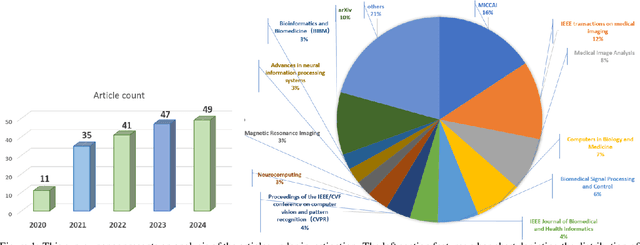
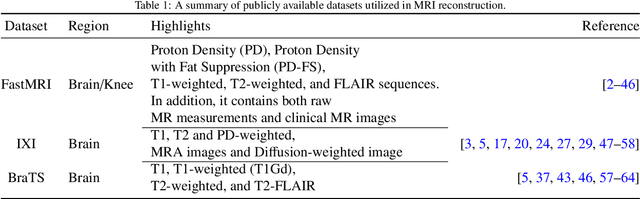
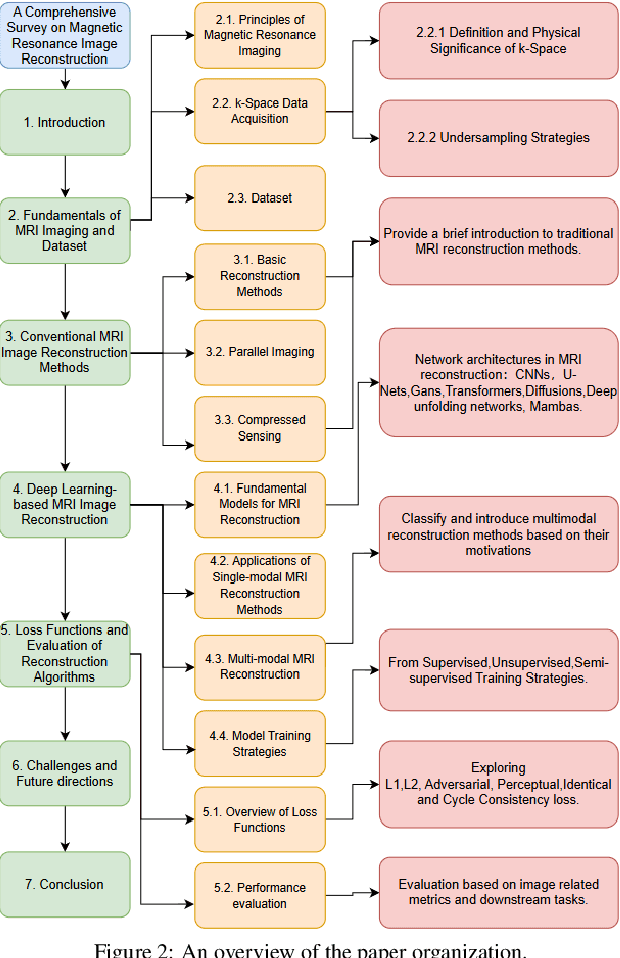
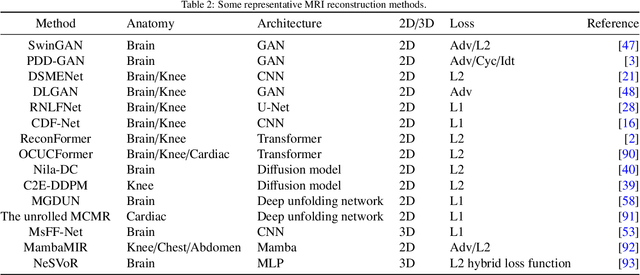
Magnetic resonance imaging (MRI) reconstruction is a fundamental task aimed at recovering high-quality images from undersampled or low-quality MRI data. This process enhances diagnostic accuracy and optimizes clinical applications. In recent years, deep learning-based MRI reconstruction has made significant progress. Advancements include single-modality feature extraction using different network architectures, the integration of multimodal information, and the adoption of unsupervised or semi-supervised learning strategies. However, despite extensive research, MRI reconstruction remains a challenging problem that has yet to be fully resolved. This survey provides a systematic review of MRI reconstruction methods, covering key aspects such as data acquisition and preprocessing, publicly available datasets, single and multi-modal reconstruction models, training strategies, and evaluation metrics based on image reconstruction and downstream tasks. Additionally, we analyze the major challenges in this field and explore potential future directions.
Surgical Workflow Recognition and Blocking Effectiveness Detection in Laparoscopic Liver Resections with Pringle Maneuver
Aug 21, 2024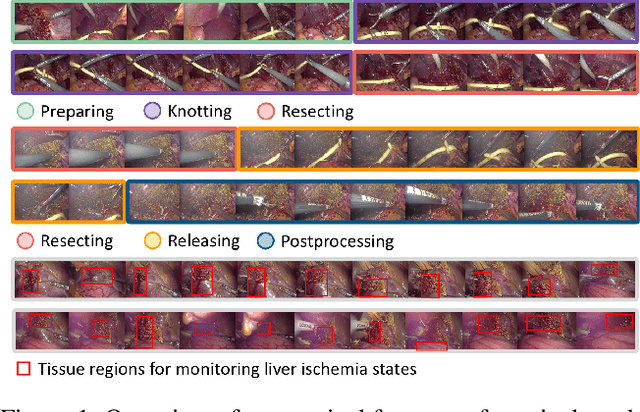
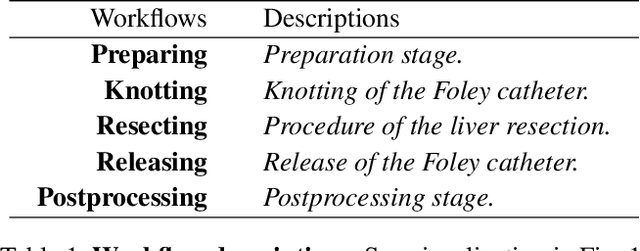

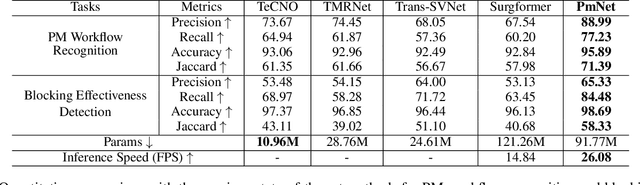
Pringle maneuver (PM) in laparoscopic liver resection aims to reduce blood loss and provide a clear surgical view by intermittently blocking blood inflow of the liver, whereas prolonged PM may cause ischemic injury. To comprehensively monitor this surgical procedure and provide timely warnings of ineffective and prolonged blocking, we suggest two complementary AI-assisted surgical monitoring tasks: workflow recognition and blocking effectiveness detection in liver resections. The former presents challenges in real-time capturing of short-term PM, while the latter involves the intraoperative discrimination of long-term liver ischemia states. To address these challenges, we meticulously collect a novel dataset, called PmLR50, consisting of 25,037 video frames covering various surgical phases from 50 laparoscopic liver resection procedures. Additionally, we develop an online baseline for PmLR50, termed PmNet. This model embraces Masked Temporal Encoding (MTE) and Compressed Sequence Modeling (CSM) for efficient short-term and long-term temporal information modeling, and embeds Contrastive Prototype Separation (CPS) to enhance action discrimination between similar intraoperative operations. Experimental results demonstrate that PmNet outperforms existing state-of-the-art surgical workflow recognition methods on the PmLR50 benchmark. Our research offers potential clinical applications for the laparoscopic liver surgery community. Source code and data will be publicly available.