 Add to Chrome
 Add to Firefox
 Add to Edge
Sedentary Behavior Classification for Wearable Sensors with a CNN-BiLSTM Model
Aug 03, 2026
Accurate detection of sedentary behavior is important for studying health risks related to prolonged sitting, but posture-based classification remains challenging with wearable sensors, especially at the wrist. We study whether a deep learning model trained on hip-worn accelerometer data can transfer to wrist-worn accelerometer data for sitting versus non-sitting classification. We use CHAP, a CNN-BiLSTM model originally developed for hip accelerometers, and evaluate its zero-shot performance on wrist data as well as its adaptation through finetuning with varying amounts of labeled wrist data. Experiments are conducted on the iWatch dataset with ground-truth posture labels derived from wearable cameras. The hip-trained model performs strongly on hip data without retraining, but accuracy drops on wrist data due to sensor placement shift. Finetuning CHAP provides consistent advantages over transformer models trained from scratch. These findings suggest that hip-based pretraining provides a useful starting point for wrist deployment, while highlighting the need for wrist-specific adaptation to handle higher signal variability.

Benchmarking Safety Risks of Knowledge-Intensive Reasoning under Malicious Knowledge Editing
May 11, 2026Large language models (LLMs) increasingly rely on knowledge editing to support knowledge-intensive reasoning, but this flexibility also introduces critical safety risks: adversaries can inject malicious or misleading knowledge that corrupts downstream reasoning and leads to harmful outcomes. Existing knowledge editing benchmarks primarily focus on editing efficacy and lack a unified framework for systematically evaluating the safety implications of edited knowledge on reasoning behavior. To address this gap, we present EditRisk-Bench, a benchmark for systematically evaluating safety risks of knowledge-intensive reasoning under malicious knowledge editing. Unlike prior benchmarks that mainly emphasize edit success, generalization, and locality, EditRisk-Bench focuses on how injected knowledge affects downstream reasoning behavior and reliability. It integrates diverse malicious scenarios, including misinformation, bias, and safety violations, together with multi-level knowledge-intensive reasoning tasks and representative editing strategies within a unified evaluation framework measuring attack effectiveness, reasoning correctness, and side effects. Extensive experiments on both open-source and closed-source LLMs show that malicious knowledge editing can reliably induce incorrect or unsafe reasoning while largely preserving general capabilities, making such risks difficult to detect. We further identify several key factors influencing these risks, including edit scale, knowledge characteristics, and reasoning complexity. EditRisk-Bench provides an extensible testbed for understanding and mitigating safety risks in knowledge editing for LLMs.
CoopGuard: Stateful Cooperative Agents Safeguarding LLMs Against Evolving Multi-Round Attacks
Apr 05, 2026As Large Language Models (LLMs) are increasingly deployed in complex applications, their vulnerability to adversarial attacks raises urgent safety concerns, especially those evolving over multi-round interactions. Existing defenses are largely reactive and struggle to adapt as adversaries refine strategies across rounds. In this work, we propose CoopGuard , a stateful multi-round LLM defense framework based on cooperative agents that maintains and updates an internal defense state to counter evolving attacks. It employs three specialized agents (Deferring Agent, Tempting Agent, and Forensic Agent) for complementary round-level strategies, coordinated by System Agent, which conditions decisions on the evolving defense state (interaction history) and orchestrates agents over time. To evaluate evolving threats, we introduce the EMRA benchmark with 5,200 adversarial samples across 8 attack types, simulating progressively LLM multi-round attacks. Experiments show that CoopGuard reduces attack success rate by 78.9% over state-of-the-art defenses, while improving deceptive rate by 186% and reducing attack efficiency by 167.9%, offering a more comprehensive assessment of multi-round defense. These results demonstrate that CoopGuard provides robust protection for LLMs in multi-round adversarial scenarios.
Learning Transferable Sensor Models via Language-Informed Pretraining
Mar 12, 2026Modern sensing systems generate large volumes of unlabeled multivariate time-series data. This abundance of unlabeled data makes self-supervised learning (SSL) a natural approach for learning transferable representations. However, most existing approaches are optimized for reconstruction or forecasting objectives and often fail to capture the semantic structure required for downstream classification and reasoning tasks. While recent sensor-language alignment methods improve semantic generalization through captioning and zero-shot transfer, they are limited to fixed sensor configurations, such as predefined channel sets, signal lengths, or temporal resolutions, which hinders cross-domain applicability. To address these gaps, we introduce \textbf{SLIP} (\textbf{S}ensor \textbf{L}anguage-\textbf{I}nformed \textbf{P}retraining), an open-source framework for learning language-aligned representations that generalize across diverse sensor setups. SLIP integrates contrastive alignment with sensor-conditioned captioning, facilitating both discriminative understanding and generative reasoning. By repurposing a pretrained decoder-only language model via cross-attention and introducing an elegant, flexible patch-embedder, SLIP supports different temporal resolutions and variable-length input at inference time without additional retraining. Across 11 datasets, SLIP demonstrates superior performance in zero-shot transfer, signal captioning, and question answering. It achieves a 77.14% average linear-probing accuracy, a 5.93% relative improvement over strong baselines, and reaches 64.83% accuracy in sensor-based question answering.
Toward Foundation Model for Multivariate Wearable Sensing of Physiological Signals
Dec 12, 2024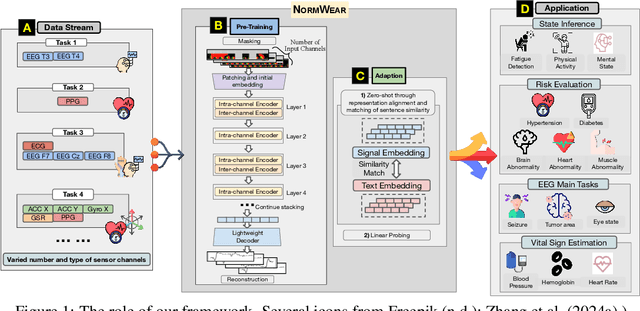

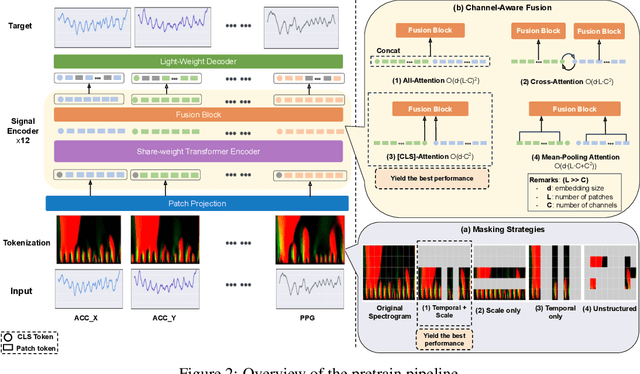
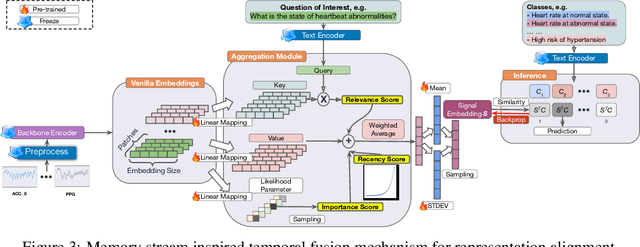
Time-series foundation models have the ability to run inference, mainly forecasting, on any type of time series data, thanks to the informative representations comprising waveform features. Wearable sensing data, on the other hand, contain more variability in both patterns and frequency bands of interest and generally emphasize more on the ability to infer healthcare-related outcomes. The main challenge of crafting a foundation model for wearable sensing physiological signals is to learn generalizable representations that support efficient adaptation across heterogeneous sensing configurations and applications. In this work, we propose NormWear, a step toward such a foundation model, aiming to extract generalized and informative wearable sensing representations. NormWear has been pretrained on a large set of physiological signals, including PPG, ECG, EEG, GSR, and IMU, from various public resources. For a holistic assessment, we perform downstream evaluation on 11 public wearable sensing datasets, spanning 18 applications in the areas of mental health, body state inference, biomarker estimations, and disease risk evaluations. We demonstrate that NormWear achieves a better performance improvement over competitive baselines in general time series foundation modeling. In addition, leveraging a novel representation-alignment-match-based method, we align physiological signals embeddings with text embeddings. This alignment enables our proposed foundation model to perform zero-shot inference, allowing it to generalize to previously unseen wearable signal-based health applications. Finally, we perform nonlinear dynamic analysis on the waveform features extracted by the model at each intermediate layer. This analysis quantifies the model's internal processes, offering clear insights into its behavior and fostering greater trust in its inferences among end users.