 Add to Chrome
 Add to Firefox
 Add to Edge
Geometry and Gradient-based Partitioning for Panoramic Outdoor Reconstruction
Jul 09, 2026
Scaling 3D Gaussian Splatting (3DGS) to large outdoor scenes is costly in both data acquisition and computation. Adopting panoramic images with equirectangular projection (ERP) can reduce capture effort via their full $360^{\circ}$ field of view, yet the resulting omnipresent visibility invalidates existing partitioning strategies that rely on local camera frustums, causing block-wise optimization to degenerate into global training. Thus, we propose PanoLOG, a two-stage coarse-to-fine framework equipped with a Geometry and Gradient-based Partitioning Strategy tailored for large-scale panoramic 3DGS reconstruction. In the global coarse stage, PanoLOG leverages sky-sphere modeling and panoramic monocular depth supervision for reliable geometry, while in the refinement stage, G$^2$PS builds adaptive bounding volumes via parallax-driven uncertainty and assigns cameras via gradient-based importance scoring. Furthermore, we construct Pano360, the first benchmark on large-scale panoramic dataset for outdoor scene reconstruction. Extensive experiments demonstrate that G$^2$PS achieves state-of-the-art rendering quality while maintaining scalable, block-parallel training. Our models, training code, and dataset are publicly available.

Multimodal OCR: Parse Anything from Documents
Mar 13, 2026We present Multimodal OCR (MOCR), a document parsing paradigm that jointly parses text and graphics into unified textual representations. Unlike conventional OCR systems that focus on text recognition and leave graphical regions as cropped pixels, our method, termed dots.mocr, treats visual elements such as charts, diagrams, tables, and icons as first-class parsing targets, enabling systems to parse documents while preserving semantic relationships across elements. It offers several advantages: (1) it reconstructs both text and graphics as structured outputs, enabling more faithful document reconstruction; (2) it supports end-to-end training over heterogeneous document elements, allowing models to exploit semantic relations between textual and visual components; and (3) it converts previously discarded graphics into reusable code-level supervision, unlocking multimodal supervision embedded in existing documents. To make this paradigm practical at scale, we build a comprehensive data engine from PDFs, rendered webpages, and native SVG assets, and train a compact 3B-parameter model through staged pretraining and supervised fine-tuning. We evaluate dots.mocr from two perspectives: document parsing and structured graphics parsing. On document parsing benchmarks, it ranks second only to Gemini 3 Pro on our OCR Arena Elo leaderboard, surpasses existing open-source document parsing systems, and sets a new state of the art of 83.9 on olmOCR Bench. On structured graphics parsing, dots.mocr achieves higher reconstruction quality than Gemini 3 Pro across image-to-SVG benchmarks, demonstrating strong performance on charts, UI layouts, scientific figures, and chemical diagrams. These results show a scalable path toward building large-scale image-to-code corpora for multimodal pretraining. Code and models are publicly available at https://github.com/rednote-hilab/dots.mocr.
dots.llm1 Technical Report
Jun 06, 2025Mixture of Experts (MoE) models have emerged as a promising paradigm for scaling language models efficiently by activating only a subset of parameters for each input token. In this report, we present dots.llm1, a large-scale MoE model that activates 14B parameters out of a total of 142B parameters, delivering performance on par with state-of-the-art models while reducing training and inference costs. Leveraging our meticulously crafted and efficient data processing pipeline, dots.llm1 achieves performance comparable to Qwen2.5-72B after pretraining on 11.2T high-quality tokens and post-training to fully unlock its capabilities. Notably, no synthetic data is used during pretraining. To foster further research, we open-source intermediate training checkpoints at every one trillion tokens, providing valuable insights into the learning dynamics of large language models.
CFTrack: Enhancing Lightweight Visual Tracking through Contrastive Learning and Feature Matching
Feb 27, 2025Achieving both efficiency and strong discriminative ability in lightweight visual tracking is a challenge, especially on mobile and edge devices with limited computational resources. Conventional lightweight trackers often struggle with robustness under occlusion and interference, while deep trackers, when compressed to meet resource constraints, suffer from performance degradation. To address these issues, we introduce CFTrack, a lightweight tracker that integrates contrastive learning and feature matching to enhance discriminative feature representations. CFTrack dynamically assesses target similarity during prediction through a novel contrastive feature matching module optimized with an adaptive contrastive loss, thereby improving tracking accuracy. Extensive experiments on LaSOT, OTB100, and UAV123 show that CFTrack surpasses many state-of-the-art lightweight trackers, operating at 136 frames per second on the NVIDIA Jetson NX platform. Results on the HOOT dataset further demonstrate CFTrack's strong discriminative ability under heavy occlusion.
Multi-query Vehicle Re-identification: Viewpoint-conditioned Network, Unified Dataset and New Metric
May 25, 2023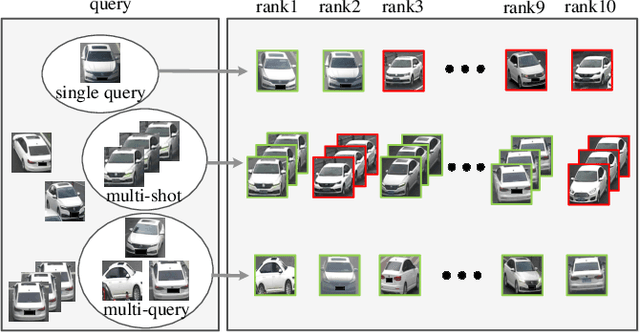
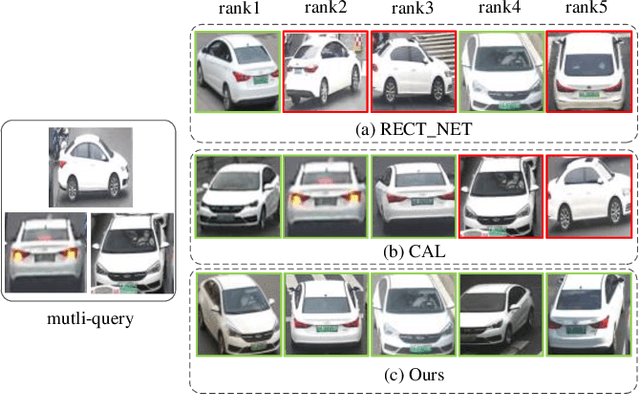
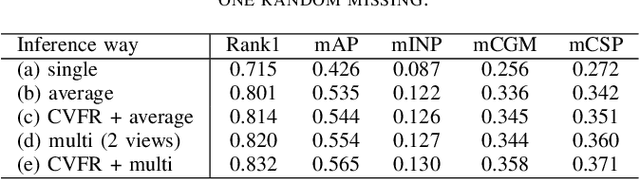
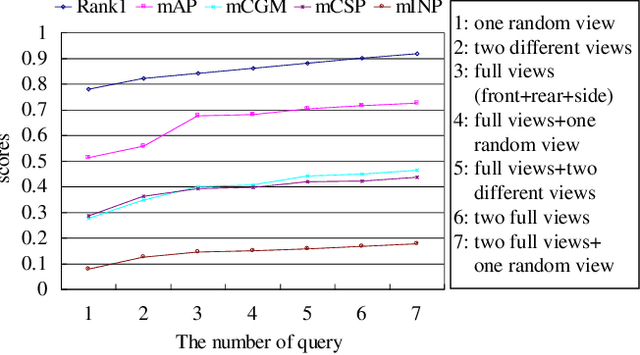
Existing vehicle re-identification methods mainly rely on the single query, which has limited information for vehicle representation and thus significantly hinders the performance of vehicle Re-ID in complicated surveillance networks. In this paper, we propose a more realistic and easily accessible task, called multi-query vehicle Re-ID, which leverages multiple queries to overcome viewpoint limitation of single one. Based on this task, we make three major contributions. First, we design a novel viewpoint-conditioned network (VCNet), which adaptively combines the complementary information from different vehicle viewpoints, for multi-query vehicle Re-ID. Moreover, to deal with the problem of missing vehicle viewpoints, we propose a cross-view feature recovery module which recovers the features of the missing viewpoints by learnt the correlation between the features of available and missing viewpoints. Second, we create a unified benchmark dataset, taken by 6142 cameras from a real-life transportation surveillance system, with comprehensive viewpoints and large number of crossed scenes of each vehicle for multi-query vehicle Re-ID evaluation. Finally, we design a new evaluation metric, called mean cross-scene precision (mCSP), which measures the ability of cross-scene recognition by suppressing the positive samples with similar viewpoints from same camera. Comprehensive experiments validate the superiority of the proposed method against other methods, as well as the effectiveness of the designed metric in the evaluation of multi-query vehicle Re-ID.