 Add to Chrome
 Add to Firefox
 Add to Edge
InfMLLM: A Unified Framework for Visual-Language Tasks
Nov 12, 2023
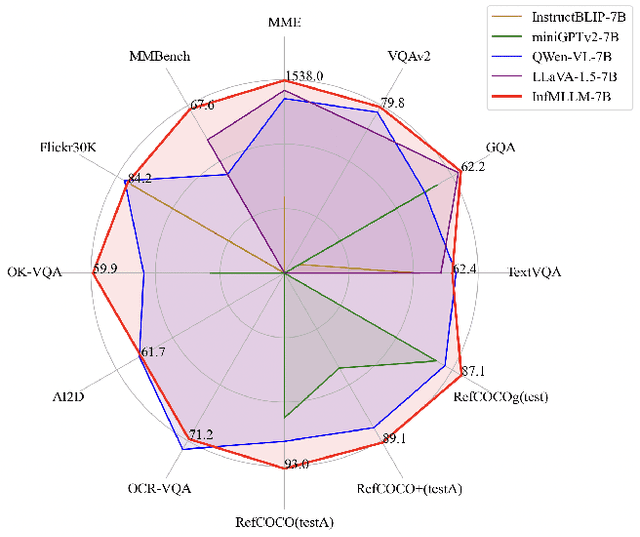
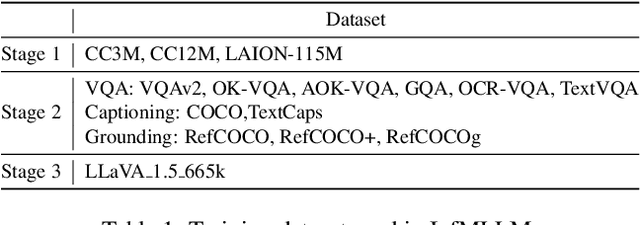
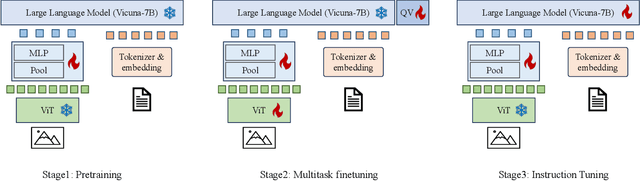

Large language models (LLMs) have proven their remarkable versatility in handling a comprehensive range of language-centric applications. To expand LLMs' capabilities to a broader spectrum of modal inputs, multimodal large language models (MLLMs) have attracted growing interest. This work delves into enabling LLMs to tackle more vision-language-related tasks, particularly image captioning, visual question answering (VQA,) and visual grounding. To this end, we implemented a three-stage training scheme: starting with lightweight alignment pretraining, then moderate-weight multitask hybrid training, and finally, LLM fine-tuning to improve instruction following capability. Throughout the training process, the requirements on GPU memory gradually increase. To effectively manage the number of visual embeddings passed to the LLM while preserving their positional information, we introduce a straightforward visual adapter module dubbed pool-adapter. Our experiments demonstrate that preserving the positional information of visual embeddings through the pool-adapter is particularly beneficial for tasks like visual grounding. We name our proposed approach InfMLLM and have evaluated it extensively on various benchmark datasets. Our results demonstrate that InfMLLM achieves either state-of-the-art (SOTA) performance or performance comparable to recent MLLMs. The code and model will be made open-source at: \url{https://github.com/mightyzau/InfMLLM}.

LogicMP: A Neuro-symbolic Approach for Encoding First-order Logic Constraints
Sep 29, 2023Integrating first-order logic constraints (FOLCs) with neural networks is a crucial but challenging problem since it involves modeling intricate correlations to satisfy the constraints. This paper proposes a novel neural layer, LogicMP, whose layers perform mean-field variational inference over an MLN. It can be plugged into any off-the-shelf neural network to encode FOLCs while retaining modularity and efficiency. By exploiting the structure and symmetries in MLNs, we theoretically demonstrate that our well-designed, efficient mean-field iterations effectively mitigate the difficulty of MLN inference, reducing the inference from sequential calculation to a series of parallel tensor operations. Empirical results in three kinds of tasks over graphs, images, and text show that LogicMP outperforms advanced competitors in both performance and efficiency.
Learning Segment Similarity and Alignment in Large-Scale Content Based Video Retrieval
Sep 20, 2023With the explosive growth of web videos in recent years, large-scale Content-Based Video Retrieval (CBVR) becomes increasingly essential in video filtering, recommendation, and copyright protection. Segment-level CBVR (S-CBVR) locates the start and end time of similar segments in finer granularity, which is beneficial for user browsing efficiency and infringement detection especially in long video scenarios. The challenge of S-CBVR task is how to achieve high temporal alignment accuracy with efficient computation and low storage consumption. In this paper, we propose a Segment Similarity and Alignment Network (SSAN) in dealing with the challenge which is firstly trained end-to-end in S-CBVR. SSAN is based on two newly proposed modules in video retrieval: (1) An efficient Self-supervised Keyframe Extraction (SKE) module to reduce redundant frame features, (2) A robust Similarity Pattern Detection (SPD) module for temporal alignment. In comparison with uniform frame extraction, SKE not only saves feature storage and search time, but also introduces comparable accuracy and limited extra computation time. In terms of temporal alignment, SPD localizes similar segments with higher accuracy and efficiency than existing deep learning methods. Furthermore, we jointly train SSAN with SKE and SPD and achieve an end-to-end improvement. Meanwhile, the two key modules SKE and SPD can also be effectively inserted into other video retrieval pipelines and gain considerable performance improvements. Experimental results on public datasets show that SSAN can obtain higher alignment accuracy while saving storage and online query computational cost compared to existing methods.
Dual-Modal Attention-Enhanced Text-Video Retrieval with Triplet Partial Margin Contrastive Learning
Sep 20, 2023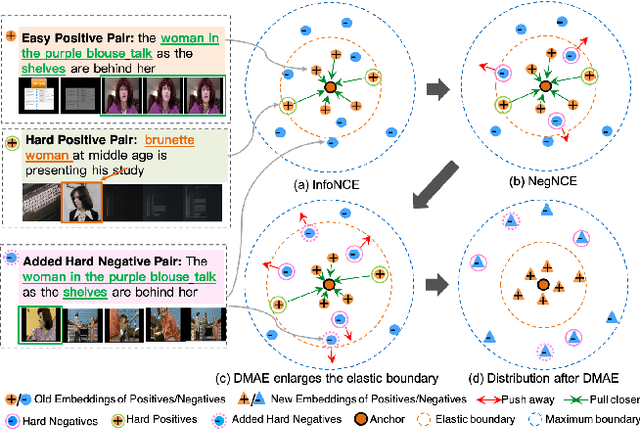
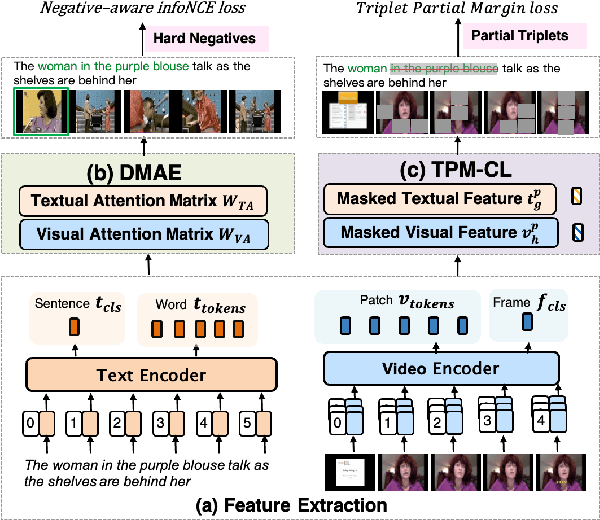
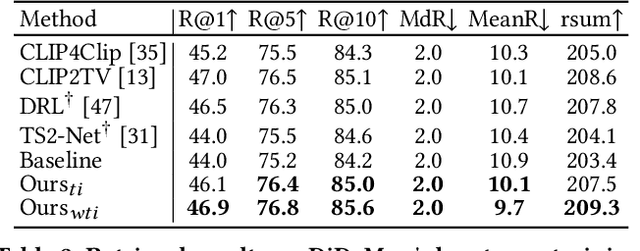
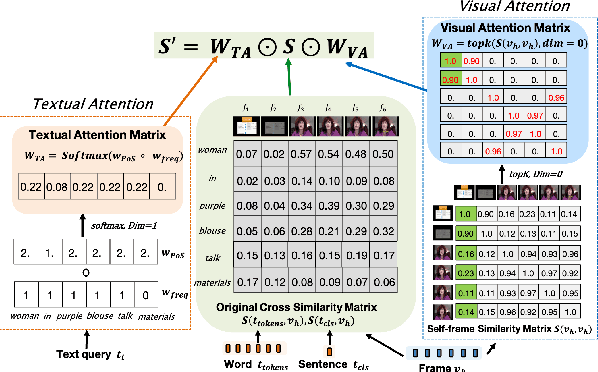
In recent years, the explosion of web videos makes text-video retrieval increasingly essential and popular for video filtering, recommendation, and search. Text-video retrieval aims to rank relevant text/video higher than irrelevant ones. The core of this task is to precisely measure the cross-modal similarity between texts and videos. Recently, contrastive learning methods have shown promising results for text-video retrieval, most of which focus on the construction of positive and negative pairs to learn text and video representations. Nevertheless, they do not pay enough attention to hard negative pairs and lack the ability to model different levels of semantic similarity. To address these two issues, this paper improves contrastive learning using two novel techniques. First, to exploit hard examples for robust discriminative power, we propose a novel Dual-Modal Attention-Enhanced Module (DMAE) to mine hard negative pairs from textual and visual clues. By further introducing a Negative-aware InfoNCE (NegNCE) loss, we are able to adaptively identify all these hard negatives and explicitly highlight their impacts in the training loss. Second, our work argues that triplet samples can better model fine-grained semantic similarity compared to pairwise samples. We thereby present a new Triplet Partial Margin Contrastive Learning (TPM-CL) module to construct partial order triplet samples by automatically generating fine-grained hard negatives for matched text-video pairs. The proposed TPM-CL designs an adaptive token masking strategy with cross-modal interaction to model subtle semantic differences. Extensive experiments demonstrate that the proposed approach outperforms existing methods on four widely-used text-video retrieval datasets, including MSR-VTT, MSVD, DiDeMo and ActivityNet.
Switch-BERT: Learning to Model Multimodal Interactions by Switching Attention and Input
Jun 25, 2023The ability to model intra-modal and inter-modal interactions is fundamental in multimodal machine learning. The current state-of-the-art models usually adopt deep learning models with fixed structures. They can achieve exceptional performances on specific tasks, but face a particularly challenging problem of modality mismatch because of diversity of input modalities and their fixed structures. In this paper, we present \textbf{Switch-BERT} for joint vision and language representation learning to address this problem. Switch-BERT extends BERT architecture by introducing learnable layer-wise and cross-layer interactions. It learns to optimize attention from a set of attention modes representing these interactions. One specific property of the model is that it learns to attend outputs from various depths, therefore mitigates the modality mismatch problem. We present extensive experiments on visual question answering, image-text retrieval and referring expression comprehension experiments. Results confirm that, whereas alternative architectures including ViLBERT and UNITER may excel in particular tasks, Switch-BERT can consistently achieve better or comparable performances than the current state-of-the-art models in these tasks. Ablation studies indicate that the proposed model achieves superior performances due to its ability in learning task-specific multimodal interactions.
Boundary-aware Backward-Compatible Representation via Adversarial Learning in Image Retrieval
May 04, 2023Image retrieval plays an important role in the Internet world. Usually, the core parts of mainstream visual retrieval systems include an online service of the embedding model and a large-scale vector database. For traditional model upgrades, the old model will not be replaced by the new one until the embeddings of all the images in the database are re-computed by the new model, which takes days or weeks for a large amount of data. Recently, backward-compatible training (BCT) enables the new model to be immediately deployed online by making the new embeddings directly comparable to the old ones. For BCT, improving the compatibility of two models with less negative impact on retrieval performance is the key challenge. In this paper, we introduce AdvBCT, an Adversarial Backward-Compatible Training method with an elastic boundary constraint that takes both compatibility and discrimination into consideration. We first employ adversarial learning to minimize the distribution disparity between embeddings of the new model and the old model. Meanwhile, we add an elastic boundary constraint during training to improve compatibility and discrimination efficiently. Extensive experiments on GLDv2, Revisited Oxford (ROxford), and Revisited Paris (RParis) demonstrate that our method outperforms other BCT methods on both compatibility and discrimination. The implementation of AdvBCT will be publicly available at https://github.com/Ashespt/AdvBCT.
A CTC Alignment-based Non-autoregressive Transformer for End-to-end Automatic Speech Recognition
Apr 15, 2023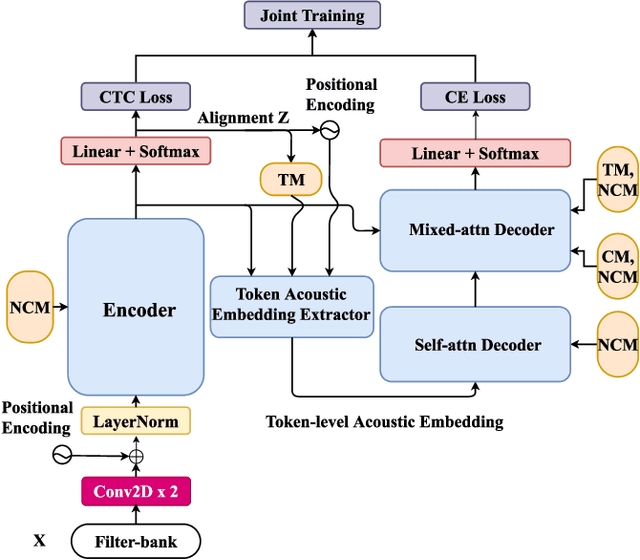
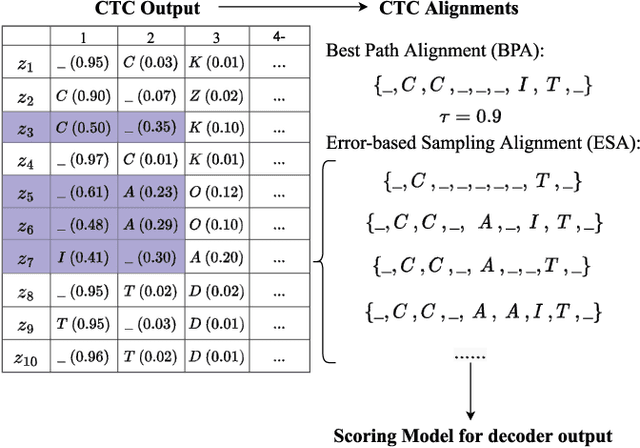
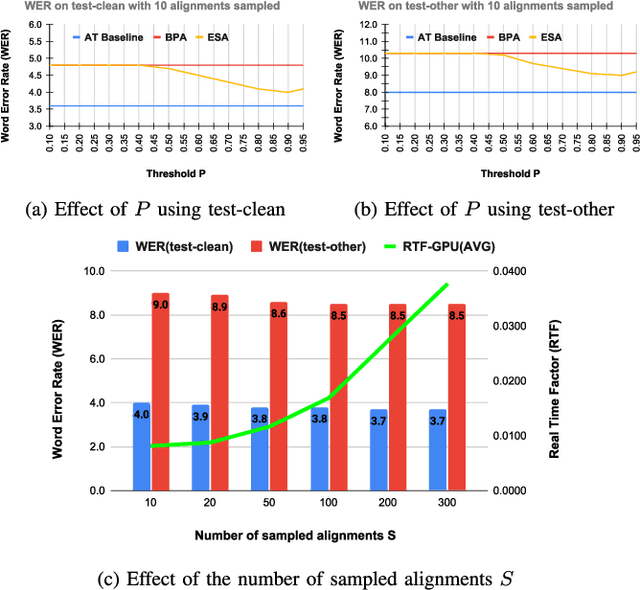
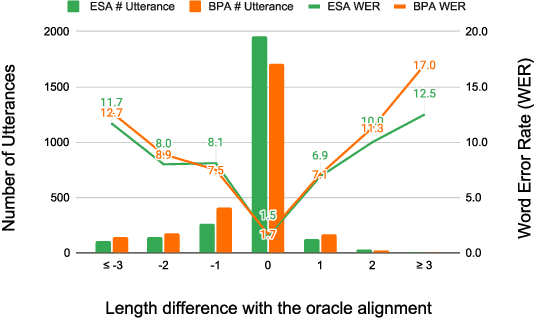
Recently, end-to-end models have been widely used in automatic speech recognition (ASR) systems. Two of the most representative approaches are connectionist temporal classification (CTC) and attention-based encoder-decoder (AED) models. Autoregressive transformers, variants of AED, adopt an autoregressive mechanism for token generation and thus are relatively slow during inference. In this paper, we present a comprehensive study of a CTC Alignment-based Single-Step Non-Autoregressive Transformer (CASS-NAT) for end-to-end ASR. In CASS-NAT, word embeddings in the autoregressive transformer (AT) are substituted with token-level acoustic embeddings (TAE) that are extracted from encoder outputs with the acoustical boundary information offered by the CTC alignment. TAE can be obtained in parallel, resulting in a parallel generation of output tokens. During training, Viterbi-alignment is used for TAE generation, and multiple training strategies are further explored to improve the word error rate (WER) performance. During inference, an error-based alignment sampling method is investigated in depth to reduce the alignment mismatch in the training and testing processes. Experimental results show that the CASS-NAT has a WER that is close to AT on various ASR tasks, while providing a ~24x inference speedup. With and without self-supervised learning, we achieve new state-of-the-art results for non-autoregressive models on several datasets. We also analyze the behavior of the CASS-NAT decoder to explain why it can perform similarly to AT. We find that TAEs have similar functionality to word embeddings for grammatical structures, which might indicate the possibility of learning some semantic information from TAEs without a language model.
DC-Former: Diverse and Compact Transformer for Person Re-Identification
Feb 28, 2023In person re-identification (re-ID) task, it is still challenging to learn discriminative representation by deep learning, due to limited data. Generally speaking, the model will get better performance when increasing the amount of data. The addition of similar classes strengthens the ability of the classifier to identify similar identities, thereby improving the discrimination of representation. In this paper, we propose a Diverse and Compact Transformer (DC-Former) that can achieve a similar effect by splitting embedding space into multiple diverse and compact subspaces. Compact embedding subspace helps model learn more robust and discriminative embedding to identify similar classes. And the fusion of these diverse embeddings containing more fine-grained information can further improve the effect of re-ID. Specifically, multiple class tokens are used in vision transformer to represent multiple embedding spaces. Then, a self-diverse constraint (SDC) is applied to these spaces to push them away from each other, which makes each embedding space diverse and compact. Further, a dynamic weight controller(DWC) is further designed for balancing the relative importance among them during training. The experimental results of our method are promising, which surpass previous state-of-the-art methods on several commonly used person re-ID benchmarks.
DRGCN: Dynamic Evolving Initial Residual for Deep Graph Convolutional Networks
Feb 10, 2023Graph convolutional networks (GCNs) have been proved to be very practical to handle various graph-related tasks. It has attracted considerable research interest to study deep GCNs, due to their potential superior performance compared with shallow ones. However, simply increasing network depth will, on the contrary, hurt the performance due to the over-smoothing problem. Adding residual connection is proved to be effective for learning deep convolutional neural networks (deep CNNs), it is not trivial when applied to deep GCNs. Recent works proposed an initial residual mechanism that did alleviate the over-smoothing problem in deep GCNs. However, according to our study, their algorithms are quite sensitive to different datasets. In their setting, the personalization (dynamic) and correlation (evolving) of how residual applies are ignored. To this end, we propose a novel model called Dynamic evolving initial Residual Graph Convolutional Network (DRGCN). Firstly, we use a dynamic block for each node to adaptively fetch information from the initial representation. Secondly, we use an evolving block to model the residual evolving pattern between layers. Our experimental results show that our model effectively relieves the problem of over-smoothing in deep GCNs and outperforms the state-of-the-art (SOTA) methods on various benchmark datasets. Moreover, we develop a mini-batch version of DRGCN which can be applied to large-scale data. Coupling with several fair training techniques, our model reaches new SOTA results on the large-scale ogbn-arxiv dataset of Open Graph Benchmark (OGB). Our reproducible code is available on GitHub.
Causal Effect Estimation: Recent Advances, Challenges, and Opportunities
Feb 02, 2023Causal inference has numerous real-world applications in many domains, such as health care, marketing, political science, and online advertising. Treatment effect estimation, a fundamental problem in causal inference, has been extensively studied in statistics for decades. However, traditional treatment effect estimation methods may not well handle large-scale and high-dimensional heterogeneous data. In recent years, an emerging research direction has attracted increasing attention in the broad artificial intelligence field, which combines the advantages of traditional treatment effect estimation approaches (e.g., propensity score, matching, and reweighing) and advanced machine learning approaches (e.g., representation learning, adversarial learning, and graph neural networks). Although the advanced machine learning approaches have shown extraordinary performance in treatment effect estimation, it also comes with a lot of new topics and new research questions. In view of the latest research efforts in the causal inference field, we provide a comprehensive discussion of challenges and opportunities for the three core components of the treatment effect estimation task, i.e., treatment, covariates, and outcome. In addition, we showcase the promising research directions of this topic from multiple perspectives.