 Add to Chrome
 Add to Firefox
 Add to Edge
How Useful is Intermittent, Asynchronous Expert Feedback for Bayesian Optimization?
Jun 10, 2024
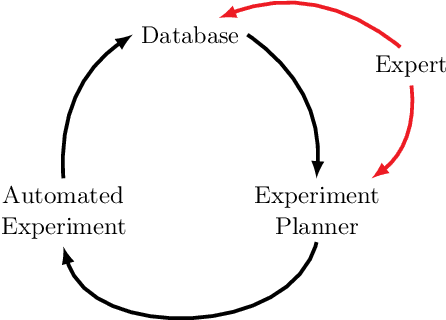
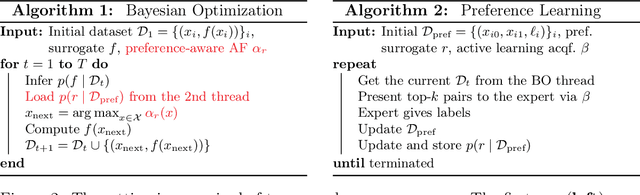
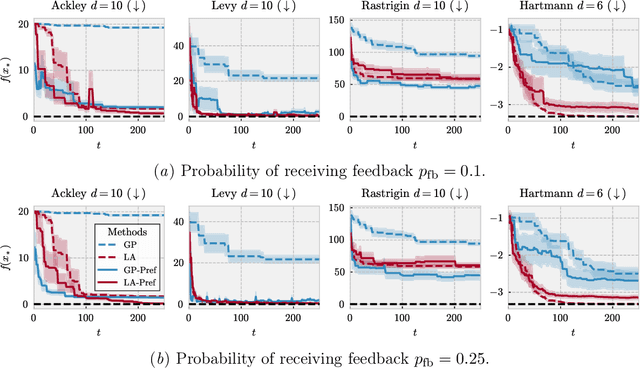

Bayesian optimization (BO) is an integral part of automated scientific discovery -- the so-called self-driving lab -- where human inputs are ideally minimal or at least non-blocking. However, scientists often have strong intuition, and thus human feedback is still useful. Nevertheless, prior works in enhancing BO with expert feedback, such as by incorporating it in an offline or online but blocking (arrives at each BO iteration) manner, are incompatible with the spirit of self-driving labs. In this work, we study whether a small amount of randomly arriving expert feedback that is being incorporated in a non-blocking manner can improve a BO campaign. To this end, we run an additional, independent computing thread on top of the BO loop to handle the feedback-gathering process. The gathered feedback is used to learn a Bayesian preference model that can readily be incorporated into the BO thread, to steer its exploration-exploitation process. Experiments on toy and chemistry datasets suggest that even just a few intermittent, asynchronous expert feedback can be useful for improving or constraining BO. This can especially be useful for its implication in improving self-driving labs, e.g. making them more data-efficient and less costly.

Gaussian Stochastic Weight Averaging for Bayesian Low-Rank Adaptation of Large Language Models
May 06, 2024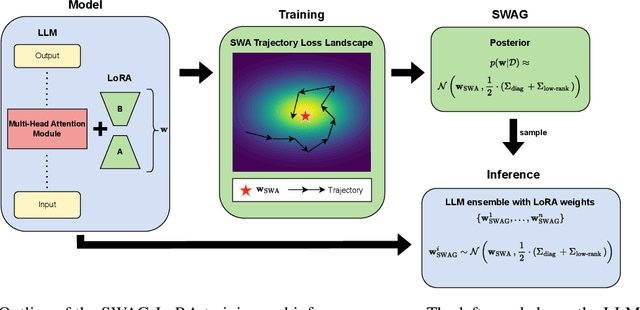
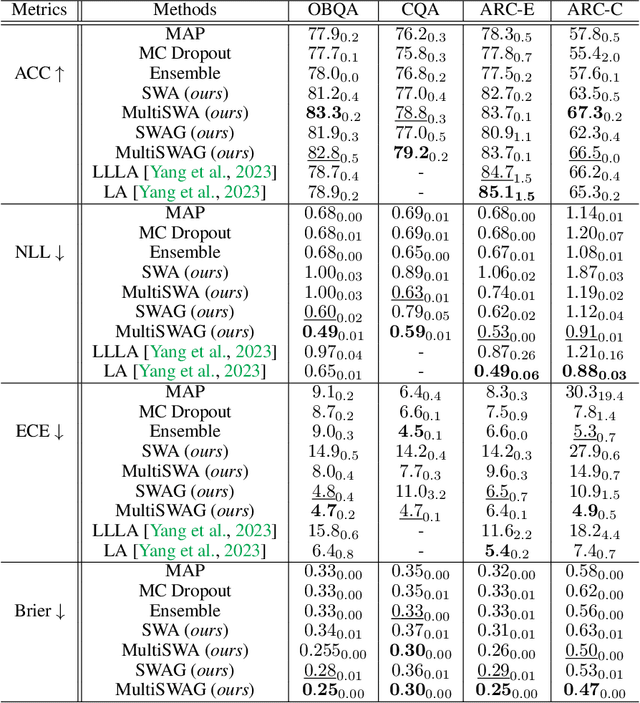
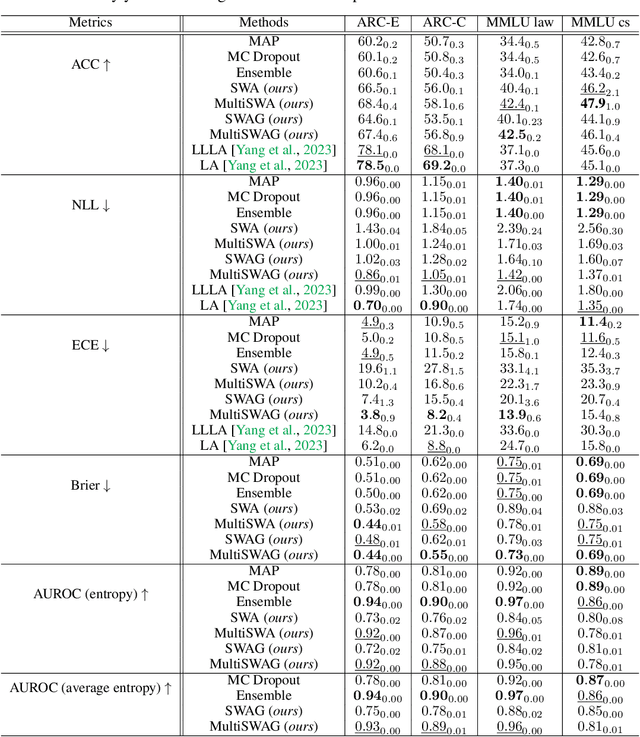
Fine-tuned Large Language Models (LLMs) often suffer from overconfidence and poor calibration, particularly when fine-tuned on small datasets. To address these challenges, we propose a simple combination of Low-Rank Adaptation (LoRA) with Gaussian Stochastic Weight Averaging (SWAG), facilitating approximate Bayesian inference in LLMs. Through extensive testing across several Natural Language Processing (NLP) benchmarks, we demonstrate that our straightforward and computationally efficient approach improves model generalization and calibration. We further show that our method exhibits greater robustness against distribution shift, as reflected in its performance on out-of-distribution tasks.
On the Challenges and Opportunities in Generative AI
Feb 28, 2024The field of deep generative modeling has grown rapidly and consistently over the years. With the availability of massive amounts of training data coupled with advances in scalable unsupervised learning paradigms, recent large-scale generative models show tremendous promise in synthesizing high-resolution images and text, as well as structured data such as videos and molecules. However, we argue that current large-scale generative AI models do not sufficiently address several fundamental issues that hinder their widespread adoption across domains. In this work, we aim to identify key unresolved challenges in modern generative AI paradigms that should be tackled to further enhance their capabilities, versatility, and reliability. By identifying these challenges, we aim to provide researchers with valuable insights for exploring fruitful research directions, thereby fostering the development of more robust and accessible generative AI solutions.
Shaving Weights with Occam's Razor: Bayesian Sparsification for Neural Networks Using the Marginal Likelihood
Feb 25, 2024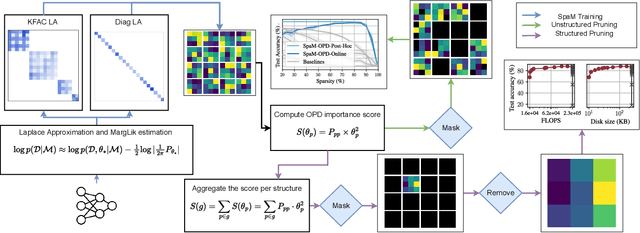
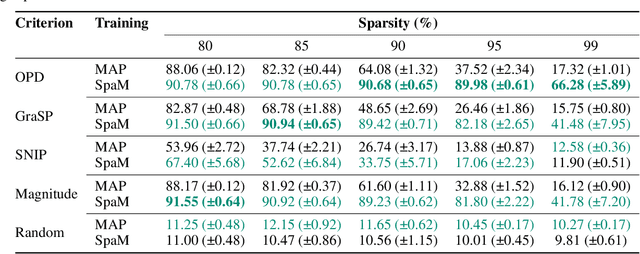
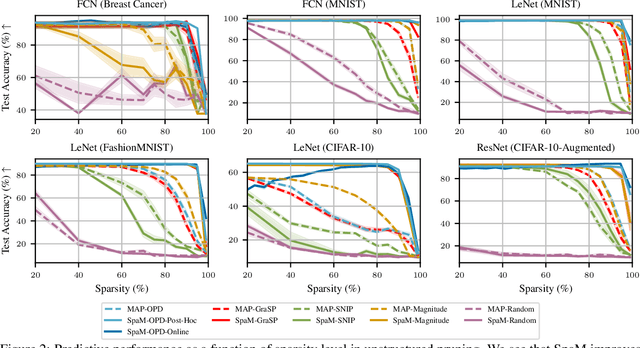
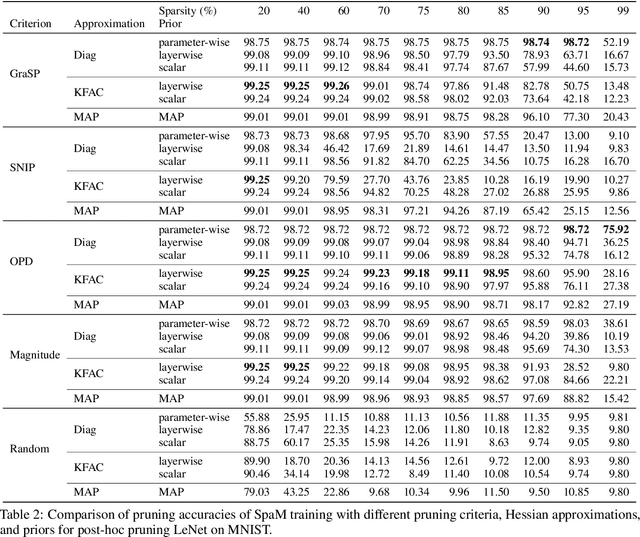
Neural network sparsification is a promising avenue to save computational time and memory costs, especially in an age where many successful AI models are becoming too large to na\"ively deploy on consumer hardware. While much work has focused on different weight pruning criteria, the overall sparsifiability of the network, i.e., its capacity to be pruned without quality loss, has often been overlooked. We present Sparsifiability via the Marginal likelihood (SpaM), a pruning framework that highlights the effectiveness of using the Bayesian marginal likelihood in conjunction with sparsity-inducing priors for making neural networks more sparsifiable. Our approach implements an automatic Occam's razor that selects the most sparsifiable model that still explains the data well, both for structured and unstructured sparsification. In addition, we demonstrate that the pre-computed posterior Hessian approximation used in the Laplace approximation can be re-used to define a cheap pruning criterion, which outperforms many existing (more expensive) approaches. We demonstrate the effectiveness of our framework, especially at high sparsity levels, across a range of different neural network architectures and datasets.
Position Paper: Bayesian Deep Learning in the Age of Large-Scale AI
Feb 06, 2024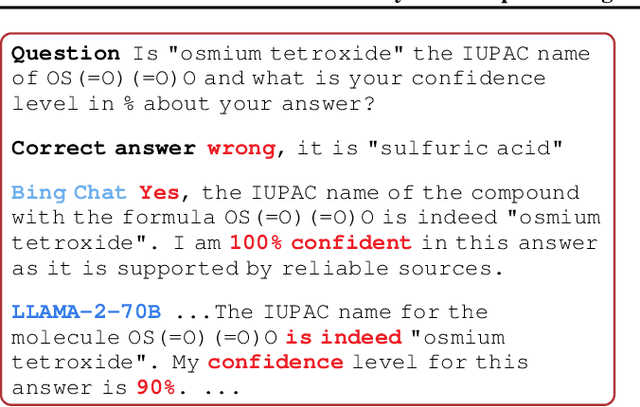

In the current landscape of deep learning research, there is a predominant emphasis on achieving high predictive accuracy in supervised tasks involving large image and language datasets. However, a broader perspective reveals a multitude of overlooked metrics, tasks, and data types, such as uncertainty, active and continual learning, and scientific data, that demand attention. Bayesian deep learning (BDL) constitutes a promising avenue, offering advantages across these diverse settings. This paper posits that BDL can elevate the capabilities of deep learning. It revisits the strengths of BDL, acknowledges existing challenges, and highlights some exciting research avenues aimed at addressing these obstacles. Looking ahead, the discussion focuses on possible ways to combine large-scale foundation models with BDL to unlock their full potential.
Uncertainty in Graph Contrastive Learning with Bayesian Neural Networks
Nov 30, 2023Graph contrastive learning has shown great promise when labeled data is scarce, but large unlabeled datasets are available. However, it often does not take uncertainty estimation into account. We show that a variational Bayesian neural network approach can be used to improve not only the uncertainty estimates but also the downstream performance on semi-supervised node-classification tasks. Moreover, we propose a new measure of uncertainty for contrastive learning, that is based on the disagreement in likelihood due to different positive samples.
Estimating optimal PAC-Bayes bounds with Hamiltonian Monte Carlo
Oct 30, 2023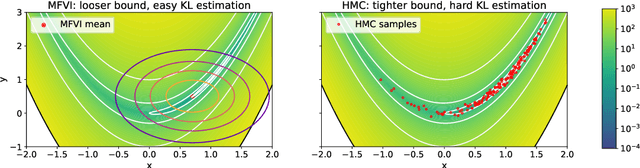

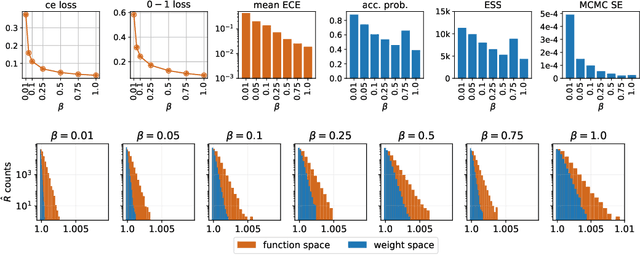
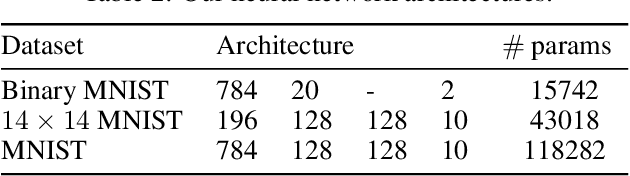
An important yet underexplored question in the PAC-Bayes literature is how much tightness we lose by restricting the posterior family to factorized Gaussian distributions when optimizing a PAC-Bayes bound. We investigate this issue by estimating data-independent PAC-Bayes bounds using the optimal posteriors, comparing them to bounds obtained using MFVI. Concretely, we (1) sample from the optimal Gibbs posterior using Hamiltonian Monte Carlo, (2) estimate its KL divergence from the prior with thermodynamic integration, and (3) propose three methods to obtain high-probability bounds under different assumptions. Our experiments on the MNIST dataset reveal significant tightness gaps, as much as 5-6\% in some cases.
A Primer on Bayesian Neural Networks: Review and Debates
Sep 28, 2023Neural networks have achieved remarkable performance across various problem domains, but their widespread applicability is hindered by inherent limitations such as overconfidence in predictions, lack of interpretability, and vulnerability to adversarial attacks. To address these challenges, Bayesian neural networks (BNNs) have emerged as a compelling extension of conventional neural networks, integrating uncertainty estimation into their predictive capabilities. This comprehensive primer presents a systematic introduction to the fundamental concepts of neural networks and Bayesian inference, elucidating their synergistic integration for the development of BNNs. The target audience comprises statisticians with a potential background in Bayesian methods but lacking deep learning expertise, as well as machine learners proficient in deep neural networks but with limited exposure to Bayesian statistics. We provide an overview of commonly employed priors, examining their impact on model behavior and performance. Additionally, we delve into the practical considerations associated with training and inference in BNNs. Furthermore, we explore advanced topics within the realm of BNN research, acknowledging the existence of ongoing debates and controversies. By offering insights into cutting-edge developments, this primer not only equips researchers and practitioners with a solid foundation in BNNs, but also illuminates the potential applications of this dynamic field. As a valuable resource, it fosters an understanding of BNNs and their promising prospects, facilitating further advancements in the pursuit of knowledge and innovation.
Hodge-Aware Contrastive Learning
Sep 14, 2023Simplicial complexes prove effective in modeling data with multiway dependencies, such as data defined along the edges of networks or within other higher-order structures. Their spectrum can be decomposed into three interpretable subspaces via the Hodge decomposition, resulting foundational in numerous applications. We leverage this decomposition to develop a contrastive self-supervised learning approach for processing simplicial data and generating embeddings that encapsulate specific spectral information.Specifically, we encode the pertinent data invariances through simplicial neural networks and devise augmentations that yield positive contrastive examples with suitable spectral properties for downstream tasks. Additionally, we reweight the significance of negative examples in the contrastive loss, considering the similarity of their Hodge components to the anchor. By encouraging a stronger separation among less similar instances, we obtain an embedding space that reflects the spectral properties of the data. The numerical results on two standard edge flow classification tasks show a superior performance even when compared to supervised learning techniques. Our findings underscore the importance of adopting a spectral perspective for contrastive learning with higher-order data.
Understanding Pathologies of Deep Heteroskedastic Regression
Jun 29, 2023Several recent studies have reported negative results when using heteroskedastic neural regression models to model real-world data. In particular, for overparameterized models, the mean and variance networks are powerful enough to either fit every single data point (while shrinking the predicted variances to zero), or to learn a constant prediction with an output variance exactly matching every predicted residual (i.e., explaining the targets as pure noise). This paper studies these difficulties from the perspective of statistical physics. We show that the observed instabilities are not specific to any neural network architecture but are already present in a field theory of an overparameterized conditional Gaussian likelihood model. Under light assumptions, we derive a nonparametric free energy that can be solved numerically. The resulting solutions show excellent qualitative agreement with empirical model fits on real-world data and, in particular, prove the existence of phase transitions, i.e., abrupt, qualitative differences in the behaviors of the regressors upon varying the regularization strengths on the two networks. Our work thus provides a theoretical explanation for the necessity to carefully regularize heteroskedastic regression models. Moreover, the insights from our theory suggest a scheme for optimizing this regularization which is quadratically more efficient than the naive approach.