 Add to Chrome
 Add to Firefox
 Add to Edge
Theoretical guidelines for annealed Langevin dynamics in compositional simulation-based inference
May 20, 2026
Compositional score-based approaches to simulation-based inference (SBI) approximate the posterior over a shared parameter given $n$ independent observations by aggregating individually learned posterior scores: currently, there are two main propositions of such methods (Geffner et al. (2023), Linhart et al. (2026)). As the resulting composite score does not correspond to the score of any distribution along the forward diffusion path of the true multi-observation posterior, sampling from it via a reverse SDE leads to an irreducible bias. Annealed Langevin dynamics provides a principled alternative: it treats the composite score as the genuine score of a sequence of tractable bridging densities and samples from them in succession. When properly tuned, it could lead to a controllable bias. However, its hyperparameters, namely step sizes, the number of steps per level, and the number of annealing levels, have so far been chosen empirically. We derive Wasserstein bounds for annealed Langevin with approximate scores and translate them into explicit decision rules for these hyperparameters that guarantee a prescribed sampling accuracy, while highlighting different theoretical aspects of each composite score formulation. In the Gaussian setting, we obtain closed-form expressions for all relevant quantities and prove that the bridging densities of Linhart et al. (2026) consistently admit larger step sizes and require fewer total Langevin steps than those of Geffner et al. (2023). Furthermore, we show empirically that the tuning obtained in the Gaussian setting generalizes to more complex problems, thus providing a well-understood and theoretically grounded starting point for practitioners using compositional score-based approaches.

$\textit{BlockFormer}$ : Transformer-based inference from interaction maps
May 20, 2026Inference from interaction maps, such as centromere identification from genome-wide chromosome conformation capture techniques -- notably Hi-C -- can be formulated as a generic inverse problem: infer a set of parameters given a map summarizing pairwise interactions between entities through blocks of variable numbers and sizes. In this work, we introduce a data-driven approach that leverages shared structure between these maps, such as global alignment between localized patterns, while handling the variability in number and size of entities arising in real-world data. Our approach relies on a transformer architecture capable of handling such variability and a custom simulator to generate abundant, yet computationally cheap synthetic data for training. Applied to the problem of centromere localization, the method accurately recovers their genomic positions across a wide range of species of various genome sizes.
Bayesian inference with sources of uncertainty: from confidence modelling to sparse estimation
May 04, 2026We introduce a general framework that extends Bayesian inference by allowing the researcher to explicitly encode confidence in each source of uncertainty within the model. This mechanism provides a new handle for model design and regularisation control. Building on this framework, we develop a general approach for inducing sparsity in statistical models and illustrate its use in linear and logistic regression, as well as in Bayesian neural networks.
Bounding Box Anomaly Scoring for simple and efficient Out-of-Distribution detection
Mar 24, 2026Out-of-distribution (OOD) detection aims to identify inputs that differ from the training distribution in order to reduce unreliable predictions by deep neural networks. Among post-hoc feature-space approaches, OOD detection is commonly performed by approximating the in-distribution support in the representation space of a pretrained network. Existing methods often reflect a trade-off between compact parametric models, such as Mahalanobis-based scores, and more flexible but reference-based methods, such as k-nearest neighbors. Bounding-box abstraction provides an attractive intermediate perspective by representing in-distribution support through compact axis-aligned summaries of hidden activations. In this paper, we introduce Bounding Box Anomaly Scoring (BBAS), a post-hoc OOD detection method that leverages bounding-box abstraction. BBAS combines graded anomaly scores based on interval exceedances, monitoring variables adapted to convolutional layers, and decoupled clustering and box construction for richer and multi-layer representations. Experiments on image-classification benchmarks show that BBAS provides robust separation between in-distribution and out-of-distribution samples while preserving the simplicity, compactness, and updateability of the bounding-box approach.
Natural Variational Annealing for Multimodal Optimization
Jan 08, 2025We introduce a new multimodal optimization approach called Natural Variational Annealing (NVA) that combines the strengths of three foundational concepts to simultaneously search for multiple global and local modes of black-box nonconvex objectives. First, it implements a simultaneous search by using variational posteriors, such as, mixtures of Gaussians. Second, it applies annealing to gradually trade off exploration for exploitation. Finally, it learns the variational search distribution using natural-gradient learning where updates resemble well-known and easy-to-implement algorithms. The three concepts come together in NVA giving rise to new algorithms and also allowing us to incorporate "fitness shaping", a core concept from evolutionary algorithms. We assess the quality of search on simulations and compare them to methods using gradient descent and evolution strategies. We also provide an application to a real-world inverse problem in planetary science.
Logarithmic Regret for Unconstrained Submodular Maximization Stochastic Bandit
Oct 11, 2024We address the online unconstrained submodular maximization problem (Online USM), in a setting with stochastic bandit feedback. In this framework, a decision-maker receives noisy rewards from a nonmonotone submodular function, taking values in a known bounded interval. This paper proposes Double-Greedy - Explore-then-Commit (DG-ETC), adapting the Double-Greedy approach from the offline and online full-information settings. DG-ETC satisfies a O(d log(dT)) problemdependent upper bound for the 1/2-approximate pseudo-regret, as well as a O(dT^{2/3}log(dT)^{1/3}) problem-free one at the same time, outperforming existing approaches. To that end, we introduce a notion of hardness for submodular functions, characterizing how difficult it is to maximize them with this type of strategy.
Just rotate it! Uncertainty estimation in closed-source models via multiple queries
May 22, 2024We propose a simple and effective method to estimate the uncertainty of closed-source deep neural network image classification models. Given a base image, our method creates multiple transformed versions and uses them to query the top-1 prediction of the closed-source model. We demonstrate significant improvements in the calibration of uncertainty estimates compared to the naive baseline of assigning 100\% confidence to all predictions. While we initially explore Gaussian perturbations, our empirical findings indicate that natural transformations, such as rotations and elastic deformations, yield even better-calibrated predictions. Furthermore, through empirical results and a straightforward theoretical analysis, we elucidate the reasons behind the superior performance of natural transformations over Gaussian noise. Leveraging these insights, we propose a transfer learning approach that further improves our calibration results.
Covariance-Adaptive Least-Squares Algorithm for Stochastic Combinatorial Semi-Bandits
Feb 23, 2024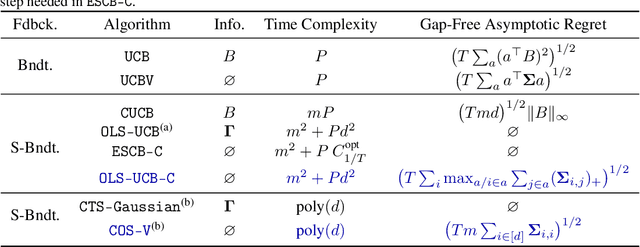
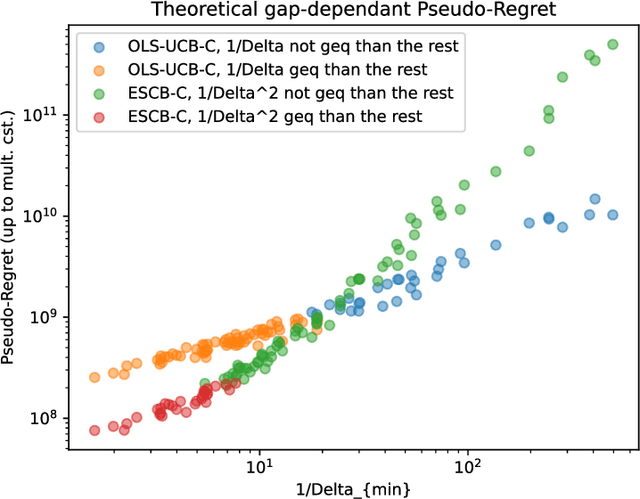
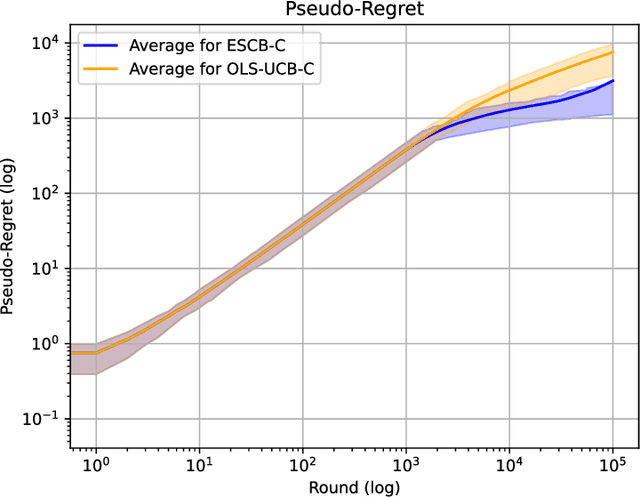
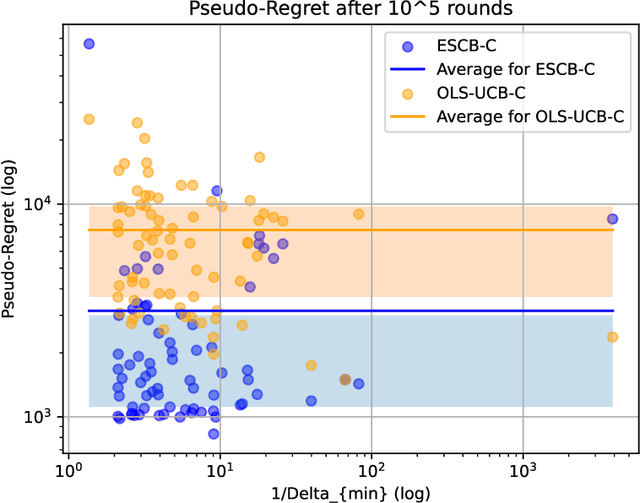
We address the problem of stochastic combinatorial semi-bandits, where a player can select from P subsets of a set containing d base items. Most existing algorithms (e.g. CUCB, ESCB, OLS-UCB) require prior knowledge on the reward distribution, like an upper bound on a sub-Gaussian proxy-variance, which is hard to estimate tightly. In this work, we design a variance-adaptive version of OLS-UCB, relying on an online estimation of the covariance structure. Estimating the coefficients of a covariance matrix is much more manageable in practical settings and results in improved regret upper bounds compared to proxy variance-based algorithms. When covariance coefficients are all non-negative, we show that our approach efficiently leverages the semi-bandit feedback and provably outperforms bandit feedback approaches, not only in exponential regimes where P $\gg$ d but also when P $\le$ d, which is not straightforward from most existing analyses.
Position Paper: Bayesian Deep Learning in the Age of Large-Scale AI
Feb 06, 2024

In the current landscape of deep learning research, there is a predominant emphasis on achieving high predictive accuracy in supervised tasks involving large image and language datasets. However, a broader perspective reveals a multitude of overlooked metrics, tasks, and data types, such as uncertainty, active and continual learning, and scientific data, that demand attention. Bayesian deep learning (BDL) constitutes a promising avenue, offering advantages across these diverse settings. This paper posits that BDL can elevate the capabilities of deep learning. It revisits the strengths of BDL, acknowledges existing challenges, and highlights some exciting research avenues aimed at addressing these obstacles. Looking ahead, the discussion focuses on possible ways to combine large-scale foundation models with BDL to unlock their full potential.
Efficient Neural Networks for Tiny Machine Learning: A Comprehensive Review
Nov 20, 2023The field of Tiny Machine Learning (TinyML) has gained significant attention due to its potential to enable intelligent applications on resource-constrained devices. This review provides an in-depth analysis of the advancements in efficient neural networks and the deployment of deep learning models on ultra-low power microcontrollers (MCUs) for TinyML applications. It begins by introducing neural networks and discussing their architectures and resource requirements. It then explores MEMS-based applications on ultra-low power MCUs, highlighting their potential for enabling TinyML on resource-constrained devices. The core of the review centres on efficient neural networks for TinyML. It covers techniques such as model compression, quantization, and low-rank factorization, which optimize neural network architectures for minimal resource utilization on MCUs. The paper then delves into the deployment of deep learning models on ultra-low power MCUs, addressing challenges such as limited computational capabilities and memory resources. Techniques like model pruning, hardware acceleration, and algorithm-architecture co-design are discussed as strategies to enable efficient deployment. Lastly, the review provides an overview of current limitations in the field, including the trade-off between model complexity and resource constraints. Overall, this review paper presents a comprehensive analysis of efficient neural networks and deployment strategies for TinyML on ultra-low-power MCUs. It identifies future research directions for unlocking the full potential of TinyML applications on resource-constrained devices.