 Add to Chrome
 Add to Firefox
 Add to Edge
Generalization in Deep Neural Networks: Minimax Rates for Gradient Methods
Jun 04, 2026
Understanding the generalization performance of over-parameterized neural networks has become a central topic in deep learning theory. While recent advances, particularly works under the Neural Tangent Kernel (NTK) regime, have shed light on the behavior of shallow architectures, the statistical generalization properties of deep neural networks (DNNs), especially in regression tasks, remain far less understood. In this paper, we make significant progress toward closing this gap by providing a comprehensive generalization analysis of DNNs trained using gradient-based methods. First, we establish, for the first time, a crucial connection between the learning dynamics of a DNN with smooth activation functions trained via gradient-based methods and those of kernel methods, showing that gradient-based methods on over-parameterized DNNs can fully inherit the favorable learning dynamics of their kernel counterparts. Building on this connection and the well-established optimality of kernel methods, we derive the first known minimax-optimal rates for the excess population risk of both gradient descent (GD) and stochastic gradient descent (SGD), under the assumption that network width scales polynomially with the sample size. Our results demonstrate that, with sufficient width, DNNs trained by GD or SGD can achieve generalization performance comparable to kernel-based methods.

Population Risk Bounds for Kolmogorov-Arnold Networks Trained by DP-SGD with Correlated Noise
May 12, 2026We establish the first population risk bounds for Kolmogorov-Arnold Networks (KANs) trained by mini-batch SGD with gradient clipping, covering non-private SGD as well as differentially private SGD (DP-SGD) with Gaussian perturbations that interpolate between independent and temporally correlated noise. This setting is substantially closer to practice than prior KAN theory along two axes: training is by mini-batch SGD, the standard recipe for modern networks, rather than full-batch gradient descent (GD); and correlated-noise mechanisms have empirically shown a more favorable privacy-utility tradeoff than independent-noise mechanisms. Our results cover the corresponding full-batch GD and independent-noise DP-GD results for KANs by Wang et al. (2026), while yielding sharper fixed-second-layer specializations. The technical core is a new analysis route for correlated-noise DP training in the non-convex regime. Temporal dependence breaks the conditional-centering structure underlying standard one-step SGD arguments, and the projection step obstructs the exact cancellation structure of correlated perturbations. We address these difficulties through an auxiliary unprojected dynamics, a shifted iterate that absorbs the current noise perturbation, and a high-probability bootstrap certifying projection inactivity. Combining this optimization analysis with a stability-based generalization argument yields the stated population risk bounds. To the best of our knowledge, this is the first optimization and population risk analysis of a correlated-noise mechanism for DP training beyond convex learning, in particular for neural networks.
Skipping the Zeros in Diffusion Models for Sparse Data Generation
May 03, 2026Diffusion models (DMs) excel on dense continuous data, but are not designed for sparse continuous data. They do not model exact zeros that represent the deliberate absence of a signal. As a result, they erase sparsity patterns and perform unnecessary computation on mostly zero entries. With Sparsity-Exploiting Diffusion (SED), we model only non-zero values, preserving sparsity. SED delivers computational savings while maintaining or improving generation quality by skipping zeros during training and inference. Across physics and biology benchmarks, SED matches or surpasses conventional DMs and domain-specific baselines, while vision experiments provide intuitive insights into the limitations of dense DMs and the benefits of SED.
Credal Concept Bottleneck Models: Structural Separation of Epistemic and Aleatoric Uncertainty
Feb 11, 2026Decomposing predictive uncertainty into epistemic (model ignorance) and aleatoric (data ambiguity) components is central to reliable decision making, yet most methods estimate both from the same predictive distribution. Recent empirical and theoretical results show these estimates are typically strongly correlated, so changes in predictive spread simultaneously affect both components and blur their semantics. We propose a credal-set formulation in which uncertainty is represented as a set of predictive distributions, so that epistemic and aleatoric uncertainty correspond to distinct geometric properties: the size of the set versus the noise within its elements. We instantiate this idea in a Variational Credal Concept Bottleneck Model with two disjoint uncertainty heads trained by disjoint objectives and non-overlapping gradient paths, yielding separation by construction rather than post hoc decomposition. Across multi-annotator benchmarks, our approach reduces the correlation between epistemic and aleatoric uncertainty by over an order of magnitude compared to standard methods, while improving the alignment of epistemic uncertainty with prediction error and aleatoric uncertainty with ground-truth ambiguity.
Optimization, Generalization and Differential Privacy Bounds for Gradient Descent on Kolmogorov-Arnold Networks
Jan 29, 2026Kolmogorov--Arnold Networks (KANs) have recently emerged as a structured alternative to standard MLPs, yet a principled theory for their training dynamics, generalization, and privacy properties remains limited. In this paper, we analyze gradient descent (GD) for training two-layer KANs and derive general bounds that characterize their training dynamics, generalization, and utility under differential privacy (DP). As a concrete instantiation, we specialize our analysis to logistic loss under an NTK-separable assumption, where we show that polylogarithmic network width suffices for GD to achieve an optimization rate of order $1/T$ and a generalization rate of order $1/n$, with $T$ denoting the number of GD iterations and $n$ the sample size. In the private setting, we characterize the noise required for $(ε,δ)$-DP and obtain a utility bound of order $\sqrt{d}/(nε)$ (with $d$ the input dimension), matching the classical lower bound for general convex Lipschitz problems. Our results imply that polylogarithmic width is not only sufficient but also necessary under differential privacy, revealing a qualitative gap between non-private (sufficiency only) and private (necessity also emerges) training regimes. Experiments further illustrate how these theoretical insights can guide practical choices, including network width selection and early stopping.
Multi-level Supervised Contrastive Learning
Feb 05, 2025


Contrastive learning is a well-established paradigm in representation learning. The standard framework of contrastive learning minimizes the distance between "similar" instances and maximizes the distance between dissimilar ones in the projection space, disregarding the various aspects of similarity that can exist between two samples. Current methods rely on a single projection head, which fails to capture the full complexity of different aspects of a sample, leading to suboptimal performance, especially in scenarios with limited training data. In this paper, we present a novel supervised contrastive learning method in a unified framework called multilevel contrastive learning (MLCL), that can be applied to both multi-label and hierarchical classification tasks. The key strength of the proposed method is the ability to capture similarities between samples across different labels and/or hierarchies using multiple projection heads. Extensive experiments on text and image datasets demonstrate that the proposed approach outperforms state-of-the-art contrastive learning methods
Sparse Data Generation Using Diffusion Models
Feb 04, 2025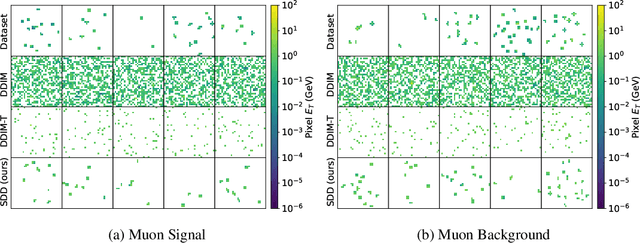
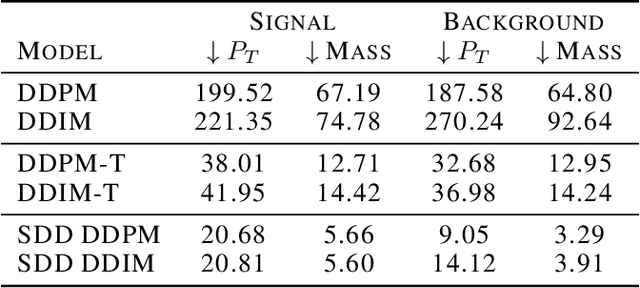
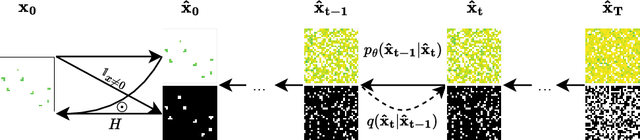
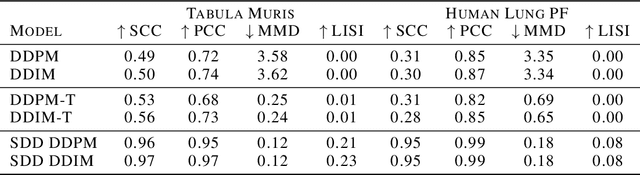
Sparse data is ubiquitous, appearing in numerous domains, from economics and recommender systems to astronomy and biomedical sciences. However, efficiently and realistically generating sparse data remains a significant challenge. We introduce Sparse Data Diffusion (SDD), a novel method for generating sparse data. SDD extends continuous state-space diffusion models by explicitly modeling sparsity through the introduction of Sparsity Bits. Empirical validation on image data from various domains-including two scientific applications, physics and biology-demonstrates that SDD achieves high fidelity in representing data sparsity while preserving the quality of the generated data.
Challenging Assumptions in Learning Generic Text Style Embeddings
Jan 27, 2025
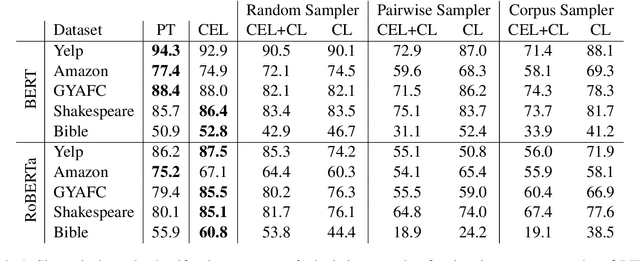

Recent advancements in language representation learning primarily emphasize language modeling for deriving meaningful representations, often neglecting style-specific considerations. This study addresses this gap by creating generic, sentence-level style embeddings crucial for style-centric tasks. Our approach is grounded on the premise that low-level text style changes can compose any high-level style. We hypothesize that applying this concept to representation learning enables the development of versatile text style embeddings. By fine-tuning a general-purpose text encoder using contrastive learning and standard cross-entropy loss, we aim to capture these low-level style shifts, anticipating that they offer insights applicable to high-level text styles. The outcomes prompt us to reconsider the underlying assumptions as the results do not always show that the learned style representations capture high-level text styles.
Towards Graph Foundation Models: A Study on the Generalization of Positional and Structural Encodings
Dec 10, 2024Recent advances in integrating positional and structural encodings (PSEs) into graph neural networks (GNNs) have significantly enhanced their performance across various graph learning tasks. However, the general applicability of these encodings and their potential to serve as foundational representations for graphs remain uncertain. This paper investigates the fine-tuning efficiency, scalability with sample size, and generalization capability of learnable PSEs across diverse graph datasets. Specifically, we evaluate their potential as universal pre-trained models that can be easily adapted to new tasks with minimal fine-tuning and limited data. Furthermore, we assess the expressivity of the learned representations, particularly, when used to augment downstream GNNs. We demonstrate through extensive benchmarking and empirical analysis that PSEs generally enhance downstream models. However, some datasets may require specific PSE-augmentations to achieve optimal performance. Nevertheless, our findings highlight their significant potential to become integral components of future graph foundation models. We provide new insights into the strengths and limitations of PSEs, contributing to the broader discourse on foundation models in graph learning.
SetPINNs: Set-based Physics-informed Neural Networks
Sep 30, 2024Physics-Informed Neural Networks (PINNs) have emerged as a promising method for approximating solutions to partial differential equations (PDEs) using deep learning. However, PINNs, based on multilayer perceptrons (MLP), often employ point-wise predictions, overlooking the implicit dependencies within the physical system such as temporal or spatial dependencies. These dependencies can be captured using more complex network architectures, for example CNNs or Transformers. However, these architectures conventionally do not allow for incorporating physical constraints, as advancements in integrating such constraints within these frameworks are still lacking. Relying on point-wise predictions often results in trivial solutions. To address this limitation, we propose SetPINNs, a novel approach inspired by Finite Elements Methods from the field of Numerical Analysis. SetPINNs allow for incorporating the dependencies inherent in the physical system while at the same time allowing for incorporating the physical constraints. They accurately approximate PDE solutions of a region, thereby modeling the inherent dependencies between multiple neighboring points in that region. Our experiments show that SetPINNs demonstrate superior generalization performance and accuracy across diverse physical systems, showing that they mitigate failure modes and converge faster in comparison to existing approaches. Furthermore, we demonstrate the utility of SetPINNs on two real-world physical systems.