 Add to Chrome
 Add to Firefox
 Add to Edge
S$^3$GNN: Efficient Global Mixing and Local Message Passing for Long-Range Graph Learning
May 22, 2026
Message-passing neural networks (MPNNs) often suffer from an information bottleneck when capturing long-range dependencies, leading to the oversquashing (OSQ) phenomenon. Alongside spatial connectivity enrichment (e.g., rewiring), recent studies have shown that spectral filtering can yield strong long-range learning outcomes, as spectral operators enable global information mixing that alleviates OSQ. These approaches achieve this either by stabilizing the Jacobian energies in deep propagation or by guaranteeing OSQ mitigation under strong theoretical assumptions. We revisit these conclusions and show that the associated Jacobian sensitivity lower bound is generally difficult to achieve in practice. We then propose S$^3$GNN, which mitigates OSQ without such restrictive assumptions by lightweightly reintroducing omitted components with substantially lower computational complexity, while standard stability constraints on feature transformations remain effective under our new dynamics. Extensive experiments across diverse domains (e.g., long-range benchmarks, KGQA, and mesh-based fluid dynamics) demonstrate that S$^3$GNN achieves up to an order-of-magnitude error reduction with up to 50\% fewer parameters. Our code can be found in https://github.com/EEthanShi/S3-GNN.git.

Estimating optimal PAC-Bayes bounds with Hamiltonian Monte Carlo
Oct 30, 2023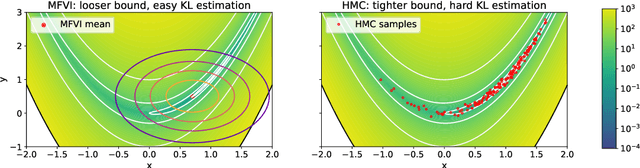

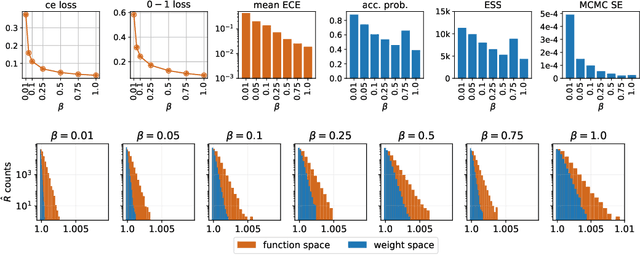
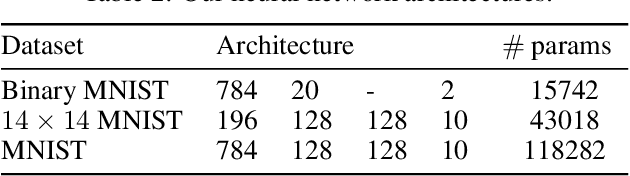
An important yet underexplored question in the PAC-Bayes literature is how much tightness we lose by restricting the posterior family to factorized Gaussian distributions when optimizing a PAC-Bayes bound. We investigate this issue by estimating data-independent PAC-Bayes bounds using the optimal posteriors, comparing them to bounds obtained using MFVI. Concretely, we (1) sample from the optimal Gibbs posterior using Hamiltonian Monte Carlo, (2) estimate its KL divergence from the prior with thermodynamic integration, and (3) propose three methods to obtain high-probability bounds under different assumptions. Our experiments on the MNIST dataset reveal significant tightness gaps, as much as 5-6\% in some cases.