 Add to Chrome
 Add to Firefox
 Add to Edge
3D Congealing: 3D-Aware Image Alignment in the Wild
Apr 02, 2024

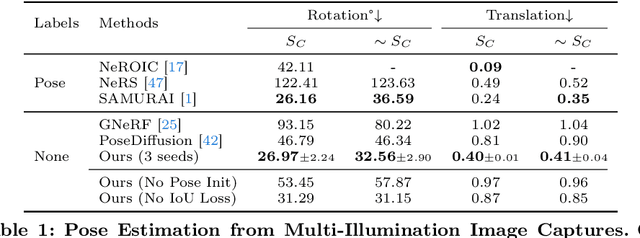


We propose 3D Congealing, a novel problem of 3D-aware alignment for 2D images capturing semantically similar objects. Given a collection of unlabeled Internet images, our goal is to associate the shared semantic parts from the inputs and aggregate the knowledge from 2D images to a shared 3D canonical space. We introduce a general framework that tackles the task without assuming shape templates, poses, or any camera parameters. At its core is a canonical 3D representation that encapsulates geometric and semantic information. The framework optimizes for the canonical representation together with the pose for each input image, and a per-image coordinate map that warps 2D pixel coordinates to the 3D canonical frame to account for the shape matching. The optimization procedure fuses prior knowledge from a pre-trained image generative model and semantic information from input images. The former provides strong knowledge guidance for this under-constraint task, while the latter provides the necessary information to mitigate the training data bias from the pre-trained model. Our framework can be used for various tasks such as correspondence matching, pose estimation, and image editing, achieving strong results on real-world image datasets under challenging illumination conditions and on in-the-wild online image collections.

WordRobe: Text-Guided Generation of Textured 3D Garments
Mar 26, 2024In this paper, we tackle a new and challenging problem of text-driven generation of 3D garments with high-quality textures. We propose "WordRobe", a novel framework for the generation of unposed & textured 3D garment meshes from user-friendly text prompts. We achieve this by first learning a latent representation of 3D garments using a novel coarse-to-fine training strategy and a loss for latent disentanglement, promoting better latent interpolation. Subsequently, we align the garment latent space to the CLIP embedding space in a weakly supervised manner, enabling text-driven 3D garment generation and editing. For appearance modeling, we leverage the zero-shot generation capability of ControlNet to synthesize view-consistent texture maps in a single feed-forward inference step, thereby drastically decreasing the generation time as compared to existing methods. We demonstrate superior performance over current SOTAs for learning 3D garment latent space, garment interpolation, and text-driven texture synthesis, supported by quantitative evaluation and qualitative user study. The unposed 3D garment meshes generated using WordRobe can be directly fed to standard cloth simulation & animation pipelines without any post-processing.
SV3D: Novel Multi-view Synthesis and 3D Generation from a Single Image using Latent Video Diffusion
Mar 18, 2024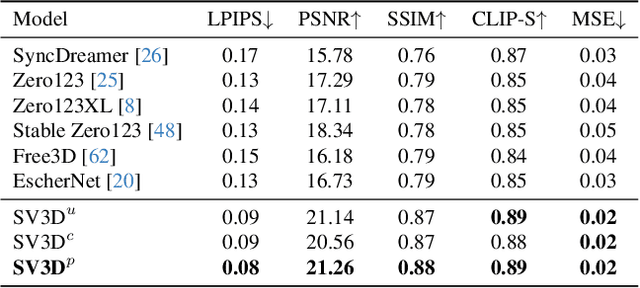
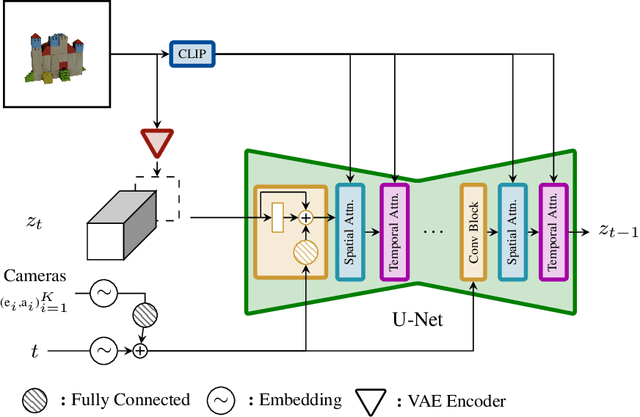
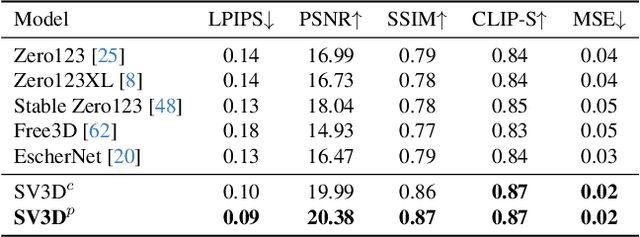
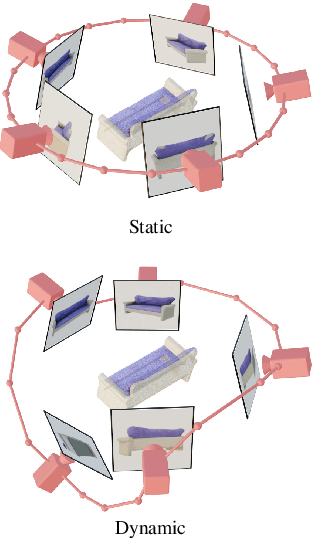
We present Stable Video 3D (SV3D) -- a latent video diffusion model for high-resolution, image-to-multi-view generation of orbital videos around a 3D object. Recent work on 3D generation propose techniques to adapt 2D generative models for novel view synthesis (NVS) and 3D optimization. However, these methods have several disadvantages due to either limited views or inconsistent NVS, thereby affecting the performance of 3D object generation. In this work, we propose SV3D that adapts image-to-video diffusion model for novel multi-view synthesis and 3D generation, thereby leveraging the generalization and multi-view consistency of the video models, while further adding explicit camera control for NVS. We also propose improved 3D optimization techniques to use SV3D and its NVS outputs for image-to-3D generation. Extensive experimental results on multiple datasets with 2D and 3D metrics as well as user study demonstrate SV3D's state-of-the-art performance on NVS as well as 3D reconstruction compared to prior works.
TripoSR: Fast 3D Object Reconstruction from a Single Image
Mar 04, 2024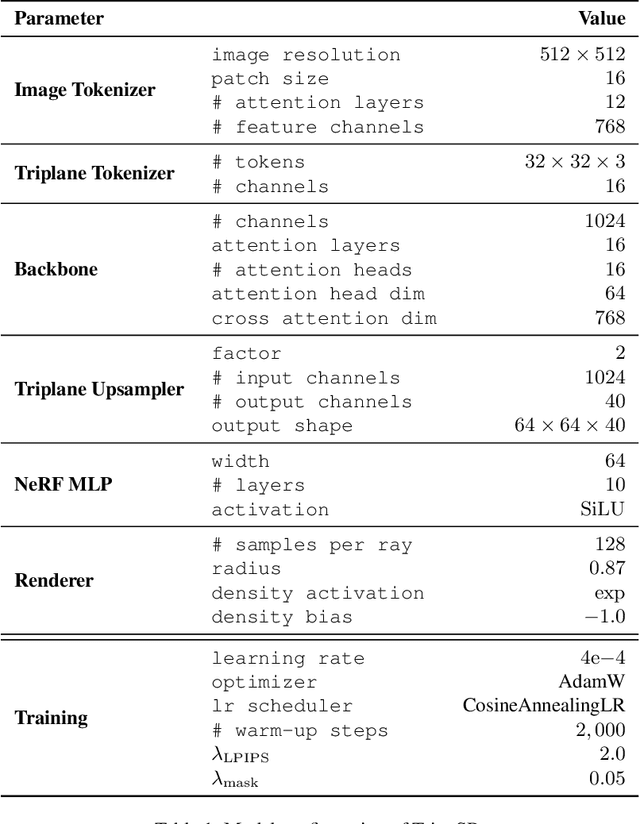
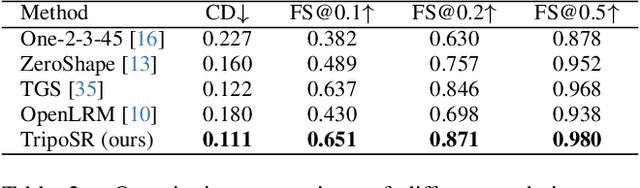
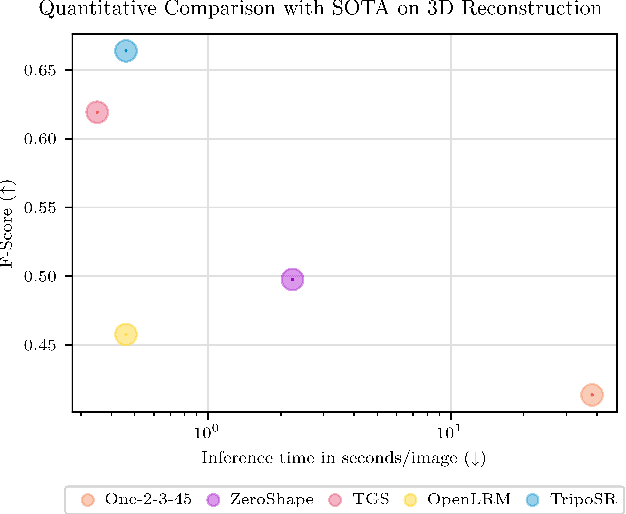
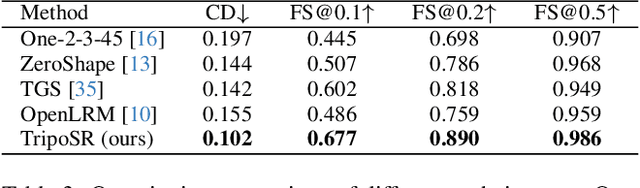
This technical report introduces TripoSR, a 3D reconstruction model leveraging transformer architecture for fast feed-forward 3D generation, producing 3D mesh from a single image in under 0.5 seconds. Building upon the LRM network architecture, TripoSR integrates substantial improvements in data processing, model design, and training techniques. Evaluations on public datasets show that TripoSR exhibits superior performance, both quantitatively and qualitatively, compared to other open-source alternatives. Released under the MIT license, TripoSR is intended to empower researchers, developers, and creatives with the latest advancements in 3D generative AI.
SHINOBI: Shape and Illumination using Neural Object Decomposition via BRDF Optimization In-the-wild
Jan 18, 2024We present SHINOBI, an end-to-end framework for the reconstruction of shape, material, and illumination from object images captured with varying lighting, pose, and background. Inverse rendering of an object based on unconstrained image collections is a long-standing challenge in computer vision and graphics and requires a joint optimization over shape, radiance, and pose. We show that an implicit shape representation based on a multi-resolution hash encoding enables faster and robust shape reconstruction with joint camera alignment optimization that outperforms prior work. Further, to enable the editing of illumination and object reflectance (i.e. material) we jointly optimize BRDF and illumination together with the object's shape. Our method is class-agnostic and works on in-the-wild image collections of objects to produce relightable 3D assets for several use cases such as AR/VR, movies, games, etc. Project page: https://shinobi.aengelhardt.com Video: https://www.youtube.com/watch?v=iFENQ6AcYd8&feature=youtu.be
ZeroShape: Regression-based Zero-shot Shape Reconstruction
Jan 16, 2024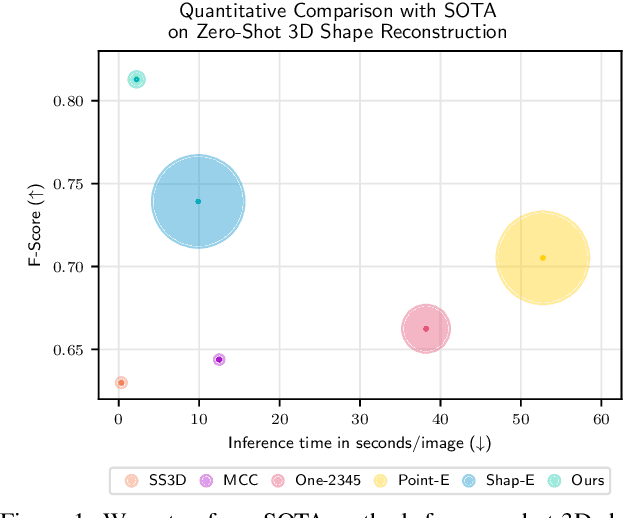
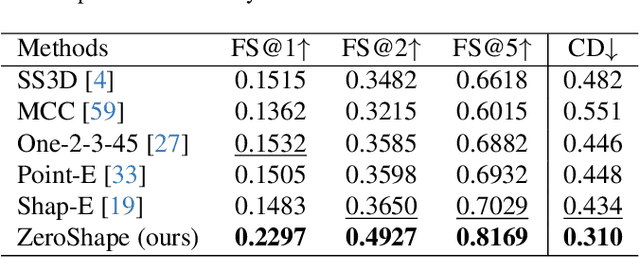
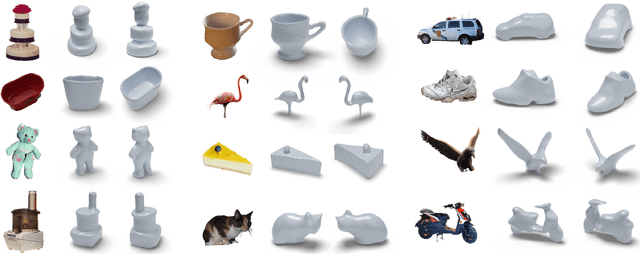
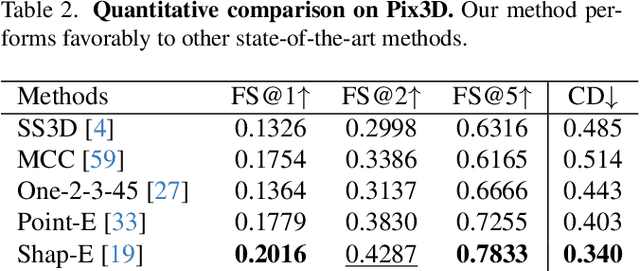
We study the problem of single-image zero-shot 3D shape reconstruction. Recent works learn zero-shot shape reconstruction through generative modeling of 3D assets, but these models are computationally expensive at train and inference time. In contrast, the traditional approach to this problem is regression-based, where deterministic models are trained to directly regress the object shape. Such regression methods possess much higher computational efficiency than generative methods. This raises a natural question: is generative modeling necessary for high performance, or conversely, are regression-based approaches still competitive? To answer this, we design a strong regression-based model, called ZeroShape, based on the converging findings in this field and a novel insight. We also curate a large real-world evaluation benchmark, with objects from three different real-world 3D datasets. This evaluation benchmark is more diverse and an order of magnitude larger than what prior works use to quantitatively evaluate their models, aiming at reducing the evaluation variance in our field. We show that ZeroShape not only achieves superior performance over state-of-the-art methods, but also demonstrates significantly higher computational and data efficiency.
Dress-Me-Up: A Dataset & Method for Self-Supervised 3D Garment Retargeting
Jan 06, 2024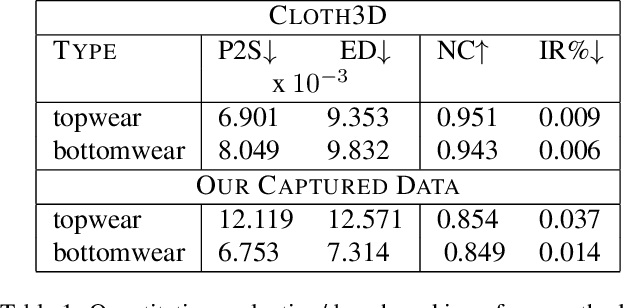
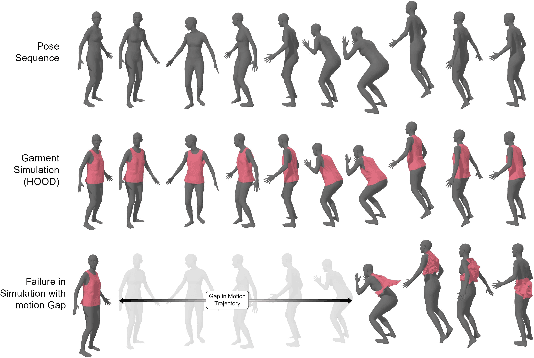
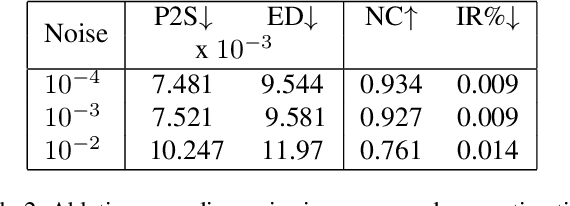
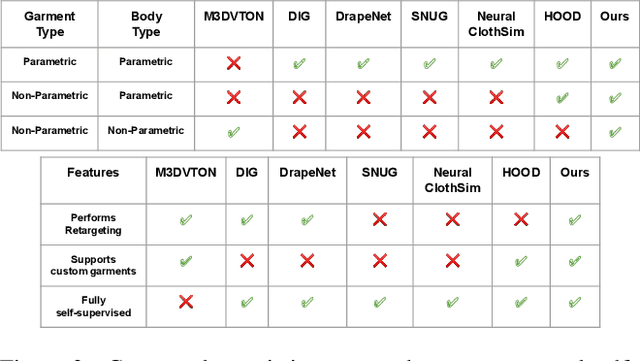
We propose a novel self-supervised framework for retargeting non-parameterized 3D garments onto 3D human avatars of arbitrary shapes and poses, enabling 3D virtual try-on (VTON). Existing self-supervised 3D retargeting methods only support parametric and canonical garments, which can only be draped over parametric body, e.g. SMPL. To facilitate the non-parametric garments and body, we propose a novel method that introduces Isomap Embedding based correspondences matching between the garment and the human body to get a coarse alignment between the two meshes. We perform neural refinement of the coarse alignment in a self-supervised setting. Further, we leverage a Laplacian detail integration method for preserving the inherent details of the input garment. For evaluating our 3D non-parametric garment retargeting framework, we propose a dataset of 255 real-world garments with realistic noise and topological deformations. The dataset contains $44$ unique garments worn by 15 different subjects in 5 distinctive poses, captured using a multi-view RGBD capture setup. We show superior retargeting quality on non-parametric garments and human avatars over existing state-of-the-art methods, acting as the first-ever baseline on the proposed dataset for non-parametric 3D garment retargeting.
DiffusionLight: Light Probes for Free by Painting a Chrome Ball
Jan 01, 2024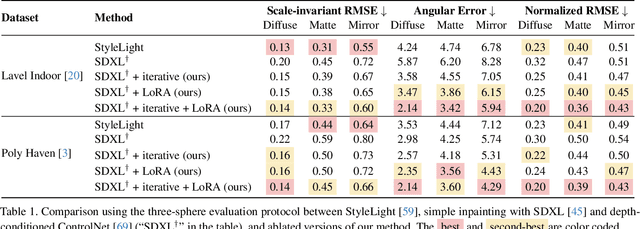
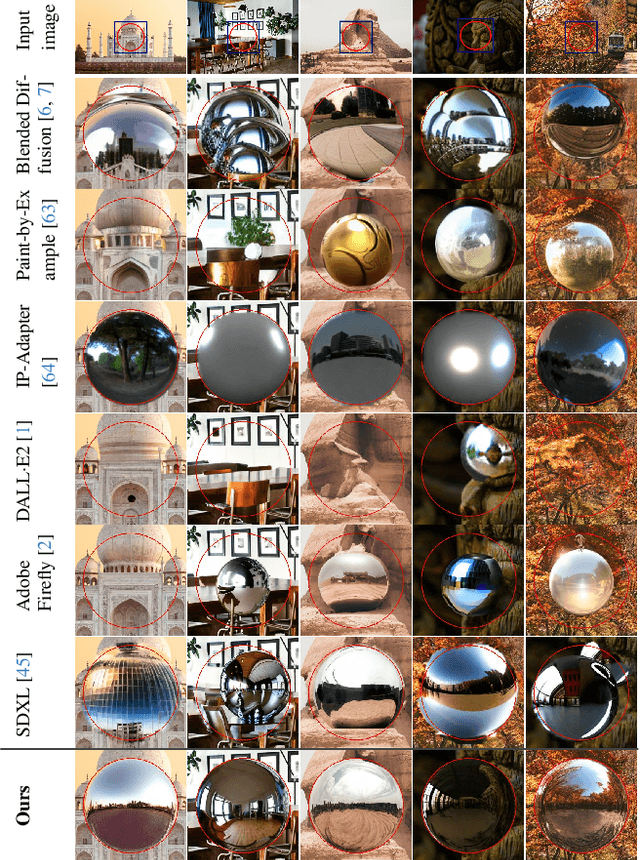
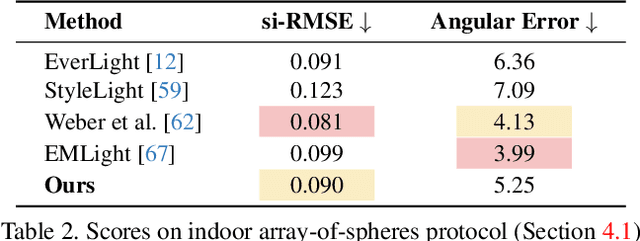
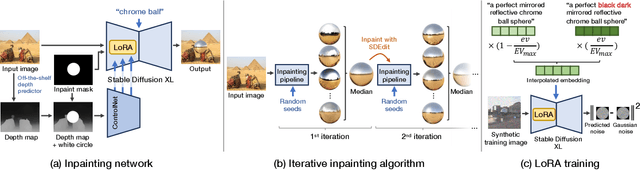
We present a simple yet effective technique to estimate lighting in a single input image. Current techniques rely heavily on HDR panorama datasets to train neural networks to regress an input with limited field-of-view to a full environment map. However, these approaches often struggle with real-world, uncontrolled settings due to the limited diversity and size of their datasets. To address this problem, we leverage diffusion models trained on billions of standard images to render a chrome ball into the input image. Despite its simplicity, this task remains challenging: the diffusion models often insert incorrect or inconsistent objects and cannot readily generate images in HDR format. Our research uncovers a surprising relationship between the appearance of chrome balls and the initial diffusion noise map, which we utilize to consistently generate high-quality chrome balls. We further fine-tune an LDR difusion model (Stable Diffusion XL) with LoRA, enabling it to perform exposure bracketing for HDR light estimation. Our method produces convincing light estimates across diverse settings and demonstrates superior generalization to in-the-wild scenarios.
HOI-Diff: Text-Driven Synthesis of 3D Human-Object Interactions using Diffusion Models
Dec 11, 2023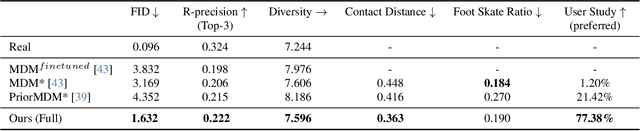
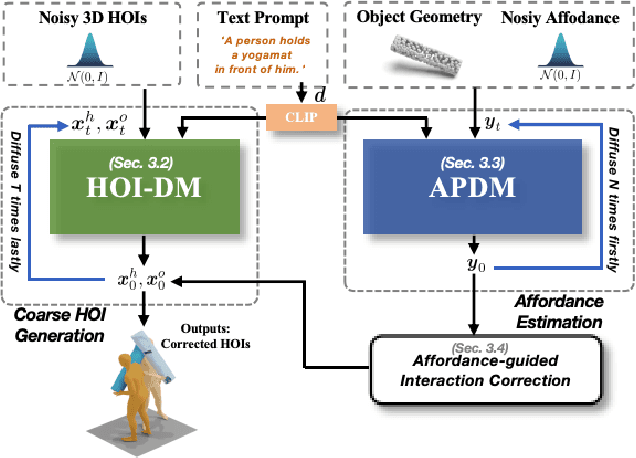
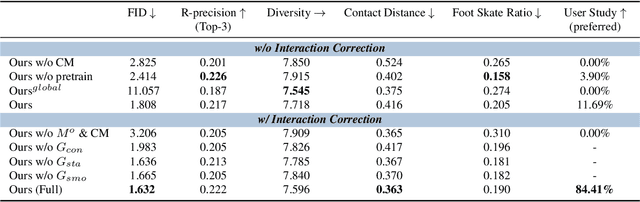
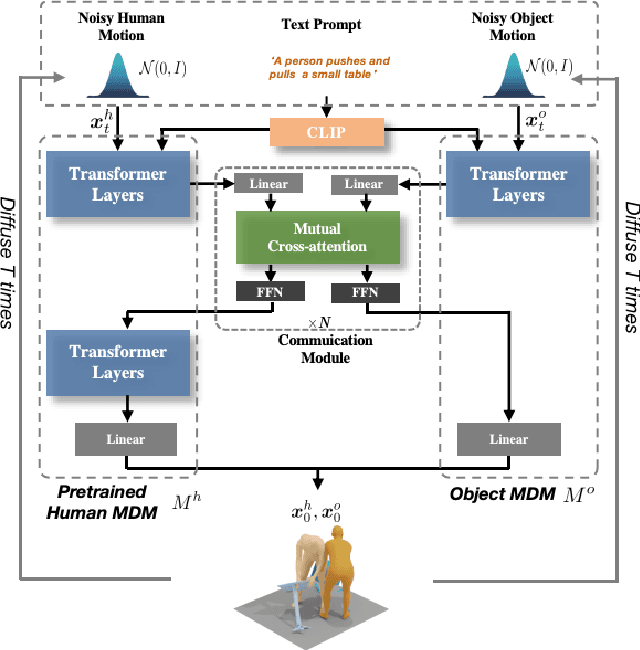
We address the problem of generating realistic 3D human-object interactions (HOIs) driven by textual prompts. Instead of a single model, our key insight is to take a modular design and decompose the complex task into simpler sub-tasks. We first develop a dual-branch diffusion model (HOI-DM) to generate both human and object motions conditioning on the input text, and encourage coherent motions by a cross-attention communication module between the human and object motion generation branches. We also develop an affordance prediction diffusion model (APDM) to predict the contacting area between the human and object during the interactions driven by the textual prompt. The APDM is independent of the results by the HOI-DM and thus can correct potential errors by the latter. Moreover, it stochastically generates the contacting points to diversify the generated motions. Finally, we incorporate the estimated contacting points into the classifier-guidance to achieve accurate and close contact between humans and objects. To train and evaluate our approach, we annotate BEHAVE dataset with text descriptions. Experimental results demonstrate that our approach is able to produce realistic HOIs with various interactions and different types of objects.
NeRFiller: Completing Scenes via Generative 3D Inpainting
Dec 07, 2023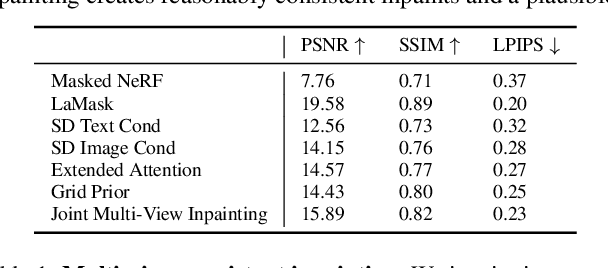
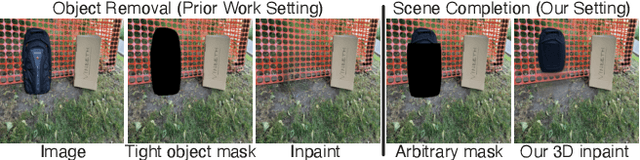
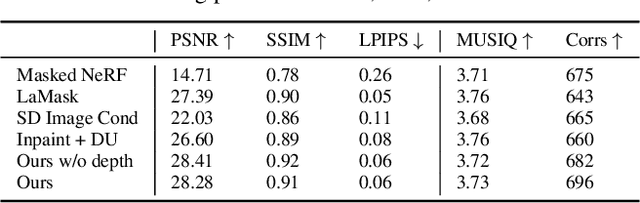
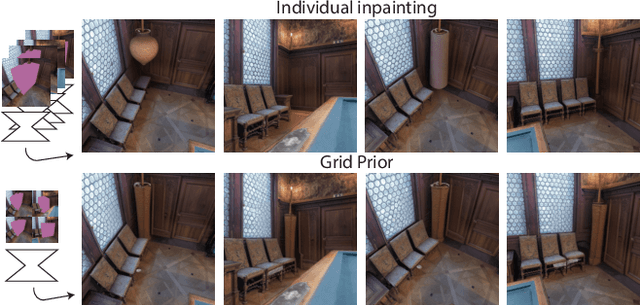
We propose NeRFiller, an approach that completes missing portions of a 3D capture via generative 3D inpainting using off-the-shelf 2D visual generative models. Often parts of a captured 3D scene or object are missing due to mesh reconstruction failures or a lack of observations (e.g., contact regions, such as the bottom of objects, or hard-to-reach areas). We approach this challenging 3D inpainting problem by leveraging a 2D inpainting diffusion model. We identify a surprising behavior of these models, where they generate more 3D consistent inpaints when images form a 2$\times$2 grid, and show how to generalize this behavior to more than four images. We then present an iterative framework to distill these inpainted regions into a single consistent 3D scene. In contrast to related works, we focus on completing scenes rather than deleting foreground objects, and our approach does not require tight 2D object masks or text. We compare our approach to relevant baselines adapted to our setting on a variety of scenes, where NeRFiller creates the most 3D consistent and plausible scene completions. Our project page is at https://ethanweber.me/nerfiller.