 Add to Chrome
 Add to Firefox
 Add to Edge
Towards Expert-level Medical AI for Real-time Video Consultations
Aug 10, 2026
Audio-visual interaction is the standard for patient-physician consultations, enabling natural communication and effective assessment of illness through non-verbal cues. While text-based AI has shown promise, it discards essential perceptual dimensions and limits patients who cannot articulate symptoms in writing. Early efforts to extend medical AI to audio-visual interaction have demonstrated feasibility but not reached clinician-level performance. Here, we provide the first demonstration of expert-level AI in real-time clinical video consultations using AMIE (Articulate Medical Intelligence Explorer) in a video configuration. AMIE (Video) is a Gemini-based multi-agent system integrating low-latency dialogue, clinical reasoning, and real-time audio-visual perception. To guide development, we established a taxonomy and automated evaluations for clinical audio-visual cues in telehealth settings. In a randomized Objective Structured Clinical Examination (OSCE) study with 30 primary care physicians (PCPs), 15 patient actors and 100 clinical scenarios, we compared AMIE (Video), its text-only counterpart AMIE (Text), and PCPs consulting via video. Clinical evaluators rated AMIE (Video) on par or better than PCPs in history-taking, diagnosis, management, and physical observation and examination. Patient actors preferred AMIE's approach to assessing and explaining conditions, while PCPs were preferred for rapport and partnership building. In modality ablation, patient actors preferred AMIE (Video)'s interface over text chat for communicative effectiveness, convenience, and feeling understood. Limitations remain in fine anatomical precision, subtle affective nuances, and high-frequency movements. While further research is needed before real-world translation, these results mark an important milestone toward AI systems capable of augmenting care across the sensory complexity of clinical practice.

ResidencyRL: Reinforcement Learning in Simulated Clinical Environments
Aug 07, 2026In medical education, physicians convert academic knowledge into clinical expertise through residency: years of training across thousands of encounters, with diverse sources of feedback and progressively greater autonomy. Much of clinical reasoning relies on the patient encounter, a dialogue in which a clinician elicits history, refines diagnostic hypotheses, and decides management under uncertainty. While large language models (LLMs) excel on static medical benchmarks, methods to optimize the full sequence of clinical decisions remain underdeveloped. We present ResidencyRL, a reinforcement learning (RL) method for training clinical artificial intelligence (AI) agents through simulated multi-turn clinical encounters (up to 60 dialogue turns and 8 tool calls per trajectory). ResidencyRL pairs the policy agent with LLM simulators capable of complex, adversarial behaviors, training against a structured reward aligned to diagnostic accuracy, management quality, communication, documentation, and safety. On held-out evaluations, the ResidencyRL agent improves diagnostic accuracy by 7.0% under adversarial conditions (88.0% vs. 81.0%) and reduces missed red flag rates by 31%, demonstrating rigorous mitigation of premature closure. Blinded expert clinicians validated these gains, preferring the trained agent in 87.6% of side-by-side comparisons. The procedural competencies transfer to unseen benchmarks: the agent outperforms the base model across all six clinical axes of the AMIE multi-visit benchmark, and shows consistent directional improvements on AgentClinic and CRAFT-MD. Our findings demonstrate that sequential clinical decision-making can be effectively learned through multi-turn RL in simulation, yielding robust, generalizable capabilities, paving the way towards clinical mastery. Prospective validation with real-world workflows remains necessary to establish clinical utility.
Gemma 4 Technical Report
Jul 02, 2026We introduce Gemma 4, a new generation of open-weight, natively multimodal language models in the Gemma model family. Designed to advance compute efficiency and reasoning, the Gemma 4 model suite features dense and Mixture-of-Experts architectures, ranging from 2.3B to 31B parameters. Alongside improved vision and audio encoders for all model sizes, we propose a unified, encoder-free architecture for our 12B model, which ingests raw audio and image patches. Furthermore, we integrate a thinking mode, enabling Gemma models to generate reasoning traces prior to responding. We improve inference speed, memory, and compute efficiency, as well as long-context abilities through critical design choices. Gemma 4 establishes a leap in performance across STEM, multimodal, and long-context benchmarks, and rivals larger, frontier open models in human-rated tasks.
Towards Conversational Medical AI with Eyes, Ears and a Voice
May 10, 2026The practice of medicine relies not only upon skillful dialogue but also on the nuanced exchange and interpretation of rich auditory and visual cues between doctors and patients. Building on the low-latency voice and video processing capabilities of Gemini, we introduce AI co-clinician, a first-of-its-kind conversational AI system utilizing continuous streams of audio-visual data from live patient conversations to inform real-time clinical decisions. Its dual-agent architecture balances deep clinical reasoning with the low latency required for natural dialogue. To assess this system, we implemented a video-based interface emulating telemedicine consultations. We crafted 20 standardized outpatient scenarios requiring proactive real-time auditory and visual reasoning and designed "TelePACES" evaluation criteria alongside case-specific rubrics. In a randomized, interface-blinded, crossover simulation study (n = 120 encounters) with 10 internal medicine residents as patient actors, we compared AI co-clinician with primary care physicians (PCPs), GPT-Realtime, and a baseline agent. AI co-clinician approached PCPs in key TelePACES dimensions, including management plans and differential diagnosis, while significantly outperforming GPT-Realtime across all general criteria. While our agent demonstrated parity with PCPs in case-specific triage measures, physicians maintained superior overall performance in case-specific assessments. Although AI co-clinician marks a significant advance in real-time telemedical AI, gaps remain in physical examination and disease-specific reasoning. Our work shows that text-only approaches fail to capture the true challenges of medical consultation and suggests that high-stakes real-time diagnostic AI is most safely advanced in collaborative, triadic models where AI can be a supportive co-clinician for doctors and patients.
Advancing Conversational Diagnostic AI with Multimodal Reasoning
May 06, 2025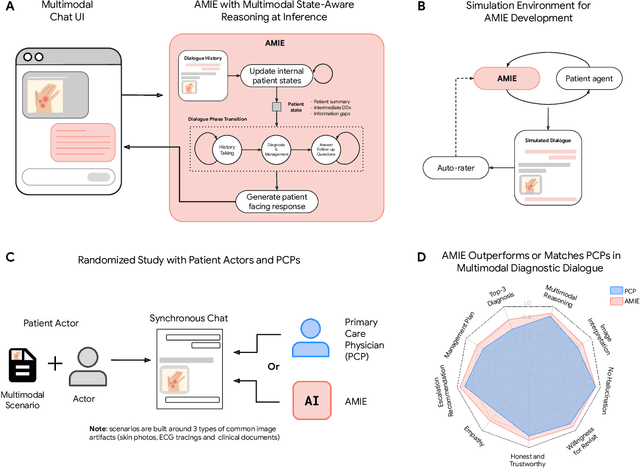
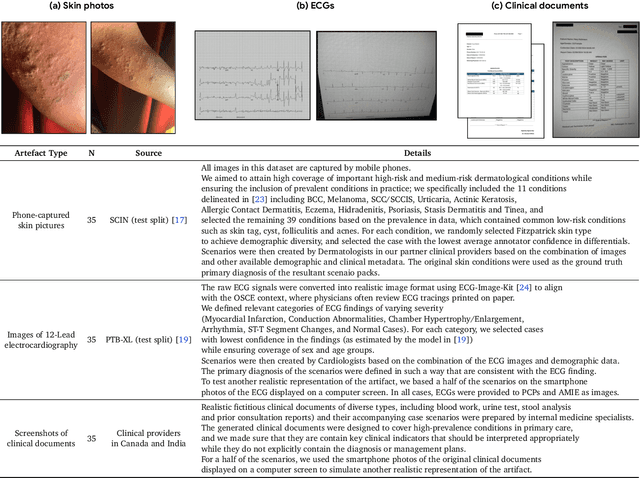
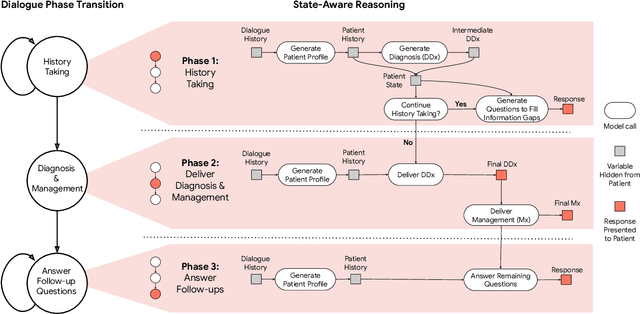
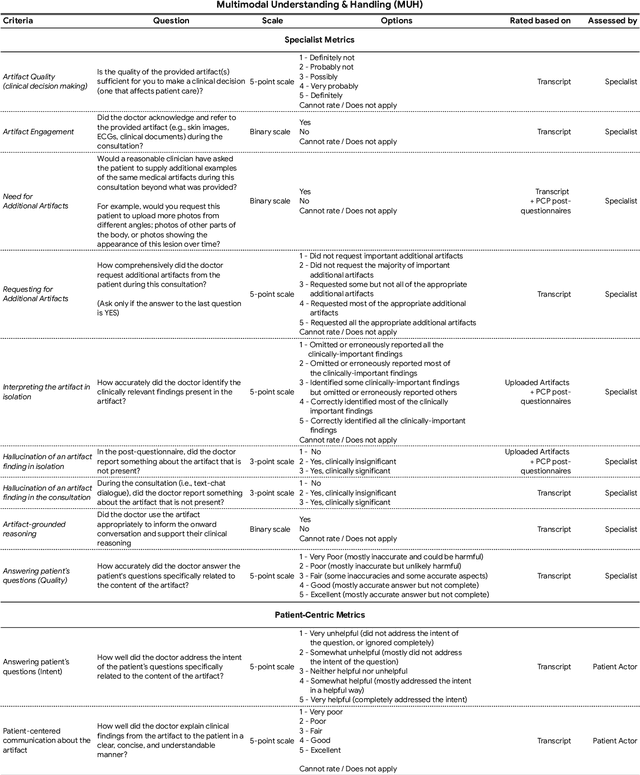
Large Language Models (LLMs) have demonstrated great potential for conducting diagnostic conversations but evaluation has been largely limited to language-only interactions, deviating from the real-world requirements of remote care delivery. Instant messaging platforms permit clinicians and patients to upload and discuss multimodal medical artifacts seamlessly in medical consultation, but the ability of LLMs to reason over such data while preserving other attributes of competent diagnostic conversation remains unknown. Here we advance the conversational diagnosis and management performance of the Articulate Medical Intelligence Explorer (AMIE) through a new capability to gather and interpret multimodal data, and reason about this precisely during consultations. Leveraging Gemini 2.0 Flash, our system implements a state-aware dialogue framework, where conversation flow is dynamically controlled by intermediate model outputs reflecting patient states and evolving diagnoses. Follow-up questions are strategically directed by uncertainty in such patient states, leading to a more structured multimodal history-taking process that emulates experienced clinicians. We compared AMIE to primary care physicians (PCPs) in a randomized, blinded, OSCE-style study of chat-based consultations with patient actors. We constructed 105 evaluation scenarios using artifacts like smartphone skin photos, ECGs, and PDFs of clinical documents across diverse conditions and demographics. Our rubric assessed multimodal capabilities and other clinically meaningful axes like history-taking, diagnostic accuracy, management reasoning, communication, and empathy. Specialist evaluation showed AMIE to be superior to PCPs on 7/9 multimodal and 29/32 non-multimodal axes (including diagnostic accuracy). The results show clear progress in multimodal conversational diagnostic AI, but real-world translation needs further research.
Towards Conversational AI for Disease Management
Mar 08, 2025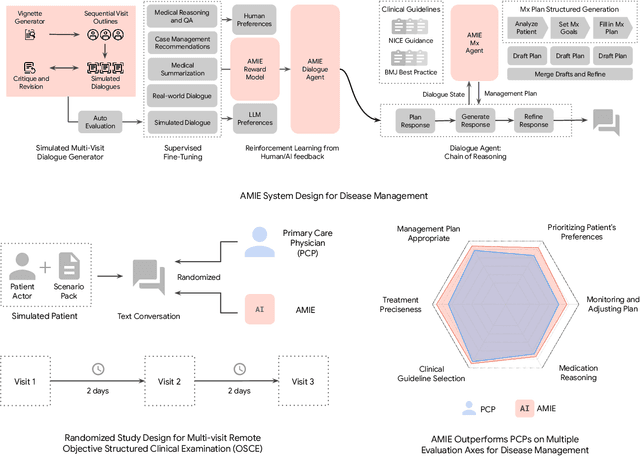

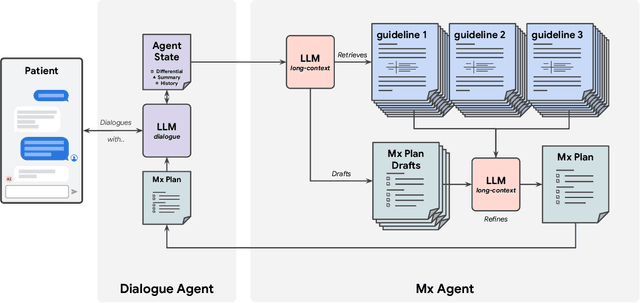

While large language models (LLMs) have shown promise in diagnostic dialogue, their capabilities for effective management reasoning - including disease progression, therapeutic response, and safe medication prescription - remain under-explored. We advance the previously demonstrated diagnostic capabilities of the Articulate Medical Intelligence Explorer (AMIE) through a new LLM-based agentic system optimised for clinical management and dialogue, incorporating reasoning over the evolution of disease and multiple patient visit encounters, response to therapy, and professional competence in medication prescription. To ground its reasoning in authoritative clinical knowledge, AMIE leverages Gemini's long-context capabilities, combining in-context retrieval with structured reasoning to align its output with relevant and up-to-date clinical practice guidelines and drug formularies. In a randomized, blinded virtual Objective Structured Clinical Examination (OSCE) study, AMIE was compared to 21 primary care physicians (PCPs) across 100 multi-visit case scenarios designed to reflect UK NICE Guidance and BMJ Best Practice guidelines. AMIE was non-inferior to PCPs in management reasoning as assessed by specialist physicians and scored better in both preciseness of treatments and investigations, and in its alignment with and grounding of management plans in clinical guidelines. To benchmark medication reasoning, we developed RxQA, a multiple-choice question benchmark derived from two national drug formularies (US, UK) and validated by board-certified pharmacists. While AMIE and PCPs both benefited from the ability to access external drug information, AMIE outperformed PCPs on higher difficulty questions. While further research would be needed before real-world translation, AMIE's strong performance across evaluations marks a significant step towards conversational AI as a tool in disease management.
ThoughtSource: A central hub for large language model reasoning data
Jan 27, 2023Large language models (LLMs) such as GPT-3 and ChatGPT have recently demonstrated impressive results across a wide range of tasks. LLMs are still limited, however, in that they frequently fail at complex reasoning, their reasoning processes are opaque, they are prone to 'hallucinate' facts, and there are concerns about their underlying biases. Letting models verbalize reasoning steps as natural language, a technique known as chain-of-thought prompting, has recently been proposed as a way to address some of these issues. Here we present the first release of ThoughtSource, a meta-dataset and software library for chain-of-thought (CoT) reasoning. The goal of ThoughtSource is to improve future artificial intelligence systems by facilitating qualitative understanding of CoTs, enabling empirical evaluations, and providing training data. This first release of ThoughtSource integrates six scientific/medical, three general-domain and five math word question answering datasets.
Variational Open-Domain Question Answering
Sep 23, 2022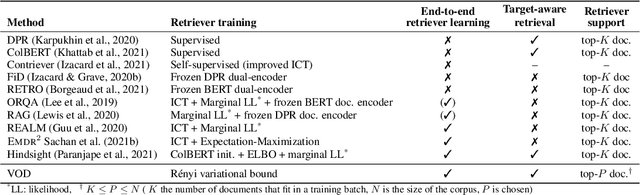
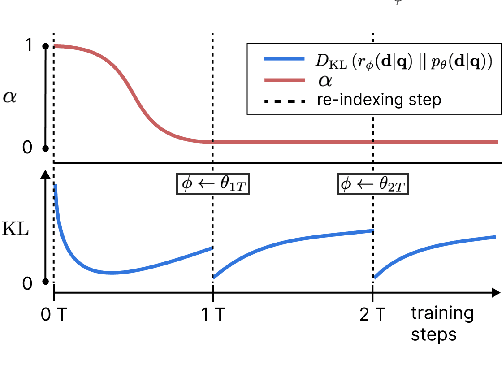
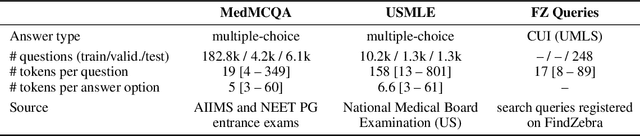
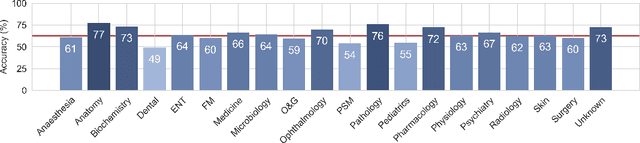
We introduce the Variational Open-Domain (VOD) framework for end-to-end training and evaluation of retrieval-augmented models (open-domain question answering and language modelling). We show that the R\'enyi variational bound, a lower bound to the task marginal likelihood, can be exploited to aid optimization and use importance sampling to estimate the task log-likelihood lower bound and its gradients using samples drawn from an auxiliary retriever (approximate posterior). The framework can be used to train modern retrieval-augmented systems end-to-end using tractable and consistent estimates of the R\'enyi variational bound and its gradients. We demonstrate the framework's versatility by training reader-retriever BERT-based models on multiple-choice medical exam questions (MedMCQA and USMLE). We registered a new state-of-the-art for both datasets (MedMCQA: $62.9$\%, USMLE: $55.0$\%). Last, we show that the retriever part of the learned reader-retriever model trained on the medical board exam questions can be used in search engines for a medical knowledge base.
Can large language models reason about medical questions?
Jul 17, 2022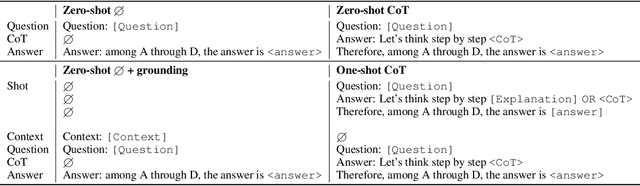
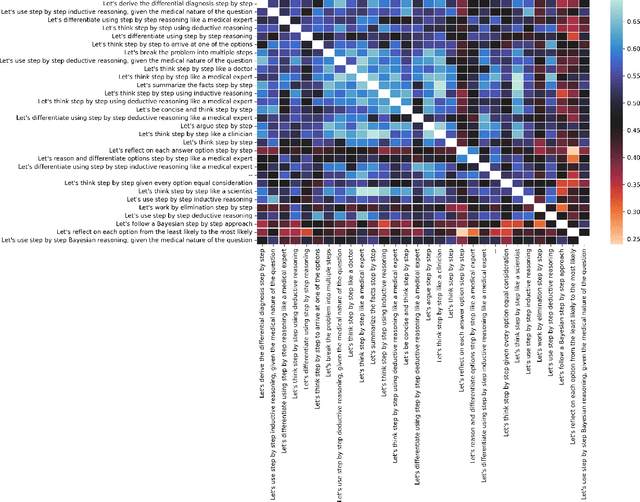
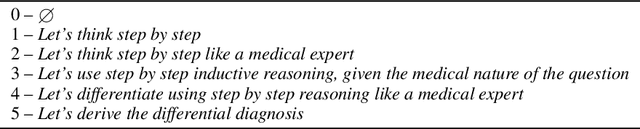
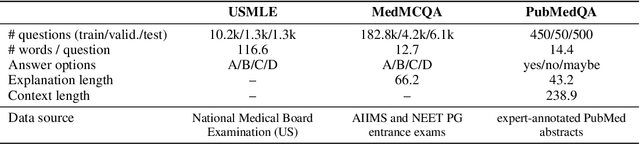
Although large language models (LLMs) often produce impressive outputs, they also fail to reason and be factual. We set out to investigate how these limitations affect the LLM's ability to answer and reason about difficult real-world based questions. We applied the human-aligned GPT-3 (InstructGPT) to answer multiple-choice medical exam questions (USMLE and MedMCQA) and medical research questions (PubMedQA). We investigated Chain-of-thought (think step by step) prompts, grounding (augmenting the prompt with search results) and few-shot (prepending the question with question-answer exemplars). For a subset of the USMLE questions, a medical domain expert reviewed and annotated the model's reasoning. Overall, GPT-3 achieved a substantial improvement in state-of-the-art machine learning performance. We observed that GPT-3 is often knowledgeable and can reason about medical questions. GPT-3, when confronted with a question it cannot answer, will still attempt to answer, often resulting in a biased predictive distribution. LLMs are not on par with human performance but our results suggest the emergence of reasoning patterns that are compatible with medical problem-solving. We speculate that scaling model and data, enhancing prompt alignment and allowing for better contextualization of the completions will be sufficient for LLMs to reach human-level performance on this type of task.
Image Super-Resolution With Deep Variational Autoencoders
Mar 17, 2022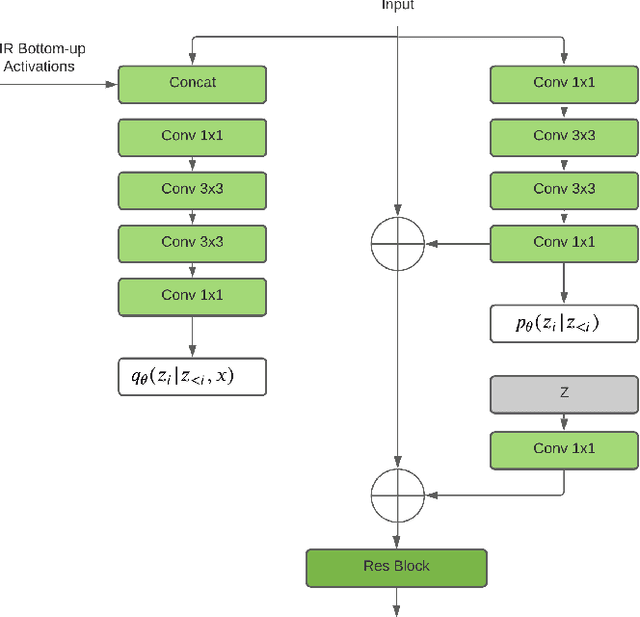
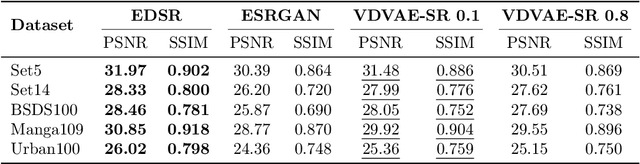
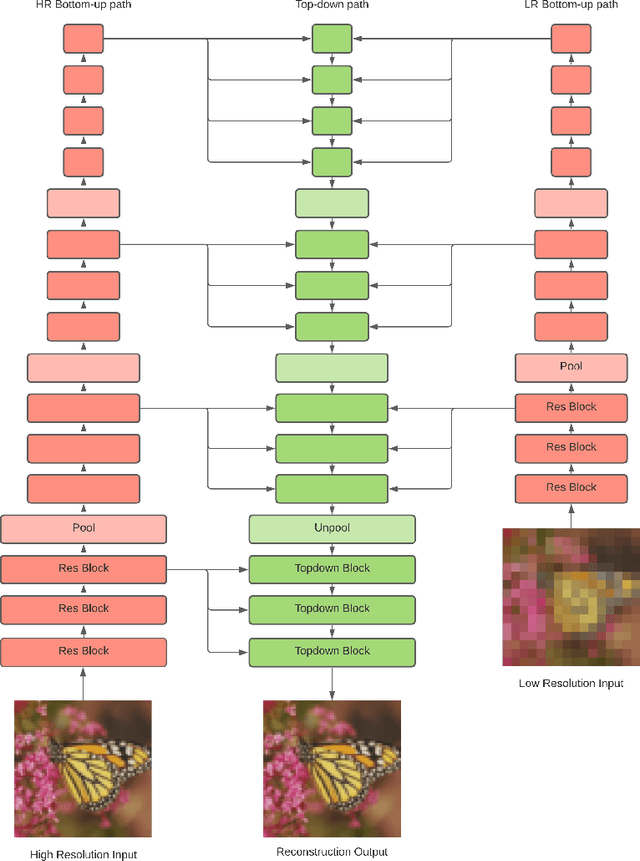
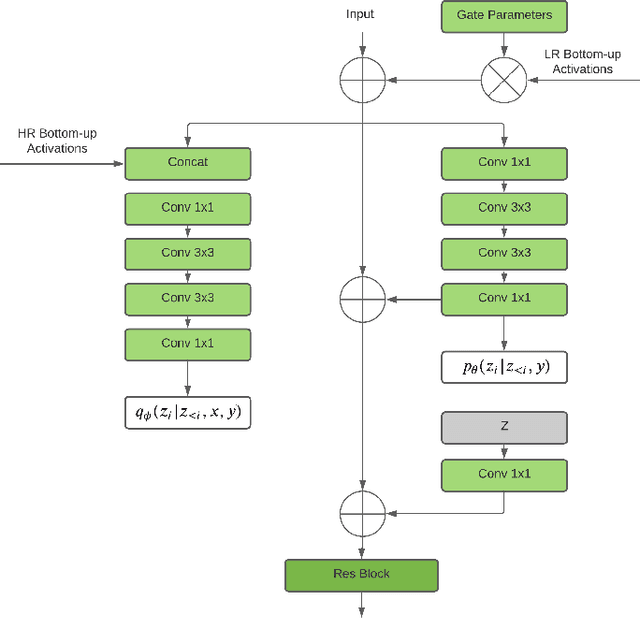
Image super-resolution (SR) techniques are used to generate a high-resolution image from a low-resolution image. Until now, deep generative models such as autoregressive models and Generative Adversarial Networks (GANs) have proven to be effective at modelling high-resolution images. Models based on Variational Autoencoders (VAEs) have often been criticized for their feeble generative performance, but with new advancements such as VDVAE (very deep VAE), there is now strong evidence that deep VAEs have the potential to outperform current state-of-the-art models for high-resolution image generation. In this paper, we introduce VDVAE-SR, a new model that aims to exploit the most recent deep VAE methodologies to improve upon image super-resolution using transfer learning on pretrained VDVAEs. Through qualitative and quantitative evaluations, we show that the proposed model is competitive with other state-of-the-art methods.