 Add to Chrome
 Add to Firefox
 Add to Edge
Steve-Evolving: Open-World Embodied Self-Evolution via Fine-Grained Diagnosis and Dual-Track Knowledge Distillation
Mar 13, 2026
Open-world embodied agents must solve long-horizon tasks where the main bottleneck is not single-step planning quality but how interaction experience is organized and evolved. To this end, we present Steve-Evolving, a non-parametric self-evolving framework that tightly couples fine-grained execution diagnosis with dual-track knowledge distillation in a closed loop. The method follows three phases: Experience Anchoring, Experience Distillation, and Knowledge-Driven Closed-Loop Control. In detail, Experience Anchoring solidifies each subgoal attempt into a structured experience tuple with a fixed schema (pre-state, action, diagnosis-result, and post-state) and organizes it in a three-tier experience space with multi-dimensional indices (e.g., condition signatures, spatial hashing, and semantic tags) plus rolling summarization for efficient and auditable recall. To ensure sufficient information density for attribution, the execution layer provides compositional diagnosis signals beyond binary outcomes, including state-difference summaries, enumerated failure causes, continuous indicators, and stagnation/loop detection. Moreover, successful trajectories of Experience Distillation are generalized into reusable skills with explicit preconditions and verification criteria, while failures are distilled into executable guardrails that capture root causes and forbid risky operations at both subgoal and task granularities. Besides, Knowledge-Driven Closed-Loop Control retrieved skills and guardrails are injected into an LLM planner, and diagnosis-triggered local replanning updates the active constraints online, forming a continual evolution process without any model parameter updates. Experiments on the long-horizon suite of Minecraft MCU demonstrate consistent improvements over static-retrieval baselines.

PolarMem: A Training-Free Polarized Latent Graph Memory for Verifiable Multimodal Agents
Jan 31, 2026As multimodal agents evolve from passive observers to long-horizon decision-makers, they require memory systems that provide not just information availability but logical verifiability. A fundamental limitation of current architectures is the epistemic asymmetry inherent in probabilistic vision-language models and dense associative memories: they conflate semantic affinity with factual existence and structurally fail to encode negative constraints. To this end, we introduce PolarMem, a training-free Polarized Latent Graph Memory designed to ground agent reasoning in verifiable evidence. PolarMem transforms fuzzy perceptual likelihoods into discrete logical constraints through non-parametric distributional partitioning. Furthermore, it employs a polarized graph topology with orthogonal inhibitory connections to explicitly store verified negation as a primary cognitive state. At inference time, we enforce a logic-dominant retrieval paradigm, suppressing hallucinatory patterns that violate negative constraints. Extensive evaluation across eight frozen Vision--Language Models and six benchmarks demonstrates that PolarMem functions as a robust cognitive system, establishing a foundation for verifiable multimodal agents. Our code is available at https://github.com/czs-ict/PolarMem.
KnowMe-Bench: Benchmarking Person Understanding for Lifelong Digital Companions
Jan 08, 2026Existing long-horizon memory benchmarks mostly use multi-turn dialogues or synthetic user histories, which makes retrieval performance an imperfect proxy for person understanding. We present \BenchName, a publicly releasable benchmark built from long-form autobiographical narratives, where actions, context, and inner thoughts provide dense evidence for inferring stable motivations and decision principles. \BenchName~reconstructs each narrative into a flashback-aware, time-anchored stream and evaluates models with evidence-linked questions spanning factual recall, subjective state attribution, and principle-level reasoning. Across diverse narrative sources, retrieval-augmented systems mainly improve factual accuracy, while errors persist on temporally grounded explanations and higher-level inferences, highlighting the need for memory mechanisms beyond retrieval. Our data is in \href{KnowMeBench}{https://github.com/QuantaAlpha/KnowMeBench}.
Training-free Context-adaptive Attention for Efficient Long Context Modeling
Dec 10, 2025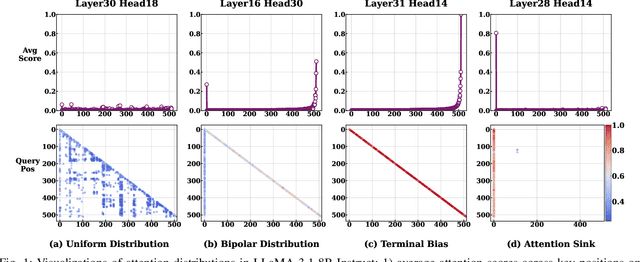
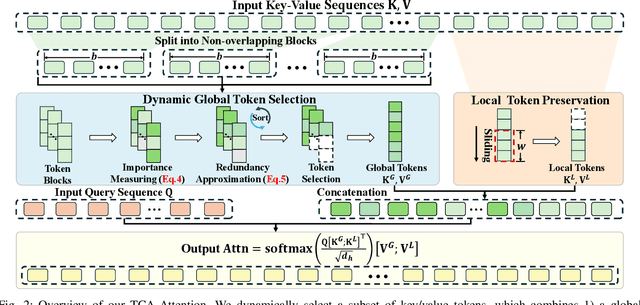
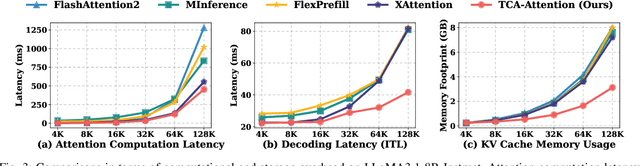
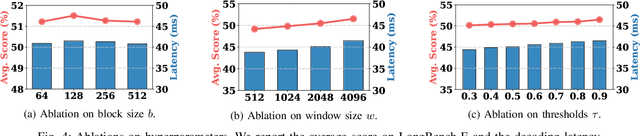
Large Language Models (LLMs) have demonstrated remarkable capabilities across a wide range of natural language processing tasks. These capabilities stem primarily from the self-attention mechanism, which enables modeling of long-range dependencies. However, the quadratic complexity of self-attention with respect to sequence length poses significant computational and memory challenges, especially as sequence length extends to extremes. While various sparse attention and KV cache compression methods have been proposed to improve efficiency, they often suffer from limitations such as reliance on fixed patterns, inability to handle both prefilling and decoding stages, or the requirement for additional training. In this paper, we propose Training-free Context-adaptive Attention (TCA-Attention), a training-free sparse attention mechanism that selectively attends to only the informative tokens for efficient long-context inference. Our method consists of two lightweight phases: i) an offline calibration phase that determines head-specific sparsity budgets via a single forward pass, and ii) an online token selection phase that adaptively retains core context tokens using a lightweight redundancy metric. TCA-Attention provides a unified solution that accelerates both prefilling and decoding while reducing KV cache memory footprint, without requiring parameter updates or architectural changes. Theoretical analysis shows that our approach maintains bounded approximation error. Extensive experiments demonstrate that TCA-Attention achieves a 2.8$\times$ speedup and reduces KV cache by 61% at 128K context length while maintaining performance comparable to full attention across various benchmarks, offering a practical plug-and-play solution for efficient long-context inference.
A Continual Learning-driven Model for Accurate and Generalizable Segmentation of Clinically Comprehensive and Fine-grained Whole-body Anatomies in CT
Mar 16, 2025Precision medicine in the quantitative management of chronic diseases and oncology would be greatly improved if the Computed Tomography (CT) scan of any patient could be segmented, parsed and analyzed in a precise and detailed way. However, there is no such fully annotated CT dataset with all anatomies delineated for training because of the exceptionally high manual cost, the need for specialized clinical expertise, and the time required to finish the task. To this end, we proposed a novel continual learning-driven CT model that can segment complete anatomies presented using dozens of previously partially labeled datasets, dynamically expanding its capacity to segment new ones without compromising previously learned organ knowledge. Existing multi-dataset approaches are not able to dynamically segment new anatomies without catastrophic forgetting and would encounter optimization difficulty or infeasibility when segmenting hundreds of anatomies across the whole range of body regions. Our single unified CT segmentation model, CL-Net, can highly accurately segment a clinically comprehensive set of 235 fine-grained whole-body anatomies. Composed of a universal encoder, multiple optimized and pruned decoders, CL-Net is developed using 13,952 CT scans from 20 public and 16 private high-quality partially labeled CT datasets of various vendors, different contrast phases, and pathologies. Extensive evaluation demonstrates that CL-Net consistently outperforms the upper limit of an ensemble of 36 specialist nnUNets trained per dataset with the complexity of 5% model size and significantly surpasses the segmentation accuracy of recent leading Segment Anything-style medical image foundation models by large margins. Our continual learning-driven CL-Net model would lay a solid foundation to facilitate many downstream tasks of oncology and chronic diseases using the most widely adopted CT imaging.