 Add to Chrome
 Add to Firefox
 Add to Edge
FinTMMBench: Benchmarking Temporal-Aware Multi-Modal RAG in Finance
Mar 07, 2025
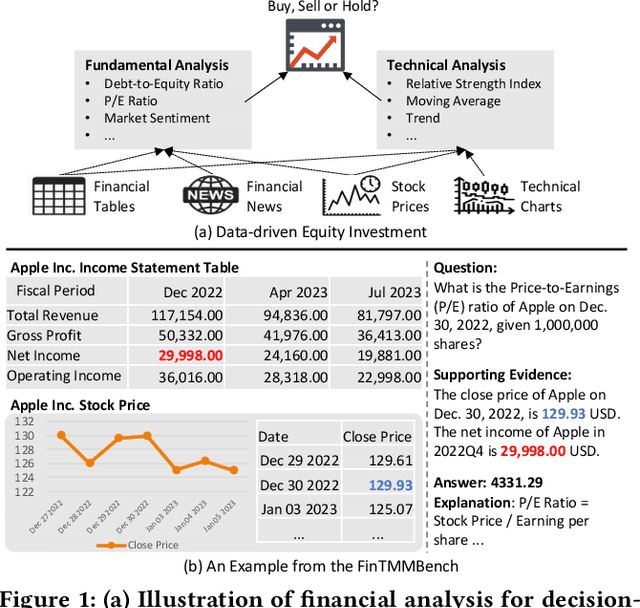
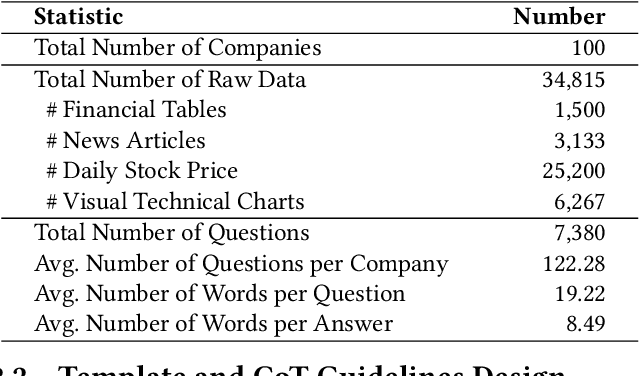
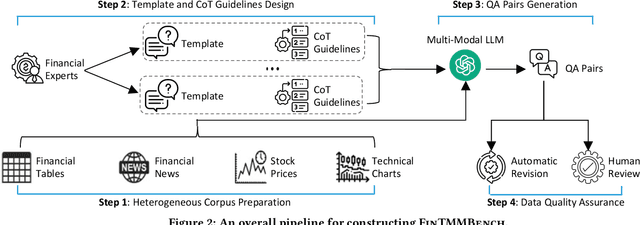
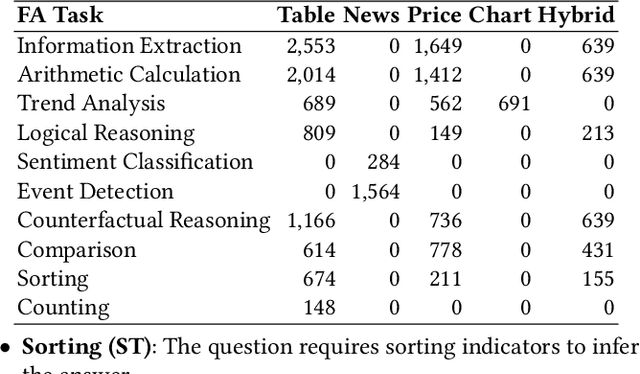
Finance decision-making often relies on in-depth data analysis across various data sources, including financial tables, news articles, stock prices, etc. In this work, we introduce FinTMMBench, the first comprehensive benchmark for evaluating temporal-aware multi-modal Retrieval-Augmented Generation (RAG) systems in finance. Built from heterologous data of NASDAQ 100 companies, FinTMMBench offers three significant advantages. 1) Multi-modal Corpus: It encompasses a hybrid of financial tables, news articles, daily stock prices, and visual technical charts as the corpus. 2) Temporal-aware Questions: Each question requires the retrieval and interpretation of its relevant data over a specific time period, including daily, weekly, monthly, quarterly, and annual periods. 3) Diverse Financial Analysis Tasks: The questions involve 10 different tasks, including information extraction, trend analysis, sentiment analysis and event detection, etc. We further propose a novel TMMHybridRAG method, which first leverages LLMs to convert data from other modalities (e.g., tabular, visual and time-series data) into textual format and then incorporates temporal information in each node when constructing graphs and dense indexes. Its effectiveness has been validated in extensive experiments, but notable gaps remain, highlighting the challenges presented by our FinTMMBench.

Personalized Generation In Large Model Era: A Survey
Mar 04, 2025In the era of large models, content generation is gradually shifting to Personalized Generation (PGen), tailoring content to individual preferences and needs. This paper presents the first comprehensive survey on PGen, investigating existing research in this rapidly growing field. We conceptualize PGen from a unified perspective, systematically formalizing its key components, core objectives, and abstract workflows. Based on this unified perspective, we propose a multi-level taxonomy, offering an in-depth review of technical advancements, commonly used datasets, and evaluation metrics across multiple modalities, personalized contexts, and tasks. Moreover, we envision the potential applications of PGen and highlight open challenges and promising directions for future exploration. By bridging PGen research across multiple modalities, this survey serves as a valuable resource for fostering knowledge sharing and interdisciplinary collaboration, ultimately contributing to a more personalized digital landscape.
Measuring What Makes You Unique: Difference-Aware User Modeling for Enhancing LLM Personalization
Mar 04, 2025Personalizing Large Language Models (LLMs) has become a critical step in facilitating their widespread application to enhance individual life experiences. In pursuit of personalization, distilling key preference information from an individual's historical data as instructional preference context to customize LLM generation has emerged as a promising direction. However, these methods face a fundamental limitation by overlooking the inter-user comparative analysis, which is essential for identifying the inter-user differences that truly shape preferences. To address this limitation, we propose Difference-aware Personalization Learning (DPL), a novel approach that emphasizes extracting inter-user differences to enhance LLM personalization. DPL strategically selects representative users for comparison and establishes a structured standard to extract meaningful, task-relevant differences for customizing LLM generation. Extensive experiments on real-world datasets demonstrate that DPL significantly enhances LLM personalization. We release our code at https://github.com/SnowCharmQ/DPL.
Beware of Your Po! Measuring and Mitigating AI Safety Risks in Role-Play Fine-Tuning of LLMs
Feb 28, 2025Role-playing enables large language models (LLMs) to engage users in immersive and personalized interactions, but it also introduces significant safety risks. Existing role-play fine-tuning techniques improve role adaptability but may degrade safety performance, particularly for villainous characters. In this work, we conduct the first comprehensive assessment of role-play fine-tuning risks by training 95 role-specific LLMs using RoleBench. Our experiments reveal that role-play fine-tuning leads to a noticeable decline in safety performance, with safety risks varying based on character traits. To tackle this challenge, we propose Safety-Aware Role-Play Fine-Tuning (SaRFT), a novel method designed to balance role-playing capabilities and safety. Extensive experiments on LLaMA-3-8B-Instruct, Gemma-2-9B-it, and Qwen2.5-7B-Instruct demonstrate that SaRFT consistently outperforms state-of-the-art baselines under both LoRA and full-parameter fine-tuning settings. Our findings highlight the necessity of role-adaptive safety measures and provide insights into mitigating role-specific safety risks in role-playing LLMs.
FACT-AUDIT: An Adaptive Multi-Agent Framework for Dynamic Fact-Checking Evaluation of Large Language Models
Feb 25, 2025Large Language Models (LLMs) have significantly advanced the fact-checking studies. However, existing automated fact-checking evaluation methods rely on static datasets and classification metrics, which fail to automatically evaluate the justification production and uncover the nuanced limitations of LLMs in fact-checking. In this work, we introduce FACT-AUDIT, an agent-driven framework that adaptively and dynamically assesses LLMs' fact-checking capabilities. Leveraging importance sampling principles and multi-agent collaboration, FACT-AUDIT generates adaptive and scalable datasets, performs iterative model-centric evaluations, and updates assessments based on model-specific responses. By incorporating justification production alongside verdict prediction, this framework provides a comprehensive and evolving audit of LLMs' factual reasoning capabilities, to investigate their trustworthiness. Extensive experiments demonstrate that FACT-AUDIT effectively differentiates among state-of-the-art LLMs, providing valuable insights into model strengths and limitations in model-centric fact-checking analysis.
Self-Improvement Towards Pareto Optimality: Mitigating Preference Conflicts in Multi-Objective Alignment
Feb 20, 2025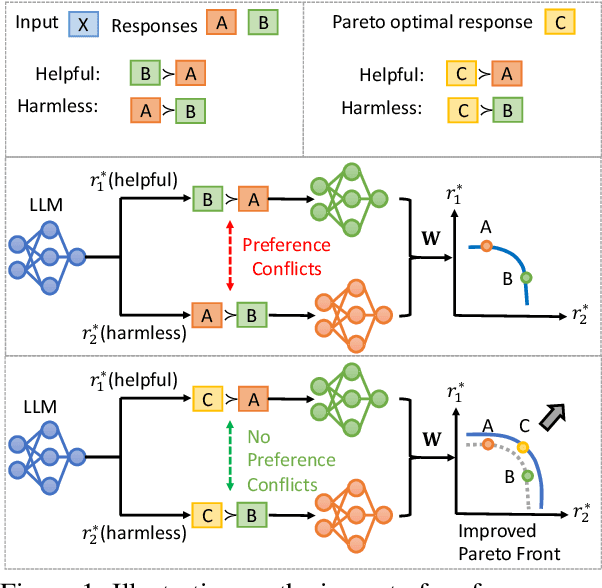
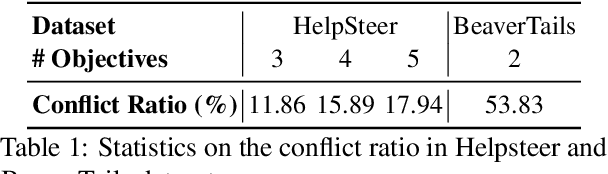
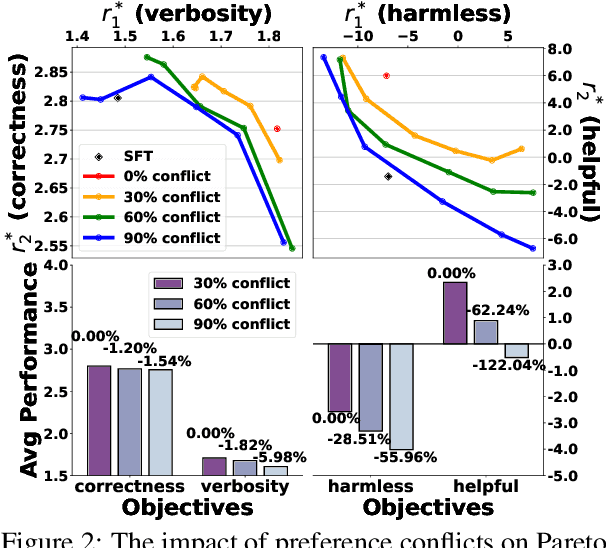
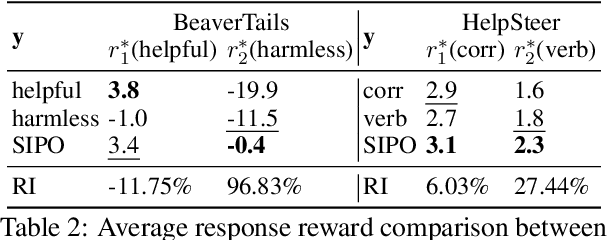
Multi-Objective Alignment (MOA) aims to align LLMs' responses with multiple human preference objectives, with Direct Preference Optimization (DPO) emerging as a prominent approach. However, we find that DPO-based MOA approaches suffer from widespread preference conflicts in the data, where different objectives favor different responses. This results in conflicting optimization directions, hindering the optimization on the Pareto Front. To address this, we propose to construct Pareto-optimal responses to resolve preference conflicts. To efficiently obtain and utilize such responses, we propose a self-improving DPO framework that enables LLMs to self-generate and select Pareto-optimal responses for self-supervised preference alignment. Extensive experiments on two datasets demonstrate the superior Pareto Front achieved by our framework compared to various baselines. Code is available at \url{https://github.com/zyttt-coder/SIPO}.
NExT-Mol: 3D Diffusion Meets 1D Language Modeling for 3D Molecule Generation
Feb 18, 20253D molecule generation is crucial for drug discovery and material design. While prior efforts focus on 3D diffusion models for their benefits in modeling continuous 3D conformers, they overlook the advantages of 1D SELFIES-based Language Models (LMs), which can generate 100% valid molecules and leverage the billion-scale 1D molecule datasets. To combine these advantages for 3D molecule generation, we propose a foundation model -- NExT-Mol: 3D Diffusion Meets 1D Language Modeling for 3D Molecule Generation. NExT-Mol uses an extensively pretrained molecule LM for 1D molecule generation, and subsequently predicts the generated molecule's 3D conformers with a 3D diffusion model. We enhance NExT-Mol's performance by scaling up the LM's model size, refining the diffusion neural architecture, and applying 1D to 3D transfer learning. Notably, our 1D molecule LM significantly outperforms baselines in distributional similarity while ensuring validity, and our 3D diffusion model achieves leading performances in conformer prediction. Given these improvements in 1D and 3D modeling, NExT-Mol achieves a 26% relative improvement in 3D FCD for de novo 3D generation on GEOM-DRUGS, and a 13% average relative gain for conditional 3D generation on QM9-2014. Our codes and pretrained checkpoints are available at https://github.com/acharkq/NExT-Mol.
Bridging Jensen Gap for Max-Min Group Fairness Optimization in Recommendation
Feb 13, 2025Group max-min fairness (MMF) is commonly used in fairness-aware recommender systems (RS) as an optimization objective, as it aims to protect marginalized item groups and ensures a fair competition platform. However, our theoretical analysis indicates that integrating MMF constraint violates the assumption of sample independence during optimization, causing the loss function to deviate from linear additivity. Such nonlinearity property introduces the Jensen gap between the model's convergence point and the optimal point if mini-batch sampling is applied. Both theoretical and empirical studies show that as the mini-batch size decreases and the group size increases, the Jensen gap will widen accordingly. Some methods using heuristic re-weighting or debiasing strategies have the potential to bridge the Jensen gap. However, they either lack theoretical guarantees or suffer from heavy computational costs. To overcome these limitations, we first theoretically demonstrate that the MMF-constrained objective can be essentially reformulated as a group-weighted optimization objective. Then we present an efficient and effective algorithm named FairDual, which utilizes a dual optimization technique to minimize the Jensen gap. Our theoretical analysis demonstrates that FairDual can achieve a sub-linear convergence rate to the globally optimal solution and the Jensen gap can be well bounded under a mini-batch sampling strategy with random shuffle. Extensive experiments conducted using six large-scale RS backbone models on three publicly available datasets demonstrate that FairDual outperforms all baselines in terms of both accuracy and fairness. Our data and codes are shared at https://github.com/XuChen0427/FairDual.
Long-Term TalkingFace Generation via Motion-Prior Conditional Diffusion Model
Feb 13, 2025Recent advances in conditional diffusion models have shown promise for generating realistic TalkingFace videos, yet challenges persist in achieving consistent head movement, synchronized facial expressions, and accurate lip synchronization over extended generations. To address these, we introduce the \textbf{M}otion-priors \textbf{C}onditional \textbf{D}iffusion \textbf{M}odel (\textbf{MCDM}), which utilizes both archived and current clip motion priors to enhance motion prediction and ensure temporal consistency. The model consists of three key elements: (1) an archived-clip motion-prior that incorporates historical frames and a reference frame to preserve identity and context; (2) a present-clip motion-prior diffusion model that captures multimodal causality for accurate predictions of head movements, lip sync, and expressions; and (3) a memory-efficient temporal attention mechanism that mitigates error accumulation by dynamically storing and updating motion features. We also release the \textbf{TalkingFace-Wild} dataset, a multilingual collection of over 200 hours of footage across 10 languages. Experimental results demonstrate the effectiveness of MCDM in maintaining identity and motion continuity for long-term TalkingFace generation. Code, models, and datasets will be publicly available.
EgoTextVQA: Towards Egocentric Scene-Text Aware Video Question Answering
Feb 11, 2025We introduce EgoTextVQA, a novel and rigorously constructed benchmark for egocentric QA assistance involving scene text. EgoTextVQA contains 1.5K ego-view videos and 7K scene-text aware questions that reflect real-user needs in outdoor driving and indoor house-keeping activities. The questions are designed to elicit identification and reasoning on scene text in an egocentric and dynamic environment. With EgoTextVQA, we comprehensively evaluate 10 prominent multimodal large language models. Currently, all models struggle, and the best results (Gemini 1.5 Pro) are around 33% accuracy, highlighting the severe deficiency of these techniques in egocentric QA assistance. Our further investigations suggest that precise temporal grounding and multi-frame reasoning, along with high resolution and auxiliary scene-text inputs, are key for better performance. With thorough analyses and heuristic suggestions, we hope EgoTextVQA can serve as a solid testbed for research in egocentric scene-text QA assistance.