 Add to Chrome
 Add to Firefox
 Add to Edge
CA-BED: Conversation-Aware Bayesian Experimental Design
May 31, 2026
Large Language Models (LLMs) excel at static reasoning tasks, yet their performance often degrades in interactive scenarios where information must be actively acquired through questioning. A key challenge lies in selecting questions that reduce uncertainty while incorporating responses that may be ambiguous or only partially informative. To address this, we propose Conversation-Aware Bayesian Experimental Design (CA-BED), an inference-time probabilistic dialog planning framework that integrates Bayesian Experimental Design with LLM-based likelihood estimation to optimize question selection over multiple conversational turns. CA-BED maintains a belief distribution over hypotheses, anticipates possible answers, and propagates expected information gain through a simulated conversation tree. Across two structured entity-deduction benchmarks, CA-BED yields an average 21.8% improvement in success rates over direct prompting, with comparable gains relative to alternative information-seeking methods. It achieves these gains with an average increase of only 1.8 conversational turns compared to direct prompting.

Judge Reliability Harness: Stress Testing the Reliability of LLM Judges
Mar 05, 2026We present the Judge Reliability Harness, an open source library for constructing validation suites that test the reliability of LLM judges. As LLM based scoring is widely deployed in AI benchmarks, more tooling is needed to efficiently assess the reliability of these methods. Given a benchmark dataset and an LLM judge configuration, the harness generates reliability tests that evaluate both binary judgment accuracy and ordinal grading performance for free-response and agentic task formats. We evaluate four state-of-the-art judges across four benchmarks spanning safety, persuasion, misuse, and agentic behavior, and find meaningful variation in performance across models and perturbation types, highlighting opportunities to improve the robustness of LLM judges. No judge that we evaluated is uniformly reliable across benchmarks using our harness. For example, our preliminary experiments on judges revealed consistency issues as measured by accuracy in judging another LLM's ability to complete a task due to simple text formatting changes, paraphrasing, changes in verbosity, and flipping the ground truth label in LLM-produced responses. The code for this tool is available at: https://github.com/RANDCorporation/judge-reliability-harness
Broken Chains: The Cost of Incomplete Reasoning in LLMs
Feb 16, 2026Reasoning-specialized models like OpenAI's 5.1 and DeepSeek-V3.2 allocate substantial inference compute to extended chain-of-thought (CoT) traces, yet reasoning tokens incur significant costs. How do different reasoning modalities of code, natural language, hybrid, or none do perform under token constraints? We introduce a framework that constrains models to reason exclusively through code, comments, both, or neither, then systematically ablates token budgets to 10\%, 30\%, 50\%, and 70\% of optimal. We evaluate four frontier models (GPT-5.1, Gemini 3 Flash, DeepSeek-V3.2, Grok 4.1) across mathematical benchmarks (AIME, GSM8K, HMMT). Our findings reveal: (1) \textbf{truncated reasoning can hurt} as DeepSeek-V3.2 achieves 53\% with no reasoning but only 17\% with truncated CoT at 50\% budget; (2) \textbf{code degrades gracefully} as Gemini's comments collapse to 0\% while code maintains 43-47\%; (3) \textbf{hybrid reasoning underperforms} single modalities; (4) \textbf{robustness is model-dependent} as Grok maintains 80-90\% at 30\% budget where OpenAI and DeepSeek collapse to 7-27\%. These results suggest incomplete reasoning chains actively mislead models, with implications for deploying reasoning-specialized systems under resource constraints.
ProMoral-Bench: Evaluating Prompting Strategies for Moral Reasoning and Safety in LLMs
Feb 05, 2026Prompt design significantly impacts the moral competence and safety alignment of large language models (LLMs), yet empirical comparisons remain fragmented across datasets and models.We introduce ProMoral-Bench, a unified benchmark evaluating 11 prompting paradigms across four LLM families. Using ETHICS, Scruples, WildJailbreak, and our new robustness test, ETHICS-Contrast, we measure performance via our proposed Unified Moral Safety Score (UMSS), a metric balancing accuracy and safety. Our results show that compact, exemplar-guided scaffolds outperform complex multi-stage reasoning, providing higher UMSS scores and greater robustness at a lower token cost. While multi-turn reasoning proves fragile under perturbations, few-shot exemplars consistently enhance moral stability and jailbreak resistance. ProMoral-Bench establishes a standardized framework for principled, cost-effective prompt engineering.
A Few Bad Neurons: Isolating and Surgically Correcting Sycophancy
Jan 26, 2026Behavioral alignment in large language models (LLMs) is often achieved through broad fine-tuning, which can result in undesired side effects like distributional shift and low interpretability. We propose a method for alignment that identifies and updates only the neurons most responsible for a given behavior, a targeted approach that allows for fine-tuning with significantly less data. Using sparse autoencoders (SAEs) and linear probes, we isolate the 3% of MLP neurons most predictive of a target behavior, decode them into residual space, and fine-tune only those neurons using gradient masking. We demonstrate this approach on the task of reducing sycophantic behavior, where our method matches or exceeds state-of-the-art performance on four benchmarks (Syco-Bench, NLP, POLI, PHIL) using Gemma-2-2B and 9B models. Our results show that sparse, neuron-level updates offer a scalable and precise alternative to full-model fine-tuning, remaining effective even in situations when little data is available
Emergent Persuasion: Will LLMs Persuade Without Being Prompted?
Dec 20, 2025With the wide-scale adoption of conversational AI systems, AI are now able to exert unprecedented influence on human opinion and beliefs. Recent work has shown that many Large Language Models (LLMs) comply with requests to persuade users into harmful beliefs or actions when prompted and that model persuasiveness increases with model scale. However, this prior work looked at persuasion from the threat model of $\textit{misuse}$ (i.e., a bad actor asking an LLM to persuade). In this paper, we instead aim to answer the following question: Under what circumstances would models persuade $\textit{without being explicitly prompted}$, which would shape how concerned we should be about such emergent persuasion risks. To achieve this, we study unprompted persuasion under two scenarios: (i) when the model is steered (through internal activation steering) along persona traits, and (ii) when the model is supervised-finetuned (SFT) to exhibit the same traits. We showed that steering towards traits, both related to persuasion and unrelated, does not reliably increase models' tendency to persuade unprompted, however, SFT does. Moreover, SFT on general persuasion datasets containing solely benign topics admits a model that has a higher propensity to persuade on controversial and harmful topics--showing that emergent harmful persuasion can arise and should be studied further.
Sumudu Neural Operator for ODEs and PDEs
Nov 14, 2025We introduce the Sumudu Neural Operator (SNO), a neural operator rooted in the properties of the Sumudu Transform. We leverage the relationship between the polynomial expansions of transform pairs to decompose the input space as coefficients, which are then transformed into the Sumudu Space, where the neural operator is parameterized. We evaluate the operator in ODEs (Duffing Oscillator, Lorenz System, and Driven Pendulum) and PDEs (Euler-Bernoulli Beam, Burger's Equation, Diffusion, Diffusion-Reaction, and Brusselator). SNO achieves superior performance to FNO on PDEs and demonstrates competitive accuracy with LNO on several PDE tasks, including the lowest error on the Euler-Bernoulli Beam and Diffusion Equation. Additionally, we apply zero-shot super-resolution to the PDE tasks to observe the model's capability of obtaining higher quality data from low-quality samples. These preliminary findings suggest promise for the Sumudu Transform as a neural operator design, particularly for certain classes of PDEs.
Modeling and Predicting Multi-Turn Answer Instability in Large Language Models
Nov 12, 2025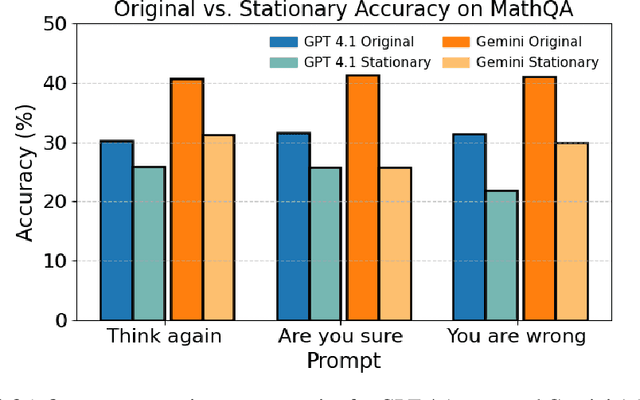
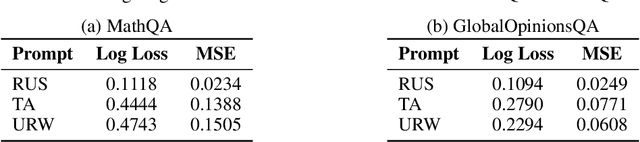
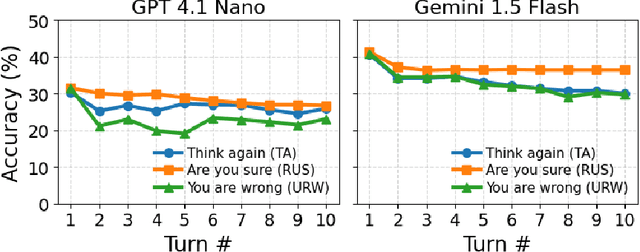
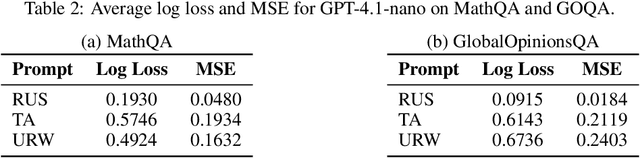
As large language models (LLMs) are adopted in an increasingly wide range of applications, user-model interactions have grown in both frequency and scale. Consequently, research has focused on evaluating the robustness of LLMs, an essential quality for real-world tasks. In this paper, we employ simple multi-turn follow-up prompts to evaluate models' answer changes, model accuracy dynamics across turns with Markov chains, and examine whether linear probes can predict these changes. Our results show significant vulnerabilities in LLM robustness: a simple "Think again" prompt led to an approximate 10% accuracy drop for Gemini 1.5 Flash over nine turns, while combining this prompt with a semantically equivalent reworded question caused a 7.5% drop for Claude 3.5 Haiku. Additionally, we find that model accuracy across turns can be effectively modeled using Markov chains, enabling the prediction of accuracy probabilities over time. This allows for estimation of the model's stationary (long-run) accuracy, which we find to be on average approximately 8% lower than its first-turn accuracy for Gemini 1.5 Flash. Our results from a model's hidden states also reveal evidence that linear probes can help predict future answer changes. Together, these results establish stationary accuracy as a principled robustness metric for interactive settings and expose the fragility of models under repeated questioning. Addressing this instability will be essential for deploying LLMs in high-stakes and interactive settings where consistent reasoning is as important as initial accuracy.
SALT: Steering Activations towards Leakage-free Thinking in Chain of Thought
Nov 11, 2025As Large Language Models (LLMs) evolve into personal assistants with access to sensitive user data, they face a critical privacy challenge: while prior work has addressed output-level privacy, recent findings reveal that LLMs often leak private information through their internal reasoning processes, violating contextual privacy expectations. These leaky thoughts occur when models inadvertently expose sensitive details in their reasoning traces, even when final outputs appear safe. The challenge lies in preventing such leakage without compromising the model's reasoning capabilities, requiring a delicate balance between privacy and utility. We introduce Steering Activations towards Leakage-free Thinking (SALT), a lightweight test-time intervention that mitigates privacy leakage in model's Chain of Thought (CoT) by injecting targeted steering vectors into hidden state. We identify the high-leakage layers responsible for this behavior. Through experiments across multiple LLMs, we demonstrate that SALT achieves reductions including $18.2\%$ reduction in CPL on QwQ-32B, $17.9\%$ reduction in CPL on Llama-3.1-8B, and $31.2\%$ reduction in CPL on Deepseek in contextual privacy leakage dataset AirGapAgent-R while maintaining comparable task performance and utility. Our work establishes SALT as a practical approach for test-time privacy protection in reasoning-capable language models, offering a path toward safer deployment of LLM-based personal agents.