 Add to Chrome
 Add to Firefox
 Add to Edge
From Personas to Plot: Character-Grounded Multi-Agent Story Generation for Long-Form Narratives
Jul 01, 2026
Although large language models (LLMs) have demonstrated impressive creative fiction generation, they struggle to maintain narrative consistency and coherent plot lines in long-form stories. In this work, we introduce a unified framework for long-form narrative generation and verification. MAGNET, a multi-agent goal-driven narrative engine for storytelling, generates stories with persona-grounded character agents that propose actions based on a shared world state and evolving story goals, while ATLAS is a graph-based pipeline that compares scene-level world representations across a generated story to detect hallucinations. By evaluating MAGNET using an LLM editor, pairwise rubric scoring, and ATLAS, we show that our framework produces coherent narratives compared to single-model prompting and IBSEN. At 100 pages, MAGNET reduced annotations and hallucinations by 41 and 50%, respectively, compared to the single model baseline and by 34 and 45%, respectively, compared to IBSEN, with pairwise rubric evaluation showing similar results. These results suggest that long-form narratives can emerge from explicit world-state tracking and goal-driven multi-agent generation, providing a foundation for controllable and structurally coherent long-form narrative generation.

CIPHER: Cryptographic Insecurity Profiling via Hybrid Evaluation of Responses
Feb 01, 2026Large language models (LLMs) are increasingly used to assist developers with code, yet their implementations of cryptographic functionality often contain exploitable flaws. Minor design choices (e.g., static initialization vectors or missing authentication) can silently invalidate security guarantees. We introduce CIPHER(\textbf{C}ryptographic \textbf{I}nsecurity \textbf{P}rofiling via \textbf{H}ybrid \textbf{E}valuation of \textbf{R}esponses), a benchmark for measuring cryptographic vulnerability incidence in LLM-generated Python code under controlled security-guidance conditions. CIPHER uses insecure/neutral/secure prompt variants per task, a cryptography-specific vulnerability taxonomy, and line-level attribution via an automated scoring pipeline. Across a diverse set of widely used LLMs, we find that explicit ``secure'' prompting reduces some targeted issues but does not reliably eliminate cryptographic vulnerabilities overall. The benchmark and reproducible scoring pipeline will be publicly released upon publication.
A Few Bad Neurons: Isolating and Surgically Correcting Sycophancy
Jan 26, 2026Behavioral alignment in large language models (LLMs) is often achieved through broad fine-tuning, which can result in undesired side effects like distributional shift and low interpretability. We propose a method for alignment that identifies and updates only the neurons most responsible for a given behavior, a targeted approach that allows for fine-tuning with significantly less data. Using sparse autoencoders (SAEs) and linear probes, we isolate the 3% of MLP neurons most predictive of a target behavior, decode them into residual space, and fine-tune only those neurons using gradient masking. We demonstrate this approach on the task of reducing sycophantic behavior, where our method matches or exceeds state-of-the-art performance on four benchmarks (Syco-Bench, NLP, POLI, PHIL) using Gemma-2-2B and 9B models. Our results show that sparse, neuron-level updates offer a scalable and precise alternative to full-model fine-tuning, remaining effective even in situations when little data is available
Alignment-Constrained Dynamic Pruning for LLMs: Identifying and Preserving Alignment-Critical Circuits
Nov 09, 2025Large Language Models require substantial computational resources for inference, posing deployment challenges. While dynamic pruning offers superior efficiency over static methods through adaptive circuit selection, it exacerbates alignment degradation by retaining only input-dependent safety-critical circuit preservation across diverse inputs. As a result, addressing these heightened alignment vulnerabilities remains critical. We introduce Alignment-Aware Probe Pruning (AAPP), a dynamic structured pruning method that adaptively preserves alignment-relevant circuits during inference, building upon Probe Pruning. Experiments on LLaMA 2-7B, Qwen2.5-14B-Instruct, and Gemma-3-12B-IT show AAPP improves refusal rates by 50\% at matched compute, enabling efficient yet safety-preserving LLM deployment.
A Scaling Law for Token Efficiency in LLM Fine-Tuning Under Fixed Compute Budgets
May 09, 2025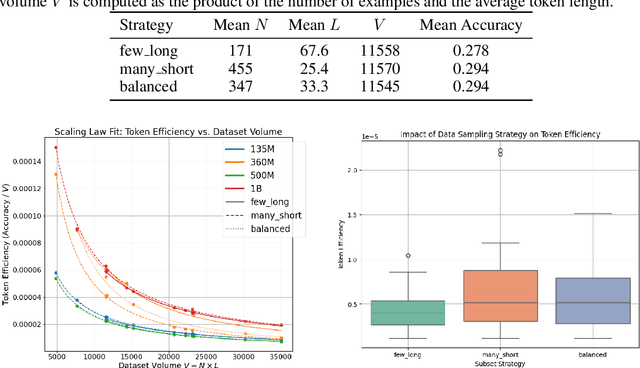

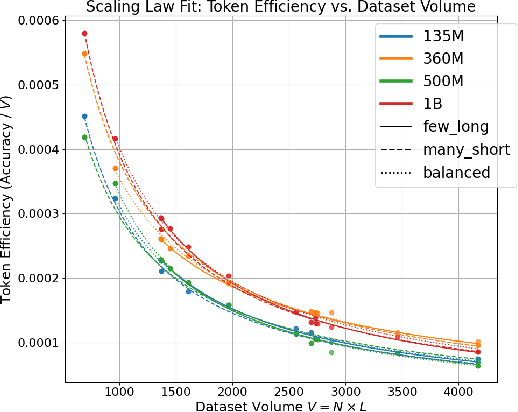
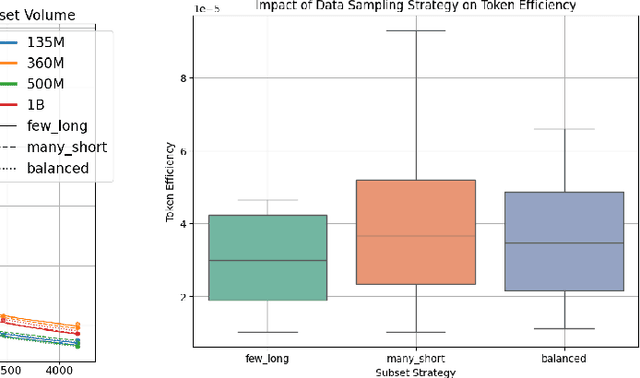
We introduce a scaling law for fine-tuning large language models (LLMs) under fixed compute budgets that explicitly accounts for data composition. Conventional approaches measure training data solely by total tokens, yet the number of examples and their average token length -- what we term \emph{dataset volume} -- play a decisive role in model performance. Our formulation is tuned following established procedures. Experiments on the BRICC dataset \cite{salavati2024reducing} and subsets of the MMLU dataset \cite{hendrycks2021measuringmassivemultitasklanguage}, evaluated under multiple subsampling strategies, reveal that data composition significantly affects token efficiency. These results motivate refined scaling laws for practical LLM fine-tuning in resource-constrained settings.