 Add to Chrome
 Add to Firefox
 Add to Edge
Rotation-Invariant Multi-IMU Activity Recognition under Independent Per-Location Orientation Shifts
Aug 16, 2026
Human Activity Recognition (HAR) with self-administered wearables, such as at-home rehabilitation and exercise monitoring, often requires reattaching inertial measurement units (IMUs) across sessions. In multi-IMU settings, this can induce independent orientation offsets across body locations, a deployment shift that conventional scalar HAR models do not structurally handle. Existing remedies rely on rotation augmentation, whose robustness depends on sampled transformations, or calibration and orientationnormalization pipelines requiring additional reference-frame assumptions or explicit procedures. We present Truly Rotation-Invariant HAR (TRI-HAR), a rotation-invariant framework that makes robustness to independent per-location IMU orientation offsets a structural model property. TRI-HAR reshapes accelerometer and gyroscope streams into triaxial vectors, applies a shared SO(3)-equivariant backbone and invariant projection to each IMU location, and fuses the resulting invariant features for activity classification. Across four multi-IMU benchmarks, TRI-HAR preserves macro-F1 under fixed independent per-location SO(3) rotations and outperforms rotation-augmented baselines under this target shift without requiring rotational augmentation.

Flow Straight to Reality: Perceptually Consistent Flow Matching for Efficient Image Restoration
Aug 11, 2026Image restoration is fundamentally constrained by the tradeoff between distortion and perception: minimizing pixel-wise error yields over-smoothed results, whereas optimizing for perceptual realism often introduces structural deviations. Recent approaches attempt to balance this tradeoff via posterior sampling or multi-stage generative pipelines, yet remain computationally expensive and architecturally complex. To overcome these limitations, we propose PCFlow (Perceptually Consistent Flow Matching), a unified framework that directly parameterizes a continuous transport from degraded observations to clean targets, jointly optimizing distortion and perceptual quality. While its latent consistency flow objective drives stable and efficient few-step inference, a Latent Consistency Perceptual Loss (LCPL) imposes semantic constraints directly on the guiding velocity field, steering the dynamics toward visually sharp data manifolds. Furthermore, recognizing the inherent conflict between structural and perceptual consistencies, we integrate a conflict-free gradient projection strategy to stabilize the multi-objective optimization landscape. Combined with lightweight, convolution-only backbone, PCFlow achieves competitive performance across diverse restoration tasks at a fraction of traditional computational costs.
Retrieve, Don't Retrain: Extending Vision Language Action Models to New Tasks at Test Time
Jun 14, 2026Extending a vision-language-action (VLA) policy to a new task typically requires task-specific teleoperated demonstrations and per-task fine-tuning, making adaptation costly in both data collection and compute. In this paper, we show that this target-side per-task adaptation cost can be replaced by retrieval. Our retrieval-augmented policy is trained once on paired demonstrations from the target embodiment (query) and a cheaper embodiment (pool, e.g., human-hand video), then frozen. New tasks are added at deployment by appending pool-side demonstrations to a retrieval pool. The frozen policy conditions on retrieved trajectories at every control step, so new tasks are absorbed by indexing data rather than updating parameters. Fine-tuning is needed only to take on a new, unseen embodiment, not for each new task. We show that retrieval improves policies beyond a specific backbone, including standard VLA policies, but its effect is especially pronounced in Cosmos Policy, a video-generation-based world-action model (WAM). In this setting, retrieval supplies coarse task progression, while the WAM's future-image objective provides an additional visual consistency signal that strengthens the retrieval-conditioned actions. On PushT, we study how retrieval provides a reusable high-level motion prior for cross-embodiment generalization to unseen goal angles, while on RoboTwin 2.0 our method outperforms cross-embodiment baselines on unseen tasks, and we additionally demonstrate the method on a real robot.
Learning Unions of Convex Sets via Invertible Latent Decomposition for Path Planning
Jun 10, 2026Collision-free path planning in cluttered, real-world environments relies on a representation of the collision-free space, and existing representations broadly fall into two categories. Explicit representations, such as unions of convex sets, can be plugged into optimization-based planners as hard collision-free constraints, but their parameters scale poorly with configuration-space dimension. Implicit representations, by contrast, are flexible and scale well to complex geometries, yet typically lack such guarantees. We bridge this gap with ILD (Invertible Latent Decomposition), a framework that jointly learns an invertible mapping and a union of explicit convex polytopes in the resulting latent space. Planning is carried out over these latent convex sets, and the invertible mapping decodes the resulting paths back to the original configuration space while preserving feasibility with respect to the refined explicit safe regions. We further propose Visibility-Guided Sampling (VGS) to keep the convex sets connected for path planning. Across 2D navigation, 6-DoF, and 14-DoF manipulation environments, ILD achieves broader coverage, better inter-set connectivity, and higher path-planning success rates than prior baselines, with zero observed false positives after test-time refinement. On a 14-DoF bimanual manipulator, we further demonstrate real-time collision-free planning, with test-time refinement adapting to scene-geometry changes during real-world deployment on a single 6-DoF arm.
Natural Functional Gradients for Smooth Trajectory Optimization
May 27, 2026Generating collision-free and smooth motions remains a central challenge in robotic manipulation, particularly in cluttered environments and narrow passages where feasible regions are highly constrained and fragmented. We propose a trajectory optimization framework that performs geometry-aware updates directly in function space using natural functional gradients. The method optimizes a Gaussian-smoothed surrogate objective that regularizes the optimization landscape through smooth trajectory perturbations while preserving trajectory-level structure. Because the updates are defined intrinsically in function space, trajectory regularity can be controlled independently of a particular time discretization. We derive a practical Monte-Carlo estimator of the natural functional gradient that requires only black-box trajectory evaluations, making the method applicable when analytic gradients are unavailable or unreliable due to collision checking and contact-rich simulation. Experiments on constrained robotic manipulation tasks demonstrate that the proposed method improves trajectory feasibility and produces smoother motions than representative planning and trajectory optimization baselines in environments with narrow geometric clearances. Additional results, videos, and implementation details are available at the project page: https://kisangpark.github.io/natural-functional-gradient/
LEGO: Latent-space Exploration for Geometry-aware Optimization of Humanoid Kinematic Design
Apr 09, 2026Designing robot morphologies and kinematics has traditionally relied on human intuition, with little systematic foundation. Motion-design co-optimization offers a promising path toward automation, but two major challenges remain: (i) the vast, unstructured design space and (ii) the difficulty of constructing task-specific loss functions. We propose a new paradigm that minimizes human involvement by (i) learning the design search space from existing mechanical designs, rather than hand-crafting it, and (ii) defining the loss directly from human motion data via motion retargeting and Procrustes analysis. Using screw-theory-based joint axis representation and isometric manifold learning, we construct a compact, geometry-preserving latent space of humanoid upper body designs in which optimization is tractable. We then solve design optimization in this latent space using gradient-free optimization. Our approach establishes a principled framework for data-driven robot design and demonstrates that leveraging existing designs and human motion can effectively guide the automated discovery of novel robot design.
Learning Dexterous Grasping from Sparse Taxonomy Guidance
Apr 05, 2026Dexterous manipulation requires planning a grasp configuration suited to the object and task, which is then executed through coordinated multi-finger control. However, specifying grasp plans with dense pose or contact targets for every object and task is impractical. Meanwhile, end-to-end reinforcement learning from task rewards alone lacks controllability, making it difficult for users to intervene when failures occur. To this end, we present GRIT, a two-stage framework that learns dexterous control from sparse taxonomy guidance. GRIT first predicts a taxonomy-based grasp specification from the scene and task context. Conditioned on this sparse command, a policy generates continuous finger motions that accomplish the task while preserving the intended grasp structure. Our result shows that certain grasp taxonomies are more effective for specific object geometries. By leveraging this relationship, GRIT improves generalization to novel objects over baselines and achieves an overall success rate of 87.9%. Moreover, real-world experiments demonstrate controllability, enabling grasp strategies to be adjusted through high-level taxonomy selection based on object geometry and task intent.
Formalizing the Sampling Design Space of Diffusion-Based Generative Models via Adaptive Solvers and Wasserstein-Bounded Timesteps
Feb 13, 2026Diffusion-based generative models have achieved remarkable performance across various domains, yet their practical deployment is often limited by high sampling costs. While prior work focuses on training objectives or individual solvers, the holistic design of sampling, specifically solver selection and scheduling, remains dominated by static heuristics. In this work, we revisit this challenge through a geometric lens, proposing SDM, a principled framework that aligns the numerical solver with the intrinsic properties of the diffusion trajectory. By analyzing the ODE dynamics, we show that efficient low-order solvers suffice in early high-noise stages while higher-order solvers can be progressively deployed to handle the increasing non-linearity of later stages. Furthermore, we formalize the scheduling by introducing a Wasserstein-bounded optimization framework. This method systematically derives adaptive timesteps that explicitly bound the local discretization error, ensuring the sampling process remains faithful to the underlying continuous dynamics. Without requiring additional training or architectural modifications, SDM achieves state-of-the-art performance across standard benchmarks, including an FID of 1.93 on CIFAR-10, 2.41 on FFHQ, and 1.98 on AFHQv2, with a reduced number of function evaluations compared to existing samplers. Our code is available at https://github.com/aiimaginglab/sdm.
Teaching Robots Like Dogs: Learning Agile Navigation from Luring, Gesture, and Speech
Jan 13, 2026In this work, we aim to enable legged robots to learn how to interpret human social cues and produce appropriate behaviors through physical human guidance. However, learning through physical engagement can place a heavy burden on users when the process requires large amounts of human-provided data. To address this, we propose a human-in-the-loop framework that enables robots to acquire navigational behaviors in a data-efficient manner and to be controlled via multimodal natural human inputs, specifically gestural and verbal commands. We reconstruct interaction scenes using a physics-based simulation and aggregate data to mitigate distributional shifts arising from limited demonstration data. Our progressive goal cueing strategy adaptively feeds appropriate commands and navigation goals during training, leading to more accurate navigation and stronger alignment between human input and robot behavior. We evaluate our framework across six real-world agile navigation scenarios, including jumping over or avoiding obstacles. Our experimental results show that our proposed method succeeds in almost all trials across these scenarios, achieving a 97.15% task success rate with less than 1 hour of demonstration data in total.
3D Occupancy Prediction with Low-Resolution Queries via Prototype-aware View Transformation
Mar 19, 2025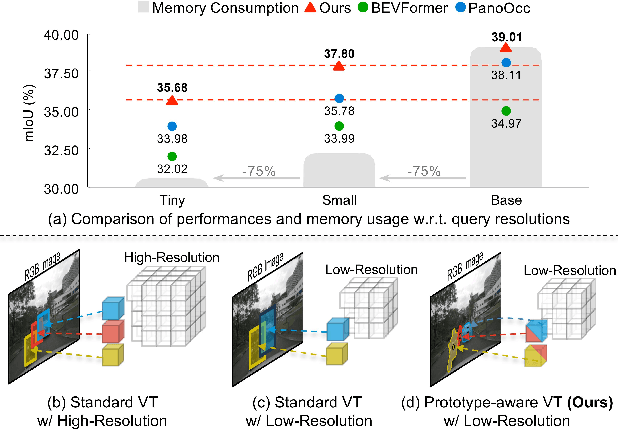
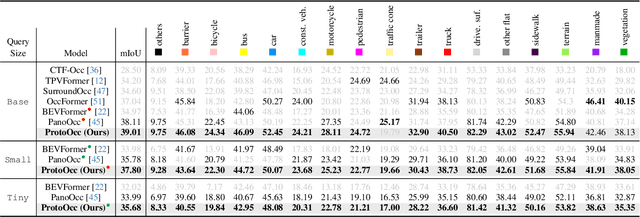
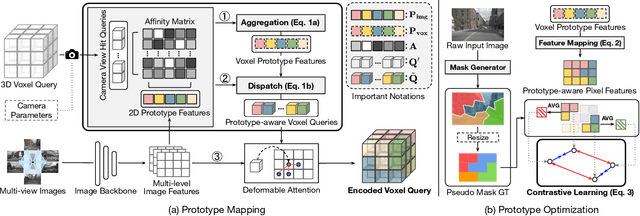
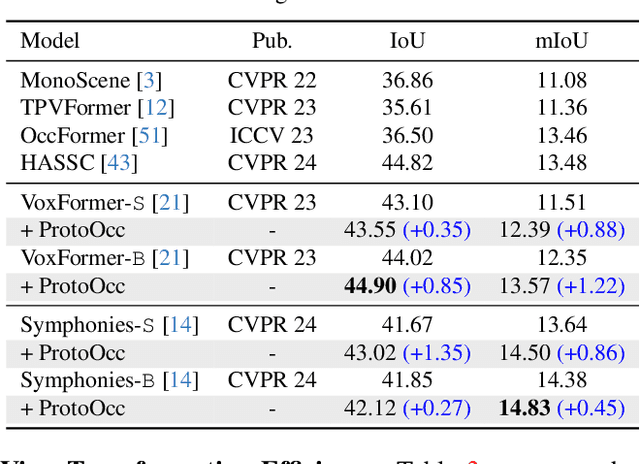
The resolution of voxel queries significantly influences the quality of view transformation in camera-based 3D occupancy prediction. However, computational constraints and the practical necessity for real-time deployment require smaller query resolutions, which inevitably leads to an information loss. Therefore, it is essential to encode and preserve rich visual details within limited query sizes while ensuring a comprehensive representation of 3D occupancy. To this end, we introduce ProtoOcc, a novel occupancy network that leverages prototypes of clustered image segments in view transformation to enhance low-resolution context. In particular, the mapping of 2D prototypes onto 3D voxel queries encodes high-level visual geometries and complements the loss of spatial information from reduced query resolutions. Additionally, we design a multi-perspective decoding strategy to efficiently disentangle the densely compressed visual cues into a high-dimensional 3D occupancy scene. Experimental results on both Occ3D and SemanticKITTI benchmarks demonstrate the effectiveness of the proposed method, showing clear improvements over the baselines. More importantly, ProtoOcc achieves competitive performance against the baselines even with 75\% reduced voxel resolution.