 Add to Chrome
 Add to Firefox
 Add to Edge
SECOND-Grasp: Semantic Contact-guided Dexterous Grasping
May 13, 2026
Achieving reliable robotic manipulation, such as dexterous grasping, requires a synergy between physically stable interactions and semantic task guidance, yet these objectives are often treated as separate, disjoint goals. In this paper, we investigate how to integrate dexterous grasping techniques, i.e., physically stable grasps for object lifting and language-guided grasp generation, to achieve both physical stability and semantic understanding. To this end, we propose SECOND-Grasp (SEmantic CONtact-guided Dexterous Grasping), a unified framework that enables robotic hands to dynamically adjust grasping strategies based on semantic reasoning while ensuring physical feasibility. We begin by obtaining coarse contact proposals through vision-language reasoning to infer where contacts should occur based on object properties, followed by segmentation to localize these regions across views. To further ensure consistency across multiple viewpoints, we introduce Semantic-Geometric Consistency Refinement (SGCR), which refines initial contact predictions by enforcing semantic consistency across views and removing geometrically invalid regions, yielding reliable 3D contact maps. Then, we derive a feasible hand pose for each contact map via inverse kinematics, generating a supervision signal for policy learning. Our approach, trained on DexGraspNet, consistently outperforms baselines in lifting success rate on both seen and unseen categories, achieving 98.2% and 97.7%, respectively, while also improving intent-aware grasping by 12.8% and 26.2%. We further show promising results on additional datasets and robotic hands, including Shadow Hand and Allegro Hand.

Active Test-time Vision-Language Navigation
Jun 07, 2025Vision-Language Navigation (VLN) policies trained on offline datasets often exhibit degraded task performance when deployed in unfamiliar navigation environments at test time, where agents are typically evaluated without access to external interaction or feedback. Entropy minimization has emerged as a practical solution for reducing prediction uncertainty at test time; however, it can suffer from accumulated errors, as agents may become overconfident in incorrect actions without sufficient contextual grounding. To tackle these challenges, we introduce ATENA (Active TEst-time Navigation Agent), a test-time active learning framework that enables a practical human-robot interaction via episodic feedback on uncertain navigation outcomes. In particular, ATENA learns to increase certainty in successful episodes and decrease it in failed ones, improving uncertainty calibration. Here, we propose mixture entropy optimization, where entropy is obtained from a combination of the action and pseudo-expert distributions-a hypothetical action distribution assuming the agent's selected action to be optimal-controlling both prediction confidence and action preference. In addition, we propose a self-active learning strategy that enables an agent to evaluate its navigation outcomes based on confident predictions. As a result, the agent stays actively engaged throughout all iterations, leading to well-grounded and adaptive decision-making. Extensive evaluations on challenging VLN benchmarks-REVERIE, R2R, and R2R-CE-demonstrate that ATENA successfully overcomes distributional shifts at test time, outperforming the compared baseline methods across various settings.
3D Occupancy Prediction with Low-Resolution Queries via Prototype-aware View Transformation
Mar 19, 2025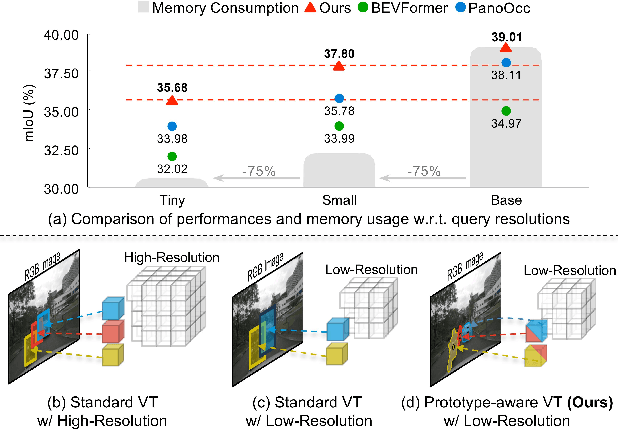
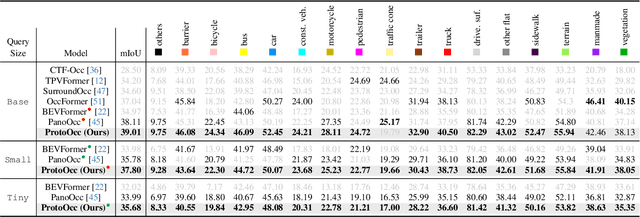
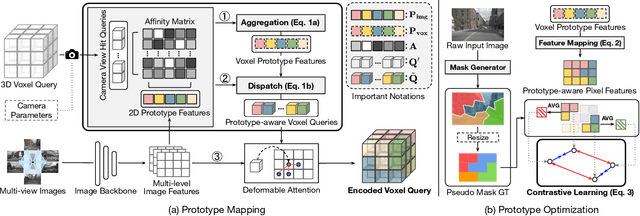
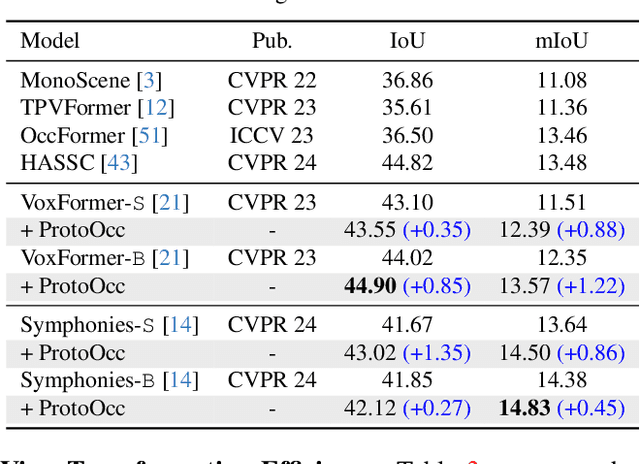
The resolution of voxel queries significantly influences the quality of view transformation in camera-based 3D occupancy prediction. However, computational constraints and the practical necessity for real-time deployment require smaller query resolutions, which inevitably leads to an information loss. Therefore, it is essential to encode and preserve rich visual details within limited query sizes while ensuring a comprehensive representation of 3D occupancy. To this end, we introduce ProtoOcc, a novel occupancy network that leverages prototypes of clustered image segments in view transformation to enhance low-resolution context. In particular, the mapping of 2D prototypes onto 3D voxel queries encodes high-level visual geometries and complements the loss of spatial information from reduced query resolutions. Additionally, we design a multi-perspective decoding strategy to efficiently disentangle the densely compressed visual cues into a high-dimensional 3D occupancy scene. Experimental results on both Occ3D and SemanticKITTI benchmarks demonstrate the effectiveness of the proposed method, showing clear improvements over the baselines. More importantly, ProtoOcc achieves competitive performance against the baselines even with 75\% reduced voxel resolution.