 Add to Chrome
 Add to Firefox
 Add to Edge
Teach the Magnitude, Not the Direction: Verifier-Bounded Credit Assignment for Multi-Turn Multi-step LLM Agents
Aug 13, 2026
Reinforcement learning with verifiable rewards (RLVR) offers a verifier-bounded performance ceiling for training multi-turn tool-use agents, yet its trajectory-level credit assignment conflates heterogeneous per-turn outcomes into a single reward signal. On-policy distillation provides dense per-token supervision but is either teacher-bounded or prone to gradient concentration collapse. We introduce $\textbf{CrEST}$, a hierarchical credit assignment framework that retains RL's verifier-bounded ceiling while incorporating dense token-level signals from a privileged self-teacher. $\textbf{CrEST}$ resolves credit at two levels: turn-segmented verified advantages address inter-turn dilution, while entropy-gated self-teacher modulation refines intra-turn token contributions. Experiments on BFCL V3 and WildToolBench show that $\textbf{CrEST}$ consistently outperforms both RL and distillation baselines across two model scales, with the largest gains on long-trajectory and strict session-level metrics. Our work demonstrates that the teacher's role in policy optimization can be reduced from determining update directions to modulating update magnitudes, unlocking dense credit assignment without sacrificing the verifier-bounded ceiling.

RODS: Reward-Driven Online Data Synthesis for Multi-Turn Tool-Use Agents
Jun 17, 2026Multi-turn tool-use RL is bottlenecked by the rapid depletion of informative samples in static datasets. We observe that the gradient signal in GRPO concentrates on tasks with the highest rollout reward variance, a consequence of the Popoviciu upper bound. Consequently, samples near the agent's capability boundary -- where successes and failures are roughly balanced -- contribute disproportionately large policy gradients. As training progresses, this boundary continuously shifts, which gradually depletes the pool of informative samples in a static dataset. We propose RODS (Reward-driven Online Data Synthesis) to resolve this depletion. RODS closes the loop between RL training and data generation by repurposing the progress reward variance as a practical, zero-cost boundary detector that requires no extra inference beyond the rollouts already computed for training. It continuously identifies such boundary samples, synthesizes new multi-turn variants matching their structural complexity (e.g., API topology and dependency depth) via a skill-aligned resampling pipeline, and manages a dynamic replay buffer that co-evolves with the policy. Starting from 400 human seeds and maintaining an active training pool of ~800 samples, RODS achieves comparable performance to a 17K-sample offline pipeline while requiring roughly 20x fewer trajectories, and improves over fixed-data RL and environment augmentation in our controlled setting.
X-Cache: Cross-Chunk Block Caching for Few-Step Autoregressive World Models Inference
Apr 22, 2026Real-time world simulation is becoming a key infrastructure for scalable evaluation and online reinforcement learning of autonomous driving systems. Recent driving world models built on autoregressive video diffusion achieve high-fidelity, controllable multi-camera generation, but their inference cost remains a bottleneck for interactive deployment. However, existing diffusion caching methods are designed for offline video generation with multiple denoising steps, and do not transfer to this scenario. Few-step distilled models have no inter-step redundancy left for these methods to reuse, and sequence-level parallelization techniques require future conditioning that closed-loop interactive generation does not provide. We present X-Cache, a training-free acceleration method that caches along a different axis: across consecutive generation chunks rather than across denoising steps. X-Cache maintains per-block residual caches that persist across chunks, and applies a dual-metric gating mechanism over a structure- and action-aware block-input fingerprint to independently decide whether each block should recompute or reuse its cached residual. To prevent approximation errors from permanently contaminating the autoregressive KV cache, X-Cache identifies KV update chunks (the forward passes that write clean keys and values into the persistent cache) and unconditionally forces full computation on these chunks, cutting off error propagation. We implement X-Cache on X-world, a production multi-camera action-conditioned driving world model built on multi-block causal DiT with few-step denoising and rolling KV cache. X-Cache achieves 71% block skip rate with 2.6x wall-clock speedup while maintaining minimum degradation.
H2Tune: Federated Foundation Model Fine-Tuning with Hybrid Heterogeneity
Jul 30, 2025Different from existing federated fine-tuning (FFT) methods for foundation models, hybrid heterogeneous federated fine-tuning (HHFFT) is an under-explored scenario where clients exhibit double heterogeneity in model architectures and downstream tasks. This hybrid heterogeneity introduces two significant challenges: 1) heterogeneous matrix aggregation, where clients adopt different large-scale foundation models based on their task requirements and resource limitations, leading to dimensional mismatches during LoRA parameter aggregation; and 2) multi-task knowledge interference, where local shared parameters, trained with both task-shared and task-specific knowledge, cannot ensure only task-shared knowledge is transferred between clients. To address these challenges, we propose H2Tune, a federated foundation model fine-tuning with hybrid heterogeneity. Our framework H2Tune consists of three key components: (i) sparsified triple matrix decomposition to align hidden dimensions across clients through constructing rank-consistent middle matrices, with adaptive sparsification based on client resources; (ii) relation-guided matrix layer alignment to handle heterogeneous layer structures and representation capabilities; and (iii) alternating task-knowledge disentanglement mechanism to decouple shared and specific knowledge of local model parameters through alternating optimization. Theoretical analysis proves a convergence rate of O(1/\sqrt{T}). Extensive experiments show our method achieves up to 15.4% accuracy improvement compared to state-of-the-art baselines. Our code is available at https://anonymous.4open.science/r/H2Tune-1407.
MorphAgent: Empowering Agents through Self-Evolving Profiles and Decentralized Collaboration
Oct 19, 2024

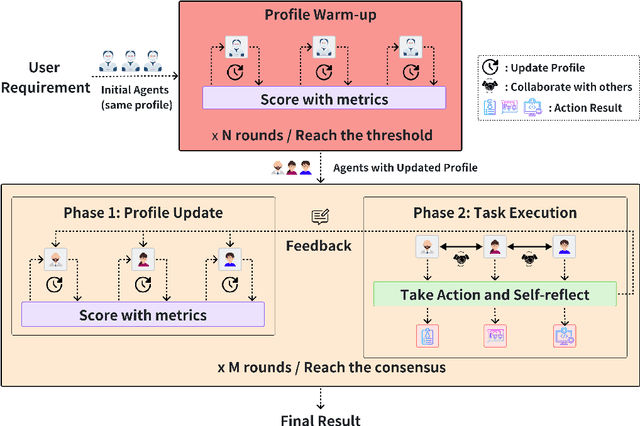
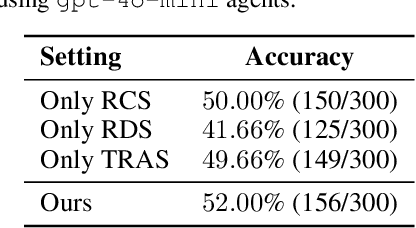
Large Language Model (LLM) based multi-agent systems (MAS) have shown promise in tackling complex tasks, but often rely on predefined roles and centralized coordination, limiting their adaptability to evolving challenges. This paper introduces MorphAgent, a novel framework for decentralized multi-agent collaboration that enables agents to dynamically evolve their roles and capabilities. Our approach employs self-evolving agent profiles, optimized through three key metrics, guiding agents in refining their individual expertise while maintaining complementary team dynamics. MorphAgent implements a two-phase process: a warm-up phase for initial profile optimization, followed by a task execution phase where agents continuously adapt their roles based on task feedback. Our experimental results show that MorphAgent outperforms traditional static-role MAS in terms of task performance and adaptability to changing requirements, paving the way for more robust and versatile multi-agent collaborative systems. Our code will be publicly available at \url{https://github.com/LINs-lab/learn2collaborate}.
Unleashing the Potential of Large Language Models as Prompt Optimizers: An Analogical Analysis with Gradient-based Model Optimizers
Feb 27, 2024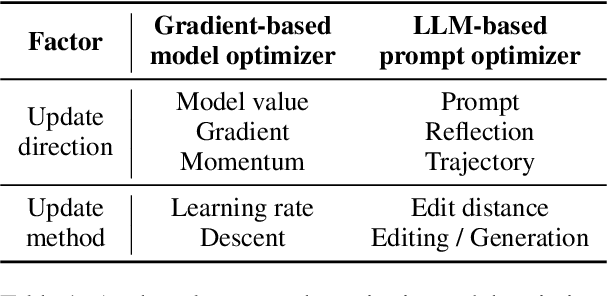
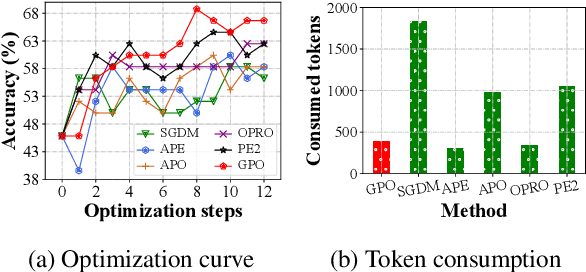
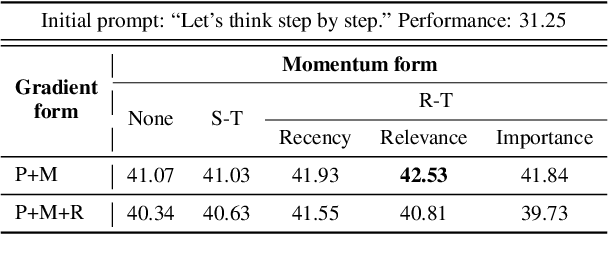
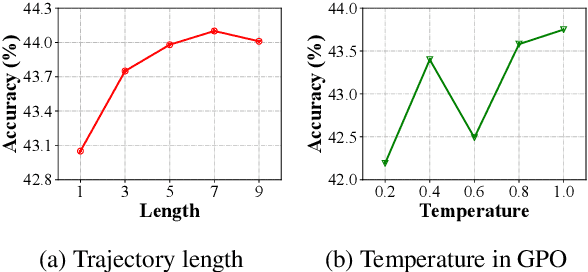
Automatic prompt optimization is an important approach to improving the performance of large language models (LLMs). Recent research demonstrates the potential of using LLMs as prompt optimizers, which can generate improved task prompts via iterative refinement. In this paper, we propose a novel perspective to investigate the design of LLM-based prompt optimizers, by drawing an analogy with gradient-based model optimizers. To connect these two approaches, we identify two pivotal factors in model parameter learning: update direction and update method. Focused on the two aspects, we borrow the theoretical framework and learning methods from gradient-based optimization to design improved strategies for LLM-based prompt optimizers. By systematically analyzing a rich set of improvement strategies, we further develop a capable Gradient-inspired LLM-based Prompt Optimizer called GPO. At each step, it first retrieves relevant prompts from the optimization trajectory as the update direction. Then, it utilizes the generation-based refinement strategy to perform the update, while controlling the edit distance through a cosine-based decay strategy. Extensive experiments demonstrate the effectiveness and efficiency of GPO. In particular, GPO brings an additional improvement of up to 56.8% on Big-Bench Hard and 55.3% on MMLU compared to baseline methods.
PreAct: Predicting Future in ReAct Enhances Agent's Planning Ability
Feb 18, 2024Addressing the discrepancies between predictions and actual outcomes often aids individuals in expanding their thought processes and engaging in reflection, thereby facilitating reasoning in the correct direction. In this paper, we introduce $\textbf{PreAct}$, an agent framework that integrates $\textbf{pre}$diction with $\textbf{rea}$soning and $\textbf{act}$ion. Leveraging the information provided by predictions, a large language model (LLM) based agent can offer more diversified and strategically oriented reasoning, which in turn leads to more effective actions that help the agent complete complex tasks. Our experiments demonstrate that PreAct outperforms the ReAct approach in accomplishing complex tasks and that PreAct can be co-enhanced when combined with Reflexion methods. We prompt the model with different numbers of historical predictions and find that historical predictions have a sustained positive effect on LLM planning. The differences in single-step reasoning between PreAct and ReAct show that PreAct indeed offers advantages in terms of diversity and strategic directivity over ReAct.
Fast and Accurate FSA System Using ELBERT: An Efficient and Lightweight BERT
Dec 06, 2022With the development of deep learning and Transformer-based pre-trained models like BERT, the accuracy of many NLP tasks has been dramatically improved. However, the large number of parameters and computations also pose challenges for their deployment. For instance, using BERT can improve the predictions in the financial sentiment analysis (FSA) task but slow it down, where speed and accuracy are equally important in terms of profits. To address these issues, we first propose an efficient and lightweight BERT (ELBERT) along with a novel confidence-window-based (CWB) early exit mechanism. Based on ELBERT, an innovative method to accelerate text processing on the GPU platform is developed, solving the difficult problem of making the early exit mechanism work more effectively with a large input batch size. Afterward, a fast and high-accuracy FSA system is built. Experimental results show that the proposed CWB early exit mechanism achieves significantly higher accuracy than existing early exit methods on BERT under the same computation cost. By using this acceleration method, our FSA system can boost the processing speed by nearly 40 times to over 1000 texts per second with sufficient accuracy, which is nearly twice as fast as FastBERT, thus providing a more powerful text processing capability for modern trading systems.
Rethinking WMMSE: Can Its Complexity Scale Linearly With the Number of BS Antennas?
May 22, 2022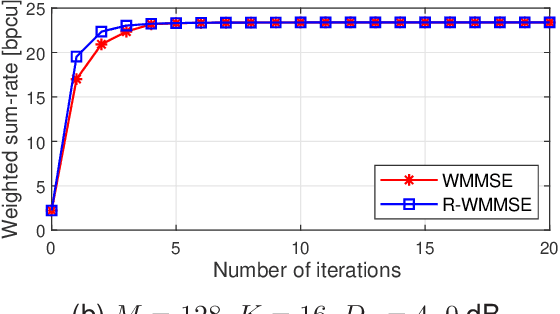
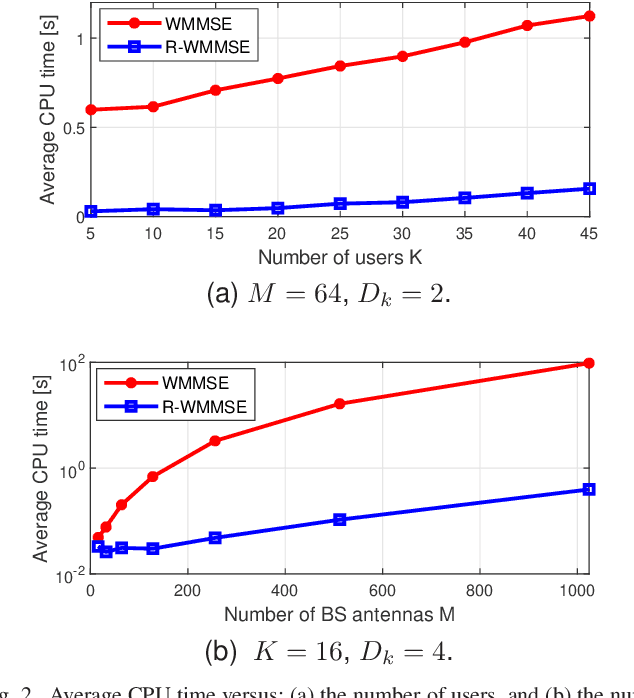
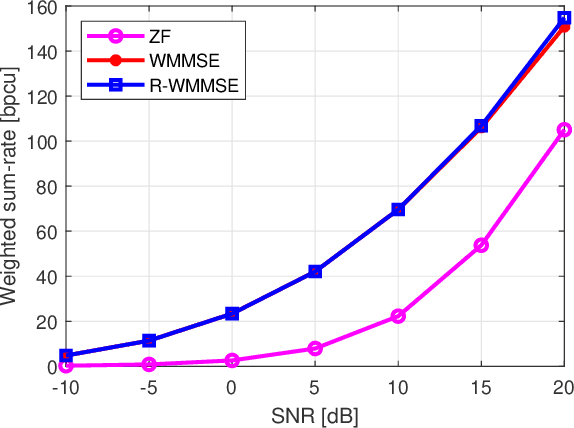
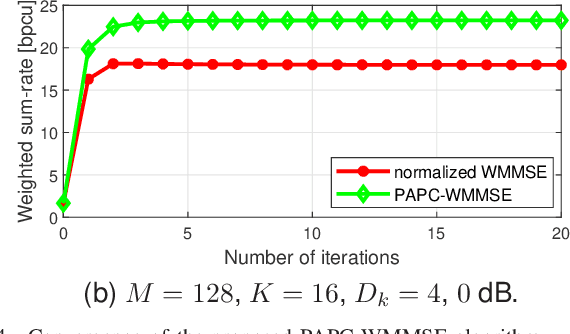
Precoding design for maximizing weighted sum-rate (WSR) is a fundamental problem for downlink of massive multi-user multiple-input multiple-output (MU-MIMO) systems. It is well-known that this problem is generally NP-hard due to the presence of multi-user interference. The weighted minimum mean-square error (WMMSE) algorithm is a popular approach for WSR maximization. However, its computational complexity is cubic in the number of base station (BS) antennas, which is unaffordable when the BS is equipped with a large antenna array. In this paper, we consider the WSR maximization problem with either a sum-power constraint (SPC) or per-antenna power constraints (PAPCs). For the former, we prove that any nontrivial stationary point must have a low-dimensional subspace structure, and then propose a reduced-WMMSE (R-WMMSE) with linear complexity by exploiting the solution structure. For the latter, we propose a linear-complexity WMMSE approach, named PAPC-WMMSE, by using a novel recursive design of the algorithm. Both R-WMMSE and PAPC-WMMSE have simple closed-form updates and guaranteed convergence to stationary points. Simulation results verify the efficacy of the proposed designs, especially the much lower complexity as compared to the state-of-the-art approaches for massive MU-MIMO systems.
Elbert: Fast Albert with Confidence-Window Based Early Exit
Jul 01, 2021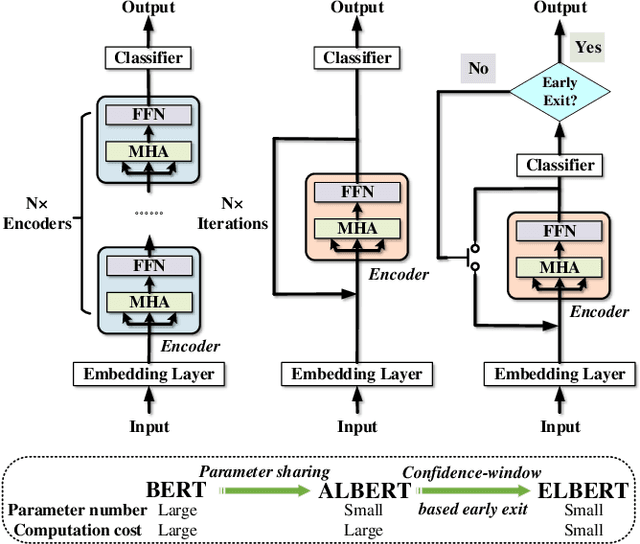
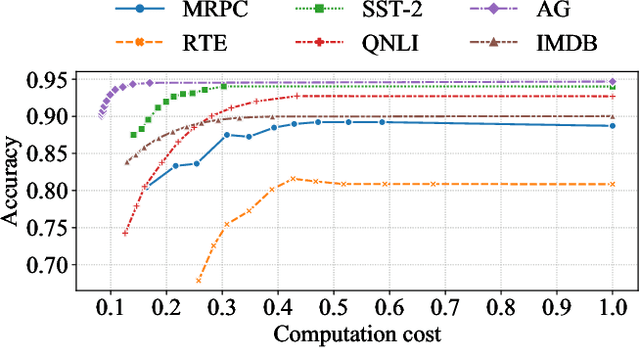
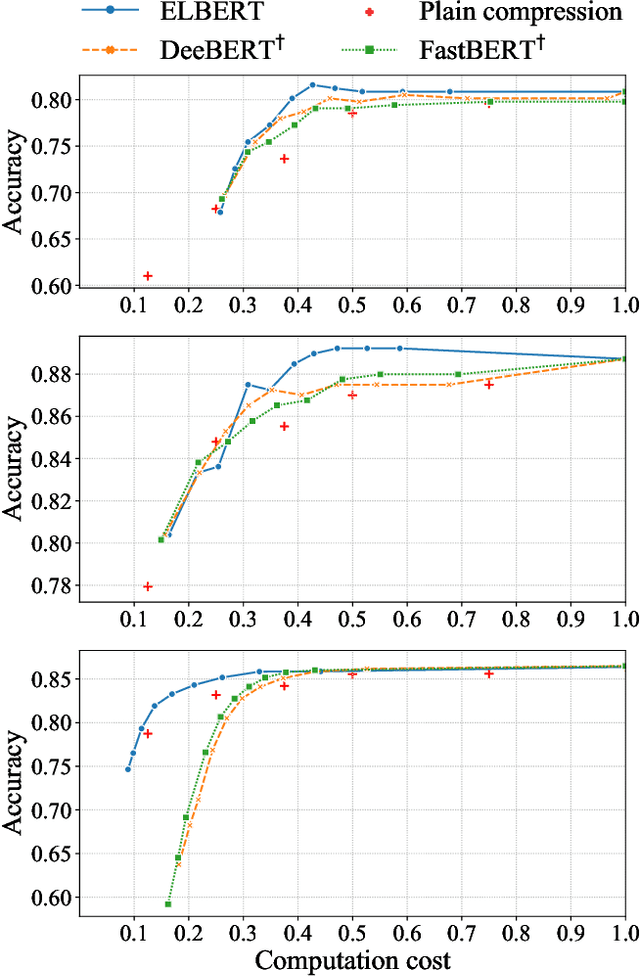
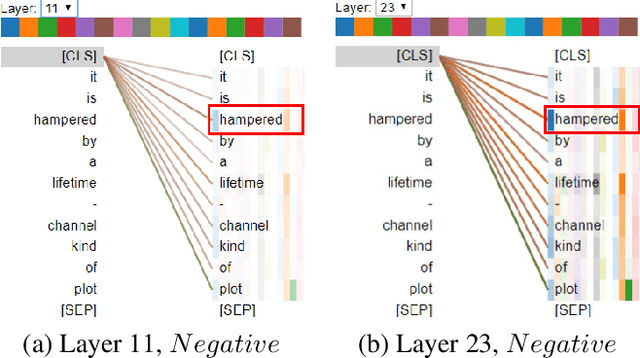
Despite the great success in Natural Language Processing (NLP) area, large pre-trained language models like BERT are not well-suited for resource-constrained or real-time applications owing to the large number of parameters and slow inference speed. Recently, compressing and accelerating BERT have become important topics. By incorporating a parameter-sharing strategy, ALBERT greatly reduces the number of parameters while achieving competitive performance. Nevertheless, ALBERT still suffers from a long inference time. In this work, we propose the ELBERT, which significantly improves the average inference speed compared to ALBERT due to the proposed confidence-window based early exit mechanism, without introducing additional parameters or extra training overhead. Experimental results show that ELBERT achieves an adaptive inference speedup varying from 2$\times$ to 10$\times$ with negligible accuracy degradation compared to ALBERT on various datasets. Besides, ELBERT achieves higher accuracy than existing early exit methods used for accelerating BERT under the same computation cost. Furthermore, to understand the principle of the early exit mechanism, we also visualize the decision-making process of it in ELBERT.