 Add to Chrome
 Add to Firefox
 Add to Edge
X-Cache: Cross-Chunk Block Caching for Few-Step Autoregressive World Models Inference
Apr 22, 2026
Real-time world simulation is becoming a key infrastructure for scalable evaluation and online reinforcement learning of autonomous driving systems. Recent driving world models built on autoregressive video diffusion achieve high-fidelity, controllable multi-camera generation, but their inference cost remains a bottleneck for interactive deployment. However, existing diffusion caching methods are designed for offline video generation with multiple denoising steps, and do not transfer to this scenario. Few-step distilled models have no inter-step redundancy left for these methods to reuse, and sequence-level parallelization techniques require future conditioning that closed-loop interactive generation does not provide. We present X-Cache, a training-free acceleration method that caches along a different axis: across consecutive generation chunks rather than across denoising steps. X-Cache maintains per-block residual caches that persist across chunks, and applies a dual-metric gating mechanism over a structure- and action-aware block-input fingerprint to independently decide whether each block should recompute or reuse its cached residual. To prevent approximation errors from permanently contaminating the autoregressive KV cache, X-Cache identifies KV update chunks (the forward passes that write clean keys and values into the persistent cache) and unconditionally forces full computation on these chunks, cutting off error propagation. We implement X-Cache on X-world, a production multi-camera action-conditioned driving world model built on multi-block causal DiT with few-step denoising and rolling KV cache. X-Cache achieves 71% block skip rate with 2.6x wall-clock speedup while maintaining minimum degradation.

X-World: Controllable Ego-Centric Multi-Camera World Models for Scalable End-to-End Driving
Mar 20, 2026Scalable and reliable evaluation is increasingly critical in the end-to-end era of autonomous driving, where vision--language--action (VLA) policies directly map raw sensor streams to driving actions. Yet, current evaluation pipelines still rely heavily on real-world road testing, which is costly, biased toward limited scenario coverage, and difficult to reproduce. These challenges motivate a real-world simulator that can generate realistic future observations under proposed actions, while remaining controllable and stable over long horizons. We present X-World, an action-conditioned multi-camera generative world model that simulates future observations directly in video space. Given synchronized multi-view camera history and a future action sequence, X-World generates future multi-camera video streams that follow the commanded actions. To ensure reproducible and editable scene rollouts, X-World further supports optional controls over dynamic traffic agents and static road elements, and retains a text-prompt interface for appearance-level control (e.g., weather and time of day). Beyond world simulation, X-World also enables video style transfer by conditioning on appearance prompts while preserving the underlying action and scene dynamics. At the core of X-World is a multi-view latent video generator designed to explicitly encourage cross-view geometric consistency and temporal coherence under diverse control signals. Experiments show that X-World achieves high-quality multi-view video generation with (i) strong view consistency across cameras, (ii) stable temporal dynamics over long rollouts, and (iii) high controllability with strict action following and faithful adherence to optional scene controls. These properties make X-World a practical foundation for scalable and reproducible evaluation.
FutureX: Enhance End-to-End Autonomous Driving via Latent Chain-of-Thought World Model
Dec 12, 2025
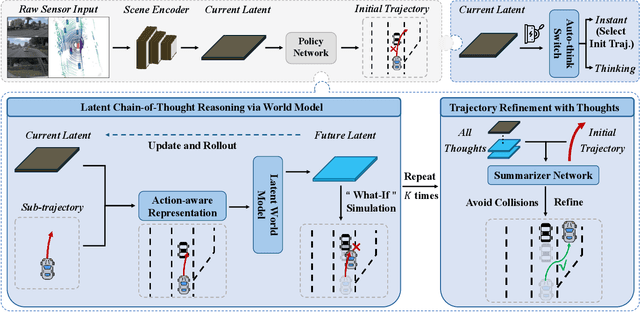

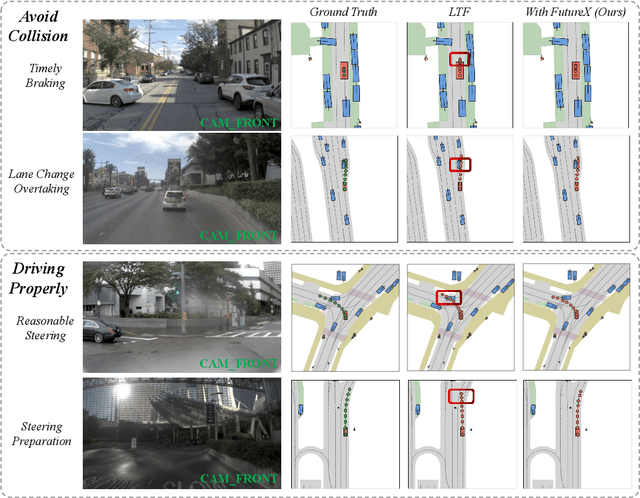
In autonomous driving, end-to-end planners learn scene representations from raw sensor data and utilize them to generate a motion plan or control actions. However, exclusive reliance on the current scene for motion planning may result in suboptimal responses in highly dynamic traffic environments where ego actions further alter the future scene. To model the evolution of future scenes, we leverage the World Model to represent how the ego vehicle and its environment interact and change over time, which entails complex reasoning. The Chain of Thought (CoT) offers a promising solution by forecasting a sequence of future thoughts that subsequently guide trajectory refinement. In this paper, we propose FutureX, a CoT-driven pipeline that enhances end-to-end planners to perform complex motion planning via future scene latent reasoning and trajectory refinement. Specifically, the Auto-think Switch examines the current scene and decides whether additional reasoning is required to yield a higher-quality motion plan. Once FutureX enters the Thinking mode, the Latent World Model conducts a CoT-guided rollout to predict future scene representation, enabling the Summarizer Module to further refine the motion plan. Otherwise, FutureX operates in an Instant mode to generate motion plans in a forward pass for relatively simple scenes. Extensive experiments demonstrate that FutureX enhances existing methods by producing more rational motion plans and fewer collisions without compromising efficiency, thereby achieving substantial overall performance gains, e.g., 6.2 PDMS improvement for TransFuser on NAVSIM. Code will be released.