 Add to Chrome
 Add to Firefox
 Add to Edge
Task-adaptive Q-Face
May 15, 2024
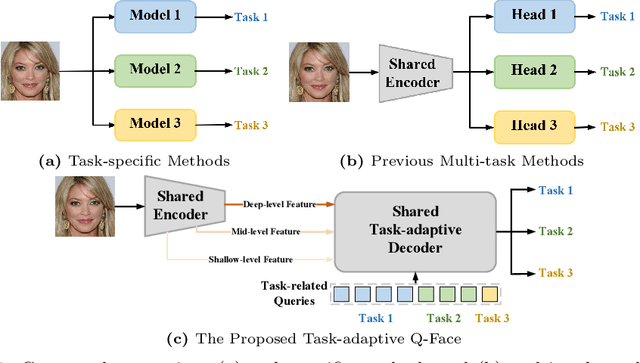
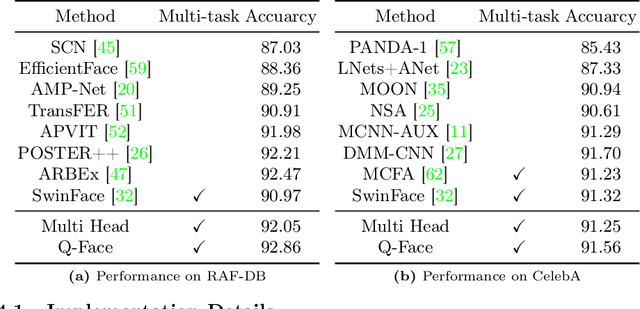
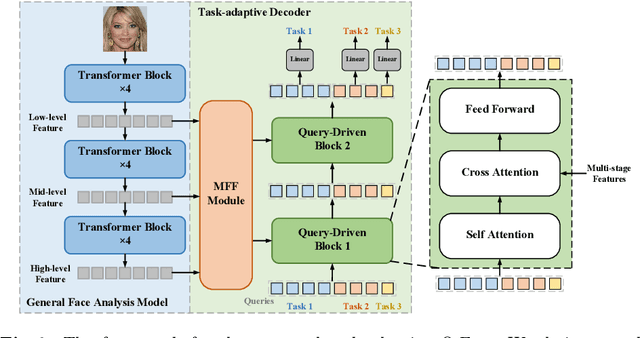
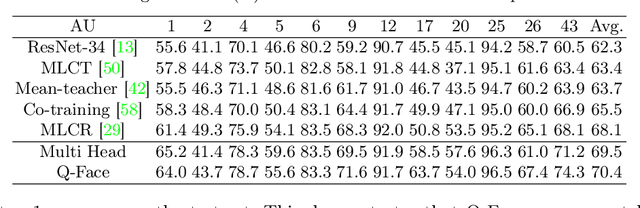
Although face analysis has achieved remarkable improvements in the past few years, designing a multi-task face analysis model is still challenging. Most face analysis tasks are studied as separate problems and do not benefit from the synergy among related tasks. In this work, we propose a novel task-adaptive multi-task face analysis method named as Q-Face, which simultaneously performs multiple face analysis tasks with a unified model. We fuse the features from multiple layers of a large-scale pre-trained model so that the whole model can use both local and global facial information to support multiple tasks. Furthermore, we design a task-adaptive module that performs cross-attention between a set of query vectors and the fused multi-stage features and finally adaptively extracts desired features for each face analysis task. Extensive experiments show that our method can perform multiple tasks simultaneously and achieves state-of-the-art performance on face expression recognition, action unit detection, face attribute analysis, age estimation, and face pose estimation. Compared to conventional methods, our method opens up new possibilities for multi-task face analysis and shows the potential for both accuracy and efficiency.

Image to Pseudo-Episode: Boosting Few-Shot Segmentation by Unlabeled Data
May 14, 2024Few-shot segmentation (FSS) aims to train a model which can segment the object from novel classes with a few labeled samples. The insufficient generalization ability of models leads to unsatisfactory performance when the models lack enough labeled data from the novel classes. Considering that there are abundant unlabeled data available, it is promising to improve the generalization ability by exploiting these various data. For leveraging unlabeled data, we propose a novel method, named Image to Pseudo-Episode (IPE), to generate pseudo-episodes from unlabeled data. Specifically, our method contains two modules, i.e., the pseudo-label generation module and the episode generation module. The former module generates pseudo-labels from unlabeled images by the spectral clustering algorithm, and the latter module generates pseudo-episodes from pseudo-labeled images by data augmentation methods. Extensive experiments on PASCAL-$5^i$ and COCO-$20^i$ demonstrate that our method achieves the state-of-the-art performance for FSS.
HPNet: Dynamic Trajectory Forecasting with Historical Prediction Attention
Apr 11, 2024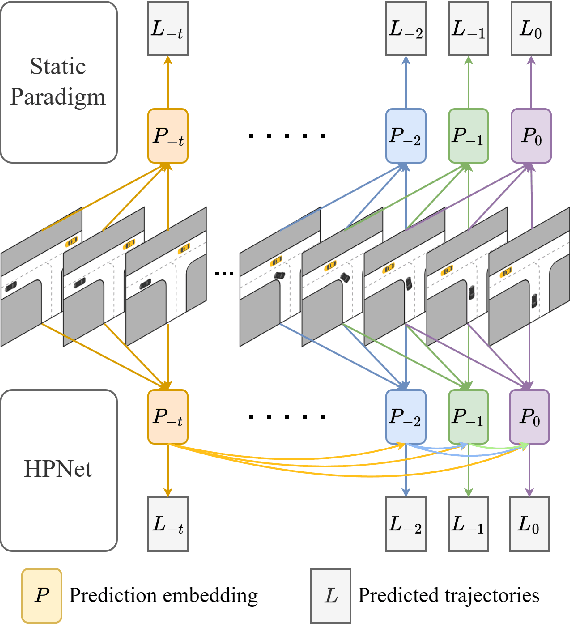

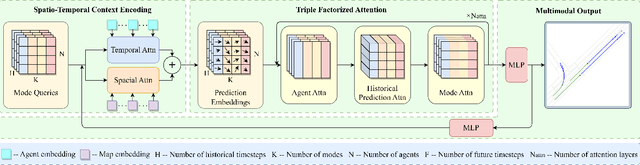
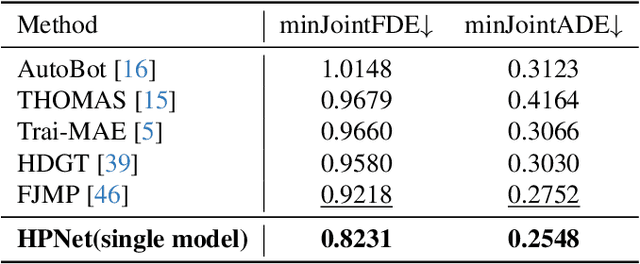
Predicting the trajectories of road agents is essential for autonomous driving systems. The recent mainstream methods follow a static paradigm, which predicts the future trajectory by using a fixed duration of historical frames. These methods make the predictions independently even at adjacent time steps, which leads to potential instability and temporal inconsistency. As successive time steps have largely overlapping historical frames, their forecasting should have intrinsic correlation, such as overlapping predicted trajectories should be consistent, or be different but share the same motion goal depending on the road situation. Motivated by this, in this work, we introduce HPNet, a novel dynamic trajectory forecasting method. Aiming for stable and accurate trajectory forecasting, our method leverages not only historical frames including maps and agent states, but also historical predictions. Specifically, we newly design a Historical Prediction Attention module to automatically encode the dynamic relationship between successive predictions. Besides, it also extends the attention range beyond the currently visible window benefitting from the use of historical predictions. The proposed Historical Prediction Attention together with the Agent Attention and Mode Attention is further formulated as the Triple Factorized Attention module, serving as the core design of HPNet.Experiments on the Argoverse and INTERACTION datasets show that HPNet achieves state-of-the-art performance, and generates accurate and stable future trajectories. Our code are available at https://github.com/XiaolongTang23/HPNet.
StylizedGS: Controllable Stylization for 3D Gaussian Splatting
Apr 08, 2024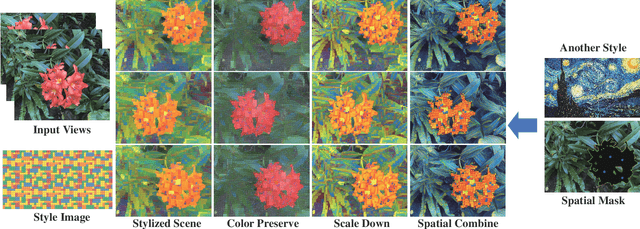
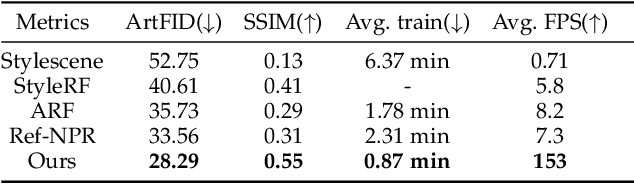
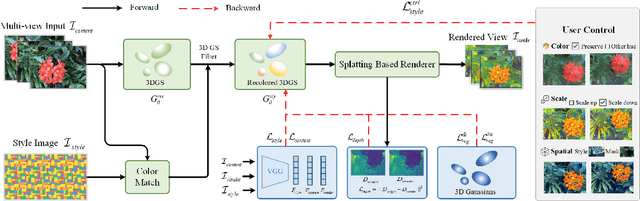

With the rapid development of XR, 3D generation and editing are becoming more and more important, among which, stylization is an important tool of 3D appearance editing. It can achieve consistent 3D artistic stylization given a single reference style image and thus is a user-friendly editing way. However, recent NeRF-based 3D stylization methods face efficiency issues that affect the actual user experience and the implicit nature limits its ability to transfer the geometric pattern styles. Additionally, the ability for artists to exert flexible control over stylized scenes is considered highly desirable, fostering an environment conducive to creative exploration. In this paper, we introduce StylizedGS, a 3D neural style transfer framework with adaptable control over perceptual factors based on 3D Gaussian Splatting (3DGS) representation. The 3DGS brings the benefits of high efficiency. We propose a GS filter to eliminate floaters in the reconstruction which affects the stylization effects before stylization. Then the nearest neighbor-based style loss is introduced to achieve stylization by fine-tuning the geometry and color parameters of 3DGS, while a depth preservation loss with other regularizations is proposed to prevent the tampering of geometry content. Moreover, facilitated by specially designed losses, StylizedGS enables users to control color, stylized scale and regions during the stylization to possess customized capabilities. Our method can attain high-quality stylization results characterized by faithful brushstrokes and geometric consistency with flexible controls. Extensive experiments across various scenes and styles demonstrate the effectiveness and efficiency of our method concerning both stylization quality and inference FPS.
GPT as Psychologist? Preliminary Evaluations for GPT-4V on Visual Affective Computing
Mar 09, 2024


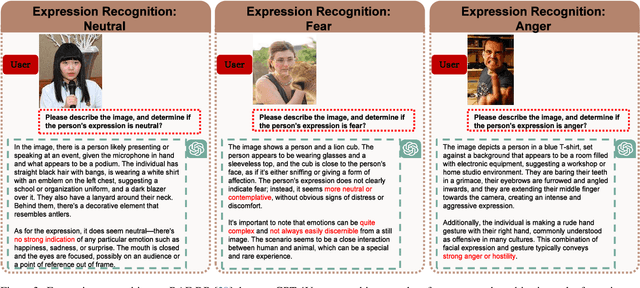
Multimodal language models (MLMs) are designed to process and integrate information from multiple sources, such as text, speech, images, and videos. Despite its success in language understanding, it is critical to evaluate the performance of downstream tasks for better human-centric applications. This paper assesses the application of MLMs with 5 crucial abilities for affective computing, spanning from visual affective tasks and reasoning tasks. The results show that GPT4 has high accuracy in facial action unit recognition and micro-expression detection while its general facial expression recognition performance is not accurate. We also highlight the challenges of achieving fine-grained micro-expression recognition and the potential for further study and demonstrate the versatility and potential of GPT4 for handling advanced tasks in emotion recognition and related fields by integrating with task-related agents for more complex tasks, such as heart rate estimation through signal processing. In conclusion, this paper provides valuable insights into the potential applications and challenges of MLMs in human-centric computing. The interesting samples are available at \url{https://github.com/LuPaoPao/GPT4Affectivity}.
Contrastive Learning of Person-independent Representations for Facial Action Unit Detection
Mar 06, 2024Facial action unit (AU) detection, aiming to classify AU present in the facial image, has long suffered from insufficient AU annotations. In this paper, we aim to mitigate this data scarcity issue by learning AU representations from a large number of unlabelled facial videos in a contrastive learning paradigm. We formulate the self-supervised AU representation learning signals in two-fold: (1) AU representation should be frame-wisely discriminative within a short video clip; (2) Facial frames sampled from different identities but show analogous facial AUs should have consistent AU representations. As to achieve these goals, we propose to contrastively learn the AU representation within a video clip and devise a cross-identity reconstruction mechanism to learn the person-independent representations. Specially, we adopt a margin-based temporal contrastive learning paradigm to perceive the temporal AU coherence and evolution characteristics within a clip that consists of consecutive input facial frames. Moreover, the cross-identity reconstruction mechanism facilitates pushing the faces from different identities but show analogous AUs close in the latent embedding space. Experimental results on three public AU datasets demonstrate that the learned AU representation is discriminative for AU detection. Our method outperforms other contrastive learning methods and significantly closes the performance gap between the self-supervised and supervised AU detection approaches.
Generalized Face Liveness Detection via De-spoofing Face Generator
Jan 17, 2024Previous Face Anti-spoofing (FAS) works face the challenge of generalizing in unseen domains. One of the major problems is that most existing FAS datasets are relatively small and lack data diversity. However, we find that there are numerous real faces that can be easily achieved under various conditions, which are neglected by previous FAS works. In this paper, we conduct an Anomalous cue Guided FAS (AG-FAS) method, which leverages real faces for improving model generalization via a De-spoofing Face Generator (DFG). Specifically, the DFG trained only on the real faces gains the knowledge of what a real face should be like and can generate a "real" version of the face corresponding to any given input face. The difference between the generated "real" face and the input face can provide an anomalous cue for the downstream FAS task. We then propose an Anomalous cue Guided FAS feature extraction Network (AG-Net) to further improve the FAS feature generalization via a cross-attention transformer. Extensive experiments on a total of nine public datasets show our method achieves state-of-the-art results under cross-domain evaluations with unseen scenarios and unknown presentation attacks.
Collaboratively Self-supervised Video Representation Learning for Action Recognition
Jan 15, 2024Considering the close connection between action recognition and human pose estimation, we design a Collaboratively Self-supervised Video Representation (CSVR) learning framework specific to action recognition by jointly considering generative pose prediction and discriminative context matching as pretext tasks. Specifically, our CSVR consists of three branches: a generative pose prediction branch, a discriminative context matching branch, and a video generating branch. Among them, the first one encodes dynamic motion feature by utilizing Conditional-GAN to predict the human poses of future frames, and the second branch extracts static context features by pulling the representations of clips and compressed key frames from the same video together while pushing apart the pairs from different videos. The third branch is designed to recover the current video frames and predict the future ones, for the purpose of collaboratively improving dynamic motion features and static context features. Extensive experiments demonstrate that our method achieves state-of-the-art performance on the UCF101 and HMDB51 datasets.
Pre-trained Model Guided Fine-Tuning for Zero-Shot Adversarial Robustness
Jan 09, 2024


Large-scale pre-trained vision-language models like CLIP have demonstrated impressive performance across various tasks, and exhibit remarkable zero-shot generalization capability, while they are also vulnerable to imperceptible adversarial examples. Existing works typically employ adversarial training (fine-tuning) as a defense method against adversarial examples. However, direct application to the CLIP model may result in overfitting, compromising the model's capacity for generalization. In this paper, we propose Pre-trained Model Guided Adversarial Fine-Tuning (PMG-AFT) method, which leverages supervision from the original pre-trained model by carefully designing an auxiliary branch, to enhance the model's zero-shot adversarial robustness. Specifically, PMG-AFT minimizes the distance between the features of adversarial examples in the target model and those in the pre-trained model, aiming to preserve the generalization features already captured by the pre-trained model. Extensive Experiments on 15 zero-shot datasets demonstrate that PMG-AFT significantly outperforms the state-of-the-art method, improving the top-1 robust accuracy by an average of 4.99%. Furthermore, our approach consistently improves clean accuracy by an average of 8.72%.
Towards Robust Semantic Segmentation against Patch-based Attack via Attention Refinement
Jan 03, 2024The attention mechanism has been proven effective on various visual tasks in recent years. In the semantic segmentation task, the attention mechanism is applied in various methods, including the case of both Convolution Neural Networks (CNN) and Vision Transformer (ViT) as backbones. However, we observe that the attention mechanism is vulnerable to patch-based adversarial attacks. Through the analysis of the effective receptive field, we attribute it to the fact that the wide receptive field brought by global attention may lead to the spread of the adversarial patch. To address this issue, in this paper, we propose a Robust Attention Mechanism (RAM) to improve the robustness of the semantic segmentation model, which can notably relieve the vulnerability against patch-based attacks. Compared to the vallina attention mechanism, RAM introduces two novel modules called Max Attention Suppression and Random Attention Dropout, both of which aim to refine the attention matrix and limit the influence of a single adversarial patch on the semantic segmentation results of other positions. Extensive experiments demonstrate the effectiveness of our RAM to improve the robustness of semantic segmentation models against various patch-based attack methods under different attack settings.