 Add to Chrome
 Add to Firefox
 Add to Edge
CoMind: Understanding Collaborative Human Activity from Multiple Minds and Views
Jul 07, 2026
Human-human collaboration is a fundamental aspect of everyday life, essential to success in a wide range of goal-directed activities from household tasks to professional teamwork. While much research has focused on modeling coordination and task execution, the cognitive processes that support such collaboration, particularly Theory of Mind (the ability to infer the mental states of others), remain difficult to study in natural settings. To address this gap, we introduce a novel egocentric and exocentric video dataset capturing real-world collaboration in cooking scenarios. The dataset integrates multi-perspective video, high-quality audio, gaze tracking, and 3D scene and object scans, with annotations for shared attention to objects, social cues and interactions between agents, as well as agent-object interactions. We establish benchmarks for Joint Attention Estimation, Socially Conditioned Object Interaction Anticipation, and Collaborative Handover Prediction, enabling research on multimodal perception, proactive assistance, and collaborative planning. By providing temporally aligned, richly annotated multimodal data, CoMind facilitates the development and evaluation of AI systems capable of modeling complex social interactions and reasoning about human behaviors in collaborative environments. Our dataset and benchmarks are made available at https://comind.ethz.ch/.

MegaFlow: Zero-Shot Large Displacement Optical Flow
Mar 26, 2026Accurate estimation of large displacement optical flow remains a critical challenge. Existing methods typically rely on iterative local search or/and domain-specific fine-tuning, which severely limits their performance in large displacement and zero-shot generalization scenarios. To overcome this, we introduce MegaFlow, a simple yet powerful model for zero-shot large displacement optical flow. Rather than relying on highly complex, task-specific architectural designs, MegaFlow adapts powerful pre-trained vision priors to produce temporally consistent motion fields. In particular, we formulate flow estimation as a global matching problem by leveraging pre-trained global Vision Transformer features, which naturally capture large displacements. This is followed by a few lightweight iterative refinements to further improve the sub-pixel accuracy. Extensive experiments demonstrate that MegaFlow achieves state-of-the-art zero-shot performance across multiple optical flow benchmarks. Moreover, our model also delivers highly competitive zero-shot performance on long-range point tracking benchmarks, demonstrating its robust transferability and suggesting a unified paradigm for generalizable motion estimation. Our project page is at: https://kristen-z.github.io/projects/megaflow.
GigaHands: A Massive Annotated Dataset of Bimanual Hand Activities
Dec 05, 2024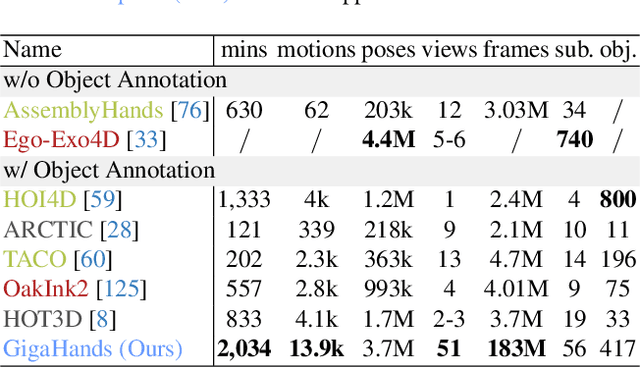
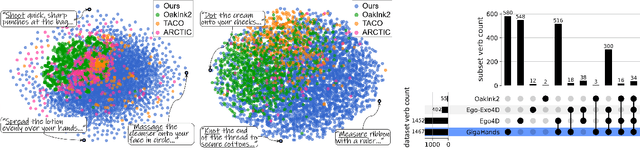

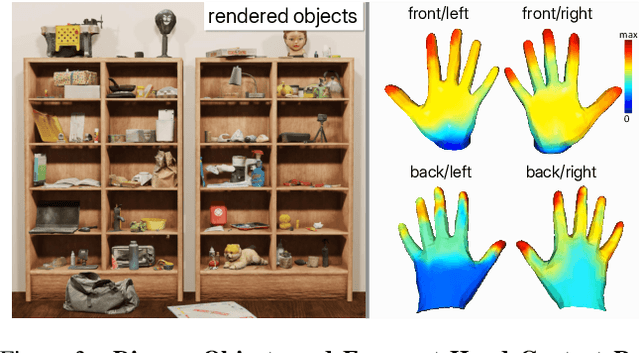
Understanding bimanual human hand activities is a critical problem in AI and robotics. We cannot build large models of bimanual activities because existing datasets lack the scale, coverage of diverse hand activities, and detailed annotations. We introduce GigaHands, a massive annotated dataset capturing 34 hours of bimanual hand activities from 56 subjects and 417 objects, totaling 14k motion clips derived from 183 million frames paired with 84k text annotations. Our markerless capture setup and data acquisition protocol enable fully automatic 3D hand and object estimation while minimizing the effort required for text annotation. The scale and diversity of GigaHands enable broad applications, including text-driven action synthesis, hand motion captioning, and dynamic radiance field reconstruction.
StylizedGS: Controllable Stylization for 3D Gaussian Splatting
Apr 08, 2024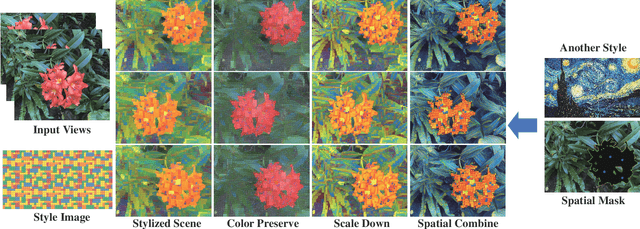
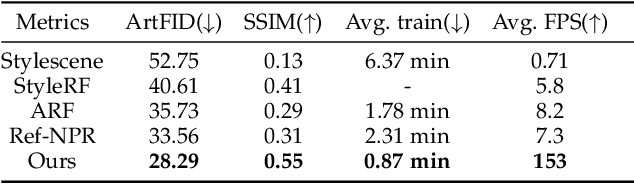
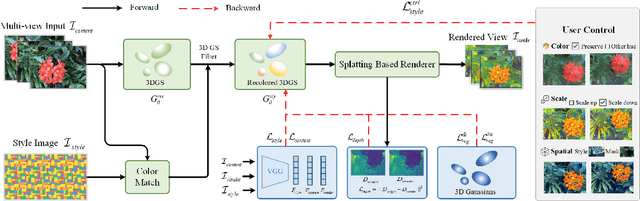

With the rapid development of XR, 3D generation and editing are becoming more and more important, among which, stylization is an important tool of 3D appearance editing. It can achieve consistent 3D artistic stylization given a single reference style image and thus is a user-friendly editing way. However, recent NeRF-based 3D stylization methods face efficiency issues that affect the actual user experience and the implicit nature limits its ability to transfer the geometric pattern styles. Additionally, the ability for artists to exert flexible control over stylized scenes is considered highly desirable, fostering an environment conducive to creative exploration. In this paper, we introduce StylizedGS, a 3D neural style transfer framework with adaptable control over perceptual factors based on 3D Gaussian Splatting (3DGS) representation. The 3DGS brings the benefits of high efficiency. We propose a GS filter to eliminate floaters in the reconstruction which affects the stylization effects before stylization. Then the nearest neighbor-based style loss is introduced to achieve stylization by fine-tuning the geometry and color parameters of 3DGS, while a depth preservation loss with other regularizations is proposed to prevent the tampering of geometry content. Moreover, facilitated by specially designed losses, StylizedGS enables users to control color, stylized scale and regions during the stylization to possess customized capabilities. Our method can attain high-quality stylization results characterized by faithful brushstrokes and geometric consistency with flexible controls. Extensive experiments across various scenes and styles demonstrate the effectiveness and efficiency of our method concerning both stylization quality and inference FPS.