 Add to Chrome
 Add to Firefox
 Add to Edge
Rethinking Normalization Placement for LLMs: Post-Norm under Curriculum Depth Growing
Aug 13, 2026
Pre-norm is the standard normalization placement in modern Transformers because it facilitates joint optimization of full-depth models. We ask whether this preference persists when depth is introduced through a curriculum. In curriculum depth growth, each appended block receives the boundary representation produced by a trained prefix, making normalization placement relevant to forward conditioning. We therefore test whether placement and training curriculum interact. In a controlled distillation study with a Qwen3-8B teacher and a nine-layer student, pre-norm and post-norm are indistinguishable under joint training, differing by $0.0004$ validation CE, while post-norm improves over pre-norm by $0.0328$ under curriculum growth, an order of magnitude larger. A post-joint control matched by student active-layer tokens remains worse than post-grow, which rules out compute as the sole explanation. The ranking crosses over during the curriculum: post-norm takes the lead once blocks are appended. Single-block and freeze controls localize the ranking change to block appending rather than shallow-block quality or retraining. Boundary diagnostics associate post-norm with stable residual scales and pre-norm with structural-token scale drift; on a fixed batch, the final pre-grow block is also nearly identity-mapped. Together with the phase-wise crossover, these observations are consistent with boundary-scale conditioning after new blocks are appended. The results motivate treating normalization placement and training curriculum as coupled design choices in this distillation setting.

InstCache: A Predictive Cache for LLM Serving
Nov 21, 2024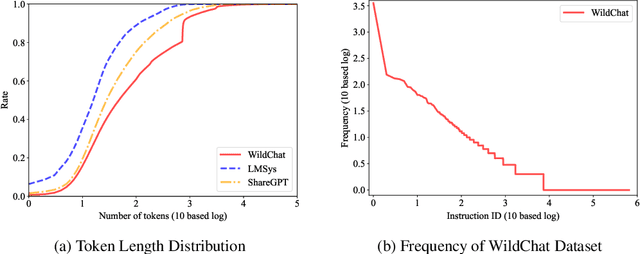
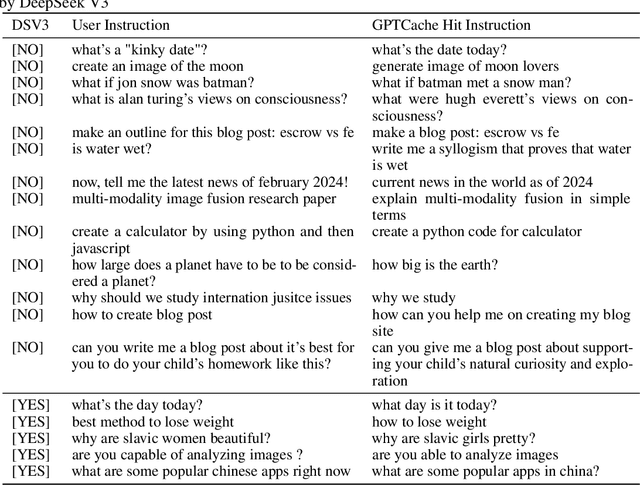
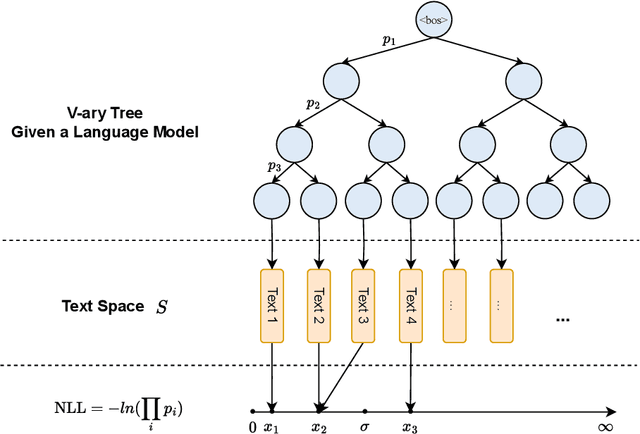
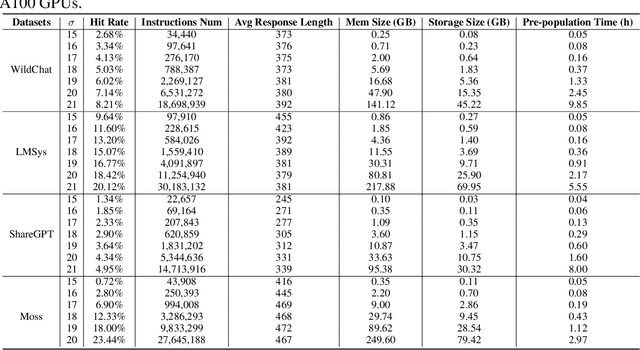
Large language models are revolutionizing every aspect of human life. However, the unprecedented power comes at the cost of significant computing intensity, suggesting long latency and large energy footprint. Key-Value Cache and Semantic Cache have been proposed as a solution to the above problem, but both suffer from limited scalability due to significant memory cost for each token or instruction embeddings. Motivated by the observations that most instructions are short, repetitive and predictable by LLMs, we propose to predict user-instructions by an instruction-aligned LLM and store them in a predictive cache, so-called InstCache. We introduce an instruction pre-population algorithm based on the negative log likelihood of instructions, determining the cache size with regard to the hit rate. The proposed InstCache is efficiently implemented as a hash table with minimal lookup latency for deployment. Experimental results show that InstCache can achieve up to 51.34% hit rate on LMSys dataset, which corresponds to a 2x speedup, at a memory cost of only 4.5GB.
CQIL: Inference Latency Optimization with Concurrent Computation of Quasi-Independent Layers
Apr 10, 2024The fast-growing large scale language models are delivering unprecedented performance on almost all natural language processing tasks. However, the effectiveness of large language models are reliant on an exponentially increasing number of parameters. The overwhelming computation complexity incurs a high inference latency that negatively affects user experience. Existing methods to improve inference efficiency, such as tensor parallelism and quantization, target to reduce per-layer computing latency, yet overlook the cumulative latency due to the number of layers. Recent works on reducing the cumulative latency through layer removing, however, lead to significant performance drop. Motivated by the similarity of inputs among adjacent layers, we propose to identify quasi-independent layers, which can be concurrently computed to significantly decrease inference latency. We also introduce a bypassing technique to mitigate the effect of information loss. Empirical experiments of the proposed approach on the LLaMA models confirm that Concurrent Computation of Quasi-Independent Layers (CQIL) can reduce latency by up to 48.3% on the LLaMA-33B model, while maintaining a close level of performance.