 Add to Chrome
 Add to Firefox
 Add to Edge
FiGuRO: Intrinsic Dimension Estimation for Multi-Modal Data
Aug 11, 2026
Determining the complexity, or Intrinsic Dimension (ID), of data is fundamental to efficient and interpretable representation learning. This is particularly challenging in multi-modal settings when trying to learn disentangled representations for shared and private information. Existing techniques leave a critical gap: they are often static, uni-modal, or in the case of contrastive methods, adapt only to the shared ID implicitly. We introduce Fidelity-Guided Rank Optimization (FiGuRO), a framework for approximating the ID of uni- and multi-modal data under constraints of model capacity and hyperparameters. FiGuRO learns the dimensions of low-rank projections using truncated singular value decomposition and an algorithm that determines when to reduce or increase dimension and in which latent space. Disentanglement of shared and private information arises as an emergent property of this optimization, eliminating the need for complex auxiliary loss functions. We demonstrate that FiGuRO outperforms existing ID estimation techniques and is more robust to hyperparameter changes. Across simulations and real-world data, FiGuRO captures distinct ID scales and varying subspace ratios, and decomposes shared and private information successfully. Furthermore, we show that FiGuRO can be applied to modern uni-modal pretrained models, enabling efficient, post-hoc disentanglement of multi-modal representations.

Protecting patient privacy in clinical foundation models: Technical and legal perspectives
Aug 07, 2026Clinical foundation models trained on large-scale patient data are increasingly used for decision support, screening, and public health. As deployment expands, privacy risk increasingly arises from model-mediated leakage, yet its prevalence and severity remain poorly quantified. Models can disclose sensitive training artifacts, enabling patient re-identification in ways not captured by data-handling controls alone. Existing frameworks, including HIPAA and GDPR, offer limited guidance for such indirect threats. We propose a practical framework for assessing privacy risk in clinical foundation models and illustrate realistic leakage scenarios across deployment settings, map them to legal regimes, and outline complementary technical and legal mitigations. Our analysis provides a context-aware risk assessment grounded in realistic usage to preserve the value of medical foundation models while rigorously safeguarding patient privacy.
MultiLoReFT: Decoupling Shared and Modality-Specific Subspaces in Multimodal Learning via Low-Rank Representation Fine-Tuning
Jul 18, 2026Real-world perception and decision making are inherently multimodal, integrating complementary signals across modalities. However, training multimodal models faces two main obstacles. First, collecting large-scale, well-aligned paired multimodal datasets is often impractical, making end-to-end multimodal training difficult. Second, existing multimodal representations frequently entangle information shared across modalities with modality-specific information, hindering interpretability and control. We introduce MultiLoReFT, an efficient and scalable low-rank representation fine-tuning framework for multimodal learning with pretrained unimodal models. MultiLoReFT extends low-rank adaptation to the multimodal setting and learns interpretable projection subspaces that decouple shared and modality-specific information. Across simulated and real-world benchmarks, it produces representations that support multimodal prediction while explicitly revealing how shared and modality-specific information is distributed across modalities.
Clinically Grounded Privacy Evaluation of Medical LMs
Jun 08, 2026Medical language models (LMs) can memorize and reproduce protected health information, but privacy evaluations often focus on recovery of training text rather than disclosure under realistic threat models. We introduce a clinically grounded framework that evaluates leakage along a graded axis of adversarial access, ranging from publicly inferable demographics to leaked note fragments. At each tier, we measure verbatim memorization of patient-specific text and semantic leakage of sensitive diagnoses. Applying the framework to an LM pretrained on 378k clinical notes, we find that routine encounter metadata (i.e. name, date of birth, provider, practice, visit date) elicits high rates of verbatim memorization across a patient's timeline and sensitive-diagnosis recovery (AUROC 0.91 for abortion, 0.81 for HIV). At the same time, exact-match memorization can overstate disclosure: 36% of memorized tokens reflect templated documentation. Our work highlights the risks of training on longitudinal clinical data, providing a practical framework for contextual privacy evaluation of medical LMs.
DynaSubVAE: Adaptive Subgrouping for Scalable and Robust OOD Detection
Jun 11, 2025Real-world observational data often contain existing or emerging heterogeneous subpopulations that deviate from global patterns. The majority of models tend to overlook these underrepresented groups, leading to inaccurate or even harmful predictions. Existing solutions often rely on detecting these samples as Out-of-domain (OOD) rather than adapting the model to new emerging patterns. We introduce DynaSubVAE, a Dynamic Subgrouping Variational Autoencoder framework that jointly performs representation learning and adaptive OOD detection. Unlike conventional approaches, DynaSubVAE evolves with the data by dynamically updating its latent structure to capture new trends. It leverages a novel non-parametric clustering mechanism, inspired by Gaussian Mixture Models, to discover and model latent subgroups based on embedding similarity. Extensive experiments show that DynaSubVAE achieves competitive performance in both near-OOD and far-OOD detection, and excels in class-OOD scenarios where an entire class is missing during training. We further illustrate that our dynamic subgrouping mechanism outperforms standalone clustering methods such as GMM and KMeans++ in terms of both OOD accuracy and regret precision.
When Style Breaks Safety: Defending Language Models Against Superficial Style Alignment
Jun 09, 2025Large language models (LLMs) can be prompted with specific styles (e.g., formatting responses as lists), including in jailbreak queries. Although these style patterns are semantically unrelated to the malicious intents behind jailbreak queries, their safety impact remains unclear. In this work, we seek to understand whether style patterns compromise LLM safety, how superficial style alignment increases model vulnerability, and how best to mitigate these risks during alignment. We evaluate 32 LLMs across seven jailbreak benchmarks, and find that malicious queries with style patterns inflate the attack success rate (ASR) for nearly all models. Notably, ASR inflation correlates with both the length of style patterns and the relative attention an LLM exhibits on them. We then investigate superficial style alignment, and find that fine-tuning with specific styles makes LLMs more vulnerable to jailbreaks of those same styles. Finally, we propose SafeStyle, a defense strategy that incorporates a small amount of safety training data augmented to match the distribution of style patterns in the fine-tuning data. Across three LLMs and five fine-tuning style settings, SafeStyle consistently outperforms baselines in maintaining LLM safety.
Machine Learning for Health symposium 2024 -- Findings track
Mar 02, 2025A collection of the accepted Findings papers that were presented at the 4th Machine Learning for Health symposium (ML4H 2024), which was held on December 15-16, 2024, in Vancouver, BC, Canada. ML4H 2024 invited high-quality submissions describing innovative research in a variety of health-related disciplines including healthcare, biomedicine, and public health. Works could be submitted to either the archival Proceedings track, or the non-archival Findings track. The Proceedings track targeted mature, cohesive works with technical sophistication and high-impact relevance to health. The Findings track promoted works that would spark new insights, collaborations, and discussions at ML4H. Both tracks were given the opportunity to share their work through the in-person poster session. All the manuscripts submitted to ML4H Symposium underwent a double-blind peer-review process.
An Information Criterion for Controlled Disentanglement of Multimodal Data
Oct 31, 2024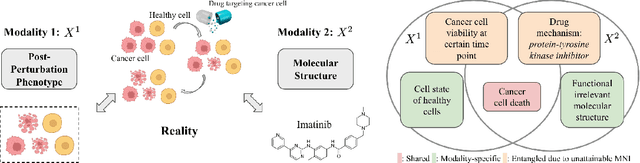
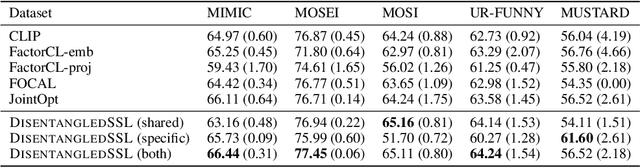
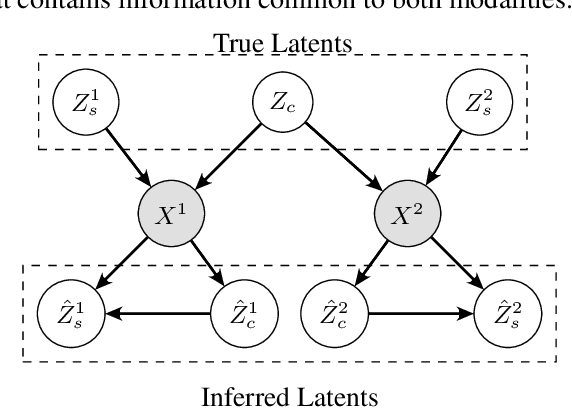
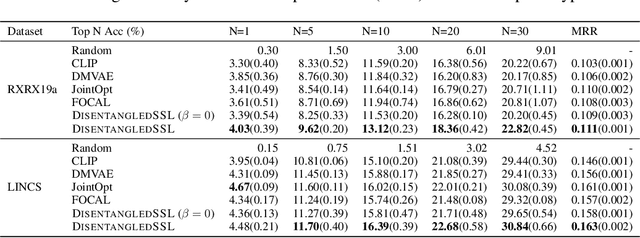
Multimodal representation learning seeks to relate and decompose information inherent in multiple modalities. By disentangling modality-specific information from information that is shared across modalities, we can improve interpretability and robustness and enable downstream tasks such as the generation of counterfactual outcomes. Separating the two types of information is challenging since they are often deeply entangled in many real-world applications. We propose Disentangled Self-Supervised Learning (DisentangledSSL), a novel self-supervised approach for learning disentangled representations. We present a comprehensive analysis of the optimality of each disentangled representation, particularly focusing on the scenario not covered in prior work where the so-called Minimum Necessary Information (MNI) point is not attainable. We demonstrate that DisentangledSSL successfully learns shared and modality-specific features on multiple synthetic and real-world datasets and consistently outperforms baselines on various downstream tasks, including prediction tasks for vision-language data, as well as molecule-phenotype retrieval tasks for biological data.
A collection of the accepted papers for the Human-Centric Representation Learning workshop at AAAI 2024
Mar 14, 2024This non-archival index is not complete, as some accepted papers chose to opt-out of inclusion. The list of all accepted papers is available on the workshop website.
Learning from Time Series under Temporal Label Noise
Feb 06, 2024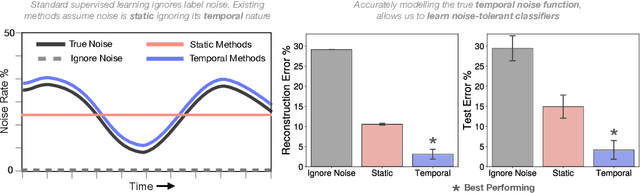
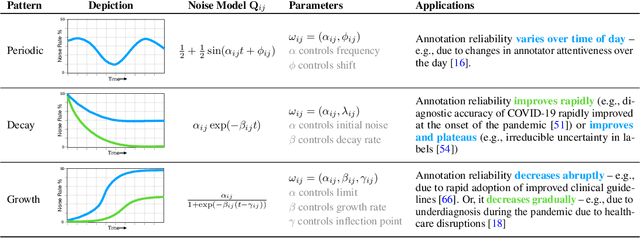
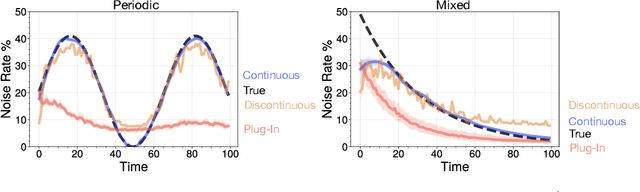
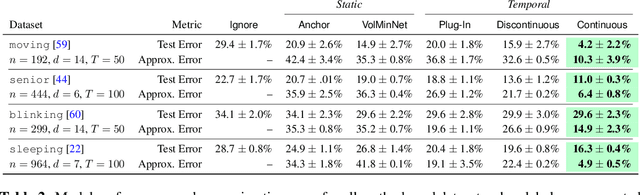
Many sequential classification tasks are affected by label noise that varies over time. Such noise can cause label quality to improve, worsen, or periodically change over time. We first propose and formalize temporal label noise, an unstudied problem for sequential classification of time series. In this setting, multiple labels are recorded in sequence while being corrupted by a time-dependent noise function. We first demonstrate the importance of modelling the temporal nature of the label noise function and how existing methods will consistently underperform. We then propose methods that can train noise-tolerant classifiers by estimating the temporal label noise function directly from data. We show that our methods lead to state-of-the-art performance in the presence of diverse temporal label noise functions using real and synthetic data.