 Add to Chrome
 Add to Firefox
 Add to Edge
MetaboNet-Bench: A Multi-modal Benchmark for Glucose Forecasting in Type 1 Diabetes
Jun 17, 2026
Glucose forecasting algorithms are an important aspect of glycemic control management in type 1 diabetes. So far, the research community has developed numerous algorithms and models for forecasting. However, it is well-recognized that the lack of standardized model performance evaluation benchmarks makes fair comparison difficult and hinders further innovation, and thus benchmark standardization is in urgent need. Furthermore, many published glucose forecasting algorithms are limited to CGM data alone, ignoring other multimodal signals such as insulin dosing and carbohydrate intake. Here, we introduce MetaboNet-Bench, a benchmark for multimodal glucose forecasting for patients with type 1 diabetes that provides an extensible open-source evaluation framework for comparison of glucose forecasting algorithms that leverage glucose, insulin, and carbohydrate data. We then demonstrate its utility by benchmarking several recently published glucose forecasting models and a custom multimodal time-series model, representing different model architectures. The results show that the benefit of adding data modalities is conditioned on the complexity of the model and that incorporating more clinical metrics helps identify meaningful gaps to fill for future research.

Machine Learning for Health symposium 2024 -- Findings track
Mar 02, 2025A collection of the accepted Findings papers that were presented at the 4th Machine Learning for Health symposium (ML4H 2024), which was held on December 15-16, 2024, in Vancouver, BC, Canada. ML4H 2024 invited high-quality submissions describing innovative research in a variety of health-related disciplines including healthcare, biomedicine, and public health. Works could be submitted to either the archival Proceedings track, or the non-archival Findings track. The Proceedings track targeted mature, cohesive works with technical sophistication and high-impact relevance to health. The Findings track promoted works that would spark new insights, collaborations, and discussions at ML4H. Both tracks were given the opportunity to share their work through the in-person poster session. All the manuscripts submitted to ML4H Symposium underwent a double-blind peer-review process.
Identifying Heterogeneous Treatment Effects in Multiple Outcomes using Joint Confidence Intervals
Dec 02, 2022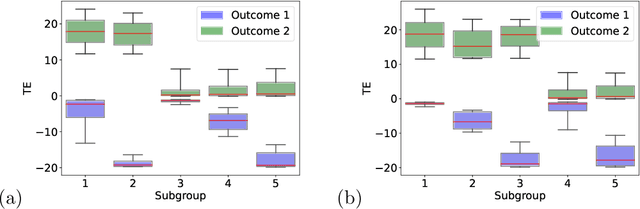
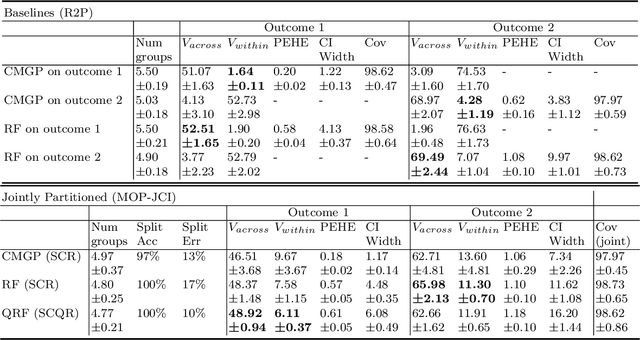
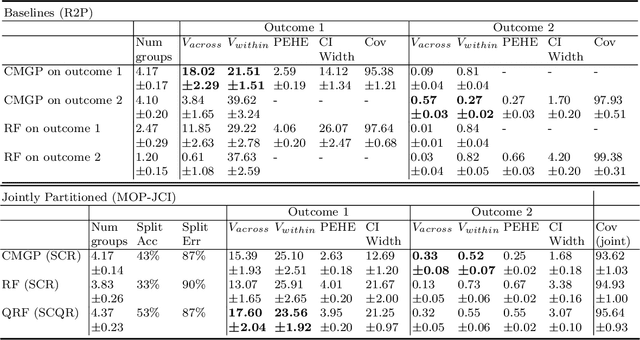
Heterogeneous treatment effects (HTEs) are commonly identified during randomized controlled trials (RCTs). Identifying subgroups of patients with similar treatment effects is of high interest in clinical research to advance precision medicine. Often, multiple clinical outcomes are measured during an RCT, each having a potentially heterogeneous effect. Recently there has been high interest in identifying subgroups from HTEs, however, there has been less focus on developing tools in settings where there are multiple outcomes. In this work, we propose a framework for partitioning the covariate space to identify subgroups across multiple outcomes based on the joint CIs. We test our algorithm on synthetic and semi-synthetic data where there are two outcomes, and demonstrate that our algorithm is able to capture the HTE in both outcomes simultaneously.
* Accepted to ML4H 2022. Available at https://proceedings.mlr.press/v193/argaw22a.html