 Add to Chrome
 Add to Firefox
 Add to Edge
RainDancer: RGB-Event Video Deraining with Rain-Oriented Spiking Dynamics
Jul 15, 2026
Video deraining aims to recover clean visual content from rainy videos for reliable perception under adverse weather. Existing methods mainly rely on RGB sequences and temporal redundancy, but RGB-only restoration remains ambiguous in dynamic rainy scenes, where rain streaks, textures, boundaries, motion, and occlusions may share similar visual patterns. Event cameras provide complementary motion-sensitive cues with high temporal resolution, but event streams also contain sensor noise and background-triggered responses, so direct RGB-Event fusion may introduce cross-modal interference. To address this issue, we propose RainDancer, a progressive RGB-Event video deraining framework based on a decompose-before-interact paradigm. The core idea is to separate rain and background components within each modality before cross-modal interaction. In the RGB branch, frame features are progressively decomposed into rain and background representations. In the event branch, a rain-oriented spiking neural network module captures sparse and bursty event dynamics associated with rain motion. Component-level fusion is then performed between semantically aligned representations for structure preservation and rain suppression. We further introduce event-domain supervision to regularize sparse event reconstruction, structural consistency, and gradient orientation. Experiments on synthetic and real RGB-Event video deraining datasets demonstrate superior quantitative performance, visual quality, and downstream perception robustness. Code is available at https://github.com/AE86-plus/RainDancer.

NTIRE 2026 The Second Challenge on Day and Night Raindrop Removal for Dual-Focused Images: Methods and Results
Apr 12, 2026This paper presents an overview of the NTIRE 2026 Second Challenge on Day and Night Raindrop Removal for Dual-Focused Images. Building upon the success of the first edition, this challenge attracted a wide range of impressive solutions, all developed and evaluated on our real-world Raindrop Clarity dataset~\cite{jin2024raindrop}. For this edition, we adjust the dataset with 14,139 images for training, 407 images for validation, and 593 images for testing. The primary goal of this challenge is to establish a strong and practical benchmark for the removal of raindrops under various illumination and focus conditions. In total, 168 teams have registered for the competition, and 17 teams submitted valid final solutions and fact sheets for the testing phase. The submitted methods achieved strong performance on the Raindrop Clarity dataset, demonstrating the growing progress in this challenging task.
Derain-Agent: A Plug-and-Play Agent Framework for Rainy Image Restoration
Mar 12, 2026While deep learning has advanced single-image deraining, existing models suffer from a fundamental limitation: they employ a static inference paradigm that fails to adapt to the complex, coupled degradations (e.g., noise artifacts, blur, and color deviation) of real-world rain. Consequently, restored images often exhibit residual artifacts and inconsistent perceptual quality. In this work, we present Derain-Agent, a plug-and-play refinement framework that transitions deraining from static processing to dynamic, agent-based restoration. Derain-Agent equips a base deraining model with two core capabilities: 1) a Planning Network that intelligently schedules an optimal sequence of restoration tools for each instance, and 2) a Strength Modulation mechanism that applies these tools with spatially adaptive intensity. This design enables precise, region-specific correction of residual errors without the prohibitive cost of iterative search. Our method demonstrates strong generalization, consistently boosting the performance of state-of-the-art deraining models on both synthetic and real-world benchmarks.
Generation of Synthetic Electronic Medical Record Text
Dec 06, 2018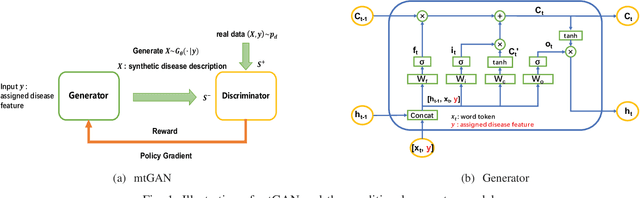
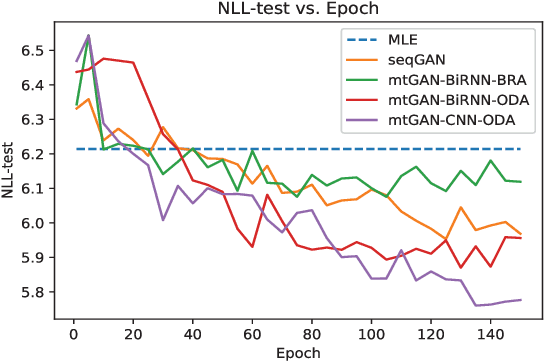
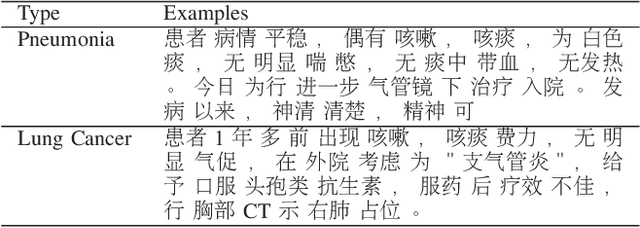
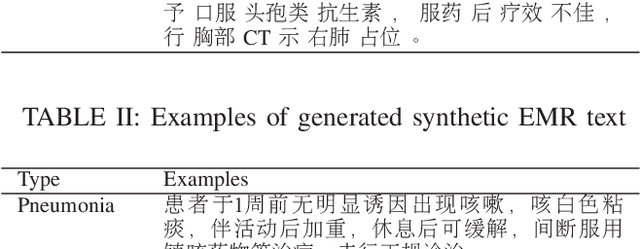
Machine learning (ML) and Natural Language Processing (NLP) have achieved remarkable success in many fields and have brought new opportunities and high expectation in the analyses of medical data. The most common type of medical data is the massive free-text electronic medical records (EMR). It is widely regarded that mining such massive data can bring up important information for improving medical practices as well as for possible new discoveries on complex diseases. However, the free EMR texts are lacking consistent standards, rich of private information, and limited in availability. Also, as they are accumulated from everyday practices, it is often hard to have a balanced number of samples for the types of diseases under study. These problems hinder the development of ML and NLP methods for EMR data analysis. To tackle these problems, we developed a model to generate synthetic text of EMRs called Medical Text Generative Adversarial Network or mtGAN. It is based on the GAN framework and is trained by the REINFORCE algorithm. It takes disease features as inputs and generates synthetic texts as EMRs for the corresponding diseases. We evaluate the model from micro-level, macro-level and application-level on a Chinese EMR text dataset. The results show that the method has a good capacity to fit real data and can generate realistic and diverse EMR samples. This provides a novel way to avoid potential leakage of patient privacy while still supply sufficient well-controlled cohort data for developing downstream ML and NLP methods. It can also be used as a data augmentation method to assist studies based on real EMR data.