 Add to Chrome
 Add to Firefox
 Add to Edge
JetViT: Efficient High-Resolution Vision Transformer with Post-Training Attention Search
May 26, 2026
We introduce JetViT, a novel family of hybrid-architecture Vision Transformer (ViT) models that match the accuracy of state-of-the-art full-attention vision foundation models while achieving substantially higher inference efficiency on high-resolution images. At the core of our approach is Post-Training Attention Search, a post-training acceleration framework that converts pre-trained full-attention ViTs into efficient hybrid-attention variants by identifying and replacing redundant full-attention blocks with linear or window-attention blocks. By inheriting the MLP and attention weights from the base model, Post-Training Attention Search efficiently explores the architectural design space through three key steps: (1) optimizing the linear-attention block design; (2) finding the best combination of linear-attention and window-attention blocks; and (3) identifying and preserving critical full-attention blocks. We evaluate JetViT on two representative high-resolution vision foundation models, DINOv3 and DepthAnythingV2. On the NVIDIA H100 GPU, JetViT achieves up to 1.79x higher throughput and up to 44.81% lower latency without sacrificing accuracy. We will release our code and accelerated ViT models soon.

SyncDiff: Synchronized Motion Diffusion for Multi-Body Human-Object Interaction Synthesis
Dec 28, 2024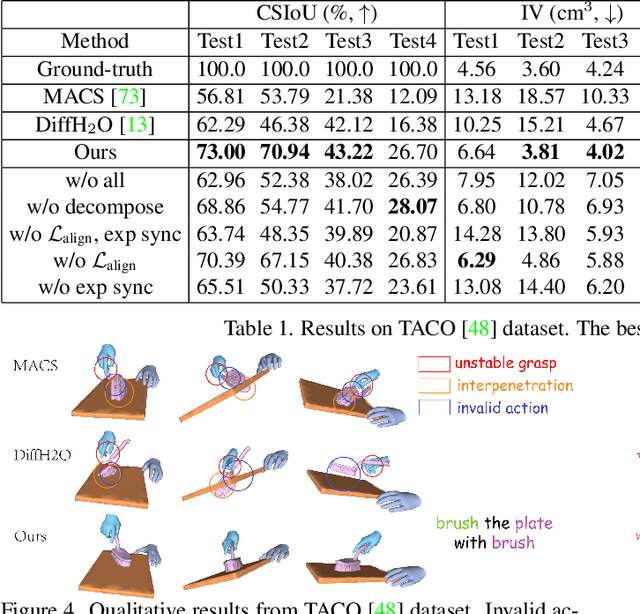

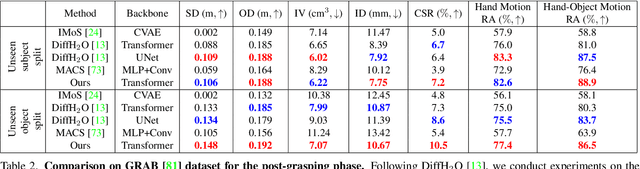
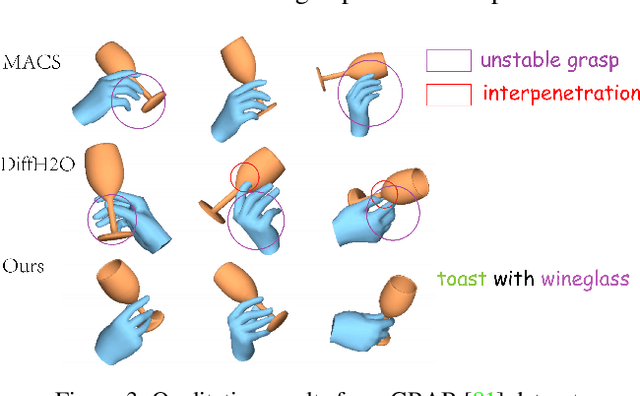
Synthesizing realistic human-object interaction motions is a critical problem in VR/AR and human animation. Unlike the commonly studied scenarios involving a single human or hand interacting with one object, we address a more generic multi-body setting with arbitrary numbers of humans, hands, and objects. This complexity introduces significant challenges in synchronizing motions due to the high correlations and mutual influences among bodies. To address these challenges, we introduce SyncDiff, a novel method for multi-body interaction synthesis using a synchronized motion diffusion strategy. SyncDiff employs a single diffusion model to capture the joint distribution of multi-body motions. To enhance motion fidelity, we propose a frequency-domain motion decomposition scheme. Additionally, we introduce a new set of alignment scores to emphasize the synchronization of different body motions. SyncDiff jointly optimizes both data sample likelihood and alignment likelihood through an explicit synchronization strategy. Extensive experiments across four datasets with various multi-body configurations demonstrate the superiority of SyncDiff over existing state-of-the-art motion synthesis methods.