 Add to Chrome
 Add to Firefox
 Add to Edge
X-OmniClaw Technical Report: A Unified Mobile Agent for Multimodal Understanding and Interaction
May 07, 2026
Inspired by the development of OpenClaw, there is a growing demand for mobile-based personal agents capable of handling complex and intuitive interactions. In this technical report, we introduce X-OmniClaw, a unified mobile agent designed for multimodal understanding and interaction in the Android ecosystem. This unified architecture of perception, memory, and action enables the agent to handle complex mobile tasks with high contextual awareness. Specifically, Omni Perception provides a unified multimodal ingress pipeline that integrates UI states, real-world visual contexts, and speech inputs, leveraging a temporal alignment module to decompose raw data into structured multimodal intent representations. Omni Memory leverages multimodal memory optimization to enhance personalized intelligence by integrating runtime working memory for task continuity with long-term personal memory distilled from local data, enabling highly context-aware and personalized interactions. Finally, Omni Action employs a hybrid grounding strategy that combines structural XML metadata with visual perception for robust interaction. Through Behavior Cloning and Trajectory Replay, the system captures user navigation as reusable skills, enabling precise direct-access execution. Demonstrations across diverse scenarios show that X-OmniClaw effectively enhances interaction efficiency and task reliability, providing a practical architectural blueprint for the next generation of mobile-native personal assistants.

OwlCap: Harmonizing Motion-Detail for Video Captioning via HMD-270K and Caption Set Equivalence Reward
Aug 27, 2025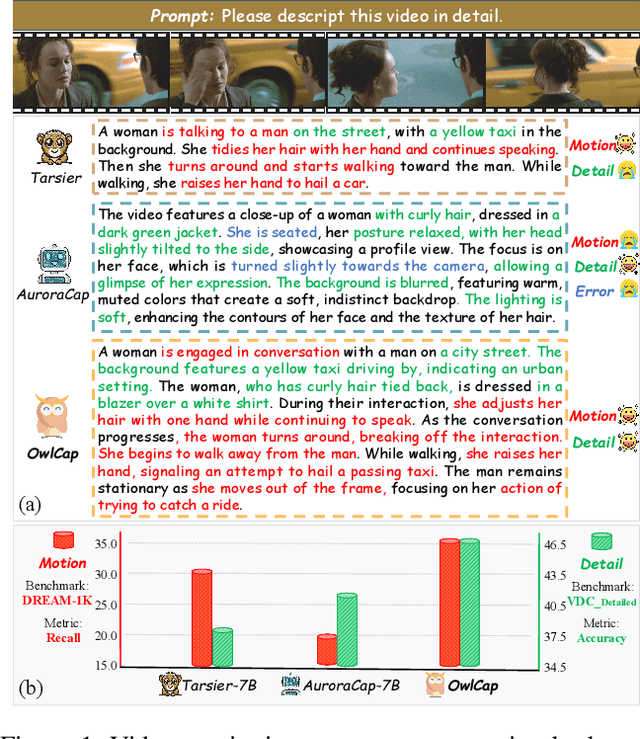
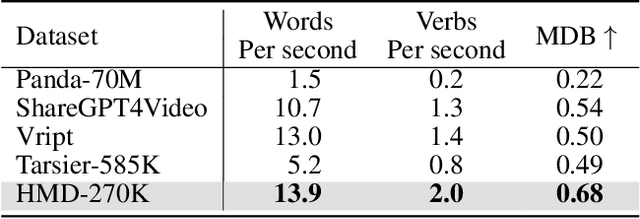
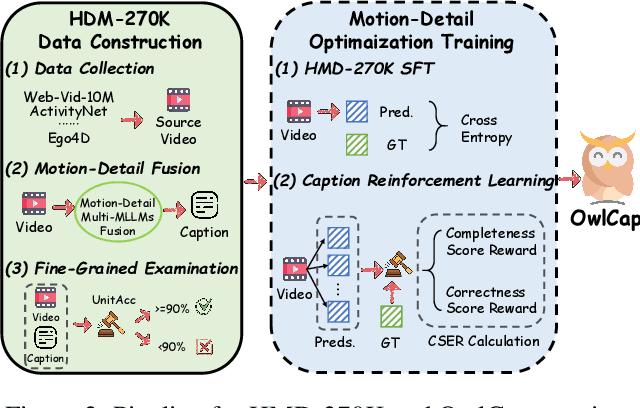

Video captioning aims to generate comprehensive and coherent descriptions of the video content, contributing to the advancement of both video understanding and generation. However, existing methods often suffer from motion-detail imbalance, as models tend to overemphasize one aspect while neglecting the other. This imbalance results in incomplete captions, which in turn leads to a lack of consistency in video understanding and generation. To address this issue, we propose solutions from two aspects: 1) Data aspect: We constructed the Harmonizing Motion-Detail 270K (HMD-270K) dataset through a two-stage pipeline: Motion-Detail Fusion (MDF) and Fine-Grained Examination (FGE). 2) Optimization aspect: We introduce the Caption Set Equivalence Reward (CSER) based on Group Relative Policy Optimization (GRPO). CSER enhances completeness and accuracy in capturing both motion and details through unit-to-set matching and bidirectional validation. Based on the HMD-270K supervised fine-tuning and GRPO post-training with CSER, we developed OwlCap, a powerful video captioning multi-modal large language model (MLLM) with motion-detail balance. Experimental results demonstrate that OwlCap achieves significant improvements compared to baseline models on two benchmarks: the detail-focused VDC (+4.2 Acc) and the motion-focused DREAM-1K (+4.6 F1). The HMD-270K dataset and OwlCap model will be publicly released to facilitate video captioning research community advancements.