 Add to Chrome
 Add to Firefox
 Add to Edge
VoLN: Vision-Only Long-Horizon Navigation---Paradigm, Benchmark, and Method
Jul 23, 2026
Vision-and-Language Navigation (VLN) enables embodied agents to follow natural-language instructions. However, route-level instructions commonly encode spatial priors, such as orientation, distance, and layout, that are not explicitly available from onboard sensing at deployment in open, GPS-denied environments. Benchmark performance under such interfaces therefore jointly reflects visual navigation ability and the use of route structure explicitly supplied by the task description. As a complementary formulation, we propose Vision-Only Long-Horizon Navigation (VoLN), which shifts route-relevant information from externally supplied instructions and global guidance to locally observable in-scene cues. In VoLN, goal views specify the destination, while route-relevant information is available only through locally observable in-scene cues that the agent must detect, interpret, and select online. We instantiate VoLN for aerial navigation through VoLN-UAV, a 7,210-episode benchmark that combines long-horizon goal-directed flight, continuous 3D motion, large viewpoint changes, and context-dependent beacon selection. We further provide VoLN-MLLM as an initial reference baseline. It aligns self-supervised visual features with a structured semantic space and predicts short-horizon waypoint segments from observation history, goal views, retrieved visual--semantic tokens, and proprioception. On the five-environment Test-Unseen split, it obtains success rates of 7.4%, 4.5%, and 1.8% on Easy, Normal, and Hard episodes, respectively. These results provide an initial evaluation of VoLN and reveal substantial remaining challenges in long-horizon evidence integration, cross-view goal matching, and closed-loop stability. Project page: https://admire-ljb.github.io/VoLN-UAV/

AERIS: Aerial-Edge Role-Driven Intelligence at Runtime via Orchestrated Language-Model Swarm
Jun 29, 2026Integrating large language models into robotic systems holds promise for enhancing autonomy, yet practical deployment remains constrained by strict heartbeat-constrained scheduling and limited computational power. We propose AERIS: an edge deployment framework for aerial platforms. It organizes dedicated small language models combined with lightweight perception and control modules into roles that can be instantiated at runtime, and dynamically rebinds them across different executors as resources change, thereby pushing intelligent capabilities to the edge. AERIS achieves long-horizon instruction decomposition through an attention-subgoal alignment mechanism, which involves annotating the currently active instruction step in messages, thereby progressively approaching long-term objectives. We evaluate AERIS on a high-fidelity UAV Vision-and-Language Navigation benchmark. Under a heartbeat-timed execution mechanism, AERIS maintains a stable perception-decision-control loop between a low-frequency planner and a high-frequency controller, supporting real-time closed-loop operation. We further validate its deployability through two real-world experiments focused on planning and fast response. A demonstration video is provided in the supplementary materials.
Interference-Aware K-Step Reachable Communication in Multi-Agent Reinforcement Learning
Mar 16, 2026Effective communication is pivotal for addressing complex collaborative tasks in multi-agent reinforcement learning (MARL). Yet, limited communication bandwidth and dynamic, intricate environmental topologies present significant challenges in identifying high-value communication partners. Agents must consequently select collaborators under uncertainty, lacking a priori knowledge of which partners can deliver task-critical information. To this end, we propose Interference-Aware K-Step Reachable Communication (IA-KRC), a novel framework that enhances cooperation via two core components: (1) a K-Step reachability protocol that confines message passing to physically accessible neighbors, and (2) an interference-prediction module that optimizes partner choice by minimizing interference while maximizing utility. Compared to existing methods, IA-KRC enables substantially more persistent and efficient cooperation despite environmental interference. Comprehensive evaluations confirm that IA-KRC achieves superior performance compared to state-of-the-art baselines, while demonstrating enhanced robustness and scalability in complex topological and highly dynamic multi-agent scenarios.
Neural Algorithmic Reasoners informed Large Language Model for Multi-Agent Path Finding
Aug 25, 2025The development and application of large language models (LLM) have demonstrated that foundational models can be utilized to solve a wide array of tasks. However, their performance in multi-agent path finding (MAPF) tasks has been less than satisfactory, with only a few studies exploring this area. MAPF is a complex problem requiring both planning and multi-agent coordination. To improve the performance of LLM in MAPF tasks, we propose a novel framework, LLM-NAR, which leverages neural algorithmic reasoners (NAR) to inform LLM for MAPF. LLM-NAR consists of three key components: an LLM for MAPF, a pre-trained graph neural network-based NAR, and a cross-attention mechanism. This is the first work to propose using a neural algorithmic reasoner to integrate GNNs with the map information for MAPF, thereby guiding LLM to achieve superior performance. LLM-NAR can be easily adapted to various LLM models. Both simulation and real-world experiments demonstrate that our method significantly outperforms existing LLM-based approaches in solving MAPF problems.
MASLab: A Unified and Comprehensive Codebase for LLM-based Multi-Agent Systems
May 22, 2025LLM-based multi-agent systems (MAS) have demonstrated significant potential in enhancing single LLMs to address complex and diverse tasks in practical applications. Despite considerable advancements, the field lacks a unified codebase that consolidates existing methods, resulting in redundant re-implementation efforts, unfair comparisons, and high entry barriers for researchers. To address these challenges, we introduce MASLab, a unified, comprehensive, and research-friendly codebase for LLM-based MAS. (1) MASLab integrates over 20 established methods across multiple domains, each rigorously validated by comparing step-by-step outputs with its official implementation. (2) MASLab provides a unified environment with various benchmarks for fair comparisons among methods, ensuring consistent inputs and standardized evaluation protocols. (3) MASLab implements methods within a shared streamlined structure, lowering the barriers for understanding and extension. Building on MASLab, we conduct extensive experiments covering 10+ benchmarks and 8 models, offering researchers a clear and comprehensive view of the current landscape of MAS methods. MASLab will continue to evolve, tracking the latest developments in the field, and invite contributions from the broader open-source community.
Hierarchical Consensus-Based Multi-Agent Reinforcement Learning for Multi-Robot Cooperation Tasks
Jul 11, 2024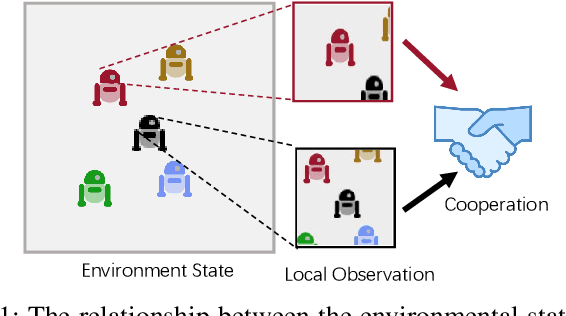
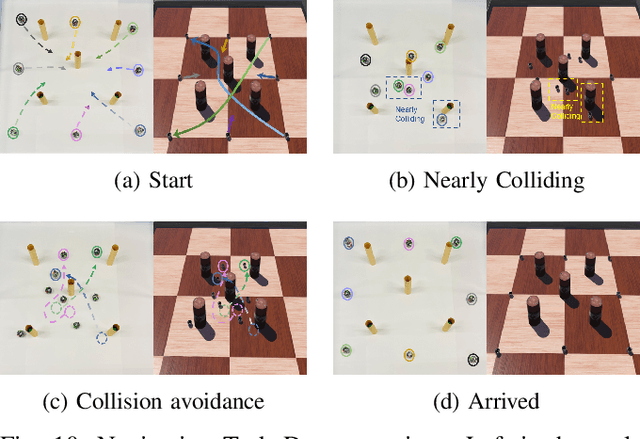
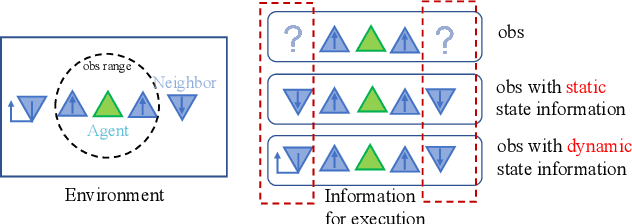
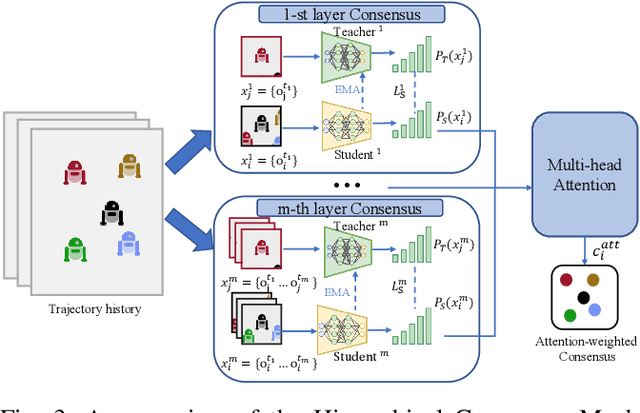
In multi-agent reinforcement learning (MARL), the Centralized Training with Decentralized Execution (CTDE) framework is pivotal but struggles due to a gap: global state guidance in training versus reliance on local observations in execution, lacking global signals. Inspired by human societal consensus mechanisms, we introduce the Hierarchical Consensus-based Multi-Agent Reinforcement Learning (HC-MARL) framework to address this limitation. HC-MARL employs contrastive learning to foster a global consensus among agents, enabling cooperative behavior without direct communication. This approach enables agents to form a global consensus from local observations, using it as an additional piece of information to guide collaborative actions during execution. To cater to the dynamic requirements of various tasks, consensus is divided into multiple layers, encompassing both short-term and long-term considerations. Short-term observations prompt the creation of an immediate, low-layer consensus, while long-term observations contribute to the formation of a strategic, high-layer consensus. This process is further refined through an adaptive attention mechanism that dynamically adjusts the influence of each consensus layer. This mechanism optimizes the balance between immediate reactions and strategic planning, tailoring it to the specific demands of the task at hand. Extensive experiments and real-world applications in multi-robot systems showcase our framework's superior performance, marking significant advancements over baselines.
Leveraging Partial Symmetry for Multi-Agent Reinforcement Learning
Dec 30, 2023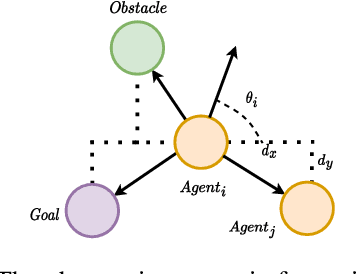
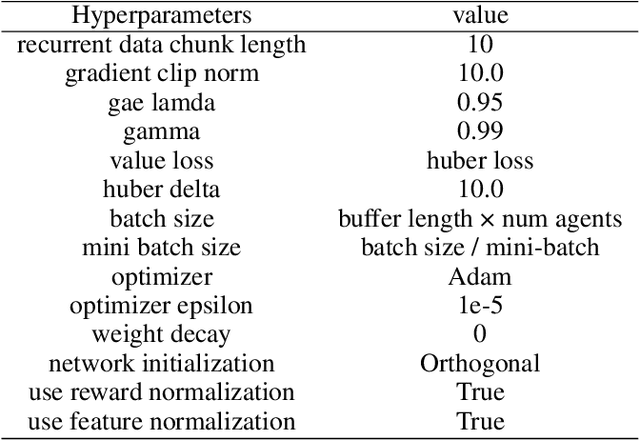
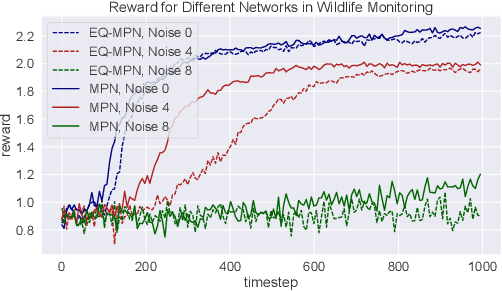
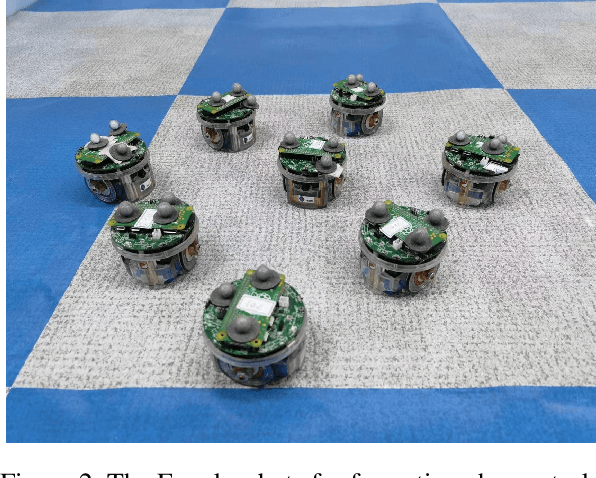
Incorporating symmetry as an inductive bias into multi-agent reinforcement learning (MARL) has led to improvements in generalization, data efficiency, and physical consistency. While prior research has succeeded in using perfect symmetry prior, the realm of partial symmetry in the multi-agent domain remains unexplored. To fill in this gap, we introduce the partially symmetric Markov game, a new subclass of the Markov game. We then theoretically show that the performance error introduced by utilizing symmetry in MARL is bounded, implying that the symmetry prior can still be useful in MARL even in partial symmetry situations. Motivated by this insight, we propose the Partial Symmetry Exploitation (PSE) framework that is able to adaptively incorporate symmetry prior in MARL under different symmetry-breaking conditions. Specifically, by adaptively adjusting the exploitation of symmetry, our framework is able to achieve superior sample efficiency and overall performance of MARL algorithms. Extensive experiments are conducted to demonstrate the superior performance of the proposed framework over baselines. Finally, we implement the proposed framework in real-world multi-robot testbed to show its superiority.
ESP: Exploiting Symmetry Prior for Multi-Agent Reinforcement Learning
Aug 09, 2023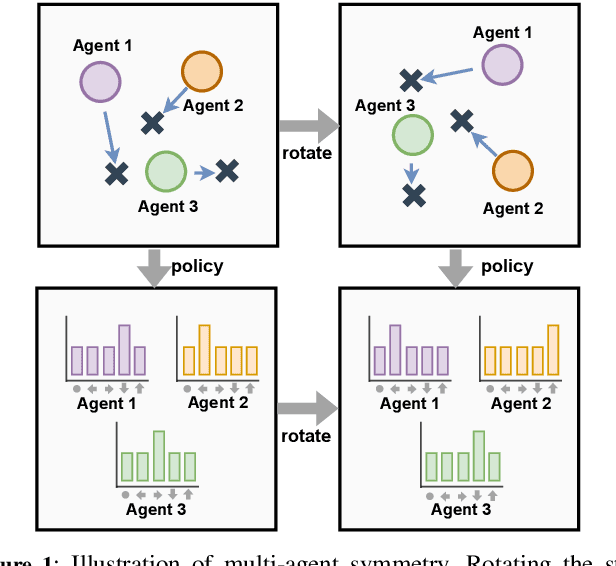

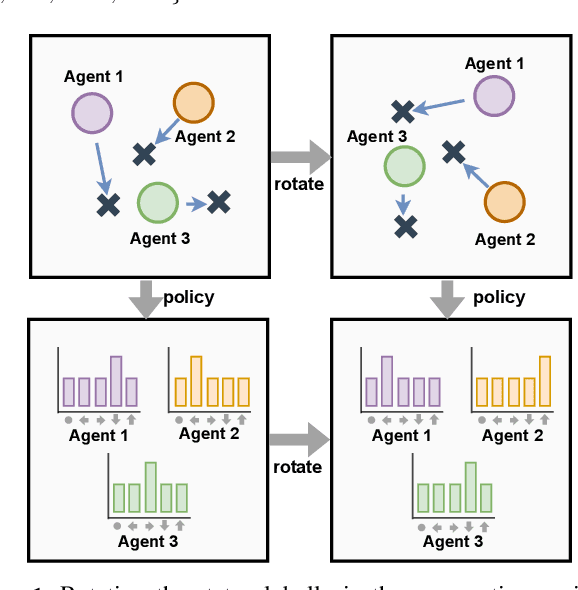

Multi-agent reinforcement learning (MARL) has achieved promising results in recent years. However, most existing reinforcement learning methods require a large amount of data for model training. In addition, data-efficient reinforcement learning requires the construction of strong inductive biases, which are ignored in the current MARL approaches. Inspired by the symmetry phenomenon in multi-agent systems, this paper proposes a framework for exploiting prior knowledge by integrating data augmentation and a well-designed consistency loss into the existing MARL methods. In addition, the proposed framework is model-agnostic and can be applied to most of the current MARL algorithms. Experimental tests on multiple challenging tasks demonstrate the effectiveness of the proposed framework. Moreover, the proposed framework is applied to a physical multi-robot testbed to show its superiority.
Physics-Informed Deep Learning For Traffic State Estimation: A Survey and the Outlook
Mar 03, 2023For its robust predictive power (compared to pure physics-based models) and sample-efficient training (compared to pure deep learning models), physics-informed deep learning (PIDL), a paradigm hybridizing physics-based models and deep neural networks (DNN), has been booming in science and engineering fields. One key challenge of applying PIDL to various domains and problems lies in the design of a computational graph that integrates physics and DNNs. In other words, how physics are encoded into DNNs and how the physics and data components are represented. In this paper, we provide a variety of architecture designs of PIDL computational graphs and how these structures are customized to traffic state estimation (TSE), a central problem in transportation engineering. When observation data, problem type, and goal vary, we demonstrate potential architectures of PIDL computational graphs and compare these variants using the same real-world dataset.
A Physics-Informed Deep Learning Paradigm for Traffic State Estimation and Fundamental Diagram Discovery
Jun 09, 2021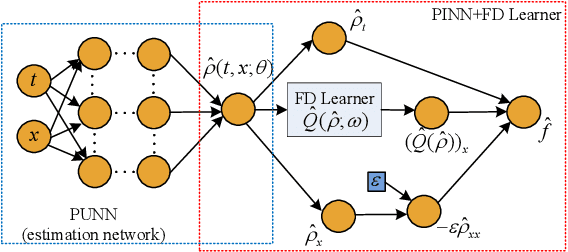
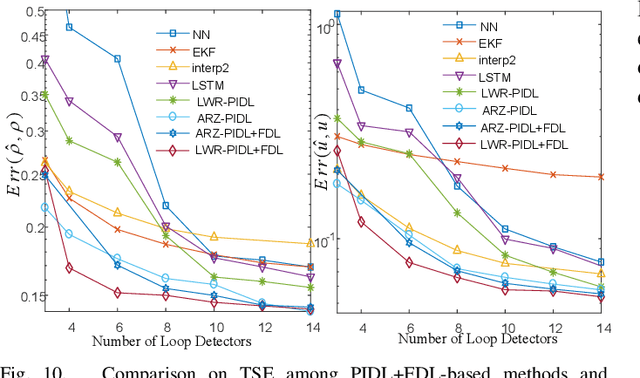
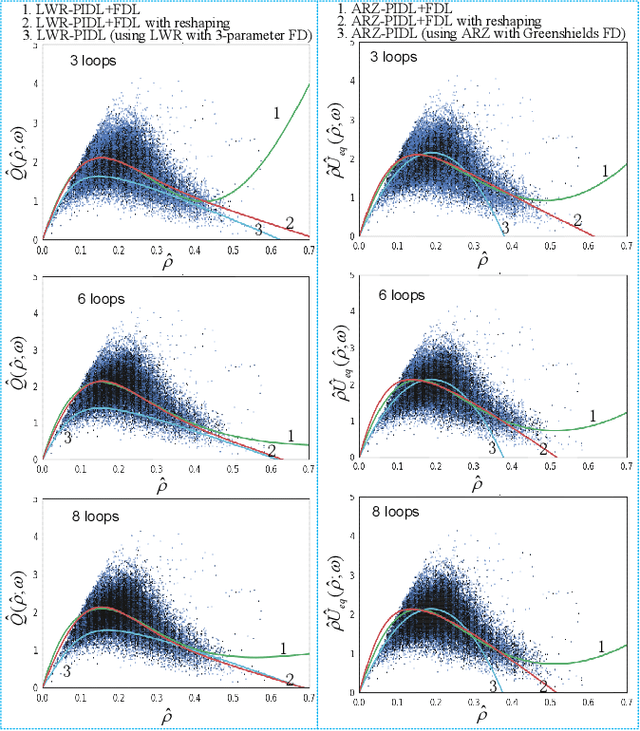
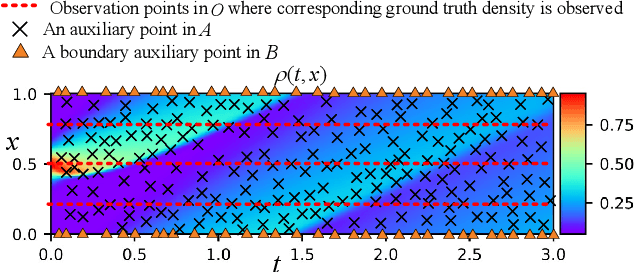
Traffic state estimation (TSE) bifurcates into two main categories, model-driven and data-driven (e.g., machine learning, ML) approaches, while each suffers from either deficient physics or small data. To mitigate these limitations, recent studies introduced hybrid methods, such as physics-informed deep learning (PIDL), which contains both model-driven and data-driven components. This paper contributes an improved paradigm, called physics-informed deep learning with a fundamental diagram learner (PIDL+FDL), which integrates ML terms into the model-driven component to learn a functional form of a fundamental diagram (FD), i.e., a mapping from traffic density to flow or velocity. The proposed PIDL+FDL has the advantages of performing the TSE learning, model parameter discovery, and FD discovery simultaneously. This paper focuses on highway TSE with observed data from loop detectors, using traffic density or velocity as traffic variables. We demonstrate the use of PIDL+FDL to solve popular first-order and second-order traffic flow models and reconstruct the FD relation as well as model parameters that are outside the FD term. We then evaluate the PIDL+FDL-based TSE using the Next Generation SIMulation (NGSIM) dataset. The experimental results show the superiority of the PIDL+FDL in terms of improved estimation accuracy and data efficiency over advanced baseline TSE methods, and additionally, the capacity to properly learn the unknown underlying FD relation.