 Add to Chrome
 Add to Firefox
 Add to Edge
Cascade: Exploiting SLO-Aware latency budget for fair and high goodput LLM inference serving
Aug 06, 2026
The reasoning and agentic capabilities of large language models have expanded the range of applications they support, from short interactive exchanges to long, compute-heavy requests. LLM serving platforms today define response-latency service-level objectives, even though requests within the same service can differ by orders of magnitude in input length, generation length, execution cost, and the availability of reusable KV-cache state. As a result, requests governed by the same service level objective have different urgency: after accounting for the time required to execute them, some have substantial latency headroom while others have almost none. We define this headroom---the difference between a request's service level objective and its predicted remaining service time---as its per-request latency budget. We present Cascade, an LLM serving system that estimates and continuously updates this budget from request characteristics, KV-cache state, and current system load. Unlike prior SLO-aware schedulers that use deadlines to govern request ordering alone, Cascade uses a single per-request budget to jointly coordinate request scheduling and KV-cache management across the memory hierarchy. Its scheduler prioritizes requests with little remaining budget, while its memory manager uses the same budget to decide whether non-resident KV state should be restored or prefetched from a deeper tier, retained in HBM, or recomputed. By directing queueing and data-movement overhead toward requests that can absorb it, Cascade improves SLO-satisfied goodput while preserving fairness across heterogeneous request classes. On production traces across three large language models, Cascade improves goodput by up to2.4x and reduces SLO violations by 40% relative to the default vLLM first-come, first-served scheduler.

Agentic Coding in the Wild: Characterizing GitHub Copilot Traces at Production Scale
Jul 30, 2026AI coding agents like GitHub Copilot, Claude Code, and Codex interleave multi-step LLM inference with tool execution, creating a workload different from chatbots. We present the first production-scale characterization of this workload using sampled GitHub Copilot traces from June 2026, comprising 3.2M users, 13M sessions, 761M LLM calls, and 95T tokens. Our analysis reveals distinctive workload properties with important systems implications. For example, agentic coding sessions consist of sparse user-initiated turns, each unfolding into an autonomous agent loop of LLM calls almost always coupled with tool execution. This structure yields KV cache hit rates averaging 90% within a turn, but falling to 55\% across turn boundaries and drastically invalidated after events like model switches or context compaction. Diverse workflows and user behaviors are observed with variable and long-tailed token consumption, time span, and tool calls. We highlight the difference between quick agentic turnaround times and the minutes-long user idle periods at turn boundaries, and design a lightweight idle-time predictor that captures 86-90\% of total idle time, enabling proactive decisions for efficient resource orchestration. These findings challenge assumptions underlying current LLM-serving systems and provide an empirical foundation for agent-native infrastructure.
Beyond Prediction: Tail-Aware Scheduling for LLM Inference
Jun 16, 2026LLM serving exhibits extreme length variability, making size-based scheduling difficult in practice. Recent LLM schedulers approximate SJF/SRPT using predicted decode lengths or ranks and primarily report mean-centric metrics such as TTFT and TBT. We show that these prediction-driven policies can be fragile under distribution shifts, bursty arrivals, and GPU memory pressure, while offering limited control over the tail latency (P90-P99) that dominates user experience, even with perfect decode-length knowledge. We introduce a distribution-aware, prediction-free scheduling framework that replaces explicit length prediction with soft priority boosting driven by lightweight statistical signals. Our design co-optimizes scheduling and cache-aware preemption to account for memory-coupled decode dynamics across workload mixes. Evaluated on production and open-source traces, our method reduces P99 TTLT by up to 35-50% relative to SRPT with perfect length knowledge and reduces TTFT by 34-47% across workloads, including reasoning-heavy and chat-heavy tasks. These results demonstrate a robust alternative for optimizing tail latency in online LLM serving.
Towards Efficient Large Multimodal Model Serving
Feb 02, 2025Recent advances in generative AI have led to large multi-modal models (LMMs) capable of simultaneously processing inputs of various modalities such as text, images, video, and audio. While these models demonstrate impressive capabilities, efficiently serving them in production environments poses significant challenges due to their complex architectures and heterogeneous resource requirements. We present the first comprehensive systems analysis of two prominent LMM architectures, decoder-only and cross-attention, on six representative open-source models. We investigate their multi-stage inference pipelines and resource utilization patterns that lead to unique systems design implications. We also present an in-depth analysis of production LMM inference traces, uncovering unique workload characteristics, including variable, heavy-tailed request distributions, diverse modal combinations, and bursty traffic patterns. Our key findings reveal that different LMM inference stages exhibit highly heterogeneous performance characteristics and resource demands, while concurrent requests across modalities lead to significant performance interference. To address these challenges, we propose a decoupled serving architecture that enables independent resource allocation and adaptive scaling for each stage. We further propose optimizations such as stage colocation to maximize throughput and resource utilization while meeting the latency objectives.
Towards Resource-Efficient Compound AI Systems
Jan 29, 2025Compound AI Systems, integrating multiple interacting components like models, retrievers, and external tools, have emerged as essential for addressing complex AI tasks. However, current implementations suffer from inefficient resource utilization due to tight coupling between application logic and execution details, a disconnect between orchestration and resource management layers, and the perceived exclusiveness between efficiency and quality. We propose a vision for resource-efficient Compound AI Systems through a declarative workflow programming model and an adaptive runtime system for dynamic scheduling and resource-aware decision-making. Decoupling application logic from low-level details exposes levers for the runtime to flexibly configure the execution environment and resources, without compromising on quality. Enabling collaboration between the workflow orchestration and cluster manager enables higher efficiency through better scheduling and resource management. We are building a prototype system, called Murakkab, to realize this vision. Our preliminary evaluation demonstrates speedups up to $\sim 3.4\times$ in workflow completion times while delivering $\sim 4.5\times$ higher energy efficiency, showing promise in optimizing resources and advancing AI system design.
TAPAS: Thermal- and Power-Aware Scheduling for LLM Inference in Cloud Platforms
Jan 05, 2025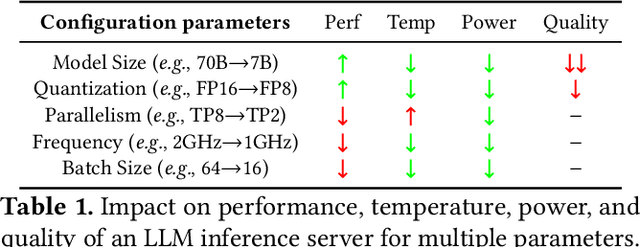


The rising demand for generative large language models (LLMs) poses challenges for thermal and power management in cloud datacenters. Traditional techniques often are inadequate for LLM inference due to the fine-grained, millisecond-scale execution phases, each with distinct performance, thermal, and power profiles. Additionally, LLM inference workloads are sensitive to various configuration parameters (e.g., model parallelism, size, and quantization) that involve trade-offs between performance, temperature, power, and output quality. Moreover, clouds often co-locate SaaS and IaaS workloads, each with different levels of visibility and flexibility. We propose TAPAS, a thermal- and power-aware framework designed for LLM inference clusters in the cloud. TAPAS enhances cooling and power oversubscription capabilities, reducing the total cost of ownership (TCO) while effectively handling emergencies (e.g., cooling and power failures). The system leverages historical temperature and power data, along with the adaptability of SaaS workloads, to: (1) efficiently place new GPU workload VMs within cooling and power constraints, (2) route LLM inference requests across SaaS VMs, and (3) reconfigure SaaS VMs to manage load spikes and emergency situations. Our evaluation on a large GPU cluster demonstrates significant reductions in thermal and power throttling events, boosting system efficiency.
Exploring LLM-based Agents for Root Cause Analysis
Mar 07, 2024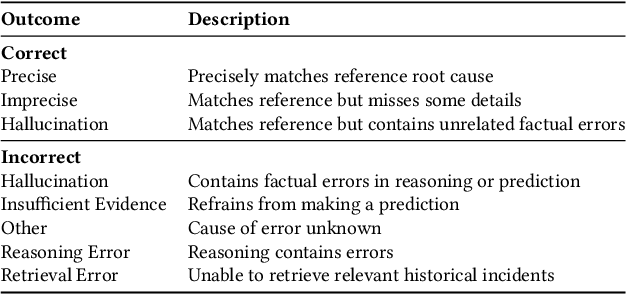

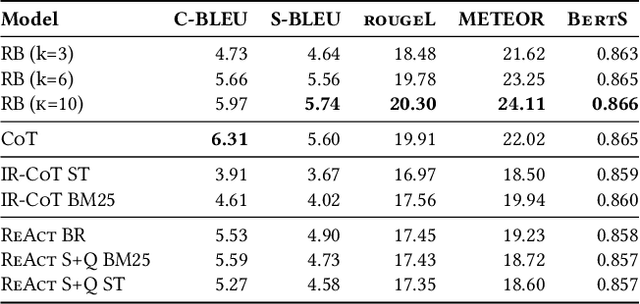
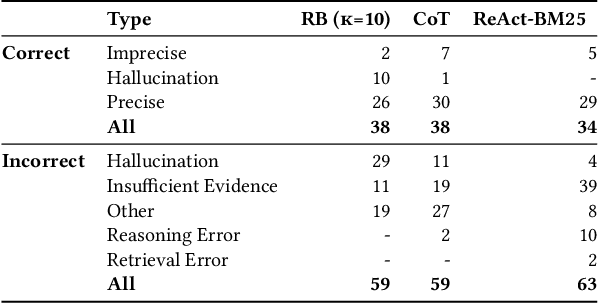
The growing complexity of cloud based software systems has resulted in incident management becoming an integral part of the software development lifecycle. Root cause analysis (RCA), a critical part of the incident management process, is a demanding task for on-call engineers, requiring deep domain knowledge and extensive experience with a team's specific services. Automation of RCA can result in significant savings of time, and ease the burden of incident management on on-call engineers. Recently, researchers have utilized Large Language Models (LLMs) to perform RCA, and have demonstrated promising results. However, these approaches are not able to dynamically collect additional diagnostic information such as incident related logs, metrics or databases, severely restricting their ability to diagnose root causes. In this work, we explore the use of LLM based agents for RCA to address this limitation. We present a thorough empirical evaluation of a ReAct agent equipped with retrieval tools, on an out-of-distribution dataset of production incidents collected at Microsoft. Results show that ReAct performs competitively with strong retrieval and reasoning baselines, but with highly increased factual accuracy. We then extend this evaluation by incorporating discussions associated with incident reports as additional inputs for the models, which surprisingly does not yield significant performance improvements. Lastly, we conduct a case study with a team at Microsoft to equip the ReAct agent with tools that give it access to external diagnostic services that are used by the team for manual RCA. Our results show how agents can overcome the limitations of prior work, and practical considerations for implementing such a system in practice.
PACE-LM: Prompting and Augmentation for Calibrated Confidence Estimation with GPT-4 in Cloud Incident Root Cause Analysis
Sep 29, 2023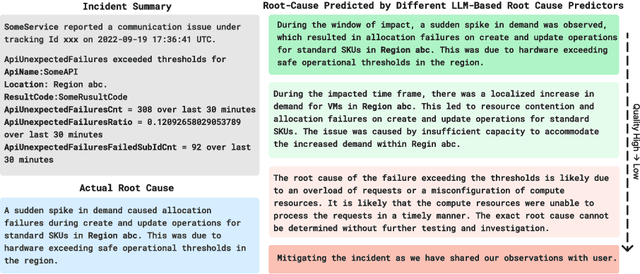
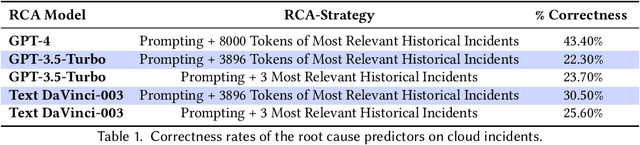

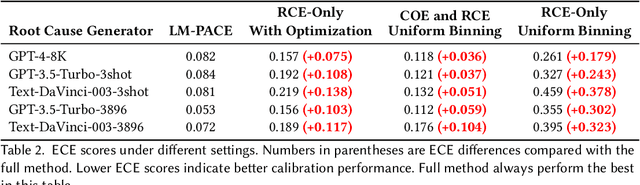
Major cloud providers have employed advanced AI-based solutions like large language models to aid humans in identifying the root causes of cloud incidents. Despite the growing prevalence of AI-driven assistants in the root cause analysis process, their effectiveness in assisting on-call engineers is constrained by low accuracy due to the intrinsic difficulty of the task, a propensity for LLM-based approaches to hallucinate, and difficulties in distinguishing these well-disguised hallucinations. To address this challenge, we propose to perform confidence estimation for the predictions to help on-call engineers make decisions on whether to adopt the model prediction. Considering the black-box nature of many LLM-based root cause predictors, fine-tuning or temperature-scaling-based approaches are inapplicable. We therefore design an innovative confidence estimation framework based on prompting retrieval-augmented large language models (LLMs) that demand a minimal amount of information from the root cause predictor. This approach consists of two scoring phases: the LLM-based confidence estimator first evaluates its confidence in making judgments in the face of the current incident that reflects its ``grounded-ness" level in reference data, then rates the root cause prediction based on historical references. An optimization step combines these two scores for a final confidence assignment. We show that our method is able to produce calibrated confidence estimates for predicted root causes, validate the usefulness of retrieved historical data and the prompting strategy as well as the generalizability across different root cause prediction models. Our study takes an important move towards reliably and effectively embedding LLMs into cloud incident management systems.
Learning Search Space Partition for Black-box Optimization using Monte Carlo Tree Search
Jul 01, 2020
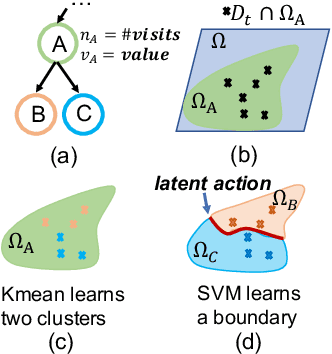
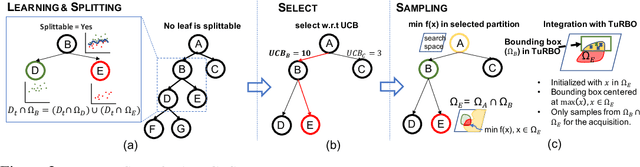
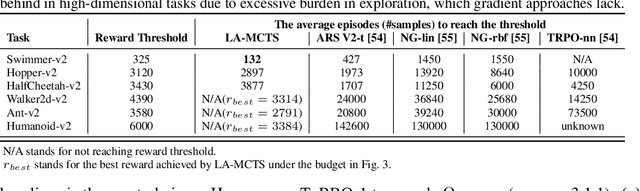
High dimensional black-box optimization has broad applications but remains a challenging problem to solve. Given a set of samples $\{\vx_i, y_i\}$, building a global model (like Bayesian Optimization (BO)) suffers from the curse of dimensionality in the high-dimensional search space, while a greedy search may lead to sub-optimality. By recursively splitting the search space into regions with high/low function values, recent works like LaNAS shows good performance in Neural Architecture Search (NAS), reducing the sample complexity empirically. In this paper, we coin LA-MCTS that extends LaNAS to other domains. Unlike previous approaches, LA-MCTS learns the partition of the search space using a few samples and their function values in an online fashion. While LaNAS uses linear partition and performs uniform sampling in each region, our LA-MCTS adopts a nonlinear decision boundary and learns a local model to pick good candidates. If the nonlinear partition function and the local model fits well with ground-truth black-box function, then good partitions and candidates can be reached with much fewer samples. LA-MCTS serves as a \emph{meta-algorithm} by using existing black-box optimizers (e.g., BO, TuRBO) as its local models, achieving strong performance in general black-box optimization and reinforcement learning benchmarks, in particular for high-dimensional problems.
Few-shot Neural Architecture Search
Jun 19, 2020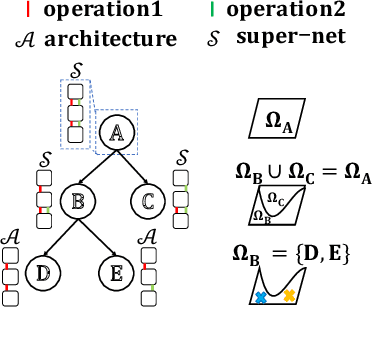
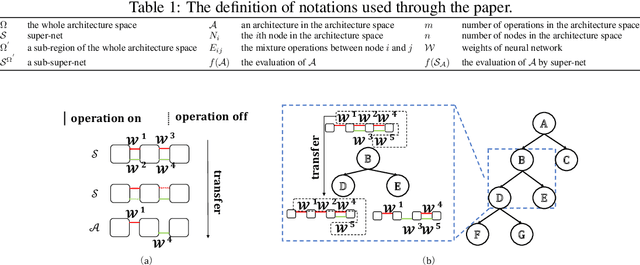
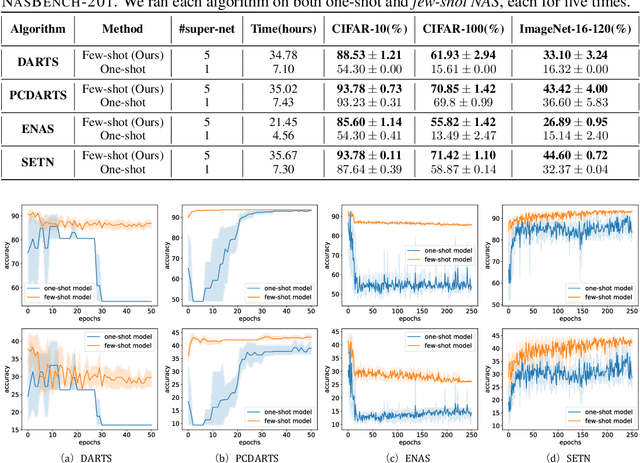
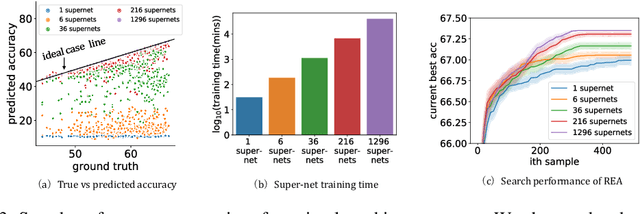
To improve the search efficiency for Neural Architecture Search (NAS), One-shot NAS proposes to train a single super-net to approximate the performance of proposal architectures during search via weight-sharing. While this greatly reduces the computation cost, due to approximation error, the performance prediction by a single super-net is less accurate than training each proposal architecture from scratch, leading to search inefficiency. In this work, we propose few-shot NAS that explores the choice of using multiple super-nets: each super-net is pre-trained to be in charge of a sub-region of the search space. This reduces the prediction error of each super-net. Moreover, training these super-nets can be done jointly via sequential fine-tuning. A natural choice of sub-region is to follow the splitting of search space in NAS. We empirically evaluate our approach on three different tasks in NAS-Bench-201. Extensive results have demonstrated that few-shot NAS, using only 5 super-nets, significantly improves performance of many search methods with slight increase of search time. The architectures found by DARTs and ENAS with few-shot models achieved 88.53% and 86.50% test accuracy on CIFAR-10 in NAS-Bench-201, significantly outperformed their one-shot counterparts (with 54.30% and 54.30% test accuracy). Moreover, on AUTOGAN and DARTS, few-shot NAS also outperforms previously state-of-the-art models.