 Add to Chrome
 Add to Firefox
 Add to Edge
Cascade: Exploiting SLO-Aware latency budget for fair and high goodput LLM inference serving
Aug 06, 2026
The reasoning and agentic capabilities of large language models have expanded the range of applications they support, from short interactive exchanges to long, compute-heavy requests. LLM serving platforms today define response-latency service-level objectives, even though requests within the same service can differ by orders of magnitude in input length, generation length, execution cost, and the availability of reusable KV-cache state. As a result, requests governed by the same service level objective have different urgency: after accounting for the time required to execute them, some have substantial latency headroom while others have almost none. We define this headroom---the difference between a request's service level objective and its predicted remaining service time---as its per-request latency budget. We present Cascade, an LLM serving system that estimates and continuously updates this budget from request characteristics, KV-cache state, and current system load. Unlike prior SLO-aware schedulers that use deadlines to govern request ordering alone, Cascade uses a single per-request budget to jointly coordinate request scheduling and KV-cache management across the memory hierarchy. Its scheduler prioritizes requests with little remaining budget, while its memory manager uses the same budget to decide whether non-resident KV state should be restored or prefetched from a deeper tier, retained in HBM, or recomputed. By directing queueing and data-movement overhead toward requests that can absorb it, Cascade improves SLO-satisfied goodput while preserving fairness across heterogeneous request classes. On production traces across three large language models, Cascade improves goodput by up to2.4x and reduces SLO violations by 40% relative to the default vLLM first-come, first-served scheduler.

An Open-Source ML-Based Full-Stack Optimization Framework for Machine Learning Accelerators
Aug 23, 2023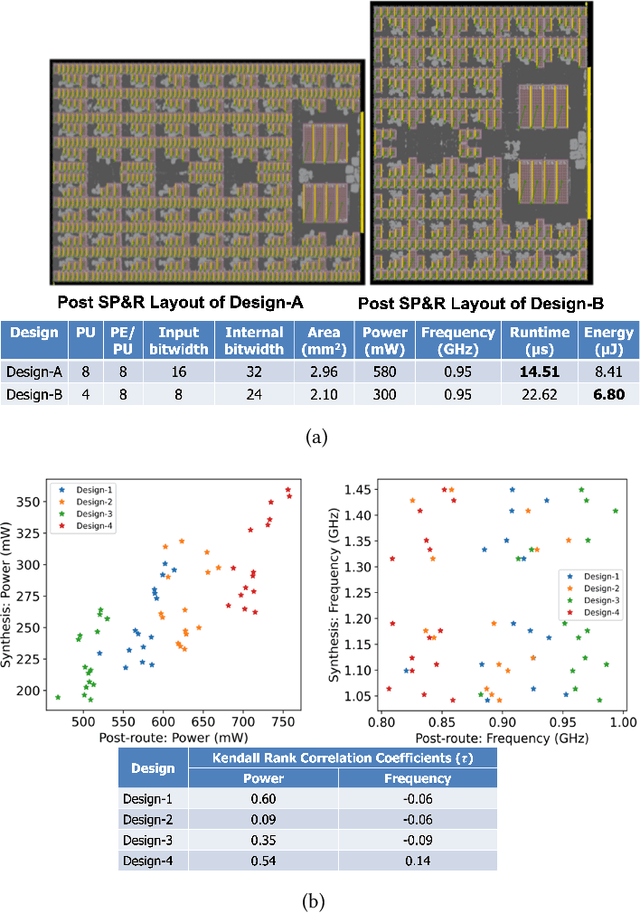
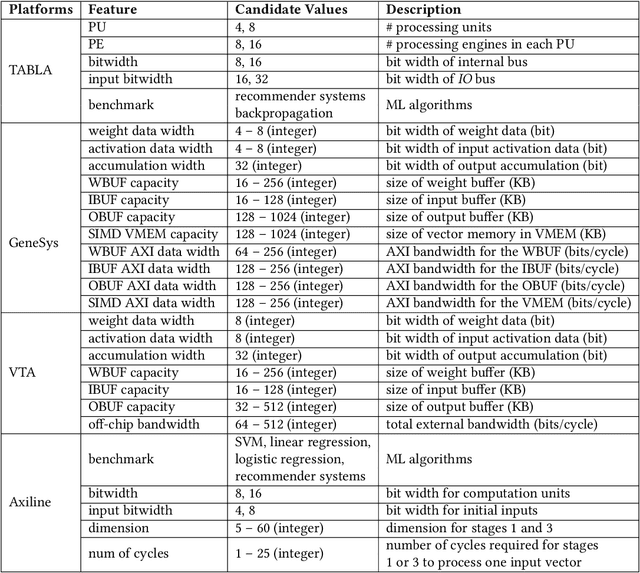
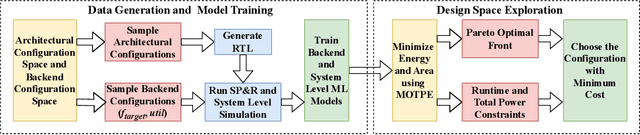
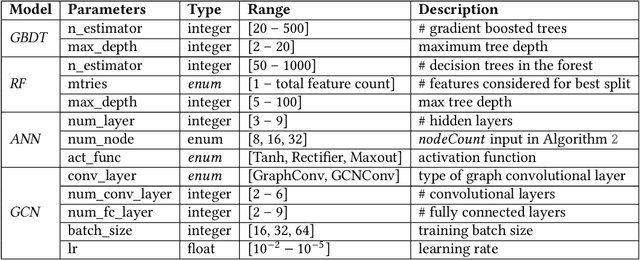
Parameterizable machine learning (ML) accelerators are the product of recent breakthroughs in ML. To fully enable their design space exploration (DSE), we propose a physical-design-driven, learning-based prediction framework for hardware-accelerated deep neural network (DNN) and non-DNN ML algorithms. It adopts a unified approach that combines backend power, performance, and area (PPA) analysis with frontend performance simulation, thereby achieving a realistic estimation of both backend PPA and system metrics such as runtime and energy. In addition, our framework includes a fully automated DSE technique, which optimizes backend and system metrics through an automated search of architectural and backend parameters. Experimental studies show that our approach consistently predicts backend PPA and system metrics with an average 7% or less prediction error for the ASIC implementation of two deep learning accelerator platforms, VTA and VeriGOOD-ML, in both a commercial 12 nm process and a research-oriented 45 nm process.