 Add to Chrome
 Add to Firefox
 Add to Edge
AtumAI: A Principled Framework for Agentic Generation of Datacenter Control-Plane Policies
Aug 03, 2026
The efficiency of a datacenter rests on its control plane policies. Designing these policies is increasingly hard: the hardware-software stack grows fast, the design space is vast and interdependent, and prototyping a single policy takes months. Agentic AI promises to automate this search. Off the shelf, however, it falls short on three fronts. It is not formal: with no structured, searchable statement of the problem, the search has little structure to exploit and hard constraints are not guaranteed. It is not transferable: each task is solved from scratch, so nothing learned on one task carries to the next. Finally, it is not systematic: relying on the LLM as the sole source of candidates, it explores a narrow slice of the design space and settles into local optima. We introduce AtumAI, a framework that generates datacenter control-plane policies with agentic AI, making the process formal, transferable, and systematic. From a goal stated in plain language, AtumAI autonomously proposes, tests, and refines candidate policies until one satisfies the request. It does so through two components. The Datacenter Task Compiler automates problem formulation: it compiles the request into a formal, machine-checkable, and searchable specification of the task's objectives, constraints, decision variables, and evaluation methodology. The Evolutionary Design Discovery Loop then searches this specification, expanding the search beyond the LLM itself via a diffusion model, an evolutionary algorithm, and a surrogate model. Together, they reduce onboarding a new task from months of engineering to writing its description. We evaluate AtumAI on three control-plane tasks with distinct problem scopes, design spaces, and trade-offs: workload placement, resource scaling, and power management. Across all tasks, the policies generated by AtumAI consistently outperform expert-engineered baselines.

Agentic Coding in the Wild: Characterizing GitHub Copilot Traces at Production Scale
Jul 30, 2026AI coding agents like GitHub Copilot, Claude Code, and Codex interleave multi-step LLM inference with tool execution, creating a workload different from chatbots. We present the first production-scale characterization of this workload using sampled GitHub Copilot traces from June 2026, comprising 3.2M users, 13M sessions, 761M LLM calls, and 95T tokens. Our analysis reveals distinctive workload properties with important systems implications. For example, agentic coding sessions consist of sparse user-initiated turns, each unfolding into an autonomous agent loop of LLM calls almost always coupled with tool execution. This structure yields KV cache hit rates averaging 90% within a turn, but falling to 55\% across turn boundaries and drastically invalidated after events like model switches or context compaction. Diverse workflows and user behaviors are observed with variable and long-tailed token consumption, time span, and tool calls. We highlight the difference between quick agentic turnaround times and the minutes-long user idle periods at turn boundaries, and design a lightweight idle-time predictor that captures 86-90\% of total idle time, enabling proactive decisions for efficient resource orchestration. These findings challenge assumptions underlying current LLM-serving systems and provide an empirical foundation for agent-native infrastructure.
Rearchitecting Datacenter Lifecycle for AI: A TCO-Driven Framework
Sep 30, 2025The rapid rise of large language models (LLMs) has been driving an enormous demand for AI inference infrastructure, mainly powered by high-end GPUs. While these accelerators offer immense computational power, they incur high capital and operational costs due to frequent upgrades, dense power consumption, and cooling demands, making total cost of ownership (TCO) for AI datacenters a critical concern for cloud providers. Unfortunately, traditional datacenter lifecycle management (designed for general-purpose workloads) struggles to keep pace with AI's fast-evolving models, rising resource needs, and diverse hardware profiles. In this paper, we rethink the AI datacenter lifecycle scheme across three stages: building, hardware refresh, and operation. We show how design choices in power, cooling, and networking provisioning impact long-term TCO. We also explore refresh strategies aligned with hardware trends. Finally, we use operation software optimizations to reduce cost. While these optimizations at each stage yield benefits, unlocking the full potential requires rethinking the entire lifecycle. Thus, we present a holistic lifecycle management framework that coordinates and co-optimizes decisions across all three stages, accounting for workload dynamics, hardware evolution, and system aging. Our system reduces the TCO by up to 40\% over traditional approaches. Using our framework we provide guidelines on how to manage AI datacenter lifecycle for the future.
Power Stabilization for AI Training Datacenters
Aug 21, 2025Large Artificial Intelligence (AI) training workloads spanning several tens of thousands of GPUs present unique power management challenges. These arise due to the high variability in power consumption during the training. Given the synchronous nature of these jobs, during every iteration there is a computation-heavy phase, where each GPU works on the local data, and a communication-heavy phase where all the GPUs synchronize on the data. Because compute-heavy phases require much more power than communication phases, large power swings occur. The amplitude of these power swings is ever increasing with the increase in the size of training jobs. An even bigger challenge arises from the frequency spectrum of these power swings which, if harmonized with critical frequencies of utilities, can cause physical damage to the power grid infrastructure. Therefore, to continue scaling AI training workloads safely, we need to stabilize the power of such workloads. This paper introduces the challenge with production data and explores innovative solutions across the stack: software, GPU hardware, and datacenter infrastructure. We present the pros and cons of each of these approaches and finally present a multi-pronged approach to solving the challenge. The proposed solutions are rigorously tested using a combination of real hardware and Microsoft's in-house cloud power simulator, providing critical insights into the efficacy of these interventions under real-world conditions.
Towards Resource-Efficient Compound AI Systems
Jan 29, 2025Compound AI Systems, integrating multiple interacting components like models, retrievers, and external tools, have emerged as essential for addressing complex AI tasks. However, current implementations suffer from inefficient resource utilization due to tight coupling between application logic and execution details, a disconnect between orchestration and resource management layers, and the perceived exclusiveness between efficiency and quality. We propose a vision for resource-efficient Compound AI Systems through a declarative workflow programming model and an adaptive runtime system for dynamic scheduling and resource-aware decision-making. Decoupling application logic from low-level details exposes levers for the runtime to flexibly configure the execution environment and resources, without compromising on quality. Enabling collaboration between the workflow orchestration and cluster manager enables higher efficiency through better scheduling and resource management. We are building a prototype system, called Murakkab, to realize this vision. Our preliminary evaluation demonstrates speedups up to $\sim 3.4\times$ in workflow completion times while delivering $\sim 4.5\times$ higher energy efficiency, showing promise in optimizing resources and advancing AI system design.
TAPAS: Thermal- and Power-Aware Scheduling for LLM Inference in Cloud Platforms
Jan 05, 2025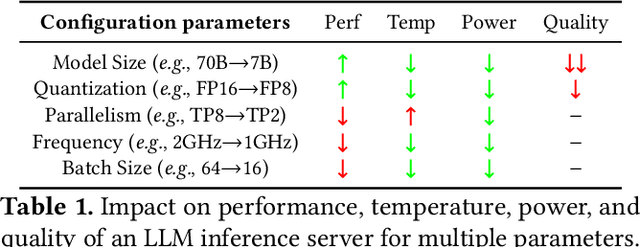


The rising demand for generative large language models (LLMs) poses challenges for thermal and power management in cloud datacenters. Traditional techniques often are inadequate for LLM inference due to the fine-grained, millisecond-scale execution phases, each with distinct performance, thermal, and power profiles. Additionally, LLM inference workloads are sensitive to various configuration parameters (e.g., model parallelism, size, and quantization) that involve trade-offs between performance, temperature, power, and output quality. Moreover, clouds often co-locate SaaS and IaaS workloads, each with different levels of visibility and flexibility. We propose TAPAS, a thermal- and power-aware framework designed for LLM inference clusters in the cloud. TAPAS enhances cooling and power oversubscription capabilities, reducing the total cost of ownership (TCO) while effectively handling emergencies (e.g., cooling and power failures). The system leverages historical temperature and power data, along with the adaptability of SaaS workloads, to: (1) efficiently place new GPU workload VMs within cooling and power constraints, (2) route LLM inference requests across SaaS VMs, and (3) reconfigure SaaS VMs to manage load spikes and emergency situations. Our evaluation on a large GPU cluster demonstrates significant reductions in thermal and power throttling events, boosting system efficiency.
POLCA: Power Oversubscription in LLM Cloud Providers
Aug 24, 2023
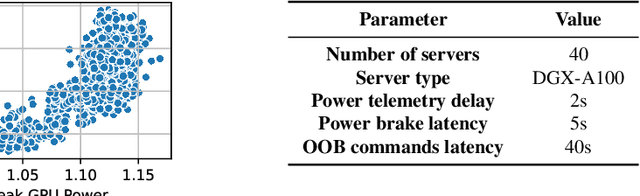
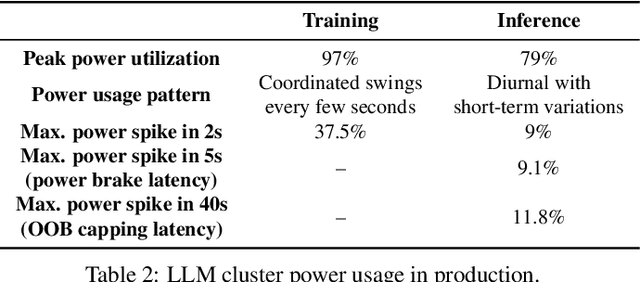
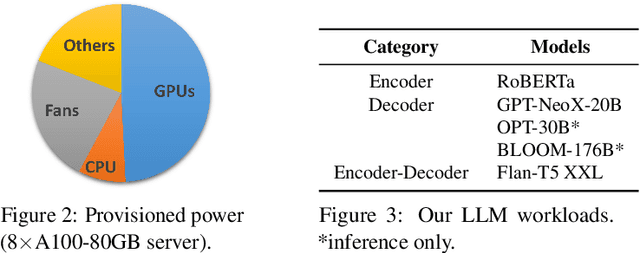
Recent innovation in large language models (LLMs), and their myriad use-cases have rapidly driven up the compute capacity demand for datacenter GPUs. Several cloud providers and other enterprises have made substantial plans of growth in their datacenters to support these new workloads. One of the key bottleneck resources in datacenters is power, and given the increasing model sizes of LLMs, they are becoming increasingly power intensive. In this paper, we show that there is a significant opportunity to oversubscribe power in LLM clusters. Power oversubscription improves the power efficiency of these datacenters, allowing more deployable servers per datacenter, and reduces the deployment time, since building new datacenters is slow. We extensively characterize the power consumption patterns of a variety of LLMs and their configurations. We identify the differences between the inference and training power consumption patterns. Based on our analysis of these LLMs, we claim that the average and peak power utilization in LLM clusters for inference should not be very high. Our deductions align with the data from production LLM clusters, revealing that inference workloads offer substantial headroom for power oversubscription. However, the stringent set of telemetry and controls that GPUs offer in a virtualized environment, makes it challenging to have a reliable and robust power oversubscription mechanism. We propose POLCA, our framework for power oversubscription that is robust, reliable, and readily deployable for GPU clusters. Using open-source models to replicate the power patterns observed in production, we simulate POLCA and demonstrate that we can deploy 30% more servers in the same GPU cluster for inference, with minimal performance loss