 Add to Chrome
 Add to Firefox
 Add to Edge
RealVDeblur: One-Step Diffusion for Generalizable Real-World Video Deblurring
Jul 22, 2026
Real-world video deblurring remains challenging due to diverse motion patterns, complex degradations, and the scarcity of realistic training data, yet robust restoration is critical for downstream pipelines such as mobile imaging and 3D reconstruction. This work presents \textbf{RealVDeblur}, an efficient generative framework designed to improve in-the-wild robustness under diverse real capture conditions. First, a large-scale, physically grounded blur synthesis pipeline is constructed from scene-level 3D Gaussian Splatting (3DGS) assets and high-frame-rate videos, providing realistic training data covering both camera-induced and object-motion blur. Second, a video diffusion prior is leveraged for restoration; to better accommodate frame-dependent blur variations, temporal compression in the VAE is disabled and a frame-wise encoding scheme is adopted. For practical deployment on long videos, multi-step diffusion sampling is distilled into an efficient one-step generator, and a training-free Temporal Window Mask stabilizes inference beyond the training horizon with constant memory usage. Extensive experiments on diverse real-world benchmarks demonstrate strong perceptual quality, semantic fidelity, and temporal consistency on unseen videos, as well as improved robustness in downstream 3D reconstruction under severe motion blur. Project page: https://rbjin.github.io/RealVDeblur

AnyRecon: Arbitrary-View 3D Reconstruction with Video Diffusion Model
Apr 21, 2026Sparse-view 3D reconstruction is essential for modeling scenes from casual captures, but remain challenging for non-generative reconstruction. Existing diffusion-based approaches mitigates this issues by synthesizing novel views, but they often condition on only one or two capture frames, which restricts geometric consistency and limits scalability to large or diverse scenes. We propose AnyRecon, a scalable framework for reconstruction from arbitrary and unordered sparse inputs that preserves explicit geometric control while supporting flexible conditioning cardinality. To support long-range conditioning, our method constructs a persistent global scene memory via a prepended capture view cache, and removes temporal compression to maintain frame-level correspondence under large viewpoint changes. Beyond better generative model, we also find that the interplay between generation and reconstruction is crucial for large-scale 3D scenes. Thus, we introduce a geometry-aware conditioning strategy that couples generation and reconstruction through an explicit 3D geometric memory and geometry-driven capture-view retrieval. To ensure efficiency, we combine 4-step diffusion distillation with context-window sparse attention to reduce quadratic complexity. Extensive experiments demonstrate robust and scalable reconstruction across irregular inputs, large viewpoint gaps, and long trajectories.
E2E-Fly: An Integrated Training-to-Deployment System for End-to-End Quadrotor Autonomy
Apr 14, 2026Training and transferring learning-based policies for quadrotors from simulation to reality remains challenging due to inefficient visual rendering, physical modeling inaccuracies, unmodeled sensor discrepancies, and the absence of a unified platform integrating differentiable physics learning into end-to-end training. While recent work has demonstrated various end-to-end quadrotor control tasks, few systems provide a systematic, zero-shot transfer pipeline, hindering reproducibility and real-world deployment. To bridge this gap, we introduce E2E-Fly, an integrated framework featuring an agile quadrotor platform coupled with a full-stack training, validation, and deployment workflow. The training framework incorporates a high-performance simulator with support for differentiable physics learning and reinforcement learning, alongside structured reward design tailored to common quadrotor tasks. We further introduce a two-stage validation strategy using sim-to-sim transfer and hardware-in-the-loop testing, and deploy policies onto two physical quadrotor platforms via a dedicated low-level control interface and a comprehensive sim-to-real alignment methodology, encompassing system identification, domain randomization, latency compensation, and noise modeling. To the best of our knowledge, this is the first work to systematically unify differentiable physical learning with training, validation, and real-world deployment for quadrotors. Finally, we demonstrate the effectiveness of our framework for training six end-to-end control tasks and deploy them in the real world.
360Recon: An Accurate Reconstruction Method Based on Depth Fusion from 360 Images
Nov 28, 2024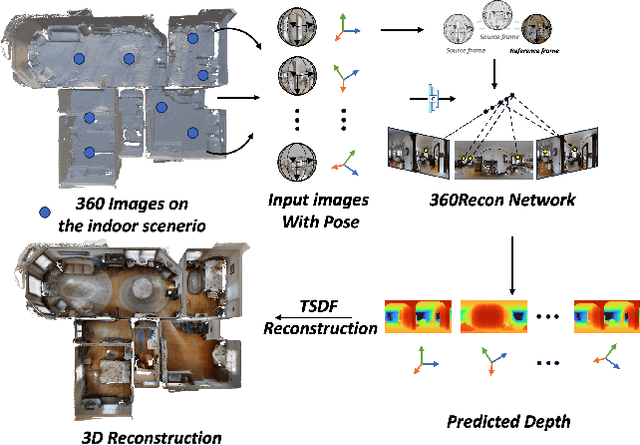
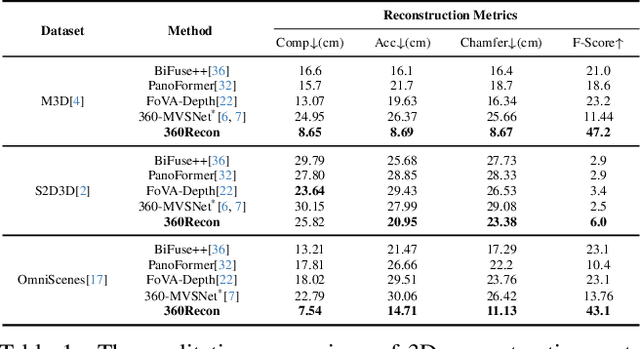
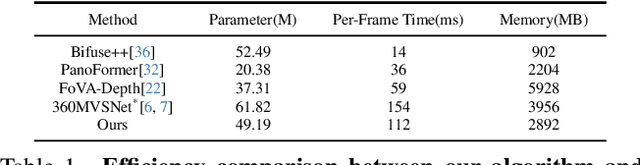
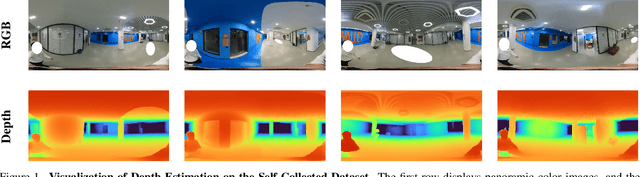
360-degree images offer a significantly wider field of view compared to traditional pinhole cameras, enabling sparse sampling and dense 3D reconstruction in low-texture environments. This makes them crucial for applications in VR, AR, and related fields. However, the inherent distortion caused by the wide field of view affects feature extraction and matching, leading to geometric consistency issues in subsequent multi-view reconstruction. In this work, we propose 360Recon, an innovative MVS algorithm for ERP images. The proposed spherical feature extraction module effectively mitigates distortion effects, and by combining the constructed 3D cost volume with multi-scale enhanced features from ERP images, our approach achieves high-precision scene reconstruction while preserving local geometric consistency. Experimental results demonstrate that 360Recon achieves state-of-the-art performance and high efficiency in depth estimation and 3D reconstruction on existing public panoramic reconstruction datasets.