 Add to Chrome
 Add to Firefox
 Add to Edge
Autonomous FPV Flight with Translational Optical Flow and Uncertainty Mask
Jun 08, 2026
Autonomous FPV quadrotor flight in complex environments using a monocular RGB camera as the sole exteroceptive sensor remains a fundamental challenge. Recent research has shown that using optical flow as the input of a neural network can achieve end-to-end autonomous flight in cluttered scenes. However, extracting the most relevant information from the flow estimation is the key bottleneck limiting agility and robustness. Existing methods struggle to disentangle obstacle-induced optical flow from the ego-motion background flow and suffer from low signal-to-noise ratios near the focus of expansion (FoE). To address these issues, we decompose the optical flow into translational and rotational components and utilize only the translational flow, which captures scene geometry and depth cues. In addition, we introduce an uncertainty mask derived from inconsistencies between forward and backward flow estimates. This mask highlights obstacle structures, including those within the FoE region. Both cues are fed to a control policy trained in a differentiable simulation framework, which enables efficient first-order optimization across perception and control. We validate our approach through extensive experiments in both simulated and real-world forest environments. The proposed system achieves robust flight at speeds of up to 13.91 m/s in simulation and 11.79 m/s in real-world tests, with a 93.3\% success rate over 30 real-world trials, nearly doubling the previously reported 6 m/s real-world speed of the monocular-RGB optical-flow UAV obstacle avoidance system.

E2E-Fly: An Integrated Training-to-Deployment System for End-to-End Quadrotor Autonomy
Apr 14, 2026Training and transferring learning-based policies for quadrotors from simulation to reality remains challenging due to inefficient visual rendering, physical modeling inaccuracies, unmodeled sensor discrepancies, and the absence of a unified platform integrating differentiable physics learning into end-to-end training. While recent work has demonstrated various end-to-end quadrotor control tasks, few systems provide a systematic, zero-shot transfer pipeline, hindering reproducibility and real-world deployment. To bridge this gap, we introduce E2E-Fly, an integrated framework featuring an agile quadrotor platform coupled with a full-stack training, validation, and deployment workflow. The training framework incorporates a high-performance simulator with support for differentiable physics learning and reinforcement learning, alongside structured reward design tailored to common quadrotor tasks. We further introduce a two-stage validation strategy using sim-to-sim transfer and hardware-in-the-loop testing, and deploy policies onto two physical quadrotor platforms via a dedicated low-level control interface and a comprehensive sim-to-real alignment methodology, encompassing system identification, domain randomization, latency compensation, and noise modeling. To the best of our knowledge, this is the first work to systematically unify differentiable physical learning with training, validation, and real-world deployment for quadrotors. Finally, we demonstrate the effectiveness of our framework for training six end-to-end control tasks and deploy them in the real world.
QuadAgent: A Responsive Agent System for Vision-Language Guided Quadrotor Agile Flight
Apr 03, 2026We present QuadAgent, a training-free agent system for agile quadrotor flight guided by vision-language inputs. Unlike prior end-to-end or serial agent approaches, QuadAgent decouples high-level reasoning from low-level control using an asynchronous multi-agent architecture: Foreground Workflow Agents handle active tasks and user commands, while Background Agents perform look-ahead reasoning. The system maintains scene memory via the Impression Graph, a lightweight topological map built from sparse keyframes, and ensures safe flight with a vision-based obstacle avoidance network. Simulation results show that QuadAgent outperforms baseline methods in efficiency and responsiveness. Real-world experiments demonstrate that it can interpret complex instructions, reason about its surroundings, and navigate cluttered indoor spaces at speeds up to 5 m/s.
Vision-Based End-to-End Learning for UAV Traversal of Irregular Gaps via Differentiable Simulation
Apr 03, 2026-Navigation through narrow and irregular gaps is an essential skill in autonomous drones for applications such as inspection, search-and-rescue, and disaster response. However, traditional planning and control methods rely on explicit gap extraction and measurement, while recent end-to-end approaches often assume regularly shaped gaps, leading to poor generalization and limited practicality. In this work, we present a fully vision-based, end-to-end framework that maps depth images directly to control commands, enabling drones to traverse complex gaps within unseen environments. Operating in the Special Euclidean group SE(3), where position and orientation are tightly coupled, the framework leverages differentiable simulation, a Stop-Gradient operator, and a Bimodal Initialization Distribution to achieve stable traversal through consecutive gaps. Two auxiliary prediction modules-a gap-crossing success classifier and a traversability predictor-further enhance continuous navigation and safety. Extensive simulation and real-world experiments demonstrate the approach's effectiveness, generalization capability, and practical robustness.
Vector Field Augmented Differentiable Policy Learning for Vision-Based Drone Racing
Mar 09, 2026Autonomous drone racing in complex environments requires agile, high-speed flight while maintaining reliable obstacle avoidance. Differentiable-physics-based policy learning has recently demonstrated high sample efficiency and remarkable performance across various tasks, including agile drone flight and quadruped locomotion. However, applying such methods to drone racing remains difficult, as key objective like gate traversal are inherently hard to express as smooth, differentiable losses. To address these challenges, we propose DiffRacing, a novel vector field-augmented differentiable policy learning framework. DiffRacing integrates differentiable losses and vector fields into the training process to provide continuous and stable gradient signals, balancing obstacle avoidance and high-speed gate traversal. In addition, a differentiable Delta Action Model compensates for dynamics mismatch, enabling efficient sim-to-real transfer without explicit system identification. Extensive simulation and real-world experiments demonstrate that DiffRacing achieves superior sample efficiency, faster convergence, and robust flight performance, thereby demonstrating that vector fields can augment traditional gradient-based policy learning with a task-specific geometric prior.
AI-IO: An Aerodynamics-Inspired Real-Time Inertial Odometry for Quadrotors
Feb 28, 2026Inertial Odometry (IO) has gained attention in quadrotor applications due to its sole reliance on inertial measurement units (IMUs), attributed to its lightweight design, low cost, and robust performance across diverse environments. However, most existing learning-based inertial odometry systems for quadrotors either use only IMU data or include additional dynamics-related inputs such as thrust, but still lack a principled formulation of the underlying physical model to be learned. This lack of interpretability hampers the model's ability to generalize and often limits its accuracy. In this work, we approach the inertial odometry learning problem from a different perspective. Inspired by the aerodynamics model and IMU measurement model, we identify the key physical quantity--rotor speed measurements required for inertial odometry and design a transformer-based inertial odometry. By incorporating rotor speed measurements, the proposed model improves velocity prediction accuracy by 36.9%. Furthermore, the transformer architecture more effectively exploits temporal dependencies for denoising and aerodynamics modeling, yielding an additional 22.4% accuracy gain over previous results. To support evaluation, we also provide a real-world quadrotor flight dataset capturing IMU measurements and rotor speed for high-speed motion. Finally, combined with an uncertainty-aware extended Kalman filter (EKF), our framework is validated across multiple datasets and real-time systems, demonstrating superior accuracy, generalization, and real-time performance. We share the code and data to promote further research (https://github.com/SJTU-ViSYS-team/AI-IO).
Curriculum Reinforcement Learning for Quadrotor Racing with Random Obstacles
Feb 27, 2026Autonomous drone racing has attracted increasing interest as a research topic for exploring the limits of agile flight. However, existing studies primarily focus on obstacle-free racetracks, while the perception and dynamic challenges introduced by obstacles remain underexplored, often resulting in low success rates and limited robustness in real-world flight. To this end, we propose a novel vision-based curriculum reinforcement learning framework for training a robust controller capable of addressing unseen obstacles in drone racing. We combine multi-stage cu rriculum learning, domain randomization, and a multi-scene updating strategy to address the conflicting challenges of obstacle avoidance and gate traversal. Our end-to-end control policy is implemented as a single network, allowing high-speed flight of quadrotors in environments with variable obstacles. Both hardware-in-the-loop and real-world experiments demonstrate that our method achieves faster lap times and higher success rates than existing approaches, effectively advancing drone racing in obstacle-rich environments. The video and code are available at: https://github.com/SJTU-ViSYS-team/CRL-Drone-Racing.
Mastering Diverse, Unknown, and Cluttered Tracks for Robust Vision-Based Drone Racing
Dec 11, 2025Most reinforcement learning(RL)-based methods for drone racing target fixed, obstacle-free tracks, leaving the generalization to unknown, cluttered environments largely unaddressed. This challenge stems from the need to balance racing speed and collision avoidance, limited feasible space causing policy exploration trapped in local optima during training, and perceptual ambiguity between gates and obstacles in depth maps-especially when gate positions are only coarsely specified. To overcome these issues, we propose a two-phase learning framework: an initial soft-collision training phase that preserves policy exploration for high-speed flight, followed by a hard-collision refinement phase that enforces robust obstacle avoidance. An adaptive, noise-augmented curriculum with an asymmetric actor-critic architecture gradually shifts the policy's reliance from privileged gate-state information to depth-based visual input. We further impose Lipschitz constraints and integrate a track-primitive generator to enhance motion stability and cross-environment generalization. We evaluate our framework through extensive simulation and ablation studies, and validate it in real-world experiments on a computationally constrained quadrotor. The system achieves agile flight while remaining robust to gate-position errors, developing a generalizable drone racing framework with the capability to operate in diverse, partially unknown and cluttered environments. https://yufengsjtu.github.io/MasterRacing.github.io/
Mapless Collision-Free Flight via MPC using Dual KD-Trees in Cluttered Environments
Mar 13, 2025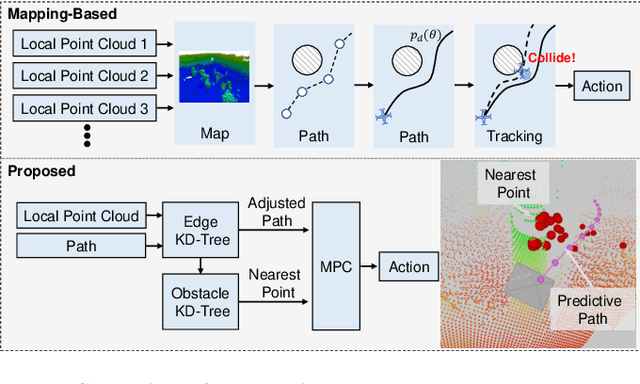
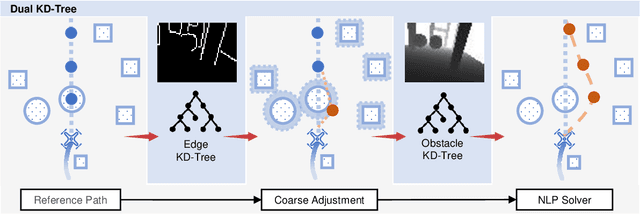
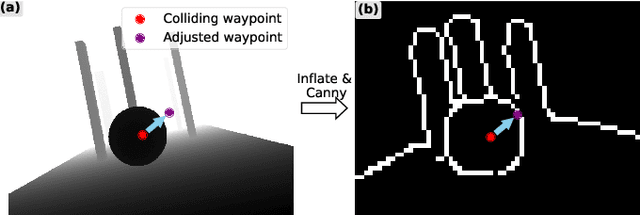
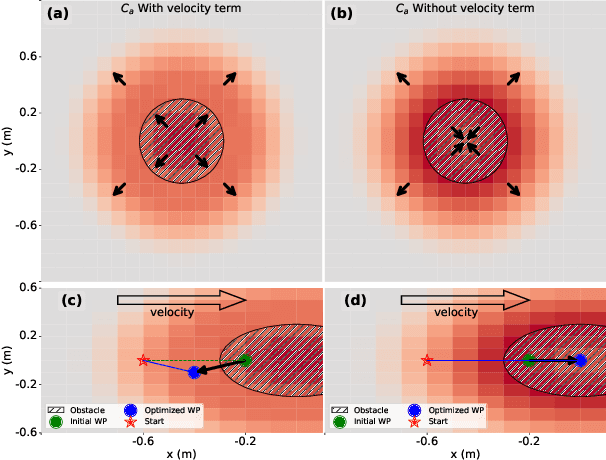
Collision-free flight in cluttered environments is a critical capability for autonomous quadrotors. Traditional methods often rely on detailed 3D map construction, trajectory generation, and tracking. However, this cascade pipeline can introduce accumulated errors and computational delays, limiting flight agility and safety. In this paper, we propose a novel method for enabling collision-free flight in cluttered environments without explicitly constructing 3D maps or generating and tracking collision-free trajectories. Instead, we leverage Model Predictive Control (MPC) to directly produce safe actions from sparse waypoints and point clouds from a depth camera. These sparse waypoints are dynamically adjusted online based on nearby obstacles detected from point clouds. To achieve this, we introduce a dual KD-Tree mechanism: the Obstacle KD-Tree quickly identifies the nearest obstacle for avoidance, while the Edge KD-Tree provides a robust initial guess for the MPC solver, preventing it from getting stuck in local minima during obstacle avoidance. We validate our approach through extensive simulations and real-world experiments. The results show that our approach significantly outperforms the mapping-based methods and is also superior to imitation learning-based methods, demonstrating reliable obstacle avoidance at up to 12 m/s in simulations and 6 m/s in real-world tests. Our method provides a simple and robust alternative to existing methods.
Seeing Through Pixel Motion: Learning Obstacle Avoidance from Optical Flow with One Camera
Nov 07, 2024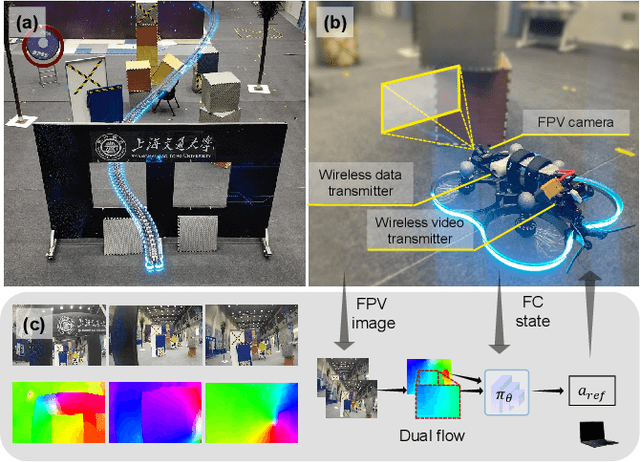

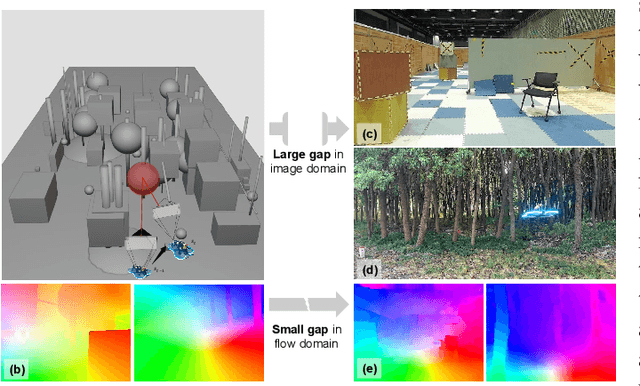

Optical flow captures the motion of pixels in an image sequence over time, providing information about movement, depth, and environmental structure. Flying insects utilize this information to navigate and avoid obstacles, allowing them to execute highly agile maneuvers even in complex environments. Despite its potential, autonomous flying robots have yet to fully leverage this motion information to achieve comparable levels of agility and robustness. Challenges of control from optical flow include extracting accurate optical flow at high speeds, handling noisy estimation, and ensuring robust performance in complex environments. To address these challenges, we propose a novel end-to-end system for quadrotor obstacle avoidance using monocular optical flow. We develop an efficient differentiable simulator coupled with a simplified quadrotor model, allowing our policy to be trained directly through first-order gradient optimization. Additionally, we introduce a central flow attention mechanism and an action-guided active sensing strategy that enhances the policy's focus on task-relevant optical flow observations to enable more responsive decision-making during flight. Our system is validated both in simulation and the real world using an FPV racing drone. Despite being trained in a simple environment in simulation, our system is validated both in simulation and the real world using an FPV racing drone. Despite being trained in a simple environment in simulation, our system demonstrates agile and robust flight in various unknown, cluttered environments in the real world at speeds of up to 6m/s.