 Add to Chrome
 Add to Firefox
 Add to Edge
Intrinsic Muon: Spectral Optimization on Riemannian Matrix Manifolds
May 10, 2026
Muon and related norm-constrained matrix optimizers have become central to large-scale learning problems. They are formulated as a linear maximization oracle (LMO) over an ambient matrix-norm ball in unconstrained Euclidean space. However, these do not generalize cleanly to manifold-valued parameters such as low-rank factorizations, orthogonality constraints, or symmetric positive definite (SPD) matrices. Naively restricting the Muon LMO to the tangent space (i) breaks quotient symmetries and (ii) couples the tangent-space constraint with an ambient norm bound, thereby obstructing closed-form solutions on various manifolds of interest. We resolve both issues with a single observation: every Riemannian metric canonically lifts a unitarily invariant Euclidean norm to an intrinsic norm on each tangent space, and the resulting intrinsic norm constrained LMO is symmetry preserving. Building on this, we introduce intrinsic Muon (iMuon), a unified framework that yields closed-form updates on the fixed-rank, SPD, Stiefel, and Grassmann manifolds for any unitarily invariant norm, including the spectral, Frobenius, and nuclear norms. We establish convergence guarantees for both deterministic and stochastic iMuon with rate constants that depend only on the manifold dimension. Notably, on the fixed-rank manifold this constant depends only on the rank, making the rate independent of factor conditioning and removing the runtime factor-rescaling required by prior work. Experiments on LoRA finetuning of LLMs, image classification, and subspace learning illustrate the efficacy of the proposed approach.

Geometric Renyi Differential Privacy: Ricci Curvature Characterized by Heat Diffusion Mechanisms
Apr 22, 2026In this paper, we develop a novel privacy mechanism for Riemannian manifold-valued data. Our key contribution lies in uncovering unexpected connections among geometric analysis, heat diffusion models, and differential privacy (DP). We characterize the Renyi divergence via dimension-free Harnack inequalities on Riemannian manifolds and establish Renyi differential privacy guarantees governed by Ricci curvature. For manifolds with nonnegative Ricci curvature, we propose a mechanism based on heat diffusion. In contrast, for general manifolds we introduce a Langevin-process-based approach that yields intrinsic mechanisms supporting normalization-free sampling and continuous privacy-utility trade-offs. We derive detailed utility analyses for both mechanisms. As a statistical application, we develop privacy-preserving estimation of the generalized Frechet mean, including nontrivial sensitivity analysis and phase transition characterizations. Numerical experiments further demonstrate the advantages of the proposed DP mechanisms over existing approaches.
Horospherical Depth and Busemann Median on Hadamard Manifolds
Apr 20, 2026\We introduce the horospherical depth, an intrinsic notion of statistical depth on Hadamard manifolds, and define the Busemann median as the set of its maximizers. The construction exploits the fact that the linear functionals appearing in Tukey's half-space depth are themselves limits of renormalized distance functions; on a Hadamard manifold the same limiting procedure produces Busemann functions, whose sublevel sets are horoballs, the intrinsic replacements for halfspaces. The resulting depth is parametrized by the visual boundary, is isometry-equivariant, and requires neither tangent-space linearization nor a chosen base point.For arbitrary Hadamard manifolds, we prove that the depth regions are nested and geodesically convex, that a centerpoint of depth at least $1/(d+1)$ exists, and hence that the Busemann median exists for every Borel probability measure. Under strictly negative sectional curvature and mild regularity assumptions, the depth is strictly quasi-concave and the median is unique. We also establish robustness: the depth is stable under total-variation perturbations, and under contamination escaping to infinity the limiting median depends on the escape direction but not on how far the contaminating mass has moved along the geodesic ray, in contrast with the Fréchet mean. Finally, we establish uniform consistency of the sample depth and convergence of sample depth regions and sample Busemann medians; on symmetric spaces of noncompact type, the argument proceeds through a VC analysis of upper horospherical halfspaces, while on general Hadamard manifolds it follows from a compactness argument under a mild non-atomicity assumption.
Robust Least-Squares Optimization for Data-Driven Predictive Control: A Geometric Approach
Nov 12, 2025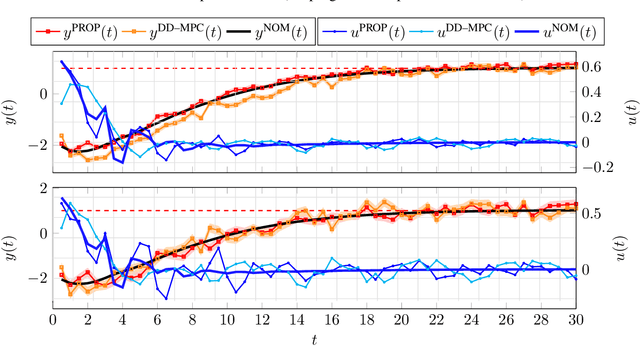
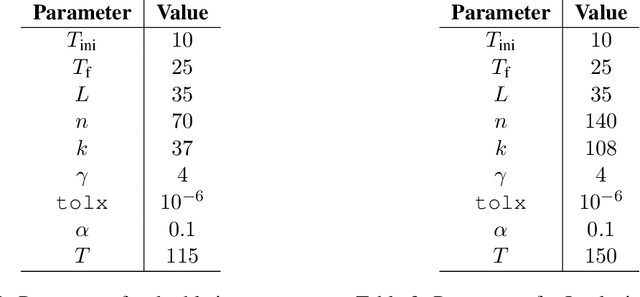
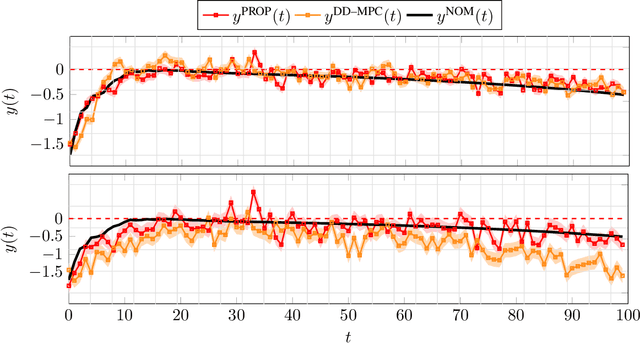
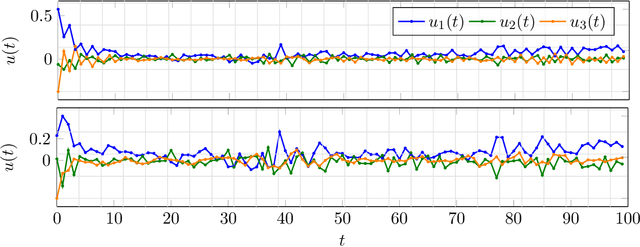
The paper studies a geometrically robust least-squares problem that extends classical and norm-based robust formulations. Rather than minimizing residual error for fixed or perturbed data, we interpret least-squares as enforcing approximate subspace inclusion between measured and true data spaces. The uncertainty in this geometric relation is modeled as a metric ball on the Grassmannian manifold, leading to a min-max problem over Euclidean and manifold variables. The inner maximization admits a closed-form solution, enabling an efficient algorithm with a transparent geometric interpretation. Applied to robust finite-horizon linear-quadratic tracking in data-enabled predictive control, the method improves upon existing robust least-squares formulations, achieving stronger robustness and favorable scaling under small uncertainty.
Universal kernels via harmonic analysis on Riemannian symmetric spaces
Jun 24, 2025The universality properties of kernels characterize the class of functions that can be approximated in the associated reproducing kernel Hilbert space and are of fundamental importance in the theoretical underpinning of kernel methods in machine learning. In this work, we establish fundamental tools for investigating universality properties of kernels in Riemannian symmetric spaces, thereby extending the study of this important topic to kernels in non-Euclidean domains. Moreover, we use the developed tools to prove the universality of several recent examples from the literature on positive definite kernels defined on Riemannian symmetric spaces, thus providing theoretical justification for their use in applications involving manifold-valued data.
Geometric statistics with subspace structure preservation for SPD matrices
Jul 02, 2024We present a geometric framework for the processing of SPD-valued data that preserves subspace structures and is based on the efficient computation of extreme generalized eigenvalues. This is achieved through the use of the Thompson geometry of the semidefinite cone. We explore a particular geodesic space structure in detail and establish several properties associated with it. Finally, we review a novel inductive mean of SPD matrices based on this geometry.
Invariant kernels on Riemannian symmetric spaces: a harmonic-analytic approach
Oct 30, 2023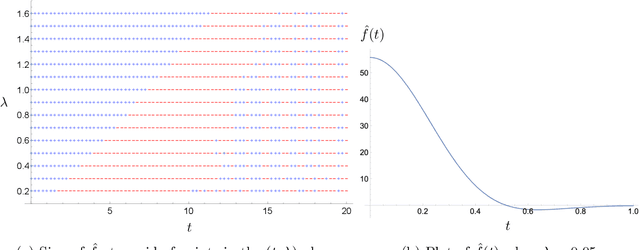
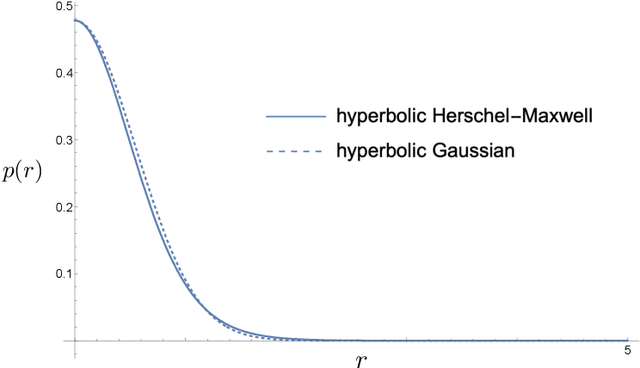
This work aims to prove that the classical Gaussian kernel, when defined on a non-Euclidean symmetric space, is never positive-definite for any choice of parameter. To achieve this goal, the paper develops new geometric and analytical arguments. These provide a rigorous characterization of the positive-definiteness of the Gaussian kernel, which is complete but for a limited number of scenarios in low dimensions that are treated by numerical computations. Chief among these results are the L$^{\!\scriptscriptstyle p}$-$\hspace{0.02cm}$Godement theorems (where $p = 1,2$), which provide verifiable necessary and sufficient conditions for a kernel defined on a symmetric space of non-compact type to be positive-definite. A celebrated theorem, sometimes called the Bochner-Godement theorem, already gives such conditions and is far more general in its scope, but is especially hard to apply. Beyond the connection with the Gaussian kernel, the new results in this work lay out a blueprint for the study of invariant kernels on symmetric spaces, bringing forth specific harmonic analysis tools that suggest many future applications.
Geometric Learning with Positively Decomposable Kernels
Oct 20, 2023Kernel methods are powerful tools in machine learning. Classical kernel methods are based on positive-definite kernels, which map data spaces into reproducing kernel Hilbert spaces (RKHS). For non-Euclidean data spaces, positive-definite kernels are difficult to come by. In this case, we propose the use of reproducing kernel Krein space (RKKS) based methods, which require only kernels that admit a positive decomposition. We show that one does not need to access this decomposition in order to learn in RKKS. We then investigate the conditions under which a kernel is positively decomposable. We show that invariant kernels admit a positive decomposition on homogeneous spaces under tractable regularity assumptions. This makes them much easier to construct than positive-definite kernels, providing a route for learning with kernels for non-Euclidean data. By the same token, this provides theoretical foundations for RKKS-based methods in general.
Differential geometry with extreme eigenvalues in the positive semidefinite cone
Apr 14, 2023Differential geometric approaches to the analysis and processing of data in the form of symmetric positive definite (SPD) matrices have had notable successful applications to numerous fields including computer vision, medical imaging, and machine learning. The dominant geometric paradigm for such applications has consisted of a few Riemannian geometries associated with spectral computations that are costly at high scale and in high dimensions. We present a route to a scalable geometric framework for the analysis and processing of SPD-valued data based on the efficient computation of extreme generalized eigenvalues through the Hilbert and Thompson geometries of the semidefinite cone. We explore a particular geodesic space structure based on Thompson geometry in detail and establish several properties associated with this structure. Furthermore, we define a novel iterative mean of SPD matrices based on this geometry and prove its existence and uniqueness for a given finite collection of points. Finally, we state and prove a number of desirable properties that are satisfied by this mean.
The Gaussian kernel on the circle and spaces that admit isometric embeddings of the circle
Feb 21, 2023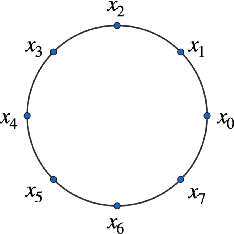
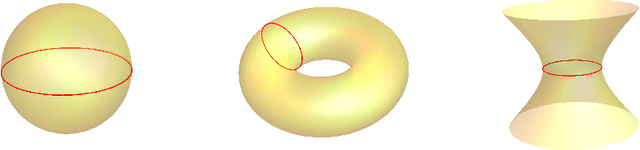
On Euclidean spaces, the Gaussian kernel is one of the most widely used kernels in applications. It has also been used on non-Euclidean spaces, where it is known that there may be (and often are) scale parameters for which it is not positive definite. Hope remains that this kernel is positive definite for many choices of parameter. However, we show that the Gaussian kernel is not positive definite on the circle for any choice of parameter. This implies that on metric spaces in which the circle can be isometrically embedded, such as spheres, projective spaces and Grassmannians, the Gaussian kernel is not positive definite for any parameter.